
Semax vs ACTH(4-10): Why Both Names Are Correct | Artemis Labs
Aug
Why Semax Is Called Both an ACTH(4-10) Analog and ACTH(4-7)PGP
Published August 26, 2026 · Artemis Labs
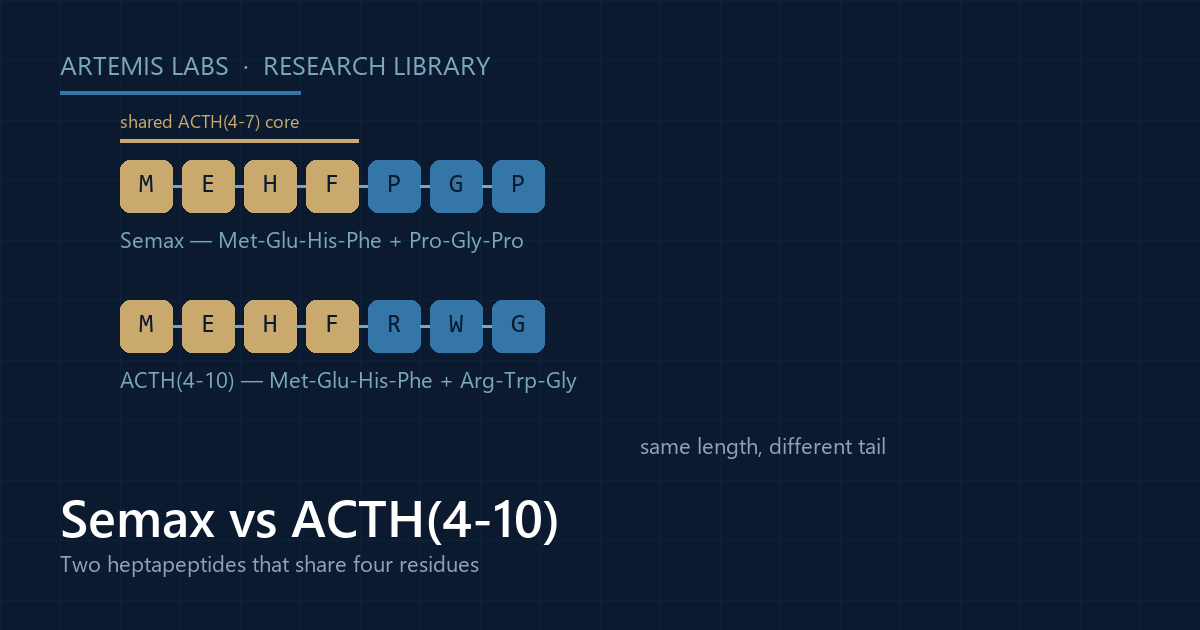
Semax — answer capsule: Semax is a seven-residue peptide with the sequence Met-Glu-His-Phe-Pro-Gly-Pro, listed at PubChem as CID 9811102, CAS 80714-61-0, molecular weight 813.9. ACTH(4-10) is a different seven-residue peptide, Met-Glu-His-Phe-Arg-Trp-Gly, listed as CID 123787, CAS 4037-01-8, molecular weight 962.1. The two molecules share their first four residues, Met-Glu-His-Phe, which is the fragment written as ACTH(4-7), and differ in the last three. Calling Semax “ACTH(4-7) plus Pro-Gly-Pro” describes what Semax is built from; calling Semax “an analog of ACTH(4-10)” describes what Semax is an analog of, which is a peptide of the same length carrying a different tail. Both designations are correct, so a record that uses one is not contradicting a record that uses the other.
Key findings
- Semax and ACTH(4-10) are both seven-residue peptides, and both entries were checked against PubChem on August 26, 2026. Semax is CID 9811102, CAS 80714-61-0, molecular weight 813.9. ACTH(4-10) is CID 123787, CAS 4037-01-8, molecular weight 962.1.
- The overlap is exactly four residues long. Met-Glu-His-Phe opens both chains. After that, Semax carries Pro-Gly-Pro and ACTH(4-10) carries Arg-Trp-Gly.
- PubChem itself uses both framings for this pair. Its structural description of Semax reads
ACTH (4-7), Pro-Gly-Pro-, and its ACTH(4-10) record carries4-10-Semaxin the synonym list. - Published papers on Semax are inconsistent about which name they print, and the inconsistency is old. A 1997 Russian clinical study of stroke patients (PMID 11517472) introduced the compound as a
synthetic derivative of ACTH-4-10, while a 2020 Russian rat study (PMID 32580520) titled itACTH(4-7)PGP (Semax). Same molecule, two conventions.
What is ACTH(4-10), and what is ACTH(4-7)?
A peptide is a short chain of amino acids. Each link in the chain is called a residue. ACTH, or adrenocorticotropic hormone, is a much longer natural peptide, and its residues are numbered along the chain from one end.
So a name written as ACTH(4-10) means the stretch of that chain running from residue 4 to residue 10. That is seven residues: Met-Glu-His-Phe-Arg-Trp-Gly. It has its own PubChem entry, CID 123787, and its own CAS registry number, 4037-01-8. Its molecular weight is 962.1.
By the same counting rule, ACTH(4-7) means residues 4 through 7 only. That is four residues: Met-Glu-His-Phe. It is the shorter head of the same stretch.
Semax is not either of those fragments. Semax is Met-Glu-His-Phe-Pro-Gly-Pro, written in one-letter code as MEHFPGP. The first four residues match ACTH(4-7). The last three, Pro-Gly-Pro, do not come from ACTH at all.
How do the two molecules compare, side by side?
This is the whole disagreement in one table. Every figure below was verified against PubChem on August 26, 2026.
| Field | Semax | ACTH(4-10) |
|---|---|---|
| Sequence (three-letter) | Met-Glu-His-Phe-Pro-Gly-Pro | Met-Glu-His-Phe-Arg-Trp-Gly |
| Residue count | 7 | 7 |
| Molecular weight | 813.9 | 962.1 |
| CAS number | 80714-61-0 | 4037-01-8 |
| PubChem CID | 9811102 | 123787 |
Read across the first row and the pattern is plain. Four residues match. Three do not. The chains are the same length, which is why the word analog fits: an analog is a molecule built on the same frame as another one, with something swapped out.
The two also weigh clearly different amounts, about 148 daltons apart. That gap matters for identity work, because a mass measurement can separate these two compounds without any argument about names.
Why do two different names describe one molecule?
Because the two names answer two different questions.
“ACTH(4-7) plus Pro-Gly-Pro” answers what is this made of. It lists the parts in order: the four-residue ACTH head, then the three-residue Pro-Gly-Pro tail. That description is structurally exact, and it is the description PubChem prints for Semax.
“An analog of ACTH(4-10)” answers what is this a version of. It points at a seven-residue reference molecule and says Semax is the same length with the tail replaced. That description is exact too, and it is the one much of the published literature uses.
Neither phrasing is a mistake, and neither is a marketing shorthand. They are two accurate sentences about the same structure. The confusion only appears when a single document flips between them without saying that both are true.
Which name does the published literature use?
Both, and there is no settled convention. These are the forms found in records we verified for this page.
| Name as written | Where it appears |
|---|---|
ACTH (4-7), Pro-Gly-Pro- |
The structural description on the PubChem record for Semax, CID 9811102 |
4-10-Semax |
A synonym on the PubChem record for ACTH(4-10), CID 123787 |
synthetic derivative of ACTH-4-10 |
PMID 11517472, a 1997 clinical study in stroke patients conducted in Russia and published in a Russian neurology journal |
ACTH(4-7)PGP (Semax) |
PMID 32580520, a 2020 rat study from the Institute of Molecular Genetics, Russian Academy of Sciences, Moscow |
the ACTH(4-10) synthetic analogs Semax and Melanotan II |
PMID 39442746, a 2024 rat study from the National Research Center “Kurchatov Institute”, Moscow, Russia |
a synthetic analog of ACTH(4-10) |
PMID 27586814, a 2016 cell-culture study at the CNR institute in Catania, Italy |
4-10-semax |
PMID 9173745, a 1997 Russian retrospective overview by the group that originated the compound |
ACTH 4-10Pro 8-Gly 9-Pro 10 |
PMID 41179234, a 2023 rat study at the Neurosurgery Department, Dr. Soetomo Hospital, Surabaya, Indonesia |
A reader who meets two of these forms in two places has not found a discrepancy. They have found two labelling habits sitting on one structure.
How can a researcher check this independently?
Names are the weakest identifier a peptide has. Numbers are the strong ones, and they are public.
Start with the CAS registry number. Semax is 80714-61-0 and ACTH(4-10) is 4037-01-8. Two different registry numbers mean two different substances, whatever the label on the page says.
Then check the PubChem CID, 9811102 for Semax and 123787 for ACTH(4-10). Each CID pulls up a full record with the sequence and the molecular weight, so a claimed sequence can be compared against the primary source rather than against a vendor description.
Finally, compare the sequence itself. If a record says Met-Glu-His-Phe-Pro-Gly-Pro, or MEHFPGP, it is describing Semax. If it says Met-Glu-His-Phe-Arg-Trp-Gly, it is describing ACTH(4-10). The three-residue tail is the whole test. Our companion page on the Semax sequence and identity figures lays out the full analytical spec, including the molecular formula and the UNII code.
What the research does not show
This page resolves a naming question. It says nothing about whether Semax does anything, and the naming resolution should not be read as support for any effect.
The evidence base behind the compound is thin and geographically narrow. No Semax study in humans has been conducted outside Russia. Four PubMed records carry a clinical-trial publication type, all four are Russian, and the index contains no meta-analyses, no systematic reviews, and no double-blind studies. There are no independent replications of the Russian human results in either direction. The single record PubMed tags as a randomized controlled trial, PMID 18379501, reported that Semax does not influence either the course of CPD or the dynamics of clinical estimates — a negative result on its primary measure — and that trial’s own abstract describes itself as open-label. A 2026 review that searched regulatory databases classifies Semax among Non-approved peptides (PMID 42021992). No FDA or EMA approval can be established from any primary source we checked.
There is also a specific limit on what the shared ACTH(4-7) head tells you. Sharing four residues is a structural fact, not a functional one. The sources reviewed for this page include no study that compared Semax and ACTH(4-10) head to head, so nothing here supports a claim about how their activities relate. Small edits to a peptide can change its behaviour a great deal: in an Italian cell-culture study, adding an acetyl group to the other end of the Semax chain produced a compound where Semax acetylation did not protect from Cu(II) induced toxicity on a SH-SY5Y neuroblastoma cell line (PMID 27586814). That acetylated compound is a separate molecule from Semax, and the result is a caution against reasoning from resemblance.
Frequently asked questions
Are Semax and ACTH(4-10) the same compound?
No. They are two different molecules with two different CAS numbers and two different PubChem records. They share the first four of their seven residues.
Is one of the two names for Semax wrong?
No. “ACTH(4-7)PGP” and “ACTH(4-10) analog” are both accurate. The first names the building blocks; the second names the reference molecule Semax is modelled on. PubChem uses both framings across the pair.
Two records use different names. How do I tell whether they mean the same molecule?
Compare the identifiers rather than the words. The CAS number, the PubChem CID, the molecular weight and the three-letter sequence will agree or they will not, and none of them depend on which naming habit the writer preferred.
Does sharing four residues with ACTH(4-10) mean the two behave alike?
Nothing on this page supports that. Structural overlap is not evidence of shared activity, and the sources here contain no direct comparison of the two. For what has actually been studied, see our overview of the research areas Semax has been examined in.
References
- PubChem Compound Summary, CID 9811102 (Semax). https://pubchem.ncbi.nlm.nih.gov/compound/9811102
- PubChem Compound Summary, CID 123787 (ACTH(4-10)). https://pubchem.ncbi.nlm.nih.gov/compound/123787
- [Effectiveness of semax in acute period of hemispheric ischemic stroke (a clinical and electrophysiological study)]. Zh Nevrol Psikhiatr Im S S Korsakova, 1997. PMID 11517472. https://pubmed.ncbi.nlm.nih.gov/11517472/
- Novel Insights into the Protective Properties of ACTH(4-7)PGP (Semax) Peptide at the Transcriptome Level Following Cerebral Ischaemia-Reperfusion in Rats. Genes (Basel), 2020. PMID 32580520. https://doi.org/10.3390/genes11060681
- Antidepressant-like and antistress effects of the ACTH(4-10) synthetic analogs Semax and Melanotan II on male rats in a model of chronic unpredictable stress. Eur J Pharmacol, 2024. PMID 39442746. https://doi.org/10.1016/j.ejphar.2024.177068
- Influence of the N-terminus acetylation of Semax, a synthetic analog of ACTH(4-10), on copper(II) and zinc(II) coordination and biological properties. J Inorg Biochem, 2016. PMID 27586814. https://doi.org/10.1016/j.jinorgbio.2016.08.013
- PMID 9173745 — Zh Vyssh Nerv Deiat Im I P Pavlova, 1997 (Russian-language retrospective overview by the originating group). https://pubmed.ncbi.nlm.nih.gov/9173745/
- PMID 41179234 — F1000Research, 2023 (rat spinal-cord-injury study, Surabaya, Indonesia). https://doi.org/10.12688/f1000research.127413.2
- [The study of chronic partial denervation and quality of life in patients with motor neuron disease treated with semax]. Zh Nevrol Psikhiatr Im S S Korsakova, 2007. PMID 18379501. https://pubmed.ncbi.nlm.nih.gov/18379501/
- PMID 42021992 — 2026 review classifying Semax among
Non-approved peptides. https://pubmed.ncbi.nlm.nih.gov/42021992/
Methodology: this page draws on the PubChem records for CID 9811102 and CID 123787 and on the PubMed records cited above. All identity figures — sequences, residue counts, molecular weights, CAS numbers and CIDs — were verified against PubChem on August 26, 2026.
All compounds sold by Artemis Labs are for laboratory research use only. Nothing on this page is medical advice, and no statement has been evaluated by the FDA.
