
Semax vs Selank: What the Research Actually Shows | Artemis Labs
Aug
Semax and Selank: what the published research actually compares
Published August 26, 2026 · Artemis Labs
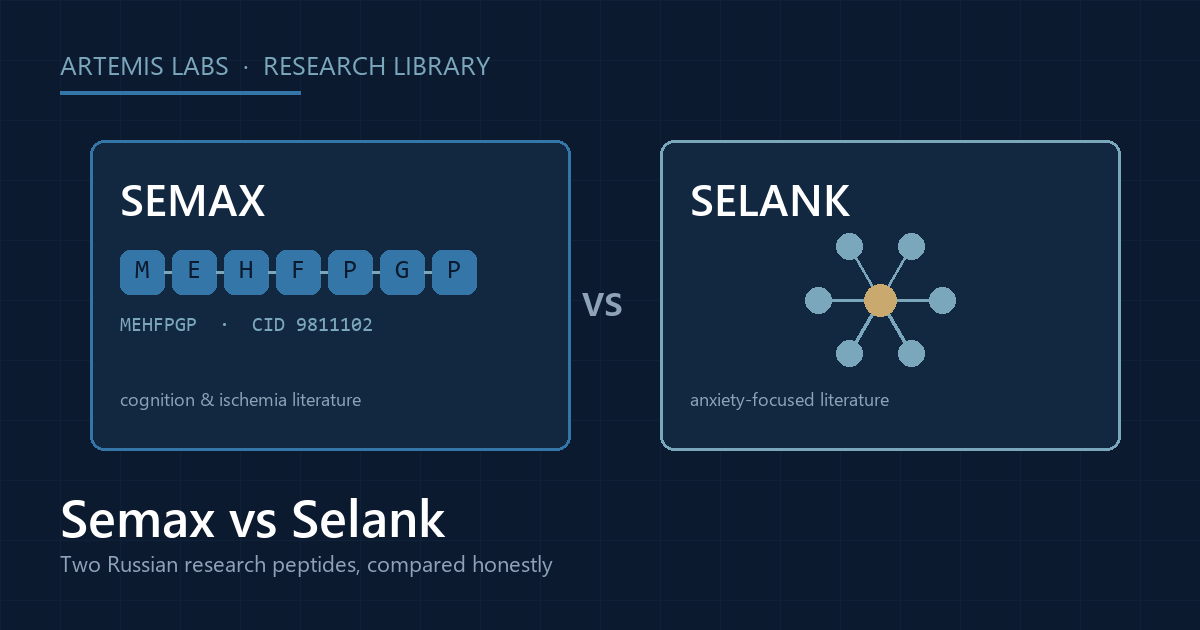
Semax and Selank — answer capsule: Semax and Selank are two synthetic seven-amino-acid peptides developed in Russia, each built by attaching the same three-residue Pro-Gly-Pro tail to a different four-residue parent fragment. Semax carries the ACTH(4-7) fragment Met-Glu-His-Phe; Selank carries the tuftsin fragment Thr-Lys-Pro-Arg. The published work on the two peptides has been aimed at different questions, with Semax studied mostly in Russian patient groups after stroke and optic-nerve injury, and Selank studied mostly in rat models of stress and withdrawal. Neither evidence base is large, and neither has been independently replicated outside Russia. For Semax that record has been counted directly at PubMed: four records carry a clinical-trial publication type, none were run outside Russia, and the single randomized controlled trial reported a negative result on its primary endpoint.
Key findings
- Both are heptapeptides ending in Pro-Gly-Pro. Semax is Met-Glu-His-Phe-Pro-Gly-Pro (PubChem CID 9811102); our Selank research record gives Thr-Lys-Pro-Arg-Pro-Gly-Pro (PubChem CID 11129257).
- Semax’s human record is entirely Russian. Four PubMed records carry a clinical-trial publication type, zero were run outside Russia, and the one record tagged as a randomized controlled trial reported that Semax
does not influence either the course of CPD or the dynamics of clinical estimates
(PMID 18379501). - Selank’s record in our files is mostly rodent work: morphine-withdrawal aversion (PMID 36322304) and stress-induced intestinal damage (PMID 32651826), both in rats, plus one Russian-journal clinical study in generalized anxiety disorder for which our record holds no outcome (PMID 18454096).
- Both compounds turned up in seized preparations sold for cognitive enhancement, in a 2020 analytical report describing them as not having completed clinical trials (PMID 31667971).
What are Semax and Selank, chemically?
Semax is seven amino acids long. Verified fresh from PubChem, its sequence is Met-Glu-His-Phe-Pro-Gly-Pro (MEHFPGP), indexed as CID 9811102, formula C37H51N9O10S, molecular weight 813.9, CAS 80714-61-0. Selank is also seven amino acids long. Our internal research record gives Thr-Lys-Pro-Arg-Pro-Gly-Pro (TKPRPGP), PubChem CID 11129257, molecular weight 751.87 Da, CAS 129954-34-3.
The design is what they share. Both end in Pro-Gly-Pro, and both attach that tail to a four-residue fragment of a larger natural molecule. For Semax the fragment is Met-Glu-His-Phe, residues 4 through 7 of adrenocorticotropic hormone, usually shortened to ACTH. For Selank it is Thr-Lys-Pro-Arg, or tuftsin, a short piece of an antibody protein. Same tail, different head. That is the one specification-level comparison between the two that is exact, and it says nothing about what either does.
A naming quirk makes many pages about Semax look self-contradictory. The literature calls it both “ACTH(4-7) plus Pro-Gly-Pro” and “an analog of ACTH(4-10)”, and both are right: ACTH(4-10) is itself seven residues, Met-Glu-His-Phe-Arg-Trp-Gly (PubChem CID 123787), so Semax matches its length and first four residues while carrying a different tail.
Which research areas has each been studied in?
The Semax human literature clusters around neurology. The largest dataset is a 2018 study at Pirogov Russian National Research Medical University in Moscow, which examined 110 patients after ischemic stroke and reported that early rehabilitation together with Semax raised plasma brain-derived neurotrophic factor, a growth signal usually shortened to BDNF, alongside faster recovery (PMID 29798983). That study had no placebo, no randomization and no stated blinding, and Semax was given on top of a rehabilitation programme, so the design cannot separate the two. Earlier Russian work covers acute stroke against a separately assembled control group of different size (PMID 11517472), optic nerve disease as an add-on to existing therapy (PMID 10741256), and motor neuron disease (PMID 18379501). A 2018 study at the Research Center of Mental Health in Moscow ran resting-state brain imaging in 24 healthy volunteers against a placebo arm and found a difference in one brain-network component (PMID 30225715) — an imaging measurement, not a measurement of thinking or performance.
The Selank record we hold points elsewhere. In rats, aversive signs of morphine withdrawal were attenuated to a level our record describes as comparable to diazepam (PMID 36322304), and protection against stress-induced intestinal damage was reported in a chronic restraint-stress model (PMID 32651826). A 2021 paper reported changes in the signalling proteins TNF-α, IL-6 and IL-10 under a social-stress paradigm (PMID 32621722); our record does not state which species was used, so this page does not either. A 2008 paper in a Russian biology journal reported changes in hippocampal BDNF in living animals (PMID 18841804). On the human side our record lists one clinical study, in generalized anxiety disorder, in a Russian neurology and psychiatry journal (PMID 18454096), and records no result for it.
One experiment measured both side by side: a 2001 study reporting that Semax and Selank each inhibited enkephalin-degrading enzymes taken from human serum (PMID 11443939). That is work on blood proteins in a dish, not on people.
How strong is each evidence base?
This is the axis where an honest comparison is possible, and the two are not in the same position. Not because one compound is better, but because we have counted one of them and not the other.
For Semax the counting was done at the primary source on August 26, 2026, using PubMed’s own search index. Four records carry a clinical-trial publication type. Zero were conducted outside Russia. One is tagged as a randomized controlled trial, and its own abstract describes it as open-label with sequential groups, contradicting the tag; its primary result was negative. There are no meta-analyses, no systematic reviews and no double-blind studies indexed at all, and no independent replication in either direction. The broader human corpus runs to roughly 18 records, all Russian-affiliated or in Russian-language Russian journals. The non-Russian primary research is entirely non-human: cell-culture work in Italy (PMID 27586814) and one rat study in Indonesia (PMID 41179234). The strongest efficacy language in that corpus, a 2005 report of significant clinical improvement
, comes from the study with the weakest stated design, no control arm described anywhere in its abstract (PMID 15792140). Our page on Semax human trials covers this in full.
For Selank we have not run the same count, and presenting our internal reading list as if we had would be dishonest. Our record holds roughly a dozen Selank citations: one human clinical study in a Russian journal with no outcome recorded, and otherwise rodent studies, work on isolated tissue, and reviews. It contains no meta-analysis, no systematic review, and no study conducted outside Russia. Our own coverage note calls Selank’s modern PubMed footprint unusually thin, and flags two citation numbers circulating in vendor documents that were checked and found not to correspond to Selank papers at all. Two 2026 reviews speak to both compounds: one by clinicians in the United States states that there is a current lack of clinical trials
(PMID 41490200), and another places Semax among Non-approved peptides
, a group it says lack long-term safety data and systematic validation
(PMID 42021992).
What the research does not show
No Semax study in humans has been conducted outside Russia. Every human record, without exception, is Russian-affiliated or published in a Russian journal. Nothing in it has been independently tested by a group in another country, in either direction.
No study compares Semax and Selank on any clinical outcome. There is no head-to-head trial in our records; the only experiment measuring both is the human-serum enzyme work above (PMID 11443939). A difference in which research areas each peptide has been studied in is a fact about funding, geography and researcher interest. It is not evidence that the two do different things in a person, and this page does not claim that it is.
The BDNF picture for Semax is not a clean increase. A rat study at the Institute of Molecular Genetics of the Russian Academy of Sciences in Moscow found expression of both neurotrophin genes decreased in rat hippocampus and retina 20 min after Semax administration
and increased in the frontal cortex. The authors’ own word for the pattern is multidirectional
(PMID 19662538).
Our own Selank mechanism sentence carries no citation, so this page does not assert it. The GABA-related mechanism given in our internal record has no reference attached, and the 2018 mechanism review it cites (PMID 30255741) is attached to no specific finding. Until that is corrected, the mechanism is unestablished as far as this page is concerned.
Safety observation exists on one side only. A Russian follow-up study of patients with posthypoxic encephalopathy reported that EEG in some cases showed episodes of paroxysmal activity after Semax was given (PMID 10199046). Our Selank record holds no comparable human observation, which means it has not been looked for in our sources, not that it is absent.
Frequently asked questions
Is Semax or Selank better?
Nothing published supports ranking them, and no trial has given both to the same group and compared outcomes. The comparison that can be made honestly is about evidence quality, and there both are thin, with Semax’s thinness measured precisely and Selank’s not yet measured at all.
Has any study measured both compounds together?
One has. A 2001 study reported that both inhibited enkephalin-degrading enzymes from human serum (PMID 11443939). That is an experiment on isolated blood proteins, not a clinical comparison.
Has either been approved for human use?
No. Neither has an FDA or EMA approval establishable from any primary source, and PubChem’s full record for Semax carries no drug and medication information, FDA Orange Book, or DrugBank section. A 2021 review in a United States clinical pharmacology journal discusses Selank in the context of the American market (PMID 34396551); market presence is not approval. Related reading: Semax anxiety and stress research.
References
- PMID 29798983 — Zh Nevrol Psikhiatr Im S S Korsakova, 2018. Clinical Trial; Pirogov Russian National Research Medical University, Moscow, Russia. Human, n=110. DOI 10.17116/jnevro20181183261-68.
- PMID 18379501 — Zh Nevrol Psikhiatr Im S S Korsakova, 2007. Tagged Randomized Controlled Trial; self-described open-label. Russia, human, n=27. Negative primary endpoint. No DOI in the PubMed record.
- PMID 10741256 — Vestn Oftalmol, 2000. Clinical Trial / Controlled Clinical Trial. Russia, human. No DOI in the PubMed record.
- PMID 11517472 — Zh Nevrol Psikhiatr Im S S Korsakova, 1997. Controlled Clinical Trial. Russia, human, 30 vs 80 control. No DOI in the PubMed record.
- PMID 15792140 — Zh Nevrol Psikhiatr Im S S Korsakova, 2005. Russia, human, n=187; no control arm described in the abstract. No DOI in the PubMed record.
- PMID 30225715 — Bull Exp Biol Med, 2018. Research Center of Mental Health, Moscow, Russia. Human, healthy volunteers, n=24, placebo-controlled, imaging endpoint. DOI 10.1007/s10517-018-4234-3.
- PMID 10199046 — Anesteziol Reanimatol, 1999. Russia, human, n=73. No DOI in the PubMed record.
- PMID 19662538 — J Mol Neurosci, 2010. Institute of Molecular Genetics RAS, Moscow, Russia. Rat (male Wistar). DOI 10.1007/s12031-009-9270-z.
- PMID 27586814 — J Inorg Biochem, 2016. Consiglio Nazionale delle Ricerche, Catania, Italy. SH-SY5Y neuroblastoma cell line. DOI 10.1016/j.jinorgbio.2016.08.013.
- PMID 41179234 — F1000Research, 2023. Dr. Soetomo Hospital, Surabaya, Indonesia. Rat (male Sprague Dawley). DOI 10.12688/f1000research.127413.2.
- PMID 11443939 — human serum enzymes, ex vivo. Measures both Semax and Selank.
- Vanhee C, Francotte A, Janvier S, Deconinck E. The occurrence of putative cognitive enhancing research peptides in seized pharmaceutical preparations: An incentive for controlling agencies to prepare for future encounters of the kind. Drug Testing and Analysis, 2020. PMID 31667971 · DOI 10.1002/dta.2717 Covers both compounds.
- PMID 36322304 — Bull Exp Biol Med, 2022. Rat, morphine-withdrawal aversion. Selank.
- PMID 32651826 — Bull Exp Biol Med, 2020. Rat, chronic restraint stress, intestinal morphology. Selank.
- PMID 32621722 — Curr Rev Clin Exp Pharmacol, 2021. Cytokine response under a social-stress paradigm; species not stated in our record. Selank.
- PMID 18841804 — Dokl Biol Sci, 2008. In vivo, hippocampal BDNF. Selank.
- PMID 18454096 — Zh Nevrol Psikhiatr, 2008. Russia, human; clinical study in generalized anxiety disorder. Selank. No outcome recorded in our research record.
- PMID 30255741 — Protein Pept Lett, 2018. Review of proposed molecular mechanisms. Selank.
- PMID 34396551 — J Clin Pharmacol, 2021. United States; review of Russian GABAergic agents in the American market. Selank.
- PMID 41490200 — JAAOS Glob Res Rev, 2026. United States review covering neuroactive peptides including both compounds. DOI 10.5435/JAAOSGlobal-D-25-00236.
- PMID 42021992 — Front Aging, 2026. Searched FDA regulatory databases through January 2026; classifies Semax among non-approved peptides. DOI 10.3389/fragi.2026.1790247.
Methodology: Semax facts come from the Artemis Labs Semax fact base, verified against PubChem and PubMed E-utilities on August 26, 2026. Selank facts come from our internal Selank product research record, last updated May 23, 2026; claims in that record carrying no citation have been left off this page. Citations are given in a title-free format throughout.
All compounds sold by Artemis Labs are for laboratory research use only. Nothing on this page is medical advice, and no statement has been evaluated by the FDA.
