
What Is Semax? What It Has Actually Been Studied For | Artemis Labs
Aug
What is Semax, and what has it actually been studied for?
Published August 26, 2026 · Artemis Labs
Semax — answer capsule: Semax is a synthetic seven-amino-acid peptide with the sequence Met-Glu-His-Phe-Pro-Gly-Pro, a molecular weight of 813.9, CAS number 80714-61-0, and PubChem CID 9811102. The research record on Semax covers stroke and cerebral ischemia, cognition and attention, neuroprotection, optic-nerve disease, and anxiety and stress. Nearly all human research on Semax was carried out in Russia, on a Russian intranasal pharmaceutical preparation, and no human study of Semax has been run anywhere else. PubMed indexes no meta-analyses, no systematic reviews, and no double-blind studies, and the single record tagged as a randomized controlled trial reported a negative result on its main measure. Those are the areas Semax has been studied in, which is a different statement from saying it works for any of them.
Key findings
- Semax is a heptapeptide, a chain of seven amino acids, sequence Met-Glu-His-Phe-Pro-Gly-Pro, molecular weight 813.9 (PubChem CID 9811102).
- Four PubMed records on Semax carry a clinical-trial publication type. All four are Russian. Zero human studies of Semax were conducted outside Russia.
- The one record tagged as a randomized controlled trial, a 2007 Russian study in motor neuron disease, reported that Semax
does not influence
the outcome it set out to measure (PMID 18379501). - Two 2026 reviews written outside Russia call the evidence thin:
there is a current lack of clinical trials
(PMID 41490200), and Semax is grouped amongNon-approved peptides
(PMID 42021992).
What is Semax?
Semax is a peptide. A peptide is a short chain of amino acids, the same building blocks that make up proteins, just far shorter. Semax has seven of them, which is why chemists call it a heptapeptide. “Hepta” means seven.
Its amino acids run in this order: Met-Glu-His-Phe-Pro-Gly-Pro, written MEHFPGP in the one-letter shorthand chemists use. The molecule weighs 813.9 daltons and its registry numbers are CAS 80714-61-0 and PubChem CID 9811102. Those numbers matter, because several closely related molecules are sold under names built from the word “Semax,” and the CID is the only reliable way to tell which one a supplier or a study means. Semax is grouped with the neuropeptides, peptides studied for activity in the brain and nervous system.
Where does Semax come from?
Semax was designed, not discovered. Its first four amino acids — Met-Glu-His-Phe — match a short stretch of ACTH, a hormone the human body makes on its own. Onto that fragment, the designers added a three-amino-acid tail: Pro-Gly-Pro.
That is why you will see Semax described two ways. Some papers call it an analog of ACTH(4-10). Others describe it as ACTH(4-7) with Pro-Gly-Pro attached. Both are accurate, and they are not in conflict. We work through the naming question in full on a separate page, Semax vs ACTH(4-10).
Who did the research, and where?
This part comes early because it changes how every other section should be read.
Essentially the entire human record on Semax is Russian. The studies were run at Russian institutions, published in Russian journals, mostly in the Russian language, and they tested a Russian intranasal pharmaceutical preparation. We checked this rather than assuming it. The wider human literature runs to roughly eighteen records, every one Russian-affiliated or in a Russian journal. Researchers elsewhere have worked with Semax, but not in people: an Italian group tested it in artificial membranes and a cell line, an Indonesian group in rats.
Russian authors describe Semax as a registered domestic drug; one paper’s title calls it a new Russian drug
. We report that as what it is, an assertion made by authors inside their own papers. We could not reach a registry to confirm it, so we do not state it as our own claim. No FDA or EMA approval is traceable in any primary source, and PubChem’s record carries no drug-approval section. For a closer look at the trials, see Semax human trials.
What has Semax been studied for?
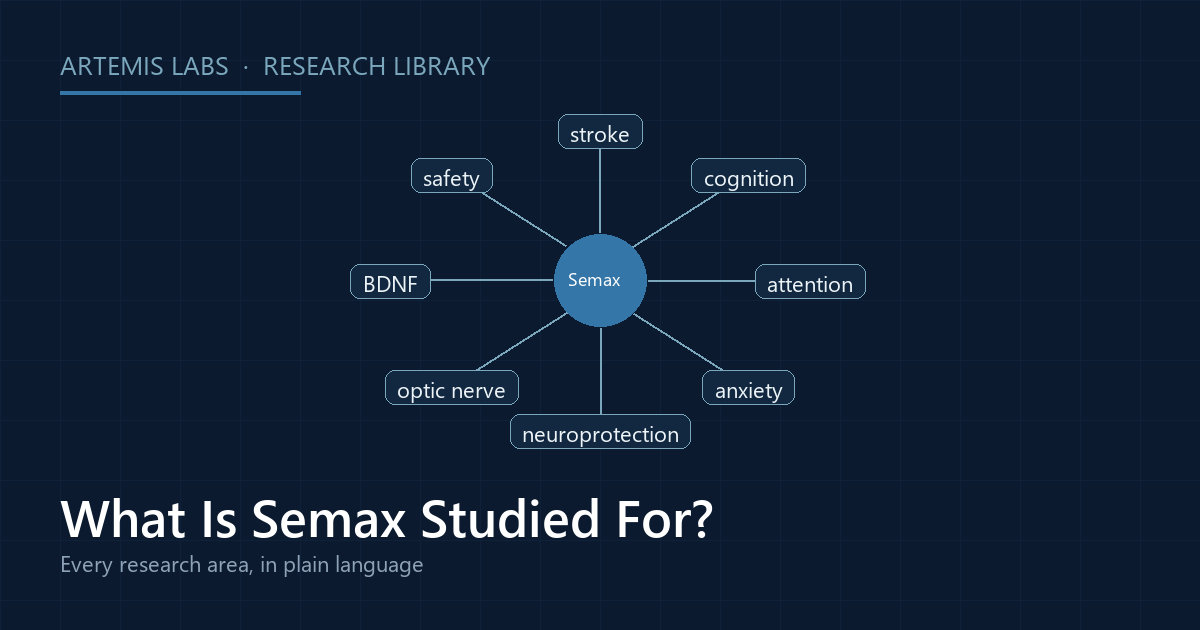
Five research areas show up in the record. Read each as “here is what researchers pointed the compound at,” never as “here is what it does.”
Stroke and cerebral ischemia
This is the deepest lane by a wide margin. Cerebral ischemia means reduced blood flow to part of the brain, which is what happens in most strokes. A 1997 Russian study followed 30 patients in the acute period after a hemispheric ischemic stroke, against a separately assembled control group of 80 patients on conventional therapy. The authors’ wording is deliberately mild: adding Semax had some influence
on how quickly damaged neurological function recovered (PMID 11517472). A 2018 study at a Moscow medical university examined 110 patients after ischemic stroke and reported that Semax alongside a rehabilitation program raised plasma BDNF levels and tracked with faster recovery. The two were given together, so that design cannot separate them (PMID 29798983).
A 2005 Russian paper on 187 patients with cerebrovascular insufficiency carries the strongest wording in the whole human record, reporting significant clinical improvement
. It also has the weakest design: its abstract describes no control arm at all (PMID 15792140). Those two facts belong together, and we will not print one without the other.
Most mechanism work here is in rats. A 2020 Russian study of rats after experimentally induced ischemia found 394 genes expressed differently after Semax, and the authors added that its molecular mechanisms of action within the brain are not yet fully understood
(PMID 32580520).
Cognition and attention
This is the area most discussed online and the thinnest one in the record. The clearest human study is a 2018 imaging study at a Moscow research center. Twenty-four healthy volunteers were scanned three times — once at rest to set a baseline, then again at five and twenty minutes — with fourteen receiving the Russian Semax preparation and ten a placebo. The scans showed a difference in the size of one part of a brain network called the default mode network (PMID 30225715). That is a picture of brain activity, not a test of memory, focus, or task performance, and it should not be read as one.
Neuroprotection
Neuroprotection means shielding nerve cells from damage. This work is in dishes and animals. A 2007 Russian study of cerebellar granule cells, nerve cells grown in a lab, found that Semax delayed calcium dysregulation under glutamate stress and improved cell survival by about 30 percent. The authors phrased the mechanism as something that can be due to
better mitochondrial resistance, not as settled (PMID 18239779).
Optic-nerve work
A smaller Russian line of research looked at diseases of the optic nerve, the cable carrying signals from the eye to the brain. A 2000 study in a Russian ophthalmology journal divided patients into three groups, one a control, and reported improved visual function (PMID 10741256). A 2001 study in glaucomatous optic neuropathy reported an advantage over traditional treatment (PMID 11569188). In both, Semax was one part of a larger treatment package, so neither result belongs to Semax alone.
Anxiety and stress
This work is in animals. A 2024 Russian study put male rats through a chronic unpredictable stress model and reported that Semax reversed or reduced several stress effects, including a drop in hippocampal BDNF. The same paper reports its own null result: in the forced swim test, no effects of the CUS procedure or peptides on the duration of rat immobility were detected
(PMID 39442746). The authors’ conclusion uses the word may
, and so do we.
What the research does not show
No human study of Semax has ever been conducted outside Russia. There are no independent replications of the Russian human results in either direction. Nobody elsewhere has tested them and confirmed them, and nobody has tested them and failed to. They have never been retested.
PubMed indexes zero meta-analyses of Semax, zero systematic reviews, and zero double-blind studies. A double-blind design is the one where neither the participant nor the researcher knows who received what, and it is the standard way to keep expectation from contaminating a result. None exists here.
The single record PubMed tags as a randomized controlled trial is a 2007 Russian study of 27 patients with motor neuron disease. Its abstract describes itself as open-label rather than blinded, and it reported a negative result on its main measure: Semax does not influence either the course of CPD or the dynamics of clinical estimates
(PMID 18379501). A compound’s only randomized trial coming back negative is not a footnote.
You will also see a specific number of Semax studies quoted online. We do not publish one. PubMed’s index confuses the word “semax” with an unrelated technical abbreviation, so the raw count pulls in papers on thyroid imaging, pesticide exposure, and cholesterol modeling. Any headline study count is inflated unless it was hand-counted from a named list.
Frequently asked questions
Is Semax an approved drug?
Not in the United States or Europe. No FDA or EMA approval is establishable from any primary source, and PubChem’s record carries no drug-approval section. Russian authors describe it as a registered domestic drug in their papers, but we could not confirm that against a registry, so we do not assert it. A 2026 review that searched regulatory databases through January 2026 lists Semax among Non-approved peptides
(PMID 42021992).
Is Semax the same thing as ACTH(4-10)?
No. They share their first four amino acids, but the last three differ: Semax carries Pro-Gly-Pro where ACTH(4-10) carries Arg-Trp-Gly. Both are seven amino acids long. The full explanation is on our Semax vs ACTH(4-10) page.
Which research area has the most behind it?
Stroke and cerebral ischemia. It has the most human records, the largest patient counts, and the most animal mechanism work. It is also where the design problems are clearest: control arms missing or unmatched, nothing blinded, and Semax almost always given on top of other treatment.
References
- PubChem Compound Summary, CID 9811102 (Semax). Sequence, formula, molecular weight, and CAS verified 2026-08-26. https://pubchem.ncbi.nlm.nih.gov/compound/9811102
- [The efficacy of semax in the tretament of patients at different stages of ischemic stroke]. Zh Nevrol Psikhiatr Im S S Korsakova, 2018. PMID 29798983 · DOI 10.17116/jnevro20181183261-68 (the misspelling appears in the PubMed record and is quoted as published)
- [The study of chronic partial denervation and quality of life in patients with motor neuron disease treated with semax]. Zh Nevrol Psikhiatr Im S S Korsakova, 2007. PMID 18379501
- [Effectiveness of semax in acute period of hemispheric ischemic stroke (a clinical and electrophysiological study)]. Zh Nevrol Psikhiatr Im S S Korsakova, 1997. PMID 11517472
- [Semax in prevention of disease progress and development of exacerbations in patients with cerebrovascular insufficiency]. Zh Nevrol Psikhiatr Im S S Korsakova, 2005. PMID 15792140
- [Evaluation of therapeutic effect of new Russian drug semax in optic nerve disease]. Vestn Oftalmol, 2000. PMID 10741256
- [Semax in the treatment of glaucomatous optic neuropathy in patients with normalized ophthalmic tone]. Vestn Oftalmol, 2001. PMID 11569188
- Effects of Semax on the Default Mode Network of the Brain. Bull Exp Biol Med, 2018. PMID 30225715 · DOI 10.1007/s10517-018-4234-3
- Novel Insights into the Protective Properties of ACTH(4-7)PGP (Semax) Peptide at the Transcriptome Level Following Cerebral Ischaemia-Reperfusion in Rats. Genes (Basel), 2020. PMID 32580520 · DOI 10.3390/genes11060681
- Effects of semax and its Pro-Gly-Pro fragment on calcium homeostasis of neurons and their survival under conditions of glutamate toxicity. Bull Exp Biol Med, 2007. PMID 18239779 · DOI 10.1007/s10517-007-0192-x
- Antidepressant-like and antistress effects of the ACTH(4-10) synthetic analogs Semax and Melanotan II on male rats in a model of chronic unpredictable stress. Eur J Pharmacol, 2024. PMID 39442746 · DOI 10.1016/j.ejphar.2024.177068
- Review, 2026 (United States). PMID 41490200 · DOI 10.5435/JAAOSGlobal-D-25-00236
- Review, 2026. PMID 42021992 · DOI 10.3389/fragi.2026.1790247
Methodology: this page draws on the PubChem compound record for CID 9811102 and PubMed-indexed primary literature retrieved and transcribed verbatim on 2026-08-26. Study counts, country of origin, and publication types were read from the source records, not from secondary summaries. Last verified 2026-08-26.
All compounds sold by Artemis Labs are for laboratory research use only. Nothing on this page is medical advice, and no statement has been evaluated by the FDA.
This article is part of the Neuropeptides product class. The class page lists every compound in it with sequence, molecular weight and the sources cited.
