
GHK-Cu Anti-Inflammatory Research: What Studies Report | Artemis Labs
Aug
What published research reports on GHK-Cu in inflammation models
Published August 26, 2026 · Artemis Labs
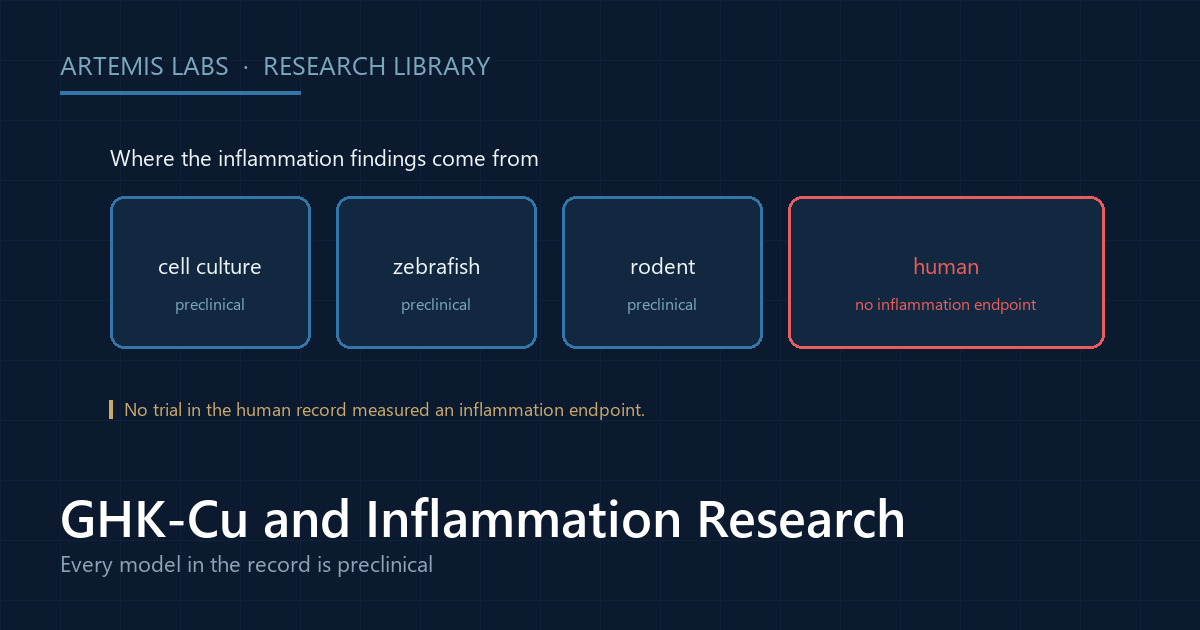
GHK-Cu — answer capsule: GHK-Cu is a copper complex of the three-amino-acid peptide glycyl-histidyl-lysine, indexed at PubChem as CID 71587328 with a molecular weight of 402.92. The published inflammation work on GHK-Cu is entirely preclinical: cultured cells, mice, and zebrafish larvae. No study has tested GHK-Cu against an inflammation endpoint in people. The reported pattern across those models is lower signalling proteins associated with inflammation and fewer inflammatory cells at the site of injury, and several of the same papers report that free copper chloride, with no peptide attached, produced the same effect. The two randomized controlled trials in humans that exist for this compound both used topical creams, and both were negative on every objective endpoint they measured.
Key findings
- In mice with lung injury caused by a bacterial cell-wall molecule, and in a cultured mouse macrophage line, GHK-Cu treatment “reduced reactive oxygen species (ROS) production, increased superoxide dismutase (SOD) activity while decreased TNF-α and IL-6 production through the suppression of NF-κB p65 and p38 MAPK signaling” (PMID 27517151).
- In zebrafish larvae, GHK-Cu “notably decreased the migration of neutrophils and macrophages, suppressed the expression of pro-inflammatory cytokines (tnf-a, il-1β, il6) and increased the expression of the anti-inflammatory cytokine il-10” (PMID 41997403). The study was run by a cosmetics manufacturer and framed as “theoretical evidences” for use as a cosmetic ingredient.
- In human dermal fibroblasts, “GGH, GHK, CuCl2 and their copper complexes decreased TNF-alpha-dependent IL-6 secretion” — copper chloride on its own did it too — and the same authors wrote that “the mechanism of anti-inflammatory properties of these peptides is not clear” (PMID 23285694).
- No human study of GHK-Cu has used an inflammation endpoint. The full controlled human record for this compound is two topical trials, both negative on their objective measures (PMID 1495150, PMID 16847171).
What is an inflammation model, and what does it stand in for?
Inflammation is the body’s response to injury or irritation. Immune cells move toward the damaged spot, and cells release signalling proteins called cytokines that recruit more of them. Two cytokines come up constantly in this literature: TNF-alpha and IL-6, both of which push the response along, and IL-10, which damps it down.
A laboratory inflammation model is a deliberate injury in a controlled system, so the response can be measured. In the GHK-Cu record those systems are a dish of cultured cells, a mouse given a lung or gut irritant, or a zebrafish larva. A model stands in for a disease, it is not the disease, so each result below names the system it came from. Our page on what GHK-Cu is studied for covers the wider research picture.
What did the mouse lung work find?
The most cited result is a 2016 study in Oncotarget using two systems at once: RAW 264.7 cells, a cultured mouse macrophage line, and mice with acute lung injury triggered by lipopolysaccharide, a molecule from bacterial cell walls that reliably provokes inflammation. The authors reported that GHK-Cu treatment “reduced reactive oxygen species (ROS) production, increased superoxide dismutase (SOD) activity while decreased TNF-α and IL-6 production through the suppression of NF-κB p65 and p38 MAPK signaling” (PMID 27517151). Reactive oxygen species are unstable oxygen-containing molecules that damage cell parts; superoxide dismutase is an enzyme that clears one of them.
Two later mouse studies from a group at China-Japan Friendship Hospital in Beijing extended that work to fibrosis, the scarring that can follow long-running inflammation. In mice with silicosis, a lung disease caused by inhaled silica dust, the authors reported that “GHK-Cu can bind to PRDX6, thus attenuating lung inflammation and fibrosis in silicosis mice without significant systemic toxicity”, and they hedged their own conclusion, writing that the results “suggest” GHK-Cu acts as a “potential” drug (PMID 38879894). Their earlier mouse airway-remodelling paper attached a human component, but that component was an observation, not a treatment: they measured GHK levels in the blood of people with asthma and found them lower than in age-matched healthy controls, with a “moderate correlation” to one breathing measure (PMID 37257226). Nobody in that study was given anything. A lower blood level in a disease does not establish that supplying the compound changes the disease.
A separate 2017 mouse study used the free copper-free peptide rather than the complex, in a bleomycin model of lung fibrosis, and reported that GHK “has significant inhibitory effects on transforming growth factor (TGF)-β1 secretion” (PMID 29311918). The distinction between the free peptide and the copper complex matters throughout this literature, and we keep it explicit on our page comparing GHK-Cu copper biology.
What did the gut and zebrafish models find?
A 2025 study in Frontiers in Pharmacology from Jining Medical University used BALB/c mice with colitis induced by dextran sulfate sodium, a standard chemical model of inflamed bowel. Every conclusion sentence in its abstract carries a hedge: GHK-Cu “may promote mucosal healing and enhance tight junction protein expression by regulating the SIRT1/STAT3 pathway” (PMID 40672369). Tight junction proteins are the seals between cells lining the gut.
A 2026 paper in the European Journal of Pharmacology used zebrafish larvae, which are transparent, so immune cells can be watched moving in a living animal. GHK-Cu “notably decreased the migration of neutrophils and macrophages, suppressed the expression of pro-inflammatory cytokines (tnf-a, il-1β, il6) and increased the expression of the anti-inflammatory cytokine il-10” (PMID 41997403). Read the authors’ own statement of purpose alongside the result: the work “provides the theoretical evidences supporting its addition as a functional cosmetic ingredient”, and the affiliation on the paper is a cosmetics company, Yunnan Botanee Bio-Technology Group Co., Ltd. That is the goal the study was designed to serve.
What did the cell studies find, and why does free copper keep appearing?
A 2018 study at the Osaka University of Pharmaceutical Sciences used Caco-2 cells, a human intestinal cell line, under chemical oxidative stress. It reported that GHK “reduced the tert-butyl hydroperoxide-induced increase in ROS levels in Caco-2 cells at concentrations of 10 µM or less”, and that GHK “diminished signals of both ·OH and ROO·, but not O2-·” — it quenched two damaging species and not a third (PMID 30042814).
The most useful cell paper for judging the whole area is a 2012 study in human dermal fibroblasts from the Medical University of Silesia. It found that “GGH, GHK, CuCl2 and their copper complexes decreased TNF-alpha-dependent IL-6 secretion in fibroblasts” (PMID 23285694). Copper chloride is a plain copper salt with no peptide in it, and it produced the effect too. The same authors state plainly that “the mechanism of anti-inflammatory properties of these peptides is not clear.”
One more study is worth naming because of what its title promises versus what it did. A 2010 paper in Inflammation Research measured how a copper tripeptide moves through isolated human skin, reporting a permeability coefficient of “2.43 ± 0.51 × 10(-4) cm/h” through dermatomed skin (PMID 20703511). It is a laboratory measurement on skin samples, framed as a step toward an anti-inflammatory use. It is not itself a study of inflammation.
What the research does not show
There is no controlled human data for GHK-Cu by any route other than topical application, and that absence was verified rather than assumed: repeated searches for a controlled human trial by any other route return nothing, and the only record tagged with a systemic route is a study in dogs. The whole controlled human record is two topical trials. In the 1992 venous-ulcer trial, a “tripeptide copper complex 0.4% cream formulation” was compared against an inert vehicle placebo in 86 patients, and the report states that silver sulfadiazine 1% cream “proved to statistically reduce the ulcer size compared with a biologically active tripeptide copper complex 0.4% cream formulation or the placebo. There was no difference between the latter two treatments” (PMID 1495150). In the 2006 laser-resurfacing trial, 13 patients used topical skin care products with or without a copper tripeptide complex, and “objective evaluation found no significant improvement in wrinkles or overall skin quality” (PMID 16847171).
Three limits are specific to this page. First, no human study has measured an inflammation endpoint for GHK-Cu at all, so nothing above has been tested in a person. Second, the direction of effect on TGF-β, a signalling protein central to both healing and scarring, is contested between independent laboratories: one computational and cell study describes gene changes “consistent with TGFβ pathway activation” (PMID 22937864), while the mouse fibrosis study above describes inhibition of TGF-β1 secretion (PMID 29311918). Both directions are in the primary literature. Third, in the cell work where a free copper salt was tested beside the peptide, the salt reproduced the effect, so these models do not establish that the peptide is the active part.
An independent 2026 systematic review that searched PubMed, Embase and Cochrane CENTRAL through March 2026 for GHK-Cu as a standalone intervention found “20 studies (18 preclinical; 2 RCTs)”, and described the evidence as constrained by “methodological variability and a limited number of well-designed clinical trials” with a “translational gap” still to close (PMID 42619529).
Frequently asked questions
Has GHK-Cu been shown to reduce inflammation in people?
No. Every inflammation result for GHK-Cu comes from cultured cells, mice, or zebrafish larvae. The only two controlled human studies used topical creams for wound and post-laser skin endpoints, and both were negative on their objective measures (PMID 1495150, PMID 16847171).
Do these studies show the peptide is doing the work?
Not on their own. In human dermal fibroblasts, copper chloride with no peptide attached lowered the same cytokine that GHK and its copper complex lowered (PMID 23285694). Separating the peptide’s contribution from copper’s would take a study designed for that question.
Why do so many of these papers come from cosmetics companies?
Because that is where the commercial interest sits. PubChem’s drug indication for both GHK and GHK-Cu reads, in full, “Commonly used in cosmetic products for the skin and hair.” The zebrafish paper above states its own aim as supporting the compound’s “addition as a functional cosmetic ingredient” (PMID 41997403). Author affiliation is a fact worth reading on every paper in this area.
Does a lower blood GHK level in disease mean supplying it would help?
No, and the authors of that work did not claim it. The asthma comparison is cross-sectional: levels were measured in patients and in healthy controls at one point in time, with nobody treated (PMID 37257226). A correlation of that kind cannot show which way cause runs.
References
- Mouse acute lung injury and RAW 264.7 macrophage study, 2016. Cited by identifier. PMID 27517151 · doi:10.18632/oncotarget.11168
- Mouse DSS colitis study, Front Pharmacol, 2025. Cited by identifier. PMID 40672369 · doi:10.3389/fphar.2025.1551843
- Zebrafish larvae study, Eur J Pharmacol, 2026. Cited by identifier. PMID 41997403 · doi:10.1016/j.ejphar.2026.178880
- Caco-2 cell oxidative-stress study, 2018. Cited by identifier; no DOI in the PubMed record. PMID 30042814
- Human dermal fibroblast cytokine study, Acta Pol Pharm, 2012. Cited by identifier; no DOI in the PubMed record. PMID 23285694
- The glycyl-l-histidyl-l-lysine-Cu2+ tripeptide complex attenuates lung inflammation and fibrosis in silicosis by targeting peroxiredoxin 6. Redox Biol, 2024. PMID 38879894 · doi:10.1016/j.redox.2024.103237
- GHK Peptide Inhibits Bleomycin-Induced Pulmonary Fibrosis in Mice by Suppressing TGFβ1/Smad-Mediated Epithelial-to-Mesenchymal Transition. Front Pharmacol, 2017. PMID 29311918 · doi:10.3389/fphar.2017.00904
- Relief of ovalbumin-induced airway remodeling by the glycyl-l-histidyl-l-lysine-Cu2+ tripeptide complex via activation of SIRT1 in airway epithelial cells. Biomed Pharmacother, 2023. PMID 37257226 · doi:10.1016/j.biopha.2023.114936
- Human skin retention and penetration of a copper tripeptide in vitro as function of skin layer towards anti-inflammatory therapy. Inflamm Res, 2010. PMID 20703511 · doi:10.1007/s00011-010-0214-4
- A gene expression signature of emphysema-related lung destruction and its reversal by the tripeptide GHK. Genome Med, 2012. PMID 22937864 · doi:10.1186/gm367
- A prospective randomized evaluator-blinded trial of two potential wound healing agents for the treatment of venous stasis ulcers. J Vasc Surg, 1992. PMID 1495150 · doi:10.1067/mva.1992.37086
- Effects of topical copper tripeptide complex on CO2 laser-resurfaced skin. Arch Facial Plast Surg, 2006. PMID 16847171 · doi:10.1001/archfaci.8.4.252
- The Regenerative Potential of GHK-Cu in Aesthetic Medicine. Aesthet Surg J, 2026. PMID 42619529 · doi:10.1093/asj/sjag169
Methodology: this page draws only on primary records verified against PubChem and the PubMed index for the Artemis Labs GHK-Cu fact base, last verified August 27, 2026. Records without a verbatim title in that fact base are cited by PMID and DOI.
All compounds sold by Artemis Labs are for laboratory research use only. Nothing on this page is medical advice, and no statement has been evaluated by the FDA.
