
How to Read a Certificate of Analysis for GHK-Cu | Artemis Labs
Aug
How to read a certificate of analysis for GHK-Cu
Published August 26, 2026 · Artemis Labs
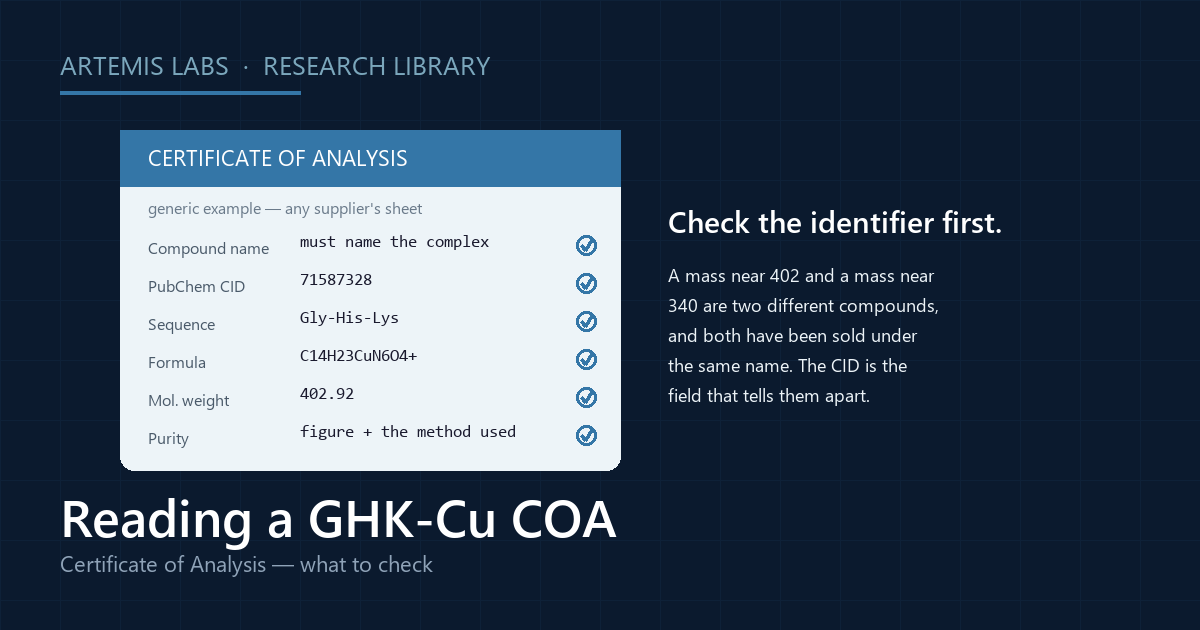
GHK-Cu — answer capsule: GHK-Cu is a copper(II) ion held by the three-amino-acid peptide Gly-His-Lys, indexed at PubChem as CID 71587328 with a molecular weight of 402.92, while the copper-free peptide is a separate record, CID 73587 at 340.38. A certificate of analysis, usually shortened to COA, is a laboratory document reporting what an analytical test found in one specific batch of material. For this compound the identity half of that document carries more weight than the purity half, because six PubChem records answer to the name “GHK-Cu”, three of them sit within two daltons of each other, and one of the six is the peptide with no copper in it at all. A COA is a chemistry document: it reports what a molecule is, never what a molecule does.
Key findings
- The verified identity set for the copper complex is: sequence Gly-His-Lys with one Cu(II) ion, formula C14H23CuN6O4+, molecular weight 402.92, exact mass 402.107675, CAS 89030-95-5, UNII 6BJQ43T1I9, InChIKey NZWIFMYRRCMYMN-ACMTZBLWSA-M, PubChem CID 71587328.
- The copper-free peptide is a different record with different numbers: C14H24N6O4, molecular weight 340.38, exact mass 340.18590327, CAS 49557-75-7, CID 73587. The roughly 62-dalton gap between the two is the easiest mismatch on a sheet to catch.
- The hard mismatch is the small one. Three 1:1 copper complexes are indexed under the same name at 400.90, 401.91 and 402.92, differing only in protonation state. A one-dalton discrepancy cannot be judged by eye, which is why a CID has to appear beside any weight.
- An HPLC purity figure is a relative measure of what one detector saw. It is not an identity test, and on its own it cannot say which molecule the main peak belongs to.
This page is a general guide to reading a certificate of analysis for this molecule. It describes what such a document contains and how to check it against the public chemical record. It makes no statement about any particular vendor’s documents, testing, or lots, including our own.
Which identifiers on a COA should match what?
Start at the identity block at the top of the sheet, before reading any percentage further down.
Count the residues. Gly-His-Lys is three amino acids: glycine, histidine, lysine, in that order. A sheet naming GHK-Cu and listing a sequence of any other length has contradicted itself, and one of the two entries is wrong.
Then check that the identifiers agree with each other and with the molecule the sheet claims to describe. For the copper complex, the formula C14H23CuN6O4+, the CAS number 89030-95-5 and the CID 71587328 all point at the same structure, and each can be typed into PubChem, the U.S. National Library of Medicine’s public chemical database, to see whether they return the same record. If a CAS number resolves to a different compound than the name printed beside it, settle that before reading anything else on the page.
Two fields do more work than they look like they do. The UNII, 6BJQ43T1I9 for the complex, is the FDA’s unique ingredient identifier — a substance registry code and nothing more, an index entry rather than a statement of approval. The InChIKey, NZWIFMYRRCMYMN-ACMTZBLWSA-M, is a fixed-length fingerprint calculated from the structure itself, with the first fourteen characters encoding the molecular skeleton. Two documents describing the same molecule carry identical InChIKeys, which makes it the fastest single field to compare. Note that the copper-free peptide’s key, MVORZMQFXBLMHM-QWRGUYRKSA-N, differs from the first character onward — the two molecules are not near neighbours by that measure. The full identifier set for both is laid out on our GHK-Cu sequence and identity reference.
What should a mass result land near, and why is there more than one right number?
Mass spectrometry sorts molecules by weight, and on a peptide COA it is usually the identity test. Its result gets compared against a calculated expectation, and for this compound there is more than one legitimate expectation on the page.
The molecular weight, 402.92 for the complex at CID 71587328, is an average. Elements occur in nature as a mixture of isotopes — carbon is mostly carbon-12 with a little carbon-13, and copper is a mix of two stable isotopes — so the average weight is calculated across those natural abundances. It describes a bulk population of molecules.
The exact or monoisotopic mass, 402.107675, is the mass of a single molecule built from each element’s most common isotope. A mass spectrometer resolves individual ions, so this is the figure a main peak is calculated against. The equivalent pair for the copper-free peptide is 340.38 average and 340.18590327 monoisotopic. The gap between average and monoisotopic is a property of the formula, not a defect in either number.
Then comes the part specific to this compound. Instruments usually detect a charged form of a molecule rather than the neutral one, and for a neutral peptide that is typically the molecule plus an added proton, about one dalton heavier than the neutral mass a sheet lists. But PubChem’s record for the copper complex is itself a cation with a formal charge of +1, so the weight printed on it already describes a charged species. Two other records for the same 1:1 complex are drawn at different protonation states and are listed at 400.90 as an anion and 401.91 as a neutral molecule. What a document should make explicit, rather than leaving a reader to infer, is which quantity it is reporting and for which form.
Mass is powerful evidence of identity but not proof by itself. Different arrangements built from the same atoms share a formula and therefore a mass, and copper’s own isotope pattern means a real spectrum of this complex is a cluster of peaks rather than one line. Mass narrows the field; sequence confirmation closes it.
What does an HPLC purity figure tell you, and what does it not?
High-performance liquid chromatography, or HPLC, pushes a sample through a column so its components separate and leave at different times. A detector watches the outflow and draws a peak for each one. The purity number on a COA is normally the area of the largest peak as a percentage of all the peak area the detector recorded.
Everything that figure cannot do follows from that definition.
It is not an identity test. It describes how dominant the main peak is, not which molecule that peak contains. A cleanly made batch of the wrong compound produces an excellent purity number.
It is relative to what the detector saw. Peptide methods commonly monitor ultraviolet absorbance around 214 or 220 nanometres, where the peptide bond absorbs. Anything that does not absorb there, or does not come off the column at all, contributes nothing to the denominator and cannot lower the percentage.
And it is not the same as content. Synthesized peptides are typically isolated as salts and hold residual water, so the share of a vial’s mass that is peptide can sit below the chromatographic purity figure. Those are separate measurements, and a document reporting only one has told you only one thing. For a metal complex there is a further question a purity percentage does not answer at all: how much copper is present, and whether it is bound to the peptide or loose. That is a different analysis, and a sheet either reports it or does not.
Why is the identity check the whole game for GHK-Cu?
Because the names in circulation do not map cleanly onto molecules, and the confusion starts at the primary database rather than in anyone’s paperwork.
Query PubChem by name for “GHK-Cu” and it returns six CIDs. The third one in that list is 73587 — the copper-free peptide, whose formula C14H24N6O4 contains no copper atom anywhere. Query it for “copper peptide” and it returns 73587 and nothing else. The free peptide’s own synonym list carries the entries “GHK-Cu”, “Copper Peptide” and “Copper(II)ghk”. Drop one word from the drug name and the molecule changes too: “Prezatide” resolves to the copper-free record, “Prezatide copper” to the complex.
Two mismatches therefore look completely different on a sheet. If a document names GHK-Cu and prints 340.38, the gap is about 62 daltons and a reader who knows both numbers catches it immediately. If it names GHK-Cu and prints 400.90 or 401.91, the gap is one or two daltons — invisible to the eye, unremarkable next to any rounding, and resolvable only by checking which CID the number was taken from. That is the wrong-CID trap, and it is the reason every number on our pages is written with its CID attached. Our page on GHK versus GHK-Cu works through all six records, and the GHK-Cu product record is the compound described here.
One number is missing from this page on purpose. A CAS-style string circulates for this compound that appears in the depositor synonym lists of two different 2:1 complexes differing by two hydrogen atoms. We do not print it, because it is ambiguous at the source. The curated CAS numbers are 89030-95-5 for the complex and 49557-75-7 for the copper-free peptide.
What the research does not show
A certificate of analysis is evidence about chemistry and nothing else. It can support a statement that a batch of material matches a structure. It cannot support any statement about what that structure does in a cell, an animal, or a person, and no purity figure however high changes that.
The underlying evidence base for GHK-Cu is thin, which is worth saying plainly on a page about verification. There is no published controlled human trial of this compound by any route other than application to skin; the searches were run repeatedly and returned nothing, and the only record indexed under a systemic route is a study in dogs. The entire controlled human record is two topical trials, and both were negative on their objective endpoints. The 1992 venous-ulcer trial compared a “tripeptide copper complex 0.4% cream formulation” against an inert vehicle placebo in 86 patients and reported that silver sulfadiazine cream reduced ulcer size against both, with “no difference between the latter two treatments” (PMID 1495150). The 2006 trial gave 13 patients topical skin care products with or without a copper tripeptide complex and found that “objective evaluation found no significant improvement in wrinkles or overall skin quality” (PMID 16847171). An independent 2026 systematic review searching three databases through March 2026 for GHK-Cu as a standalone intervention counted “20 studies (18 preclinical; 2 RCTs)” and described a “translational gap” still to close (PMID 42619529). PubChem’s own stated indication for both molecules reads, in full, “Commonly used in cosmetic products for the skin and hair.”
The database gaps described above are gaps in the public record, not findings about any seller. A missing curated CAS number means the registry has not assigned one that PubChem returns; it says nothing about what is in a given vial. Only analysis of that vial can speak to that.
Frequently asked questions
What molecular weight should a GHK-Cu COA show?
402.92 as the average molecular weight for the complex at CID 71587328, or 402.107675 as its exact mass. Both are correct and they answer different questions, so a document should say which one it is reporting. 340.38 belongs to the copper-free peptide at CID 73587.
Does a high HPLC purity percentage mean the vial contains GHK-Cu?
No. Purity by HPLC describes how dominant the main peak is relative to other peaks the detector recorded. Identity comes from mass and sequence confirmation, checked against CID 71587328 and the formula C14H23CuN6O4+, and the copper content is a separate measurement again.
What if a sheet lists a mass near 400.90 or 401.91?
Those are the weights PubChem lists for the same 1:1 copper complex drawn at other protonation states, at CID 139035031 and CID 165429100 respectively. Neither carries a curated CAS number. A one-dalton difference cannot be resolved by eye, so the question to ask is which CID the figure was taken from.
How many amino acids should be listed for GHK-Cu?
Three. The sequence is Gly-His-Lys, plus one copper(II) ion in the complex. A different residue count on a sheet labelled GHK-Cu is an internal contradiction on that sheet.
References
- PubChem Compound Summary, CID 71587328 (Prezatide copper). https://pubchem.ncbi.nlm.nih.gov/compound/71587328 — formula C14H23CuN6O4+, molecular weight 402.92, exact mass 402.107675, charge +1, CAS 89030-95-5, UNII 6BJQ43T1I9, InChIKey NZWIFMYRRCMYMN-ACMTZBLWSA-M, INCI Copper tripeptide-1. Retrieved August 27, 2026.
- PubChem Compound Summary, CID 73587 (glycyl-L-histidyl-L-lysine). https://pubchem.ncbi.nlm.nih.gov/compound/73587 — formula C14H24N6O4, molecular weight 340.38, exact mass 340.18590327, CAS 49557-75-7, InChIKey MVORZMQFXBLMHM-QWRGUYRKSA-N. Synonym list includes “GHK-Cu”, “Copper Peptide” and “Copper(II)ghk”. Retrieved August 27, 2026.
- PubChem Compound Summary, CID 139035031 (molecular weight 400.90, charge -1) and CID 165429100 (molecular weight 401.91, charge 0) — 1:1 copper complexes at other protonation states, neither carrying a curated CAS number. Retrieved August 27, 2026.
- PubChem name queries “GHK-Cu” (six CIDs returned), “copper peptide” (returns 73587) and “Prezatide” (returns 73587). Retrieved August 27, 2026.
- PubChem Drug and Medication Information headings for CID 73587 and CID 71587328, drug indication verbatim: “Commonly used in cosmetic products for the skin and hair.” Retrieved August 27, 2026.
- A prospective randomized evaluator-blinded trial of two potential wound healing agents for the treatment of venous stasis ulcers. J Vasc Surg, 1992. PMID 1495150 · doi:10.1067/mva.1992.37086
- Effects of topical copper tripeptide complex on CO2 laser-resurfaced skin. Arch Facial Plast Surg, 2006. PMID 16847171 · doi:10.1001/archfaci.8.4.252
- The Regenerative Potential of GHK-Cu in Aesthetic Medicine. Aesthet Surg J, 2026. PMID 42619529 · doi:10.1093/asj/sjag169
Methodology: this page draws on PubChem compound records fetched directly from the PUG REST interface and on PubMed records retrieved through NCBI E-utilities. All chemical identifiers and quoted study text were verified against those primary sources on August 27, 2026.
All compounds sold by Artemis Labs are for laboratory research use only. Nothing on this page is medical advice, and no statement has been evaluated by the FDA.
