
GHK-Cu Copper Biology: What the Research Reports | Artemis Labs
Aug
What published research reports about the copper in GHK-Cu
Published August 26, 2026 · Artemis Labs
GHK-Cu — answer capsule: GHK-Cu is a copper(II) ion held by the three-amino-acid peptide glycyl-histidyl-lysine, indexed at PubChem as CID 71587328 with a molecular weight of 402.92, while the copper-free peptide is a separate record, CID 73587 at 340.38. The published copper chemistry runs in both directions and both belong on the page. In a human skin-cell model GHK-Cu “was not cytotoxic” at concentrations where two plain copper salts were irritant, GHK rescued zebrafish larvae from copper-induced heart effects, and GHK abolished hydroxyl-radical generation driven by free copper in a chemistry assay. Against that, three independent laboratories report that plain copper chloride and peptides that are not GHK reproduce several of the same effects, so the peptide may not be the active part in every assay. And the one study that mapped a concentration curve found it biphasic, with the effect peaking at nanomolar levels and then fading — a published observation about cultured cells, not advice.
Key findings
- In a keratinocyte model of skin irritation, “GHK-Cu was not cytotoxic and did not induce any significant change in the expression levels of various skin irritation-related biomarkers”, while CuCl2 and Cu(OAc)2 upregulated irritation markers at the same treatment concentrations (PMID 27892491). In-vitro, topical scope only.
- In zebrafish larvae, copper(II) exposure “induced bradycardia and heartbeat irregularity”, and GHK tripeptides “could rescue those experiencing cardiotoxicity, even at the lowest concentration of 1 nM” (PMID 32825031).
- In a 2007 chemistry study, “Ascorbate-dependent hydroxyl radical generation by free Cu(II)” was “abolished in the presence of 2-fold molar excess glycylhystidyllysine (GHK)” — the source’s own spelling (PMID 17929832).
- Counter-evidence in the same literature: “GHK and its copper complex and free copper ions decreased IGF-2-dependent TGF-β1 secretion” in fibroblasts (PMID 25745767), and two synthetic analogues “showed an activity comparable to or even higher than that of GHK” (PMID 11325542).
Why is there a copper atom in this molecule at all?
Copper is a metal the body needs in small amounts and handles carefully. Loose copper ions are chemically reactive: in the presence of a reducing agent such as vitamin C, they help generate hydroxyl radicals, which are short-lived molecules that damage whatever they touch. Cells therefore keep almost no copper floating free, holding it instead on proteins.
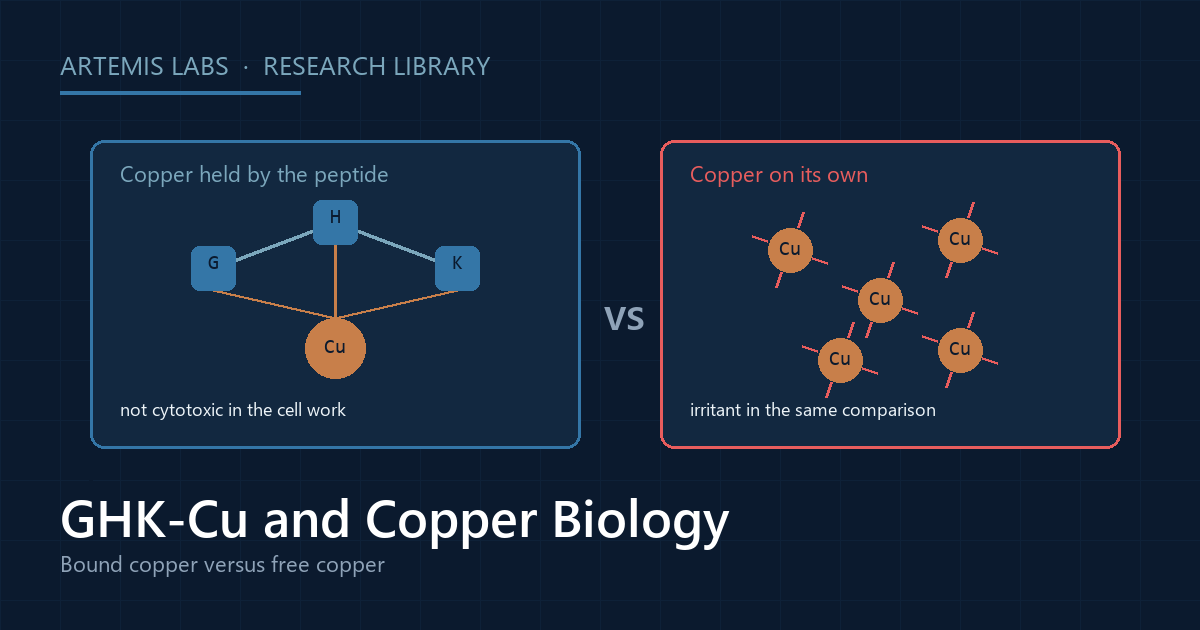
Chelation is the name for that holding. A chelator wraps around a metal ion through several attachment points and changes how the metal behaves. GHK-Cu is a chelate: the peptide glycyl-histidyl-lysine, three amino acids long, holding one copper(II) ion. Everything on this page follows from that arrangement, and from one practical consequence of it — the peptide with copper and the peptide without copper are two different chemical entities, with different weights and different database records. Our page on GHK versus GHK-Cu works through that split, because the public databases themselves blur it. The product record for the copper complex is GHK-Cu.
What happens when bound copper is compared against loose copper?
A 2016 study from the Department of Pharmacy at the National University of Singapore ran exactly that comparison in cultured skin cells. The authors reported that “these copper compounds exhibited different irritancy potentials at the same treatment concentrations”, and specifically that “GHK-Cu was not cytotoxic and did not induce any significant change in the expression levels of various skin irritation-related biomarkers”, while “IL-1α and IL-8, HSPA1A and FOSL1 were significantly upregulated following 24-h treatment with CuCl2 and Cu(OAc)2 at 58 and 580 μM without concomitant inhibition in cell viability” (PMID 27892491). Those four names are stress and inflammation markers cells switch on when irritated. Copper chloride and copper acetate are plain copper salts.
The authors’ summary is that “GHK-Cu has a low potential of inducing skin irritation and therefore provides a safer alternative for the delivery of copper through skin.” That sentence has a boundary drawn around it by the study’s own design: it is a keratinocyte model, in a dish, testing irritancy on skin. It says nothing about copper reaching the rest of the body, because nothing about the rest of the body was measured.
A 2020 study from Chung Yuan Christian University in Taiwan tested the same question in a living animal. Zebrafish larvae exposed to copper(II) developed “bradycardia and heartbeat irregularity” — a slow heart rate and an uneven beat — and GHK tripeptides “could rescue those experiencing cardiotoxicity, even at the lowest concentration of 1 nM” (PMID 32825031). The protection ran against copper, not with it.
What does the chemistry alone show?
Stripped of cells entirely, the result is consistent. A 2007 study in Biochemistry found that “Ascorbate-dependent hydroxyl radical generation by free Cu(II)” was “abolished in the presence of 2-fold molar excess glycylhystidyllysine (GHK)” (PMID 17929832). We quote the spelling the record carries rather than correcting it. In plain terms: copper that is held generates fewer damaging radicals than copper that is loose.
What the peptide contributes structurally was examined by a group at the University of Ferrara in 2001. They report that “the formation of copper complexes, driven by the first (Gly) residue, appears necessary while the second residue (His) does not appear to play a specific role; the presence of the free side chain of the third residue (Lys) appears to be of fundamental importance” (PMID 11325542). Note what that says about histidine, the residue most often described as the copper anchor in popular accounts of this molecule.
Is the peptide the active part, or is it the copper?
This is the open question in the area, and three independent groups have published results that keep it open.
The Ferrara group’s two synthetic analogues, which are not GHK, “showed an activity comparable to or even higher than that of GHK” (PMID 11325542). A 2014 study of TGF-β secretion in human dermal fibroblasts found that “GHK and its copper complex and free copper ions decreased IGF-2-dependent TGF-β1 secretion” — the free ions did it too (PMID 25745767). And a 2012 fibroblast study found that “GGH, GHK, CuCl2 and their copper complexes decreased TNF-alpha-dependent IL-6 secretion in fibroblasts”, again with plain copper chloride among the actives (PMID 23285694).
Three laboratories, three assays, one pattern: in these systems the specific GHK sequence was not required for the effect. That does not prove the peptide is inert. It means these particular experiments cannot attribute the result to the peptide, and any claim that they do is reading past what they measured.
What did the one concentration-response study report?
A 1992 study at the Université de Reims Champagne-Ardenne measured sulfated glycosaminoglycan synthesis — a class of long sugar chains that help build the material between cells — in cultured human fibroblasts. It reported that “GHK-Cu induced a dose-dependent increase of the synthesis of total GAGs”, and then the qualifier that matters: “The effect of GHK-Cu was biphasic with a maximal stimulation at 10(-9) to 10(-8) M. At higher concentrations, the rate of synthesis returned progressively to that of control cultures.” The same paper adds that “no influence of GHK-Cu on the synthesis of hyaluronic acid was observed” (PMID 1522753).
Biphasic means the response rose, peaked, and then came back down toward baseline as concentration kept climbing. It is a bell-shaped curve, and its peak in that experiment sat in the nanomolar range. This is a published result from one 1992 experiment in a dish. It is recorded here because a compound whose measured effect disappears at higher concentrations is a fact readers of this literature should have, not because it implies anything about how anyone should handle any material. It is not a recommendation, and nothing on this page is.
What the research does not show
None of the copper chemistry above has been studied in a person by any route other than application to skin. The searches were run and they came back empty: there is no published controlled human trial of GHK-Cu by any non-topical route, and the only record indexed with a systemic route of delivery is a study in dogs. The entire controlled human record is two topical trials, both negative on their objective endpoints — an 86-patient 1992 trial in which a “tripeptide copper complex 0.4% cream formulation” showed “no difference” from an inert vehicle placebo (PMID 1495150), and a 13-patient 2006 trial of topical skin care products in which “objective evaluation found no significant improvement in wrinkles or overall skin quality” (PMID 16847171).
That absence cuts in both directions, and the honest statement is symmetrical. The favourable copper findings above are bounded to cells, zebrafish, and a chemistry bench. No study reports GHK-Cu causing copper accumulation or copper overload either — but that is an absence of evidence rather than evidence of safety, because nobody has ever measured systemic copper exposure from this compound in a human. Our GHK-Cu safety research page works through that record in full.
One further gap belongs here. A 1995 study found that “Gly-His-Lys interacts with AT1 receptors”, a receptor family involved in blood-pressure regulation, with the effects it measured in rat liver cells blocked by losartan, a selective antagonist for that receptor (PMID 8545239). It is an off-target interaction that the widely circulated reviews of this peptide do not discuss, and it has not been followed up.
Frequently asked questions
Is the copper in GHK-Cu the same as taking copper?
Chemically, no — bound copper and loose copper behaved differently in every direct comparison located. In cultured skin cells GHK-Cu “was not cytotoxic” where two copper salts triggered irritation markers (PMID 27892491), and in a chemistry assay GHK abolished radical generation by free copper (PMID 17929832). All of that is in-vitro or in zebrafish. What copper from this complex does inside a human body has not been studied.
Does more GHK-Cu produce more of the measured effect?
In the one experiment that mapped the curve, no. The response was “biphasic with a maximal stimulation at 10(-9) to 10(-8) M”, and at higher concentrations synthesis “returned progressively to that of control cultures” (PMID 1522753). That is a single 1992 cell-culture finding, reported as a result and nothing more.
Which molecular weight belongs to which molecule?
340.38 belongs to the copper-free tripeptide at PubChem CID 73587. 402.92 belongs to the copper complex at CID 71587328. Always read the CID beside the number, because six different PubChem records answer to the name “GHK-Cu” and one of them is the copper-free peptide.
Why does free copper chloride keep showing up in these results?
Because researchers included it as a comparator, and it worked in several assays. That is a finding worth publishing rather than hiding: it means those experiments do not establish the peptide as the active principle (PMID 23285694, PMID 25745767).
References
- Selected Biomarkers Revealed Potential Skin Toxicity Caused by Certain Copper Compounds. Sci Rep, 2016. PMID 27892491 · doi:10.1038/srep37664
- Zebrafish larvae copper-toxicity study, Biomolecules, 2020. Cited by identifier. PMID 32825031 · doi:10.3390/biom10091202
- Copper redox chemistry study, Biochemistry, 2007. Cited by identifier. PMID 17929832 · doi:10.1021/bi701079z
- Copper complexes of glycyl-histidyl-lysine and two of its synthetic analogues: chemical behaviour and biological activity. Biochim Biophys Acta, 2001. PMID 11325542 · doi:10.1016/s0304-4165(01)00127-1
- Effect of GLY-HIS-LYS and its copper complex on TGF-β secretion in normal human dermal fibroblasts. Acta Pol Pharm, 2014. No DOI in the PubMed record. PMID 25745767
- Human dermal fibroblast cytokine study, Acta Pol Pharm, 2012. Cited by identifier; no DOI in the PubMed record. PMID 23285694
- Stimulation of sulfated glycosaminoglycan synthesis by the tripeptide-copper complex glycyl-L-histidyl-L-lysine-Cu2+. Life Sci, 1992. PMID 1522753 · doi:10.1016/0024-3205(92)90504-i
- Glycyl-histidyl-lysine interacts with the angiotensin II AT1 receptor. Peptides, 1995. PMID 8545239 · doi:10.1016/0196-9781(95)02015-o
- A prospective randomized evaluator-blinded trial of two potential wound healing agents for the treatment of venous stasis ulcers. J Vasc Surg, 1992. PMID 1495150 · doi:10.1067/mva.1992.37086
- Effects of topical copper tripeptide complex on CO2 laser-resurfaced skin. Arch Facial Plast Surg, 2006. PMID 16847171 · doi:10.1001/archfaci.8.4.252
- PubChem Compound Summary, CID 71587328 (Prezatide copper). https://pubchem.ncbi.nlm.nih.gov/compound/71587328 — formula C14H23CuN6O4+, molecular weight 402.92, CAS 89030-95-5. Retrieved August 27, 2026.
- PubChem Compound Summary, CID 73587 (glycyl-L-histidyl-L-lysine). https://pubchem.ncbi.nlm.nih.gov/compound/73587 — formula C14H24N6O4, molecular weight 340.38, CAS 49557-75-7. Retrieved August 27, 2026.
Methodology: this page draws only on primary records verified against PubChem and the PubMed index for the Artemis Labs GHK-Cu fact base, last verified August 27, 2026. Records without a verbatim title in that fact base are cited by PMID and DOI.
All compounds sold by Artemis Labs are for laboratory research use only. Nothing on this page is medical advice, and no statement has been evaluated by the FDA.
