
GHK-Cu Safety Research: What Has and Has Not Been Measured | Artemis Labs
Aug
GHK-Cu safety research: what has been measured, and what has not
Published August 26, 2026 · Artemis Labs
GHK-Cu safety research — answer capsule: the laboratory record on GHK-Cu and copper toxicity runs in the compound’s favour, and it is very narrow. In cultured human skin cells, GHK-Cu
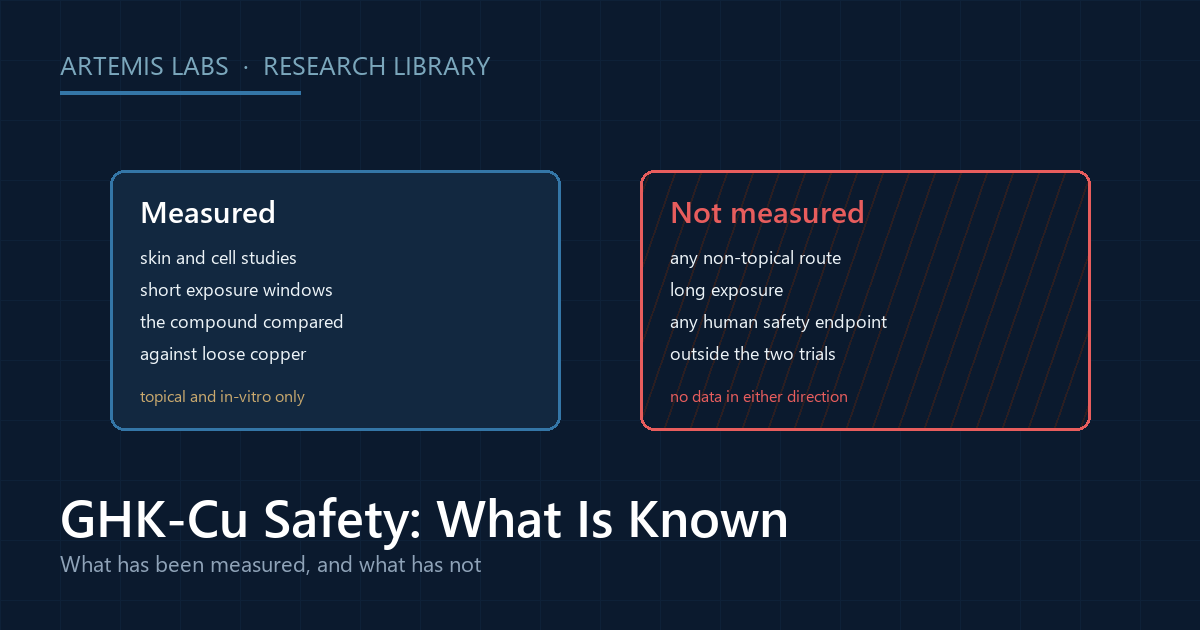
was not cytotoxicwhile two loose copper salts raised irritation markers at the same concentrations; in zebrafish larvae the copper-free peptide protected against copper-induced heart effects; and in a chemistry study GHK abolished the damaging hydroxyl-radical reaction that free copper drives. All of that is cell, fish and test-tube work on topical or chemical questions. Against it sit independent findings that point the other way, including a guinea-pig study reporting slower skin reorganization and a cell study reporting decreased cell reproduction. The structural fact that matters more than any of these: no human has ever been studied with GHK-Cu by any route other than the skin, so there is no systemic human safety dataset to be reassured or alarmed by. Artemis Labs supplies GHK-Cu as a laboratory reference compound and states that gap plainly.
Key findings
- The direct comparison favours the complex over loose copper. In cultured human skin cells,
GHK-Cu was not cytotoxic and did not induce any significant change in the expression levels of various skin irritation-related biomarkers, while copper chloride and copper acetate raised four irritation markers at58 and 580 μM(PMID 27892491). - Counter-evidence exists and points the other way. A guinea-pig study reported
a slower reorganization of the skin and a delayed activation of fibroblasts, and in the same paper the compoundsdecreased cell reproductionin culture (PMID 8836453). - The published concentration response has a peak, not a slope. In cultured human fibroblasts the effect on connective-tissue building blocks was
biphasic, andAt higher concentrations, the rate of synthesis returned progressively to that of control cultures(PMID 1522753). - No systemic human safety data exists in either direction. Nobody has been studied outside the topical route, so the absence of adverse-event reports reflects an absence of measurement, not a record of safety.
The copper question, and the honest answer to it
Copper in its loose ionic form can drive chemistry that damages tissue — it can hand off electrons and generate the hydroxyl radical, one of the most reactive species in biology. A reasonable person looking at a copper-containing peptide asks whether it carries that risk with it. We went looking for evidence that it does, and what came back mostly ran the other way. We report that as found.
The most directly relevant study is from the Department of Pharmacy at the National University of Singapore, published in 2016. It compared several copper compounds in cultured human skin cells using markers of irritation. Verbatim: These copper compounds exhibited different irritancy potentials at the same treatment concentrations. GHK-Cu was not cytotoxic and did not induce any significant change in the expression levels of various skin irritation-related biomarkers. IL-1α and IL-8, HSPA1A and FOSL1 were significantly upregulated following 24-h treatment with CuCl2 and Cu(OAc)2 at 58 and 580 μM without concomitant inhibition in cell viability. The authors’ summary sentence reads: GHK-Cu has a low potential of inducing skin irritation and therefore provides a safer alternative for the delivery of copper through skin.
Read the boundary on that as carefully as the result. It is a keratinocyte model — human skin cells grown in a dish — testing irritation from something applied to skin. It says nothing about copper reaching the rest of the body.
Two other studies point the same direction. In zebrafish larvae, copper exposure caused slow and irregular heartbeats, and the copper-free GHK tripeptide could rescue those experiencing cardiotoxicity, even at the lowest concentration of 1 nM (PMID 32825031). In a 2007 chemistry paper, the hydroxyl-radical generation driven by free copper and ascorbate was abolished in the presence of 2-fold molar excess glycylhystidyllysine (GHK) (PMID 17929832). The underlying chemistry is consistent: copper held inside a peptide complex is less reactive than copper floating free. The chemistry side of this is covered in more depth on our page on GHK-Cu copper biology research.
What points the other way
A page that stopped at the paragraph above would be selling rather than reporting. Independent groups have published findings that cut against the compound, and they belong here.
In 1995, pharmacologists at the University of Florence applied tripeptide-copper complexes to guinea-pig dorsal skin. Their reported main effects were A slower reorganization of the skin and a delayed activation of fibroblasts — the opposite of the accelerated-healing story the compound is usually attached to. The same paper reports that in cell culture, The products studied at a concentration of 10(-7) M, decreased cell reproduction and increased collagen expression.
In bone cells, a French INSERM group found nulls and one inhibitory result: coating surfaces with the free complex or the peptide had no effect on osteoblast spreading, and the complex slightly inhibited the basal and 1,25(OH)2D-induced stimulation of ALP activity or osteocalcin production in rat and human bone cells (PMID 8747089). In a rat knee-ligament model, the benefit did not last: a difference in joint laxity at six weeks had gone by twelve, with no significant difference in ultimate load, gait parameters, and histological scores, and the authors’ own summary that the effects could not last as treatment discontinued (PMID 25731775). The word transiently is in that paper’s title.
Two further items are unresolved rather than negative, and both deserve to be on a safety page. A 1995 study from the National Autonomous University of Mexico reported that binding experiments clearly indicated that Gly-His-Lys interacts with AT1 receptors — a receptor in the cardiovascular system — an interaction that appears in none of the reviews written about this compound (PMID 8545239). And a 2025 paper from a peptide manufacturer reported that a combination of a palmitoylated copper peptide with acetyl tyrosine effectively promotes melanin production in both types of melanoma cells, in human and mouse melanoma cell lines (PMID 39632290). That agent is a two-component complex rather than GHK-Cu, the measured endpoint was pigment production rather than cell growth, and the study was run by a company selling peptides — but it is the only record we found in which a copper-peptide species increased an activity in a malignant human cell line, and it sits against the sweeping protective claims made elsewhere.
What the concentration data actually showed
One published result is regularly misread as a reason to go higher, and it says the reverse. A 1992 study at the Université de Reims measured how cultured human fibroblasts responded across a range of concentrations. Verbatim: The effect of GHK-Cu was biphasic with a maximal stimulation at 10(-9) to 10(-8) M. At higher concentrations, the rate of synthesis returned progressively to that of control cultures. The same paper adds a null: No influence of GHK-Cu on the synthesis of hyaluronic acid was observed.
Biphasic means the response curve rose to a peak and then came back down. In that assay, concentrations above the peak produced less effect, not more. We report this as the published result it is, and draw no conclusion from it about any preparation.
The gap that matters more than any single finding
Everything above is cell culture, fish, guinea pigs, rats or chemistry. Now the human side, and it is short. The only two human trials of GHK-Cu are the 1992 leg-ulcer trial of a topical tripeptide copper complex 0.4% cream formulation in 86 patients, and the 2006 trial of topical copper-tripeptide skin-care products in 13 patients after laser resurfacing. Both applied material to skin. Neither was designed or sized to detect uncommon harms — 13 patients cannot, and even 86 can only find common ones. Those trials are covered fully on our page on GHK-Cu human trials.
Outside the topical route, the human safety literature is empty because the human literature is empty. Six differently-built searches for a controlled human trial of GHK-Cu by any whole-body route were run; four returned a count of zero, one returned a study in 12 dogs, and one returned materials-science and cell papers. So when a search for adverse events, contact dermatitis, allergy, sensitization or skin irritation returns five records containing no adverse-event report, and a search across copper-toxicity terms returns eleven records that are all protective or unrelated, the correct reading is not “GHK-Cu has a clean safety record.” It is that almost nothing has been measured in people, and nothing at all outside the skin. GHK-Cu is supplied here as a laboratory reference compound, and this is the reason we will not describe it as having an established safety profile.
What the research does not show
No systemic human safety data exists for GHK-Cu in either direction, because no human has ever been studied outside the topical route. An absence of adverse-event reports is not evidence of safety when nothing was measured. That single sentence is the honest summary of this page, and it outranks every reassuring cell-culture result above it.
- The favourable copper findings are bounded to their models. A keratinocyte irritation assay, zebrafish larvae and a test-tube radical measurement describe topical and chemical questions. None of them describes what copper delivered any other way would do in a person.
- No long-term data exists at all. The longest human exposure in the record is six months, in a two-component hair product study in which the copper peptide’s contribution cannot be separated out.
- Independent reviewers say so in their own words. A 2026 review from a sports-medicine institute in Phoenix writes that for unapproved peptides,
rigorous human safety data are scarce, and there is potential for serious harm to patients, and names GHK-Cu in its reviewed set. A 2026 review from Alfaisal University in Riyadh places GHK-Cu among compounds thatlack long-term safety data and systematic validation. A 2026 review from Brigham and Women’s Hospital notes that for this class,clinical evidence in humans is limited. - No retraction and no safety communication exists. That search returns zero. With a published record this small, an empty retraction list carries almost no information.
Frequently asked questions
Does the copper in GHK-Cu behave like loose copper?
Not in the laboratory comparisons that have been run. In cultured human skin cells the complex was not cytotoxic while copper chloride and copper acetate raised irritation markers, and in a chemistry study the peptide abolished the radical-generating reaction that free copper drives. Those results are bounded to cell and test-tube models of topical or chemical questions.
Have side effects been reported in people?
No adverse-event report appears in the indexed literature, and the reason is that the human literature consists of two small topical trials from 1992 and 2006. Nothing has been measured outside the skin, in anyone, ever.
Is the biphasic finding a reason to use less?
It is not guidance of any kind. It is a description of what one 1992 cell-culture experiment measured: a response that peaked and then fell back toward the untreated cultures. We report the shape of that published curve and stop there.
References
- Sci Rep, 2016. Human keratinocyte irritation biomarkers comparing GHK-Cu against copper salts, Department of Pharmacy, National University of Singapore. PMID 27892491 · DOI 10.1038/srep37664
- Biomolecules, 2020. Zebrafish larvae exposed to copper, Chung Yuan Christian University, Taiwan. PMID 32825031 · DOI 10.3390/biom10091202
- Biochemistry, 2007. Ascorbate-dependent hydroxyl-radical generation by free copper, abolished by GHK. PMID 17929832 · DOI 10.1021/bi701079z
- Arch Int Pharmacodyn Ther, 1995. Guinea-pig dorsal skin and cultured fibroblasts, Department of Pharmacology, University of Florence, Italy. PMID 8836453 (no DOI in the PubMed record)
- Cell Mol Biol (Noisy-le-grand), 1995. Rat and human osteoblastic cells, INSERM Unité 349, Lariboisière Hospital, Paris. PMID 8747089 (no DOI in the PubMed record)
- J Orthop Res, 2015. Rat anterior cruciate ligament reconstruction model; benefit present at 6 weeks and absent at 12, The Chinese University of Hong Kong. PMID 25731775 · DOI 10.1002/jor.22831
- Life Sci, 1992. Cultured human fibroblasts; biphasic concentration response and a null for hyaluronic acid, CNRS URA 610, Université de Reims Champagne-Ardenne, France. PMID 1522753 · DOI 10.1016/0024-3205(92)90504-i
- Peptides, 1995. Radioligand binding competition showing an interaction with the angiotensin II AT1 receptor, Departamento de Bioenergética, Universidad Nacional Autónoma de México. PMID 8545239 · DOI 10.1016/0196-9781(95)02015-o
- Biochem Biophys Res Commun, 2025. A375 and B16 melanoma cell lines treated with a palmitoyl copper peptide and acetyl tyrosine complex; Shanghai Peptide Biotechnology Co. Ltd. PMID 39632290 · DOI 10.1016/j.bbrc.2024.151060
- J Vasc Surg, 1992. Randomized evaluator-blinded trial against an inert vehicle placebo, 86 evaluable patients, University of Texas Medical Branch, Galveston. Topical cream. PMID 1495150 · DOI 10.1067/mva.1992.37086
- Arch Facial Plast Surg, 2006. Randomized with-or-without trial in 13 patients, Facial Aesthetic Concepts, San Clemente, California. Topical skin-care products. PMID 16847171 · DOI 10.1001/archfaci.8.4.252
- 2026 review, Performance Medicine Institute, Phoenix, Arizona, on unapproved peptides and the scarcity of rigorous human safety data. PMID 41966639 · DOI 10.1007/s40279-026-02437-0
- 2026 review, College of Medicine, Alfaisal University, Riyadh, listing GHK-Cu among non-approved peptides lacking long-term safety data. PMID 42021992 · DOI 10.3389/fragi.2026.1790247
- 2026 review, Department of Anesthesiology, Perioperative, and Pain Medicine, Brigham and Women’s Hospital, Harvard University, Boston. PMID 42635865 · DOI 10.1007/s11916-026-01542-z
- Ann Dermatol, 2016. Six-month two-component topical study in 45 patients, Kyungpook National University School of Medicine, Daegu, Korea. PMID 27489425 · DOI 10.5021/ad.2016.28.4.438
Methodology: this page draws on PubMed records retrieved through NCBI E-utilities, including nine searches run specifically to find negative, toxicity and adverse-event evidence, with every quoted string transcribed verbatim from the source named beside it; last verified August 27, 2026.
All compounds sold by Artemis Labs are for laboratory research use only. Nothing on this page is medical advice, and no statement has been evaluated by the FDA.
