
GHK-Cu Human Trials: Two in 34 Years, Both Null | Artemis Labs
Aug
What human trials of GHK-Cu actually exist
Published August 26, 2026 · Artemis Labs
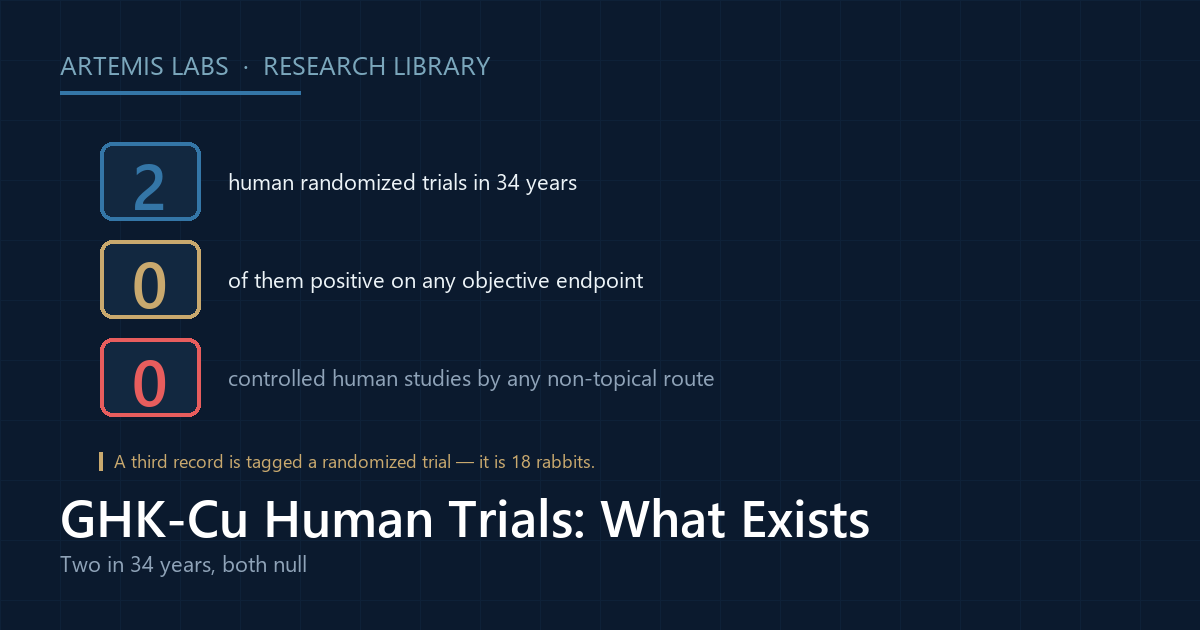
GHK-Cu human trials — answer capsule: GHK-Cu has exactly two randomized controlled trials in people, published in 1992 and 2006, and both were negative on every endpoint measured by an instrument or a blinded evaluator. The 1992 trial used a topical cream in 86 patients with leg ulcers and found no difference from an inert placebo. The 2006 trial used topical skin-care products in 13 patients after laser resurfacing and found no significant improvement on any objective measure. PubMed returns a count of three when asked for randomized trials of GHK-Cu, but the third record is a study in 18 rabbits, so any automated count of GHK-Cu trials is wrong by one. An independent 2026 systematic review searching three databases reached the same number of two. No controlled human trial of GHK-Cu by any route other than the skin has ever been published.
Key findings
- Two human trials in 34 years. PMID 1495150 (1992, topical cream, n=86) and PMID 16847171 (2006, topical skin-care products, n=13). Nothing has been added since.
- Both were null on the objective measures. The 1992 trial found
no differencebetween the topical copper-peptide cream and placebo. The 2006 trial’s own conclusion readsObjective evaluation found no significant improvement in wrinkles or overall skin quality. - The third “trial” is in rabbits. PubMed tags PMID 17083573 as a
Randomized Controlled Trial. It is a veterinary experiment inEighteen New Zealand rabbits. - An independent method got the same answer. A 2026 PRISMA review from a university in Dubai searched PubMed, Embase and Cochrane CENTRAL through March 2026 for GHK-Cu
as a standalone interventionand reported20 studies (18 preclinical; 2 RCTs) were included(PMID 42619529).
How many GHK-Cu human trials are there?
Two. That is a hand-counted number, taken from reading each trial-tagged record rather than trusting a search total, and the distinction matters more here than for most compounds.
Ask PubMed for randomized controlled trials of GHK-Cu and it returns a count of three, with the identifiers 17083573, 16847171 and 1495150. Ask it more broadly — every clinical-trial tag it has, including controlled clinical trials and multicentre studies — and you get the same three records back. So there is no fourth study of any kind hiding behind a narrower query. But the first of those three is the rabbit study, which means anyone who quotes the search count instead of reading the records overstates the human trial record by fifty percent. GHK-Cu is supplied here as a laboratory reference compound, and this is the human record we can point to.
What did the 1992 trial find?
This is the strongest human study of GHK-Cu that exists, and its result is negative.
Surgeons in the Division of Plastic Surgery at the University of Texas Medical Branch in Galveston ran what their abstract describes as a prospective randomized evaluator-blinded trial comparing two potential wound healing agents to an inert vehicle placebo. Eighty-six evaluable patients completed the trial. The condition was venous stasis ulcers — open sores on the lower leg caused by poor blood return. Randomized allocation, a blinded person doing the assessments, a real placebo, and 86 people finishing: no other human study of this compound has all four.
The result, in the authors’ own words: Silver sulfadiazine 1% in a cream proved to statistically reduce the ulcer size compared with a biologically active tripeptide copper complex 0.4% cream formulation or the placebo. There was no difference between the latter two treatments.
Read that carefully. The topical copper-peptide cream was indistinguishable from the placebo cream, and a decades-old generic antibacterial cream beat both. That is the highest-quality human evidence in the record, it is 34 years old, and it points away from the compound. We publish it because leaving it out would misrepresent the record.
What did the 2006 trial find?
A private aesthetic practice in San Clemente, California studied topical copper-tripeptide skin-care products on skin that had just been treated with a carbon-dioxide resurfacing laser. The design, verbatim: Patients were then randomized to receive posttreatment skin regimens with or without GHK-Cu. Evaluations for erythema throughout the posttreatment period were performed using computer software and blinded evaluators. Erythema is redness. Thirteen patients completed the study.
Every instrument-measured and blind-rated endpoint came back null: Computer analysis and blinded evaluators found no statistically significant differences between groups for earlier resolution of erythema. All the patients experienced significant improvement in wrinkles and overall skin quality, but no differences were found between groups. The authors’ conclusion is blunter still: topical copper-tripeptide products offered no significant reduction or resolution of redness, and Objective evaluation found no significant improvement in wrinkles or overall skin quality.
One result was positive, and it is worth naming precisely what it was: The results of the questionnaire indicated a significant difference in the posttreatment improvement of overall skin quality for patients using GHK-Cu (P = .04). A self-report questionnaire, in thirteen people, in a with-or-without design where every participant knew whether they had been given an extra product to apply. That is a lead worth following, not a finding. Anyone citing this trial as evidence that GHK-Cu improves skin has to carry the objective nulls in the same sentence. We go further into that literature on our page on GHK-Cu skin research.
Why do some sources say there are three trials?
Because PubMed’s publication-type tags say so, and the tags are counting a veterinary experiment. PMID 17083573, from the Faculty of Veterinary Medicine at Uludag University in Bursa, Turkey, carries the publication types Journal Article, Randomized Controlled Trial. Its methods sentence reads Eighteen New Zealand rabbits were divided into three groups: TCC, zinc oxide and no treatment. Its indexing terms include Animals and Rabbits.
The study’s result was positive for the topical copper complex on wound area, and its authors hedged it themselves and named the species while doing so: The results suggest that TCC is a better choice in the treatment protocols of open wounds in rabbits than zinc oxide. It is a legitimate animal study. It is not a human trial, and any GHK-Cu trial count taken from an automated query rather than from reading the records inherits this error.
Has anyone else counted independently?
Yes, and they got the same number by a different method. PMID 42619529 is a 2026 systematic review from the College of Medicine at Mohammed Bin Rashid University of Medicine and Health Sciences and Dubai Health, in the United Arab Emirates — no connection to any company selling this compound. Its method, verbatim: A systematic search of PubMed, Embase, and Cochrane CENTRAL was conducted from database inception through March 2026, following PRISMA guidelines. Eligible studies included clinical and preclinical models investigating GHK-Cu as a standalone intervention for aesthetic applications. Its count, verbatim: 20 studies (18 preclinical; 2 RCTs) were included.
Two RCTs. Three databases, an independent team, a formal method, and the same answer as a hand count. The review is also frank about what that means, in its own words: the findings were constrained by methodological variability and a limited number of well-designed clinical trials, and larger controlled trials will be needed to close the translational gap.
One thing in that review we could not confirm, and we are flagging it rather than repeating it. The review also states that GHK-Cu significantly reduced wrinkle volume and depth compared with controls. We could not locate an indexed randomized trial reporting that result. The only two human RCTs are the ones above, and the 2006 one says the opposite about wrinkles in its own abstract. A dedicated search for wrinkle-outcome trials surfaced exactly one randomized record, and its active ingredient is palmityl tripeptide-1 — a different, palmitoylated molecule — in a four-component eye cream studied by its own manufacturer. So that sentence is something the review says. It is not something we can vouch for, and we do not repeat it on our own authority.
Is there any human trial outside the topical route?
No, and this was checked rather than assumed. Six differently-constructed searches were run for a controlled human trial of GHK-Cu by any whole-body route. Four returned a count of zero outright. One returned a single record carrying a systemic-route index heading, and that record is a study in 12 mature English Pointers — dogs, with material placed directly into the wounds rather than dosed to the whole animal (PMID 8669775). The last returned six records that turned out to be materials-science papers, cell work or reviews.
The closest thing that exists is PMID 29482481, a 2018 study from a clinic in Mumbai described by its authors as open-label, prospective, single-arm: no control group, no blinding, and a scalp formulation carrying six active components, of which copper tripeptide-1 is one. Nothing in it can be attributed to the copper peptide. Whole-body work with GHK-Cu exists only in mice and rats. The full formulation argument is on our page on topical versus systemic GHK-Cu evidence.
What the research does not show
No controlled human study of GHK-Cu outside the topical route has ever been published, so nothing in this record speaks to research-vial material. Both human trials applied a cream or a skin-care product to skin. That is a different formulation, a different route and a different concentration from anything in a laboratory vial, and the two evidence bases do not transfer to one another. Four further limits belong on the record:
- Neither null has ever been retested. A search for replication attempts returned six records, and every one of them matched on DNA replication or cell reproduction rather than a repeat study. The 1992 and 2006 results stand unchecked in both directions.
- There is no double-blind GHK-Cu study at all. That PubMed search returns a count of zero. The 1992 trial was evaluator-blinded, which is not the same thing; the 2006 trial blinded its evaluators but not its patients.
- There is no meta-analysis. Two separate searches — for meta-analyses and for the systematic-review subset — both return zero. The 2026 PRISMA review exists but is not indexed in that subset.
- PubMed indexing is not the whole world. This count reflects what is indexed in PubMed and, by way of the 2026 review, in Embase and Cochrane CENTRAL. Trials that were registered but never published, and the cosmetic-science literature that is largely not PubMed-indexed, would not appear here. The accurate statement is that no controlled human trial of systemic GHK-Cu is indexed, not that none was ever attempted.
Frequently asked questions
Do two negative trials mean GHK-Cu does nothing?
No. Two trials asked two narrow questions — leg ulcers in 1992, laser-treated facial skin in 2006 — using topical creams, and both answered in the negative. That is not the same as the compound having been ruled out across every research question. The honest position is that the human record is tiny, old, entirely topical and negative where it has been measured.
Why does an online source say GHK-Cu has three human trials?
Almost always because the number came from a PubMed publication-type count rather than from reading the three records. One of the three is a study in 18 rabbits, published in a veterinary dermatology journal.
Which trial is the most important one?
The 1992 study, because it is the only one with randomization, a blinded evaluator, a genuine inert placebo and a meaningful number of patients. It found the topical copper-peptide cream no different from placebo.
References
- J Vasc Surg, 1992. Prospective randomized evaluator-blinded trial against an inert vehicle placebo in venous stasis ulcers, 86 evaluable patients, Division of Plastic Surgery, University of Texas Medical Branch, Galveston. Topical cream. PMID 1495150 · DOI 10.1067/mva.1992.37086
- Arch Facial Plast Surg, 2006. Randomized with-or-without trial in 13 patients after carbon-dioxide laser resurfacing, Facial Aesthetic Concepts, San Clemente, California. Topical skin-care products. PMID 16847171 · DOI 10.1001/archfaci.8.4.252
- Vet Dermatol, 2006. Eighteen New Zealand rabbits, Department of Pathology, Faculty of Veterinary Medicine, Uludag University, Bursa, Turkey; carries the
Randomized Controlled Trialpublication tag. PMID 17083573 · DOI 10.1111/j.1365-3164.2006.00551.x - Aesthet Surg J, 2026. PRISMA systematic review of standalone GHK-Cu across PubMed, Embase and Cochrane CENTRAL through March 2026; Mohammed Bin Rashid University of Medicine and Health Sciences and Dubai Health, United Arab Emirates. PMID 42619529 · DOI 10.1093/asj/sjag169
- J Cosmet Laser Ther, 2018. Open-label, prospective, single-arm study of a six-component scalp formulation, The Esthetic Clinics, Mumbai, India. PMID 29482481 · DOI 10.1080/14764172.2018.1439965
- Am J Vet Res, 1996. Study in 12 English Pointers, Scott-Ritchey Research Center, Auburn University; the only PubMed record for GHK-Cu carrying a systemic-route index heading. PMID 8669775 (no DOI in the PubMed record)
- Skin Res Technol, 2024. Randomized 12-week trial of a four-component eye cream whose peptide active is
palmityl tripeptide-1, run by the manufacturer, Mageline Biology Tech Co., Ltd, Wuhan, China. PMID 38932444 · DOI 10.1111/srt.13790
Methodology: this page draws on PubMed records retrieved through NCBI E-utilities, including complete identifier lists for every clinical-trial publication type, with every quoted string transcribed verbatim from the source named beside it; last verified August 27, 2026.
All compounds sold by Artemis Labs are for laboratory research use only. Nothing on this page is medical advice, and no statement has been evaluated by the FDA.
