
GHK-Cu Topical vs Systemic Evidence: What Transfers | Artemis Labs
Aug
Topical versus systemic: what the GHK-Cu evidence can and cannot say
Published August 26, 2026 · Artemis Labs
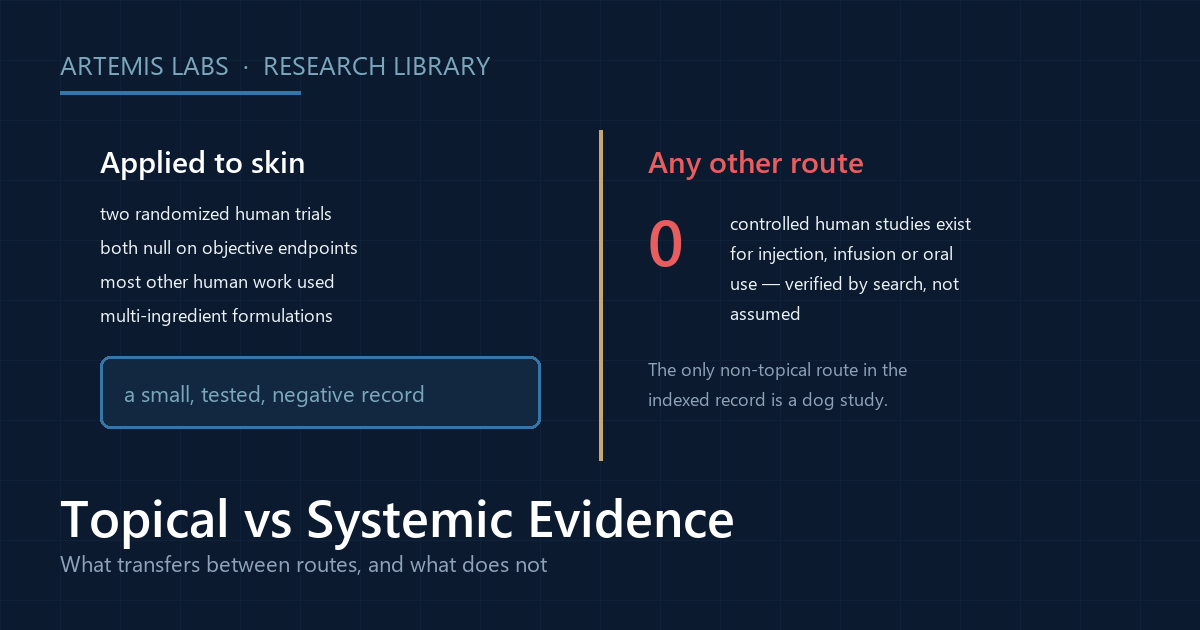
GHK-Cu topical versus systemic evidence — answer capsule: every human study of GHK-Cu ever published applied it to skin, and six of the eight applied it inside a product containing several other active ingredients. Because those products were tested as products, no result from them can be assigned to the copper peptide rather than to the other ingredients, the vehicle, or the procedure the product accompanied. All four hair and scalp studies and every positive cosmetic result sit in that unattributable group; the only two studies whose result belongs to GHK-Cu alone are the two randomized trials, and both were negative. Separately, no controlled human study of GHK-Cu by any route other than the skin has ever been published — that was checked with six differently-built searches, four of which returned zero. Nothing in the cosmetic literature describes research-vial material, and Artemis Labs does not present it as if it did.
Key findings
- Six of eight human studies cannot attribute their result. Of the eight studies located in which GHK-Cu was applied to people, six used formulations with two to six actives. The two exceptions are the 1992 and 2006 randomized trials, and both were null on their objective endpoints.
- Every positive human cosmetic result is multi-ingredient. That includes all four hair and scalp studies. There is no single-agent human hair study of GHK-Cu indexed in PubMed at all.
- Zero controlled human data outside the topical route. Four route-specific searches returned counts of zero; the one record carrying a systemic-route index heading is a study in 12 dogs, and whole-body administration of GHK-Cu appears only in mice and rats.
- The vehicle can be most of the effect. In a rat wound study, wound area fell 64.5% with the copper-tripeptide gel, 45.6% with the gel base alone, and 28.2% with no treatment (PMID 14648529). Compared against the correct arm, the compound’s share is 18.9 percentage points, not 36.3.
Why a cosmetic study usually cannot tell you what the peptide did
When a study tests a finished product, the thing being tested is the product. If a serum contains five actives and a scrub is used alongside it, whatever the study measured was produced by that whole regimen. Splitting the credit between the ingredients afterwards is not something the data supports — that would need separate arms for each ingredient, which none of these studies had.
This is not a technicality invented to be harsh on the compound. It is why regulators and systematic reviewers exclude multi-ingredient studies when they want to know what a single ingredient does; the 2026 systematic review discussed on our page on GHK-Cu human trials restricted itself to studies of GHK-Cu as a standalone intervention for exactly this reason, and found only twenty studies in the world, two of them in people.
The eight human studies, and what each one actually applied
Here is the complete set, hand-counted from the records rather than taken from a search total.
- PMID 1495150 (1992). A
tripeptide copper complex 0.4% cream formulationagainst aninert vehicle placebo, 86 patients. One active. Attributable — and it found no difference from placebo. - PMID 16847171 (2006).
skin care products that contain a copper tripeptide complex, with-or-without design, 13 patients. Partly attributable — and every objective endpoint was null. - PMID 27489425 (2016). A topical product the authors call
ALAVAX, which is a two-part complex of 5-aminolevulinic acid and the copper-free GHK peptide, in 45 patients with male pattern hair loss. Not attributable: 5-aminolevulinic acid has its own independent hair literature. The paper also reports that the higher-strength arm performed worse than the lower one, and that there wasno statistically significant difference in hair length and hair thicknessacross the three groups. - PMID 33397562 (2020). A pilot in 10 people using a tripeptide-and-hexapeptide serum alongside a laser procedure. Two peptides plus a procedure. Not attributable.
- PMID 29482481 (2018). A scalp formulation containing
vascular endothelial growth factor, basic fibroblast growth factor, insulin-like growth factor, keratinocyte growth factor, thymosin β4, and copper tripeptide-1. Six actives,open-label, prospective, single-arm, no control group. Not attributable. - PMID 39449909 (2024). A two-product scalp regimen — a scrub plus a serum containing
copper tripeptide-1, witch hazel (Hamamelis virginiana), hesperidin, hyaluronic acid, and pea protein (Pisum sativum)— studiedopen-labelwith no control arm over 15 days, and named in the paper as a specific commercial regimen. Not attributable. - PMID 36061477 (2022). A multi-component topical formulation built around
Tripeptide-1 and Hexapeptide-12 (TriHex™). Every author is an employee of the company selling it, and the authors themselves list the study’s limits asrelatively small numbers of patientsand thenon-competitive nature of the trial.Not attributable. - PMID 38932444 (2024). A randomized trial of a four-component eye cream from its own manufacturer. Its peptide active is
palmityl tripeptide-1— a palmitoylated derivative, a different molecule — so this is not GHK-Cu evidence at all, despite being the record most often surfaced by wrinkle-outcome searches.
Six of the eight cannot separate the copper peptide from what it was mixed with. A seventh is not the copper peptide. The two that can attribute are the two negative randomized trials. The hair and scalp subset is covered in more depth on our page on GHK-Cu hair research.
The vehicle problem, shown with numbers
Multi-ingredient formulations are one attribution trap. The carrier the compound is dissolved in is another, and one animal study makes it unusually visible. In a 2003 study at the University of Florida, 24 rats with poorly-supplied open wounds were treated with a commercial topical copper-tripeptide gel, with the gel base alone, or with nothing. By day 13: initial wound area had decreased by 64.5% in the TCC group, 45.6% in the vehicle group, and 28.2% in the control group.
The gel base by itself moved the wound from 28.2% to 45.6% — in those rats, more than half of the total change in wound area came from the carrier. Quote “64.5% versus 28.2%” and you have credited the peptide with the gel’s work. The correct comparison is against the vehicle arm, and it is 18.9 percentage points. This is a rat study, and its authors closed by writing Clinical evaluation of topical TCC is warranted. That was 2003; the human trial record has not grown since.
A related case sits in the delivery-system literature. A 2017 mouse study reported that scald wounds treated with GHK-Cu packaged into liposomes did better than wounds treated with free GHK-Cu (PMID 28370978). The unpackaged complex was the weaker comparator in its own paper. Results like that belong to the delivery system as much as to the molecule.
Does anything applied to skin reach the rest of the body?
Very little, and the one measurement available says so quantitatively. A 2010 laboratory study measured how a copper tripeptide moves through isolated human skin and reported a permeability coefficient of 2.43 ± 0.51 × 10(-4) cm/h through skin thinned to the dermis (PMID 20703511). That is a bench measurement on excised tissue, not a measurement in a living person, and it exists precisely because skin is a barrier rather than a doorway.
Which is the crux of this page. A cosmetic study measures what happens when a small amount of a formulated product meets the outside of the skin barrier. Nothing about that describes the material in a research vial, at a different concentration, in a different medium, in a laboratory setting. GHK-Cu is supplied here as a laboratory reference compound, and the honest position is that the cosmetic record does not carry over to it.
What the research does not show
No controlled human study of GHK-Cu by any route other than the skin has ever been published — so there is no human evidence base for research-vial material at all. This was checked six ways rather than assumed. Four searches combining trial publication types with whole-body route terms returned a count of zero. One returned a single record with a systemic-route index heading: a study in 12 mature English Pointers, in which material was placed directly into the wounds rather than dosed to the animal. One returned six records that turned out to be materials-science papers, cell work and reviews. Whole-body administration exists only in mice and rats.
- Positive cosmetic results do not become GHK-Cu results by repetition. Every positive human cosmetic finding in this record came from a product with other actives in it, and several were run by the company selling the product.
- The concentrations differ by orders of magnitude. In cultured human cells, the strongest reported effect on connective-tissue building blocks occurred at
10(-9) to 10(-8) M, andAt higher concentrations, the rate of synthesis returned progressively to that of control cultures(PMID 1522753). Reported as the published result it is: the response curve had a peak and then fell, so a higher concentration did not produce a larger effect in that assay. - Some effects were reproduced without the peptide. Independent groups reported that copper chloride alone lowered the same inflammatory signal as the complex (PMID 23285694), and that two synthetic analogues showed activity
comparable to or even higher than that of GHK(PMID 11325542). Where that holds, the specific sequence may not be what is doing the work. - The cosmetic-science literature is largely outside PubMed. Positive results may exist in industry journals this method cannot reach. Our count describes indexed literature and says nothing about the unindexed kind.
Frequently asked questions
If a copper-peptide serum worked in a study, why can’t that be cited?
It can be cited — as evidence about that serum. What it cannot do is tell you what the copper peptide contributed, because the study had no arm that separated it out. That distinction is the whole of this page.
Is GHK-Cu absorbed into the body from skin?
The only measurement available is a permeability coefficient from isolated human skin in a laboratory setup, not a measurement in a living person. No human study has ever measured what happens to GHK-Cu given by any route other than the skin.
Why does this matter for a research vial?
Because the vial is not a cream. Different concentration, different medium, different setting, and no controlled human data of its own. Reading cosmetic-cream results across to it would be the single most common error made about this compound, and we would rather name it than repeat it.
References
- J Vasc Surg, 1992. Randomized evaluator-blinded trial against an inert vehicle placebo, 86 evaluable patients, University of Texas Medical Branch, Galveston. Topical cream, single active. PMID 1495150 · DOI 10.1067/mva.1992.37086
- Arch Facial Plast Surg, 2006. Randomized with-or-without trial in 13 patients, Facial Aesthetic Concepts, San Clemente, California. Topical skin-care products. PMID 16847171 · DOI 10.1001/archfaci.8.4.252
- Ann Dermatol, 2016. Two-component topical complex of 5-aminolevulinic acid and GHK in 45 patients, Kyungpook National University School of Medicine, Daegu, Korea. PMID 27489425 · DOI 10.5021/ad.2016.28.4.438
- 2020 pilot study in 10 patients combining a tripeptide/hexapeptide serum with a 1540 nm laser procedure. PMID 33397562 (no DOI in the PubMed record)
- J Cosmet Laser Ther, 2018. Open-label, prospective, single-arm study of a six-component scalp formulation, The Esthetic Clinics, Mumbai, India. PMID 29482481 · DOI 10.1080/14764172.2018.1439965
- Cureus, 2024. Open-label, single-centre, uncontrolled 15-day study of a two-product scalp regimen, NovoBliss Research Private Limited, Ahmedabad, India. PMID 39449909 · DOI 10.7759/cureus.70108
- J Clin Aesthet Dermatol, 2022. Company-run biopsy sub-study of a multi-component topical formulation; all authors employed by ALASTIN Skincare, Carlsbad, California. PMID 36061477 (no DOI in the PubMed record)
- Skin Res Technol, 2024. Randomized 12-week trial of a four-component eye cream whose peptide active is
palmityl tripeptide-1; run by the manufacturer, Mageline Biology Tech Co., Ltd, Wuhan, China. PMID 38932444 · DOI 10.1111/srt.13790 - Vet Surg, 2003. Topical copper-tripeptide gel versus vehicle versus untreated control in 24 Sprague-Dawley rats, University of Florida College of Veterinary Medicine. PMID 14648529 · DOI 10.1111/j.1532-950x.2003.00515.x
- Wound Repair Regen, 2017. Mouse scald model and HUVEC cells comparing liposome-packaged against free GHK-Cu, Dalian Medical University, China. PMID 28370978 · DOI 10.1111/wrr.12520
- Inflamm Res, 2010. Laboratory permeation measurement across isolated human skin. PMID 20703511 · DOI 10.1007/s00011-010-0214-4
- Life Sci, 1992. Cultured human fibroblasts; biphasic concentration response for sulfated glycosaminoglycan synthesis, CNRS URA 610, Université de Reims Champagne-Ardenne, France. PMID 1522753 · DOI 10.1016/0024-3205(92)90504-i
- Acta Pol Pharm, 2012. Human dermal fibroblasts; copper chloride lowered the same inflammatory signal as the complexes, Medical University of Silesia, Sosnowiec, Poland. PMID 23285694 (no DOI in the PubMed record)
- Biochim Biophys Acta, 2001. Copper complexes of GHK and two synthetic analogues, Department of Chemistry, University of Ferrara, Italy. PMID 11325542 · DOI 10.1016/s0304-4165(01)00127-1
- Am J Vet Res, 1996. Study in 12 English Pointers, Auburn University; the only PubMed record for GHK-Cu carrying a systemic-route index heading. PMID 8669775 (no DOI in the PubMed record)
- Aesthet Surg J, 2026. PRISMA systematic review restricted to standalone GHK-Cu; Mohammed Bin Rashid University of Medicine and Health Sciences and Dubai Health, United Arab Emirates. PMID 42619529 · DOI 10.1093/asj/sjag169
Methodology: this page draws on PubMed records retrieved through NCBI E-utilities, with every human application study read individually and every quoted string transcribed verbatim from the source named beside it; last verified August 27, 2026.
All compounds sold by Artemis Labs are for laboratory research use only. Nothing on this page is medical advice, and no statement has been evaluated by the FDA.
