
GHK-Cu Skin Research: What the Two Human Trials Found
Aug
What skin research on GHK-Cu actually found
Published August 26, 2026 · Artemis Labs
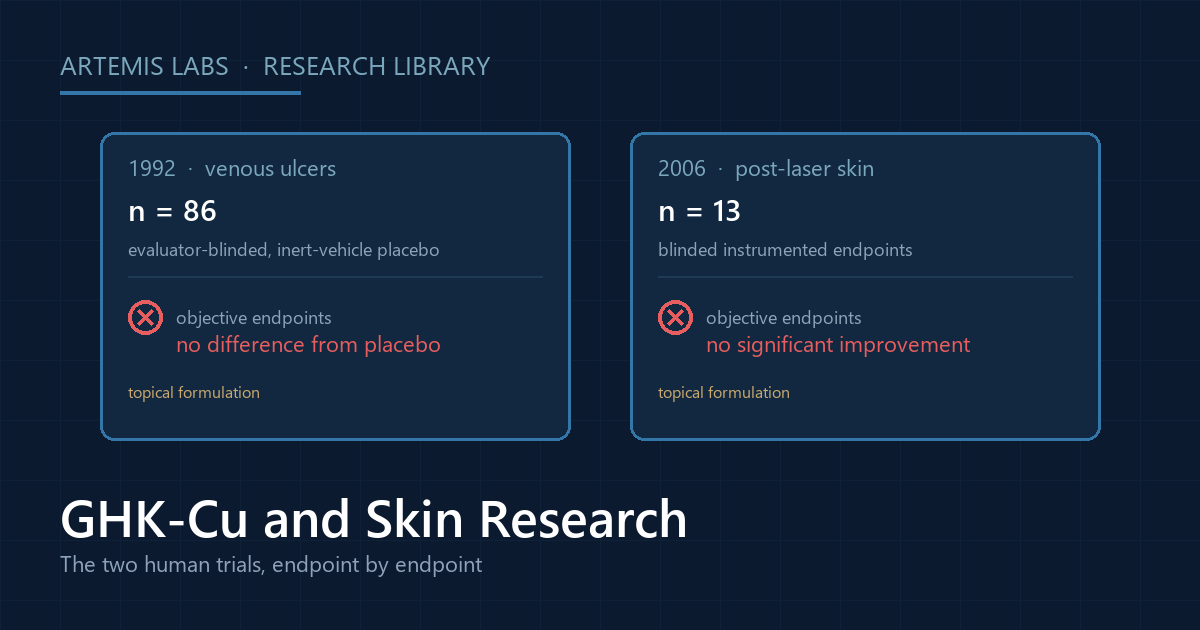
GHK-Cu skin research — answer capsule: GHK-Cu is a copper-bound tripeptide (PubChem CID 71587328) that has been studied in human skin for more than three decades, and PubMed indexes exactly two randomized human trials of it. Both tested a topical cream, and both reported no benefit on any objective measurement. In the larger trial, a 0.4% tripeptide copper complex cream performed no differently from an inert placebo cream in venous leg ulcers, and both were beaten by an ordinary silver sulfadiazine cream. In the smaller trial, blinded instrument-based scoring of laser-treated facial skin found no difference between the group using GHK-Cu skin care products and the group that did not. Most of the remaining human skin literature tested multi-ingredient cosmetic products in which the contribution of GHK-Cu alone cannot be separated out.
Key findings
- Two human randomized trials exist, and both were negative. PMID 1495150 (topical 0.4% cream, n=86) and PMID 16847171 (topical skin care products, n=13) are the whole set.
- An independent 2026 systematic review reached the same count. Searching three databases through March 2026 for GHK-Cu
as a standalone intervention, it found20 studies (18 preclinical; 2 RCTs)(PMID 42619529). - Most positive human skin results come from mixed products. Six of the eight human studies that applied something to people used formulations with several active ingredients, so no result can be assigned to GHK-Cu by itself.
- The chemical database that indexes this compound calls it a cosmetic ingredient. PubChem’s entire drug indication field for both the free peptide (CID 73587) and the copper complex (CID 71587328) reads:
Commonly used in cosmetic products for the skin and hair.
What did the strongest human trial find?
The best-designed human study of this compound is also the oldest one. In 1992, a team at the University of Texas Medical Branch in Galveston published a trial in venous stasis ulcers — open sores on the lower leg caused by poor vein circulation. Their own description of the design, word for word: This study reports a prospective randomized evaluator-blinded trial comparing two potential wound healing agents to an inert vehicle placebo. Eighty-six evaluable patients completed the trial. Randomized allocation, a real placebo cream, and evaluators who did not know which arm they were scoring.
The result, in the authors’ words: Silver sulfadiazine 1% in a cream proved to statistically reduce the ulcer size compared with a biologically active tripeptide copper complex 0.4% cream formulation or the placebo. There was no difference between the latter two treatments. The topical 0.4% tripeptide copper complex cream and the placebo cream produced the same result, and a cheap generic antibacterial cream out-performed both.
That is 34 years old and it has never been repeated. A PubMed search for replication attempts of either human trial returns nothing — not a failed repeat, not a successful one.
What did the second human trial find?
In 2006, a private aesthetic practice in San Clemente, California published the only other randomized human study. Patients who had undergone carbon dioxide laser skin resurfacing were, in the paper’s words, randomized to receive posttreatment skin regimens with or without GHK-Cu — so the formulation tested was a topical skin care product containing a copper tripeptide complex, not the isolated compound. Thirteen patients completed it.
Redness was measured by computer software and scored by blinded evaluators. The finding, verbatim: Computer analysis and blinded evaluators found no statistically significant differences between groups for earlier resolution of erythema. All the patients experienced significant improvement in wrinkles and overall skin quality, but no differences were found between groups. Erythema is medical shorthand for skin redness. The authors’ own conclusion is blunter still: Objective evaluation found no significant improvement in wrinkles or overall skin quality.
One measurement did come out positive. A patient questionnaire showed a significant difference in the posttreatment improvement of overall skin quality for patients using GHK-Cu (P = .04). In a 13-person study with no placebo arm, every participant knew whether they had been given an extra product to apply, so a self-rating is the weakest endpoint in the study — and it is the only one that moved. Anyone citing this trial as a positive skin result has to carry the instrument-measured nulls in the same sentence.
Why can’t the other skin studies settle the question?
Because almost none of them tested GHK-Cu on its own. Of the eight human studies located that applied any GHK-containing preparation to people, six used products with several active ingredients at once. A 2020 pilot in ten people combined a tripeptide and hexapeptide serum with a 1540 nm laser device. A 2022 biopsy sub-study tested a topical complex whose stated components are Tripeptide-1 and Hexapeptide-12 (TriHex™); its authors, all employees of the company selling the product, wrote that the study was limited by relatively small numbers of patients and by its non-competitive nature. A 2024 randomized eye-cream trial that often gets counted as GHK-Cu evidence is not one: its active peptide is palmityl tripeptide-1, a different, fat-modified molecule, and it was studied by its own manufacturer.
When four ingredients go into a jar and the skin looks better, the jar worked. That tells you nothing about which ingredient did it. This is the central reason cosmetic-cream results say very little about a research vial, and we treat it as its own subject in our page on topical versus systemic GHK-Cu evidence.
What has been shown in cells and skin samples?
The laboratory record is more active than the human one, and it should be read as laboratory work. In cultured human fibroblasts — the cells that build the skin’s connective scaffolding — a 1992 French study reported that GHK-Cu induced a dose-dependent increase of the synthesis of total GAGs, meaning glycosaminoglycans, the water-binding molecules packed between skin cells. The same paper recorded two qualifiers that rarely travel with the finding: the effect was biphasic, with maximal stimulation at 10(-9) to 10(-8) M, and At higher concentrations, the rate of synthesis returned progressively to that of control cultures. More was not better in that experiment; past a narrow window the effect simply went away. The authors also noted No influence of GHK-Cu on the synthesis of hyaluronic acid was observed.
A 2016 laboratory study in skin cells at the National University of Singapore compared copper compounds for irritancy, finding that GHK-Cu was not cytotoxic and did not induce any significant change in the expression levels of various skin irritation-related biomarkers, while free copper salts did. That is a cell-culture irritancy model and nothing more, but it is an honest result and it points the friendly way.
What the research does not show
No controlled human study of GHK-Cu by any non-topical route has ever been published. Every search formulation for a controlled human trial using a systemic route returned zero records; the only route-tagged hit in the index is a study in dogs. The two human trials that exist both tested creams applied to skin. Four further limits belong on the record:
- Both human trials were negative on every objective measurement. That is the highest-quality evidence in existence for this compound in skin, and it points away from benefit.
- Neither trial has been repeated by anyone. A search for replication work returns no attempt in either direction, so the nulls have not been confirmed and have not been overturned.
- One widely repeated claim could not be verified. The 2026 systematic review states that GHK-Cu
significantly reduced wrinkle volume and depth compared with controls. We looked for the trial behind that sentence and could not find one indexed in PubMed — the only randomized wrinkle record we located tests a different peptide. We report the review’s sentence as the review’s, never as ours. - An animal study found the opposite of faster healing. A 1995 study from the University of Florence in guinea-pig skin reported that
A slower reorganization of the skin and a delayed activation of fibroblasts are the main effects observed with these peptides-Cu complexes.Fibroblasts are the cells that rebuild connective tissue, and delayed activation is the reverse of the mechanism usually claimed for this compound.
An independent 2025 review from Shahid Beheshti University in Tehran put the state of the field plainly: for these peptides in skin products, there is a surprising absence of clinical studies using them. For the whole trial ledger see our page on GHK-Cu human trials, and for where this sits among related compounds see our dermatology research topic. GHK-Cu is supplied here as a laboratory reference compound.
Frequently asked questions
How many human trials of GHK-Cu in skin are there?
Two randomized ones, published in 1992 and 2006. A third record carrying a randomized-trial tag in PubMed is an experiment in rabbits, so any automated count of GHK-Cu trials is one too high.
Did the trials show GHK-Cu improves skin?
No. Every objective, instrument-measured or evaluator-blinded endpoint in both trials was null. The single positive result was a patient self-rating questionnaire in the 13-person study, where participants knew which group they were in.
Why do so many articles describe strong skin effects?
Two reasons. Much of the positive human data comes from multi-ingredient cosmetic products where GHK-Cu is one of several actives, and much of the expansive review literature comes from a company that sells GHK-Cu products. Both are traceable in the source records themselves.
References
- Mulder GD, et al. A prospective randomized evaluator-blinded trial of two potential wound healing agents for the treatment of venous stasis ulcers. J Vasc Surg, 1992. Division of Plastic Surgery, University of Texas Medical Branch, Galveston. PMID 1495150 · DOI 10.1067/mva.1992.37086
- Effects of topical copper tripeptide complex on CO2 laser-resurfaced skin. Arch Facial Plast Surg, 2006. Facial Aesthetic Concepts, San Clemente, California. PMID 16847171 · DOI 10.1001/archfaci.8.4.252
- The Regenerative Potential of GHK-Cu in Aesthetic Medicine. Aesthet Surg J, 2026. Mohammed Bin Rashid University of Medicine and Health Sciences, Dubai, United Arab Emirates. PMID 42619529 · DOI 10.1093/asj/sjag169
- Stimulation of sulfated glycosaminoglycan synthesis by the tripeptide-copper complex glycyl-L-histidyl-L-lysine-Cu2+. Life Sci, 1992. Laboratoire de Biochimie, CNRS URA 610, Université de Reims Champagne-Ardenne, France. PMID 1522753 · DOI 10.1016/0024-3205(92)90504-i
- Selected Biomarkers Revealed Potential Skin Toxicity Caused by Certain Copper Compounds. Sci Rep, 2016. Department of Pharmacy, National University of Singapore. PMID 27892491 · DOI 10.1038/srep37664
- 2022 topical formulation biopsy sub-study, J Clin Aesthet Dermatol; all authors employed by ALASTIN Skincare, Carlsbad, California. PMID 36061477 (no DOI in the PubMed record)
- 2024 randomized 12-week multi-component eye cream trial, Skin Res Technol; Research & Development Center, Mageline Biology Tech Co., Ltd, Wuhan, China. Active peptide is
palmityl tripeptide-1, not GHK-Cu. PMID 38932444 · DOI 10.1111/srt.13790 - 2020 pilot in 10 patients combining a tripeptide/hexapeptide serum with 1540 nm laser treatment. PMID 33397562 (no DOI in the PubMed record)
- 2025 review of peptide skin permeability and formulation, Shahid Beheshti University of Medical Sciences, Tehran, Iran. PMID 39963574 · DOI 10.34172/bi.30071
- Effect of tripeptide-copper complexes on the process of skin wound healing and on cultured fibroblasts. Arch Int Pharmacodyn Ther, 1995. Department of Pharmacology, University of Florence, Italy. PMID 8836453 (no DOI in the PubMed record)
Methodology: this page draws on PubMed records retrieved through NCBI E-utilities and the PubChem records for CID 73587 and CID 71587328, with every quoted string transcribed verbatim from the source named beside it; last verified August 27, 2026.
All compounds sold by Artemis Labs are for laboratory research use only. Nothing on this page is medical advice, and no statement has been evaluated by the FDA.
