
GHK-Cu Sequence and Identity: CID, CAS, Mass | Artemis Labs
Aug
GHK-Cu sequence and identity: the verified identifiers, and what each one is for
Published August 26, 2026 · Artemis Labs
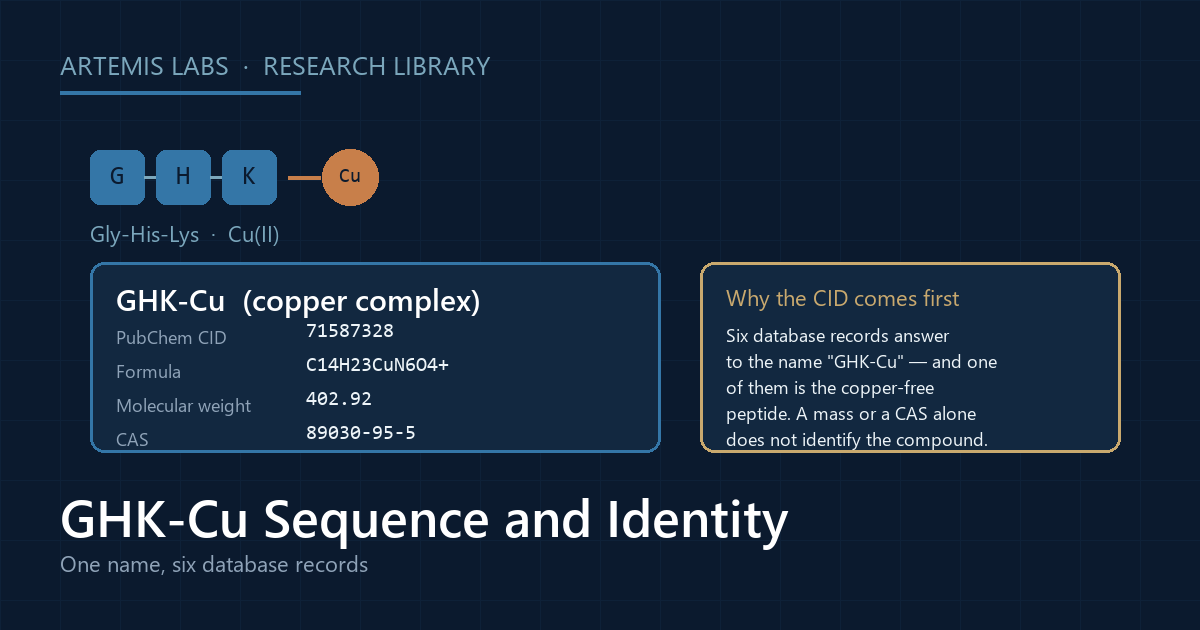
GHK-Cu — answer capsule: GHK-Cu is a copper(II) ion held by a three-amino-acid peptide with the sequence glycine-histidine-lysine, written Gly-His-Lys or GHK. PubChem indexes the copper complex as CID 71587328, formula C14H23CuN6O4+, molecular weight 402.92, CAS 89030-95-5, and the copper-free peptide separately as CID 73587, formula C14H24N6O4, molecular weight 340.38, CAS 49557-75-7. Both records carry the cosmetic-ingredient names Copper tripeptide-1 and Tripeptide-1 respectively, and PubChem’s stated drug indication for both, in full, is “Commonly used in cosmetic products for the skin and hair.” Because six PubChem records answer to the name GHK-Cu, every weight and registry number on this page is written with the CID it came from.
Key findings
- The sequence is Gly-His-Lys — glycine, histidine, lysine — three amino acids, the shortest peptide in common research use.
- Verified copper-free record: CID 73587, C14H24N6O4, molecular weight 340.38, exact mass 340.18590327, charge 0, CAS 49557-75-7, UNII 39TG2H631E, InChIKey MVORZMQFXBLMHM-QWRGUYRKSA-N.
- Verified copper-complex record: CID 71587328, C14H23CuN6O4+, molecular weight 402.92, exact mass 402.107675, charge +1, CAS 89030-95-5, UNII 6BJQ43T1I9, InChIKey NZWIFMYRRCMYMN-ACMTZBLWSA-M.
- Neither record has an entry in the FDA Orange Book, the register of approved drug products: PubChem returns “no data found” for that heading on both.
What is the sequence, and why is it the starting point?
A peptide is a short chain of amino acids. This one has three: glycine, then histidine, then lysine. Written in the three-letter convention that is Gly-His-Lys; in the one-letter convention it is GHK, which is where the common name comes from. Chains are always written from the amino end to the acid end, so the order is part of the identity — a different order would be a different molecule.
For a peptide, everything else follows from the sequence. The formula, the weight, the fingerprint and the registry numbers are all derived from that chain plus, in the copper case, one metal ion. So a document that names GHK-Cu and lists a sequence of a different length has contradicted itself, and one of the two entries is wrong. Our page on GHK versus GHK-Cu covers why the two entities are so easily merged, and the GHK-Cu product record is the compound this page describes.
The two verified identity blocks
Every value below was fetched from the named PubChem record on August 27, 2026, and read from PubChem’s curated identifier headings rather than its depositor synonym lists.
GHK — the copper-free tripeptide
| PubChem CID | 73587 |
| Record title | glycyl-L-histidyl-L-lysine |
| Sequence | Gly-His-Lys (3 residues) |
| Molecular formula | C14H24N6O4 |
| Molecular weight | 340.38 |
| Exact / monoisotopic mass | 340.18590327 |
| Formal charge | 0 |
| CAS number | 49557-75-7 |
| UNII | 39TG2H631E |
| DrugBank | DB11296, name Prezatide |
| InChIKey | MVORZMQFXBLMHM-QWRGUYRKSA-N |
| INCI name | Tripeptide-1 |
| IUPAC name | (2S)-6-amino-2-[[(2S)-2-[(2-aminoacetyl)amino]-3-(1H-imidazol-5-yl)propanoyl]amino]hexanoic acid |
GHK-Cu — the copper complex
| PubChem CID | 71587328 |
| Record title | Prezatide copper |
| Sequence | Gly-His-Lys with one Cu(II) ion |
| Molecular formula | C14H23CuN6O4+ |
| Molecular weight | 402.92 |
| Exact / monoisotopic mass | 402.107675 |
| Formal charge | +1 |
| CAS number | 89030-95-5 |
| UNII | 6BJQ43T1I9 |
| DrugBank | DB14683, name Prezatide copper |
| InChIKey | NZWIFMYRRCMYMN-ACMTZBLWSA-M |
| INCI name | Copper tripeptide-1 |
| Other listed names | GHK copper, Copper tripeptide, GHK-Cu, CG-copper peptide |
What is each of those identifiers actually for?
They are not interchangeable, and knowing what each one answers makes a mismatch easier to spot.
The CID is PubChem’s compound number — a database key for one specific structure. It is the most useful field on this page, because names are ambiguous and CIDs are not. Typing a CID into PubChem returns exactly one record.
The CAS number is a registry number assigned by the Chemical Abstracts Service. It is widely used on labels and safety documents. It identifies a substance, not a quality level and not an approval, and the same substance can have historic or depositor-supplied numbers circulating alongside the curated one.
The UNII is the FDA’s unique ingredient identifier. It is a substance registry code and nothing more — an index entry, not a statement that anything has been reviewed or approved.
The DrugBank ID points to a curated entry in a public pharmacology database. Again a catalogue reference, not an approval.
The InChIKey is a fixed-length fingerprint calculated from the structure itself. The first fourteen characters encode the molecular skeleton, and the later blocks encode stereochemistry and charge. Two documents describing the same molecule carry the same InChIKey, which makes it the fastest single field to compare between a sheet and a database.
The INCI name is the international naming convention for cosmetic ingredients. That both of these molecules have one is itself informative about where they are used.
Molecular weight and exact mass answer different questions. The molecular weight, 340.38 for the free peptide and 402.92 for the complex, is an average across the natural mix of isotopes — the number a balance corresponds to. The exact or monoisotopic mass, 340.18590327 and 402.107675, is the mass of one molecule built from each element’s most common isotope, which is what a mass spectrometer’s peak is calculated against. Both are correct for the same molecule.
Formal charge is the field most often dropped, and for this compound it should not be. The complex’s PubChem record is a cation with a charge of +1, which is why the weight sits at 402.92 rather than at one of the neighbouring values described below.
Which GHK-Cu record is the right one to cite, and what is the caveat?
CID 71587328 is the one to publish. Among the 1:1 copper complexes indexed under this name it is the only record carrying a curated CAS number, a curated UNII, a DrugBank entry and the INCI name.
The caveat is real and we would rather state it than smooth it. PubChem’s structure for 71587328 depicts a salt-style arrangement with a formal charge of +1. Two other records, CID 139035031 at 400.90 and CID 165429100 at 401.91, depict the amide-deprotonated chelate that the coordination-chemistry literature describes at physiological pH. In other words, the record carrying the regulatory identifiers and the record carrying the chemically canonical chelate structure are not the same record. The three sit within about two daltons of each other. This is why 402.92 should never be presented as “the” molecular weight of GHK-Cu without the CID beside it.
Two more records should not be cited at all. CID 342538 is a second free-GHK entry whose fingerprint has the stereochemistry stripped out and which carries no curated CAS number and no UNII. And one CAS-style string appears in the depositor synonym lists of two different 2:1 complexes that differ from each other by two hydrogen atoms; we do not print that number, because it is ambiguous at the primary source. The two curated CAS numbers are the ones in the tables above.
A note for anyone pulling these fields programmatically: PubChem now returns the connectivity structure under the key ConnectivitySMILES. Code that asks for the older CanonicalSMILES key gets nothing back, without an error.
What do the regulatory annotations on these records say?
Less than people assume, and the wording is worth quoting in full. PubChem’s drug indication for CID 73587, sourced from DrugBank, reads: “Commonly used in cosmetic products for the skin and hair.” The drug indication for CID 71587328 reads exactly the same. That is the entire indication text on both records. No disease is named.
The FDA Orange Book, which is the register of approved drug products, returns “no data found” for both records. Both do carry pointers to the FDA National Drug Code Directory and to DailyMed, but those are listing and labelling databases rather than approval registers — DailyMed’s own scope note, returned in the same data, says it holds labelling for prescription and nonprescription drugs and “additional products such as medical gases, devices, cosmetics, dietary supplements, and medical foods.” A DailyMed presence is not evidence of drug approval.
What the research does not show
An identifier establishes what a molecule is. It says nothing about what that molecule does, and none of the numbers above should be read as evidence of an effect.
The evidence base itself is thin, and that belongs on an identity page because precise chemistry is often mistaken for strong evidence. There is no published controlled human trial of GHK-Cu by any route other than application to skin; that absence was verified by repeated searching, and the only record indexed under a systemic route is a study in dogs. The complete controlled human record is two topical trials, both negative on their objective endpoints. In the 1992 venous-ulcer trial, a “tripeptide copper complex 0.4% cream formulation” was compared against an inert vehicle placebo in 86 patients, and the report states there was “no difference between the latter two treatments” (PMID 1495150). In the 2006 trial, 13 patients used topical skin care products with or without a copper tripeptide complex, and “objective evaluation found no significant improvement in wrinkles or overall skin quality” (PMID 16847171). An independent 2026 systematic review searching three databases through March 2026 for GHK-Cu as a standalone intervention found “20 studies (18 preclinical; 2 RCTs)” (PMID 42619529).
The database gaps noted above are gaps in the public record, not statements about any vendor’s material. Only analysis of a specific batch can describe that batch, and our guide to reading a certificate of analysis for GHK-Cu explains what such a document can and cannot settle.
Frequently asked questions
How many amino acids are in GHK-Cu?
Three: glycine, histidine and lysine, in that order, plus one copper(II) ion in the complex. A sheet naming GHK-Cu and listing any other residue count contains an internal contradiction.
What molecular weight should a GHK-Cu document show?
402.92 for the copper complex, stated with CID 71587328, or 402.107675 as its exact mass. 340.38 belongs to the copper-free peptide at CID 73587. Both numbers are correct for their own molecule and wrong for the other one.
Is the UNII or DrugBank entry a sign of FDA approval?
No. A UNII is a substance registry code and a DrugBank ID is a catalogue reference. The FDA Orange Book — the actual approved-product register — returns no data for either record, and PubChem’s stated indication for both is “Commonly used in cosmetic products for the skin and hair.”
Why do these pages always print a CID next to a number?
Because six PubChem records answer to the name GHK-Cu, three of them within two daltons of each other, and one of the six is the copper-free peptide. A weight without a CID does not identify a molecule for this compound.
References
- PubChem Compound Summary, CID 73587 (glycyl-L-histidyl-L-lysine). https://pubchem.ncbi.nlm.nih.gov/compound/73587 — sequence Gly-His-Lys, formula C14H24N6O4, molecular weight 340.38, exact mass 340.18590327, charge 0, CAS 49557-75-7, UNII 39TG2H631E, DrugBank DB11296, InChIKey MVORZMQFXBLMHM-QWRGUYRKSA-N, INCI Tripeptide-1. Retrieved August 27, 2026.
- PubChem Compound Summary, CID 71587328 (Prezatide copper). https://pubchem.ncbi.nlm.nih.gov/compound/71587328 — formula C14H23CuN6O4+, molecular weight 402.92, exact mass 402.107675, charge +1, CAS 89030-95-5, UNII 6BJQ43T1I9, DrugBank DB14683, InChIKey NZWIFMYRRCMYMN-ACMTZBLWSA-M, INCI Copper tripeptide-1. Retrieved August 27, 2026.
- PubChem Compound Summary, CID 139035031 (C14H21CuN6O4-, molecular weight 400.90) and CID 165429100 (C14H22CuN6O4, molecular weight 401.91) — 1:1 copper complexes at other protonation states, neither carrying a curated CAS number. Retrieved August 27, 2026.
- PubChem Drug and Medication Information headings for CID 73587 and CID 71587328, drug indication verbatim: “Commonly used in cosmetic products for the skin and hair.” FDA Orange Book heading returns no data on both records. Retrieved August 27, 2026.
- A prospective randomized evaluator-blinded trial of two potential wound healing agents for the treatment of venous stasis ulcers. J Vasc Surg, 1992. PMID 1495150 · doi:10.1067/mva.1992.37086
- Effects of topical copper tripeptide complex on CO2 laser-resurfaced skin. Arch Facial Plast Surg, 2006. PMID 16847171 · doi:10.1001/archfaci.8.4.252
- The Regenerative Potential of GHK-Cu in Aesthetic Medicine. Aesthet Surg J, 2026. PMID 42619529 · doi:10.1093/asj/sjag169
Methodology: every identifier on this page was fetched directly from PubChem’s compound interface and read from its curated identifier headings rather than depositor synonym lists, and every study is cited from the Artemis Labs GHK-Cu fact base, last verified August 27, 2026.
All compounds sold by Artemis Labs are for laboratory research use only. Nothing on this page is medical advice, and no statement has been evaluated by the FDA.
