
GHK vs GHK-Cu: Two Different Molecules | Artemis Labs
Aug
GHK vs GHK-Cu: two different molecules, and why the databases confuse them
Published August 26, 2026 · Artemis Labs
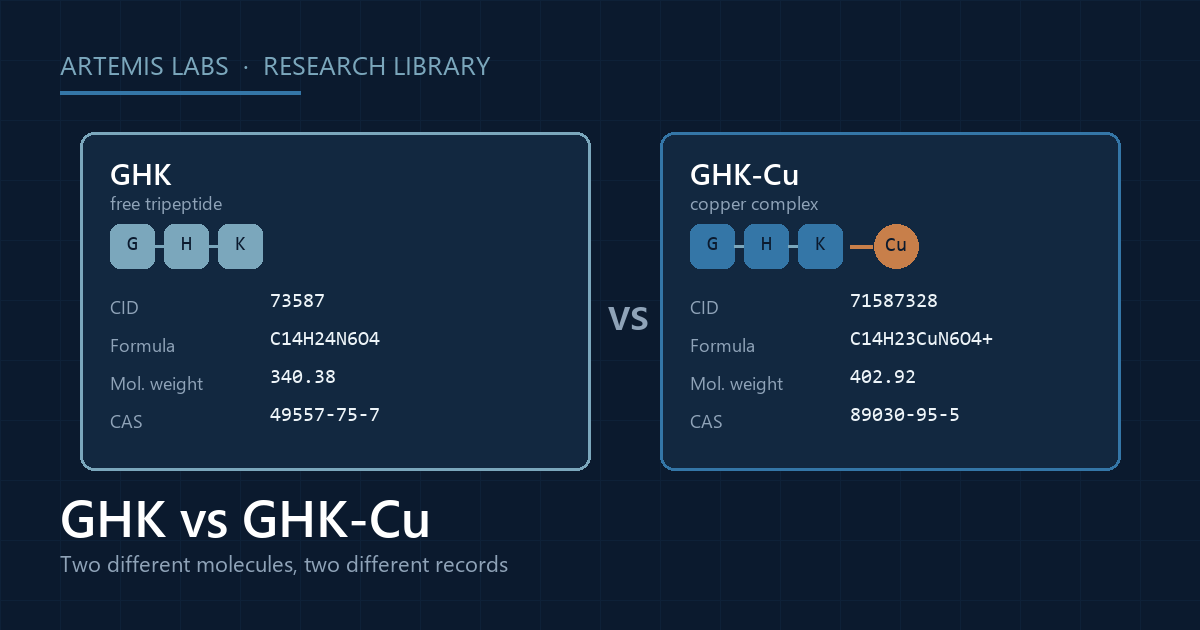
GHK and GHK-Cu — answer capsule: GHK is the free tripeptide glycyl-histidyl-lysine, indexed at PubChem as CID 73587, formula C14H24N6O4, molecular weight 340.38, CAS 49557-75-7. GHK-Cu is that peptide holding one copper(II) ion, indexed as CID 71587328, formula C14H23CuN6O4+, molecular weight 402.92, CAS 89030-95-5. The two are separate chemical entities with a roughly 62-dalton difference between them, and the confusion between them is not sloppiness downstream — it starts at the primary source. Six different PubChem records answer to the single name “GHK-Cu”, three of them differ from each other by two daltons, and one of the six is the copper-free peptide, whose own synonym list carries the entries “GHK-Cu” and “Copper Peptide”. Anyone checking a document against a database needs to know which molecule a number belongs to before the number means anything.
Key findings
- The two verified records are CID 73587 (GHK, C14H24N6O4, 340.38, CAS 49557-75-7) and CID 71587328 (GHK-Cu, C14H23CuN6O4+, 402.92, CAS 89030-95-5). Retrieved from PubChem on August 27, 2026.
- A PubChem name query for “GHK-Cu” returns six CIDs, and the third one in the list is 73587 — the peptide with no copper atom anywhere in its formula.
- Three of those six are 1:1 copper complexes differing only in protonation state, listed at 400.90, 401.91 and 402.92. Two others are 2:1 complexes listed at 742.3 and 744.3. A two-dalton spread separates records that share a name.
- PubChem’s name query for “copper peptide” returns 73587 and nothing else — the copper-free molecule, and only that.
What is the actual difference between the two molecules?
GHK is a peptide three amino acids long: glycine, histidine, lysine, in that order. GHK-Cu is the same three amino acids holding a single copper(II) ion in a chelate, meaning the peptide wraps the metal through several attachment points. Adding the copper changes the formula, the weight, the charge, the CAS registry number, and the structural fingerprint. Here is the verified pair, each figure taken from the record named beside it.
| Field | GHK (free tripeptide) | GHK-Cu (copper complex) |
|---|---|---|
| PubChem CID | 73587 | 71587328 |
| Record title | glycyl-L-histidyl-L-lysine | Prezatide copper |
| Sequence | Gly-His-Lys | Gly-His-Lys with Cu(II) |
| Molecular formula | C14H24N6O4 | C14H23CuN6O4+ |
| Molecular weight | 340.38 | 402.92 |
| CAS number | 49557-75-7 | 89030-95-5 |
| InChIKey | MVORZMQFXBLMHM-QWRGUYRKSA-N | NZWIFMYRRCMYMN-ACMTZBLWSA-M |
| Formal charge | 0 | +1 |
| INCI name | Tripeptide-1 | Copper tripeptide-1 |
Read the table by column, not by row. Every figure in the middle column belongs to the peptide without copper, and every figure in the right column belongs to the complex. Mixing one row across columns is how identity errors get made, and it happens often enough that we write the CID as part of the number: 340.38 at CID 73587, 402.92 at CID 71587328. The product record for the complex is GHK-Cu, and the full identifier set for both molecules, with an explanation of what each identifier is for, is on our GHK-Cu sequence and identity reference.
Why does one name return six different records?
Because “GHK-Cu” is a common name, not a structure, and several structures have been deposited under it. Querying PubChem’s compound-by-name interface for GHK-Cu returns six CIDs. Their properties, each fetched from the record itself:
| CID | Formula | Molecular weight | Charge | What it is |
|---|---|---|---|---|
| 73587 | C14H24N6O4 | 340.38 | 0 | the copper-free peptide |
| 139035031 | C14H21CuN6O4- | 400.90 | -1 | 1:1 complex, anion |
| 165429100 | C14H22CuN6O4 | 401.91 | 0 | 1:1 complex, neutral |
| 71587328 | C14H23CuN6O4+ | 402.92 | +1 | 1:1 complex, cation |
| 9831891 | C28H46CuN12O8 | 742.3 | 0 | 2:1 complex |
| 133697840 | C28H48CuN12O8 | 744.3 | 0 | 2:1 complex |
Three of the six are the same 1:1 copper complex drawn at different protonation states, spread across two daltons. Two more are 2:1 complexes, where two peptides share one copper, likewise two daltons apart. Only 71587328 among the 1:1 records carries a curated CAS number, a curated FDA substance identifier, a DrugBank record and the cosmetic-ingredient name, which is why it is the one we publish.
The practical consequence is worth stating flatly. A piece of software that resolves the name “GHK-Cu” and takes the first result, or the last, or the shortest, gets a different molecule depending on which rule it uses — and one of the six answers is not a copper complex at all.
Where does the database itself blur the two?
In four places we verified directly.
First, the copper-free record indexes itself under copper names. CID 73587, whose formula C14H24N6O4 contains no copper atom, carries the depositor synonyms “GHK-Cu”, “Copper Peptide”, “Copper(II)ghk”, “Copper glycyl-histidyl-lysine” and “GHK-Cu(2:1)”. The reverse query confirms it: asking PubChem for “copper peptide” returns 73587, and only 73587.
Second, dropping one word changes the molecule. The bare drug name “Prezatide” resolves to 73587, the peptide without copper. “Prezatide copper” is the complex. The two names sit one word apart and point at different structures.
Third, a second free-GHK record exists alongside the first. Querying “GHK” returns both 73587 and 342538. The second record carries a structural fingerprint with the stereochemistry stripped out and has no curated CAS number and no curated FDA identifier, so it should not be cited, but it is there and it answers to the same name.
Fourth, one CAS-style number appears in the depositor synonym lists of two different 2:1 complexes whose formulas differ by two hydrogen atoms. We do not print that number anywhere on this site, because it is a depositor string rather than a curated identifier and it is ambiguous at the primary source itself. The curated CAS numbers are the two in the table above.
One more caution about method. Depositor synonym lists on these records are demonstrably unreliable — CID 73587’s list also contains two entries for a cedarwood oil product. Identifiers should be read from PubChem’s curated headings, not from the raw synonym list.
Does the research literature keep them apart?
Not consistently, and neither does the search engine. PubMed rewrites a query for “GHK-Cu” into a broader one that also matches every copper-free glycyl-histidyl-lysine paper — the expansion is visible in the query translation PubMed returns with its own results. A search aimed at the copper complex therefore returns papers about the peptide without copper, silently.
The effect shows up in the studies themselves. Several of the most-cited results in this area used the free peptide: the 2012 computational and cell study that produced the only independent gene work names the tripeptide GHK (PMID 22937864), the 2017 mouse lung-fibrosis study used GHK (PMID 29311918), and the 2016 human hair study used a two-component product built on GHK rather than the copper complex (PMID 27489425). None of those is evidence about the copper complex without saying so out loud, which is why we name the exact species in every citing sentence.
What the research does not show
Nothing on this page is evidence that either molecule does anything. It is a chemistry and indexing reference, and identity is all it establishes.
The evidence picture for the copper complex is thin and should not be inferred from the precision of the identifiers above. There is no published controlled human trial of GHK-Cu by any route other than application to skin — verified by repeated searching, with the only systemically dosed record being a study in dogs. The complete controlled human record is two topical trials, both negative on their objective endpoints: an 86-patient 1992 venous-ulcer trial in which a “tripeptide copper complex 0.4% cream formulation” showed “no difference” from an inert vehicle placebo (PMID 1495150), and a 13-patient 2006 trial of topical skin care products with or without a copper tripeptide complex, where “objective evaluation found no significant improvement in wrinkles or overall skin quality” (PMID 16847171).
The database gaps described here are gaps in the public record, not statements about any seller’s material. A missing curated CAS number means the registry has not assigned one that PubChem returns. Only analysis of a specific batch can say what is in that batch, and our guide to reading a certificate of analysis for GHK-Cu covers what such a document can and cannot settle.
Frequently asked questions
Is GHK-Cu just GHK with copper added?
Structurally that is the relationship, but they are separate entities with separate records, weights, CAS numbers and fingerprints: 340.38 at CID 73587 against 402.92 at CID 71587328. A result obtained with one is not automatically a result about the other, and several well-known studies in this area used the copper-free peptide.
Which molecular weight should appear beside the name GHK-Cu?
402.92, stated with CID 71587328. If a document shows 340.38 beside a copper-complex name, the two entries contradict each other, and the mismatch has to be resolved before anything else on the page can be trusted.
Why does searching for “copper peptide” return a molecule with no copper?
Because PubChem’s synonym index carries “Copper Peptide” on the free tripeptide’s record. It is an indexing artefact at the primary source, verified by direct query, and it is the clearest single illustration of why a CID belongs beside every number.
How many studies exist on GHK-Cu specifically?
We do not publish a study count for this compound, and neither should anyone reading the same database. PubMed’s own query expansion merges copper-complex papers with copper-free peptide papers, so any raw count includes both. Hand-counted, named study lists are the only honest way to describe this literature, and that is how our research pages are built.
References
- PubChem Compound Summary, CID 73587 (glycyl-L-histidyl-L-lysine). https://pubchem.ncbi.nlm.nih.gov/compound/73587 — formula C14H24N6O4, molecular weight 340.38, CAS 49557-75-7, InChIKey MVORZMQFXBLMHM-QWRGUYRKSA-N, INCI Tripeptide-1. Retrieved August 27, 2026.
- PubChem Compound Summary, CID 71587328 (Prezatide copper). https://pubchem.ncbi.nlm.nih.gov/compound/71587328 — formula C14H23CuN6O4+, molecular weight 402.92, CAS 89030-95-5, InChIKey NZWIFMYRRCMYMN-ACMTZBLWSA-M, INCI Copper tripeptide-1. Retrieved August 27, 2026.
- PubChem name query “GHK-Cu”, returning CIDs 139035031, 9831891, 73587, 71587328, 133697840 and 165429100, with each record’s formula, weight and charge fetched individually. Retrieved August 27, 2026.
- PubChem name queries “copper peptide” (returns 73587), “Prezatide” (returns 73587) and “GHK” (returns 73587 and 342538). Retrieved August 27, 2026.
- A gene expression signature of emphysema-related lung destruction and its reversal by the tripeptide GHK. Genome Med, 2012. PMID 22937864 · doi:10.1186/gm367
- GHK Peptide Inhibits Bleomycin-Induced Pulmonary Fibrosis in Mice by Suppressing TGFβ1/Smad-Mediated Epithelial-to-Mesenchymal Transition. Front Pharmacol, 2017. PMID 29311918 · doi:10.3389/fphar.2017.00904
- Efficacy of a Complex of 5-Aminolevulinic Acid and Glycyl-Histidyl-Lysine Peptide on Hair Growth. Ann Dermatol, 2016. PMID 27489425 · doi:10.5021/ad.2016.28.4.438
- A prospective randomized evaluator-blinded trial of two potential wound healing agents for the treatment of venous stasis ulcers. J Vasc Surg, 1992. PMID 1495150 · doi:10.1067/mva.1992.37086
- Effects of topical copper tripeptide complex on CO2 laser-resurfaced skin. Arch Facial Plast Surg, 2006. PMID 16847171 · doi:10.1001/archfaci.8.4.252
Methodology: every identifier on this page was fetched directly from PubChem’s compound interface and read from its curated identifier headings rather than depositor synonym lists, and every study is cited from the Artemis Labs GHK-Cu fact base, last verified August 27, 2026.
All compounds sold by Artemis Labs are for laboratory research use only. Nothing on this page is medical advice, and no statement has been evaluated by the FDA.
