
GHK-Cu Wound Healing Research: The Full Evidence Record
Aug
What wound healing research on GHK-Cu actually found
Published August 26, 2026 · Artemis Labs
GHK-Cu wound healing research — answer capsule: GHK-Cu is a copper-bound tripeptide (PubChem CID 71587328) whose wound healing record is almost entirely animal work, and the animals disagree with each other. The one human wound trial, published in 1992, tested a topical 0.4% tripeptide copper complex cream in venous leg ulcers and found no difference from an inert placebo cream. Separate animal studies in rabbits and in rats reported faster wound closure, while an independent study in guinea pigs reported slower reorganization of the skin. No human wound trial has been run since 1992, and no controlled human study of GHK-Cu by any non-topical route has ever been published.
Key findings
- The single human wound trial was null. A topical 0.4% tripeptide copper complex cream matched placebo in venous stasis ulcers (PMID 1495150, n=86, randomized, evaluator-blinded).
- The most cited positive wound result is in rabbits. Eighteen New Zealand rabbits, topical tripeptide-copper complex versus zinc oxide versus no treatment; the authors hedged their own conclusion to rabbits (PMID 17083573).
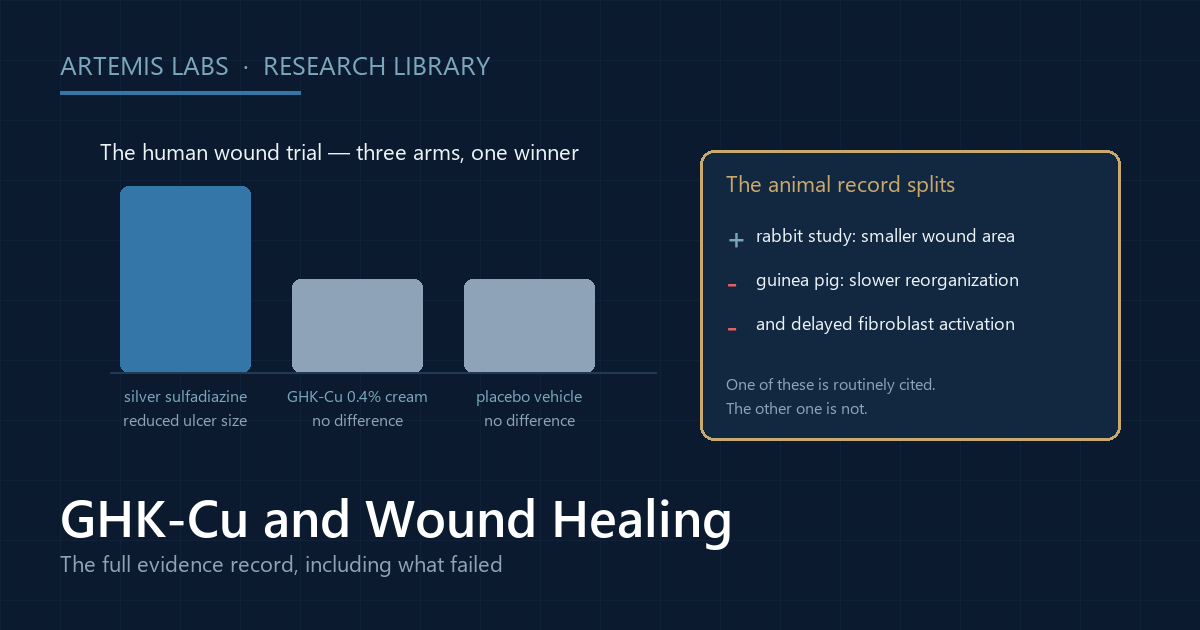
- An independent animal study found the opposite direction. In guinea-pig skin, a 1995 study reported
a slower reorganization of the skin and a delayed activation of fibroblasts(PMID 8836453). - In the strongest rat study, the gel base did most of the work. Wound area fell 64.5% with the peptide gel, 45.6% with the vehicle alone and 28.2% with no treatment (PMID 14648529).
What happened in the one human wound trial?
In 1992, surgeons at the University of Texas Medical Branch in Galveston tested two candidate wound agents against a placebo in venous stasis ulcers — open sores on the lower leg that come from poor vein circulation. Their design, verbatim: This study reports a prospective randomized evaluator-blinded trial comparing two potential wound healing agents to an inert vehicle placebo. Eighty-six evaluable patients completed the trial.
The result, in the authors’ words: Silver sulfadiazine 1% in a cream proved to statistically reduce the ulcer size compared with a biologically active tripeptide copper complex 0.4% cream formulation or the placebo. There was no difference between the latter two treatments. The topical 0.4% tripeptide copper complex cream and the placebo cream came out level, and a decades-old antibacterial cream beat both.
That trial is 34 years old and it is still the only randomized human wound study of this compound. Nobody has repeated it, and a search for replication work in either direction returns no attempt. An independent 2026 systematic review searching three databases through March 2026 for GHK-Cu as a standalone intervention counted 20 studies (18 preclinical; 2 RCTs) — a ratio that tells you where the evidence lives. The full trial ledger is on our page about GHK-Cu human trials.
What did the rabbit study find?
The most frequently cited positive wound result for this compound is a 2006 study in rabbits from the Faculty of Veterinary Medicine at Uludag University in Bursa, Turkey. The design, verbatim: Eighteen New Zealand rabbits were divided into three groups: TCC, zinc oxide and no treatment. TCC is the tripeptide-copper complex, applied topically to open wounds in rabbits.
The rabbits given the topical tripeptide-copper complex closed their wounds faster: The mean unhealed wound area was significantly smaller in the TCC than in the zinc oxide group on day 7, but it was significantly smaller in the TCC group than in to the control group on days 7, 14 and 21. The authors then bounded their own conclusion, and the boundary is the important part: The results suggest that TCC is a better choice in the treatment protocols of open wounds in rabbits than zinc oxide. Their word is suggest and their species is rabbits; both belong with the citation every time it is used.
There is a second reason to name the species. PubMed tags this rabbit experiment as a Randomized Controlled Trial, the same tag it applies to human trials. Any count of GHK-Cu randomized trials pulled from those tags is therefore one too high, and an automated summary that reports three trials has quietly turned a rabbit study into a human one.
Which animal study points the other way?
A 1995 study from the Department of Pharmacology at the University of Florence tested tripeptide-copper complexes on guinea-pig dorsal skin. It reported the opposite of accelerated repair, verbatim: A slower reorganization of the skin and a delayed activation of fibroblasts are the main effects observed with these peptides-Cu complexes. Fibroblasts are the cells that rebuild the connective scaffolding under a wound; delayed activation is the reverse of the mechanism usually claimed for this compound.
The same paper’s cell-culture arm went in the same direction: The products studied at a concentration of 10(-7) M, decreased cell reproduction and increased collagen expression. Fewer cells, more collagen — a mixed picture, not a clean positive.
This study is independent of any company selling GHK-Cu, it is a live-animal result rather than a cell dish, and it almost never appears in summaries of the compound. When independent animal models split in opposite directions on the same question, the honest reading is that the question is unsettled, not that one side won.
What about the rat gel study?
A 2003 study from the University of Florida College of Veterinary Medicine used 24 adult male Sprague-Dawley rats and a named commercial product — topical glycyl-L-histidyl-L-lysine tripeptide-copper complex (TCC; Iamin 2% Gel; Procyte Corporation, Redmond, WA) — on ischemic open wounds, meaning wounds with a deliberately restricted blood supply. The headline is real: On day 13, initial wound area had decreased by 64.5% in the TCC group, 45.6% in the vehicle group, and 28.2% in the control group. Inflammatory markers moved too, with lower TNF-alpha, MMP-2 and MMP-9 in the peptide group than in untreated wounds.
The middle number is the one to read. The vehicle — the gel base with no peptide in it — took wound closure from 28.2% to 45.6% on its own. The share attributable to the peptide is the gap between 64.5% and 45.6%, under 19 points, not the 36 points you get by quoting the peptide group against the untreated group. Anything that compares the peptide arm to the no-treatment arm is using the wrong control. The authors closed with a request written in 2003 and still unanswered: Clinical evaluation of topical TCC is warranted.
Two more animal records fill out the picture. A 2017 mouse scald study from Dalian Medical University tested GHK-Cu packaged into liposomes, tiny fat bubbles used to carry a compound into tissue, and reported that angiogenesis in burned mouse skin was better compared with free GHK-Cu — the unpackaged complex was the weaker comparator, so the result belongs to the delivery system as much as to the peptide. And a 2015 rat study of anterior cruciate ligament repair from the Chinese University of Hong Kong put its own limit in its title: the benefit was transient. Knee laxity differed at 6 weeks, but there was no significant difference at 12 weeks post-operation, and the beneficial effects could not last as treatment discontinued.
What the research does not show
No controlled human study of GHK-Cu by any non-topical route has ever been published. Every search formulation for a controlled human trial using a systemic route returned zero records. The one record in the index tagged with a systemic route is a 1996 study in dogs — twelve English Pointers — and even there the material was placed locally into the wound rather than dosed through the body. Four further limits belong on the record:
- The only human wound trial was negative and has never been repeated. It is also the best-designed study in the whole GHK-Cu literature, which makes the null harder to set aside, not easier.
- The animal models contradict each other. Rabbits and rats healed faster; guinea pigs reorganized more slowly. No one has run the study that would resolve the split.
- No published work supports musculoskeletal use. A 2026 review from the Keck School of Medicine of USC states that GHK-Cu
showed promise in wound healing and anti-inflammatory effects, but no clinical data support its use for musculoskeletal conditions. - The peptide may not be the active part in every assay. A 2001 study at the University of Ferrara found that
The two synthetic analogues showed an activity comparable to or even higher than that of GHK, and that the histidine residuedoes not appear to play a specific role.
For the human skin trials in full see our page on GHK-Cu skin research. GHK-Cu is supplied here as a laboratory reference compound.
Frequently asked questions
Has GHK-Cu been shown to heal wounds in people?
No. The one randomized human wound trial, in venous leg ulcers, found a topical 0.4% tripeptide copper complex cream no different from an inert placebo cream, and a generic silver sulfadiazine cream out-performed both.
Why is the rabbit study cited so often?
Because it is positive and because PubMed tags it as a randomized controlled trial. It is an experiment in eighteen rabbits, and the authors limited their own conclusion to rabbits in the abstract.
Is the animal wound evidence consistent?
No. Rabbit and rat studies reported faster closure; an independent guinea-pig study reported slower skin reorganization and delayed fibroblast activation. Both directions are in the published record.
References
- A prospective randomized evaluator-blinded trial of two potential wound healing agents for the treatment of venous stasis ulcers. J Vasc Surg, 1992. Division of Plastic Surgery, University of Texas Medical Branch, Galveston. PMID 1495150 · DOI 10.1067/mva.1992.37086
- Evaluation of the effects of topical tripeptide-copper complex and zinc oxide on open-wound healing in rabbits. Vet Dermatol, 2006. Department of Pathology, Faculty of Veterinary Medicine, Uludag University, Bursa, Turkey. PMID 17083573 · DOI 10.1111/j.1365-3164.2006.00551.x
- Effect of tripeptide-copper complexes on the process of skin wound healing and on cultured fibroblasts. Arch Int Pharmacodyn Ther, 1995. Department of Pharmacology, University of Florence, Italy. Guinea-pig dorsal skin. PMID 8836453 (no DOI in the PubMed record)
- The effect of topical tripeptide-copper complex on healing of ischemic open wounds. Vet Surg, 2003. University of Florida College of Veterinary Medicine, Gainesville. 24 Sprague-Dawley rats. PMID 14648529 · DOI 10.1111/j.1532-950x.2003.00515.x
- GHK-Cu-liposomes accelerate scald wound healing in mice by promoting cell proliferation and angiogenesis. Wound Repair Regen, 2017. Department of Biotechnology, Dalian Medical University, China. PMID 28370978 · DOI 10.1111/wrr.12520
- Tripeptide-copper complex GHK-Cu (II) transiently improved healing outcome in a rat model of ACL reconstruction. J Orthop Res, 2015. The Chinese University of Hong Kong. PMID 25731775 · DOI 10.1002/jor.22831
- 1996 study of locally placed materials in pad wounds of 12 English Pointers, Am J Vet Res. Scott-Ritchey Research Center, College of Veterinary Medicine, Auburn University, Alabama. PMID 8669775 (no DOI in the PubMed record)
- The Regenerative Potential of GHK-Cu in Aesthetic Medicine. Aesthet Surg J, 2026. Mohammed Bin Rashid University of Medicine and Health Sciences, Dubai, United Arab Emirates. PMID 42619529 · DOI 10.1093/asj/sjag169
- 2026 review, Keck School of Medicine of USC, Los Angeles, California. PMID 41476424 · DOI 10.1177/03635465251357593
- Copper complexes of glycyl-histidyl-lysine and two of its synthetic analogues: chemical behaviour and biological activity. Biochim Biophys Acta, 2001. Department of Chemistry, University of Ferrara, Italy. PMID 11325542 · DOI 10.1016/s0304-4165(01)00127-1
Methodology: this page draws on PubMed records retrieved through NCBI E-utilities and the PubChem record for CID 71587328, with every quoted string transcribed verbatim from the source named beside it; last verified August 27, 2026.
All compounds sold by Artemis Labs are for laboratory research use only. Nothing on this page is medical advice, and no statement has been evaluated by the FDA.
