
What Is GHK-Cu Studied For? The Research Record | Artemis Labs
Aug
What is GHK-Cu studied for?
Published August 26, 2026 · Artemis Labs
GHK-Cu — answer capsule: GHK-Cu is a very short peptide, three amino acids long, joined to a copper ion; PubChem, the public chemistry database run by the US National Library of Medicine, lists it as CID 71587328. PubChem’s own one-line description of what the compound is used for reads, in full,
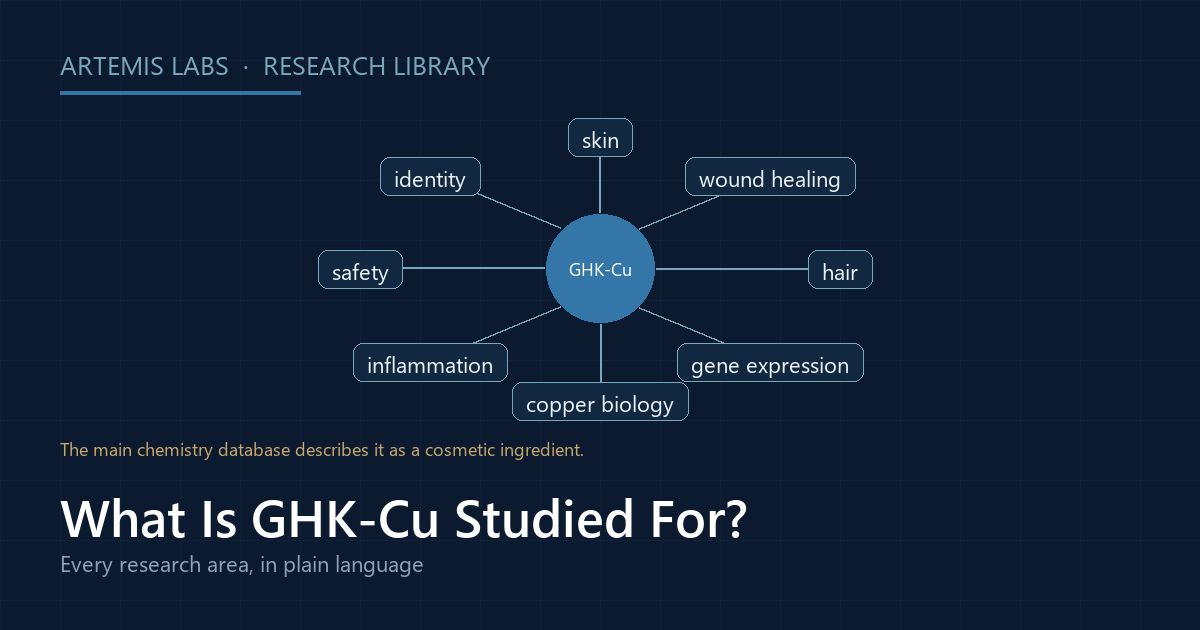
Commonly used in cosmetic products for the skin and hair.Published research on it clusters into skin and wound repair, hair and scalp products, lung tissue remodeling, inflammation, copper chemistry, and gene activity — and almost all of that work is in cells, mice, rats, rabbits or guinea pigs rather than people. Only two human randomized trials exist in the 34 years since the first one was published, both used topical creams or skin-care products, and both were negative on every measurement an instrument or a blinded evaluator made. Artemis Labs supplies GHK-Cu as a laboratory reference compound.
Key findings
- The primary database calls it a cosmetic ingredient. PubChem’s
Drug Indicationfield for GHK-Cu (CID 71587328) and for the copper-free peptide GHK (CID 73587) is identical and complete in one sentence:Commonly used in cosmetic products for the skin and hair.No disease is named. A query for either record’s FDA Orange Book section — the register of approved drugs — returnsPUGVIEW.NotFound. - Two human randomized trials, both negative. A 1992 trial in leg ulcers used a topical
tripeptide copper complex 0.4% cream formulationin 86 patients and found it no different from an inert placebo cream (PMID 1495150). A 2006 trial of topical copper-tripeptide skin-care products in 13 patients after laser resurfacing reportedno statistically significant differences between groupson its instrument-measured endpoints (PMID 16847171). - An independent 2026 review counted the same way. A systematic review from a university in Dubai searched PubMed, Embase and Cochrane CENTRAL through March 2026 for studies of GHK-Cu
as a standalone interventionand reported20 studies (18 preclinical; 2 RCTs) were included(PMID 42619529). - Two molecules share one name. GHK, the copper-free tripeptide, has molecular weight 340.38 (CID 73587). GHK-Cu, the copper complex, has molecular weight 402.92 (CID 71587328). PubChem’s own name index returns six different CIDs for the search term “GHK-Cu”, and one of the six is the copper-free peptide.
What is GHK-Cu, in plain words?
A peptide is a short chain of amino acids, the same building blocks proteins are made of. GHK is one of the shortest possible: glycine, histidine, lysine — three amino acids, which is why it is called a tripeptide. Its PubChem record (CID 73587) gives its molecular weight as 340.38 and its cosmetic-industry name as TRIPEPTIDE-1 [INCI].
GHK-Cu is that same tripeptide holding a copper ion. Copper is a metal the human body needs in trace amounts; a peptide that wraps around a metal ion this way is called a complex, and the chemistry of the complex is not the chemistry of either piece alone. The copper complex has its own PubChem record, CID 71587328, molecular weight 402.92, cosmetic name Copper tripeptide-1 [INCI], and its own drug-registry name, Prezatide copper.
GHK-Cu is supplied here as a laboratory reference compound, and everything below describes published research on the compound rather than any use of it. Those two records get mixed up constantly, including by the database itself — the copper-free peptide’s synonym list contains the strings GHK-Cu and Copper Peptide even though there is no copper atom anywhere in its formula. Because of that, any molecular weight or registry number is only meaningful with its CID printed beside it. We wrote a separate page on exactly this problem: GHK vs GHK-Cu.
What does the main chemistry database say the compound is for?
This is the cleanest answer available anywhere, and it is one sentence long. PubChem’s Drug and Medication Information section, sourced from DrugBank, gives a Drug Indication for each record. For the copper-free peptide (DrugBank DB11296) it reads: Commonly used in cosmetic products for the skin and hair. For the copper complex (DrugBank DB14683) it reads, identically: Commonly used in cosmetic products for the skin and hair.
That is the entire field for both. No condition, no disease, no therapeutic use. Both records also return {"Fault": {"Code": "PUGVIEW.NotFound", "Message": "No data found"}} when asked for an FDA Orange Book section, which is the register of drugs the FDA has approved. Both records do carry pointers into DailyMed, a labeling archive — but DailyMed’s own scope note in the same payload says it covers labeling for drugs, devices, cosmetics, supplements and medical foods, so a listing there is not an approval of anything.
Which research areas has it actually been studied in?
Six, and it is worth being precise about the species in each, because the species is usually not human.
Skin and wound repair. This is the oldest and largest area. It holds both human trials described below, a rat study of topical copper-tripeptide gel on poorly-supplied wounds (PMID 14648529), a study in 18 rabbits (PMID 17083573), and a guinea-pig study that reported the opposite of faster healing — a slower reorganization of the skin and a delayed activation of fibroblasts (PMID 8836453). Fibroblasts are the cells that build the fibrous scaffolding of skin. Our topic hub for this area is dermatology research.
Hair and scalp. Every human study here applied a product with several active ingredients in it, so none of them can say what the copper peptide did on its own.
Lung tissue remodeling. Mouse work, from one research group in Beijing and others: a silica-dust lung model (PMID 38879894) and a lung-scarring model in which the copper-free peptide was given to mice (PMID 29311918).
Inflammation. Mice with lung injury (PMID 27517151), mice with bowel inflammation where every conclusion in the abstract is hedged with may (PMID 40672369), zebrafish larvae in a study run by a cosmetics company that framed its own purpose as supporting the compound’s addition as a functional cosmetic ingredient (PMID 41997403), and cultured human cells.
Copper chemistry. Laboratory work comparing the complex against loose copper salts. In cultured human skin cells, GHK-Cu was not cytotoxic while copper chloride and copper acetate raised irritation markers (PMID 27892491).
Gene activity. One independent primary study, from Boston University and the University of British Columbia, which identified 127 genes tied to lung-tissue destruction and then used a computer database of drug-response patterns to nominate GHK as a compound predicted to reverse that pattern (PMID 22937864). No animal and no person was given anything in that paper. Much larger gene numbers circulate online; they come from review articles whose authors all share the address of a company that sells GHK-Cu products, which is a fact readable straight off the affiliation line.
What does the human record add up to?
Two randomized trials, 14 years apart, and nothing since. In 1992, surgeons at the University of Texas Medical Branch ran a randomized, evaluator-blinded trial in venous leg ulcers with an inert vehicle placebo and 86 evaluable patients — the strongest design in the whole record. Their result, verbatim: silver sulfadiazine cream proved to statistically reduce the ulcer size compared with a biologically active tripeptide copper complex 0.4% cream formulation or the placebo. There was no difference between the latter two treatments. The topical copper-peptide cream matched placebo and lost to an inexpensive generic.
In 2006, a private aesthetic practice in California randomized 13 patients after carbon-dioxide laser resurfacing to topical skin-care regimens with or without copper tripeptide. Every instrument-measured and blind-rated endpoint was null; the authors’ conclusion says Objective evaluation found no significant improvement in wrinkles or overall skin quality. A third PubMed record carries the Randomized Controlled Trial tag, which is why “three trials” gets quoted — it is the study in 18 rabbits. The full accounting is on our page on GHK-Cu human trials.
What the research does not show
No controlled human study of GHK-Cu by any route other than the skin has ever been published. Not one. Six differently-worded searches for a controlled human trial by any whole-body route were run against PubMed; four returned a count of zero, and the two that returned anything returned animal or cell records — the single hit carrying a systemic-route index heading is a study in 12 dogs. Whole-body work of that kind exists only in mice and rats. That means the research-vial material we sell has no controlled human evidence base of its own, and the topical cosmetic literature cannot be borrowed to fill the gap.
- Most of the positive human results cannot be attributed to GHK-Cu. Of the eight human studies located in which something was actually applied to people, six used formulations with several active ingredients, so the copper peptide’s individual share of any effect is unknowable. Every positive cosmetic result and all four hair or scalp studies fall in that group.
- Neither negative trial has ever been repeated. A search for replication attempts returned nothing but papers about DNA replication. The 1992 null and the 2006 null stand unretested, in both directions.
- Independent reviewers say the clinical evidence is not there. A 2026 review from the Keck School of Medicine of USC states that GHK-Cu
showed promise in wound healing and anti-inflammatory effects, but no clinical data support its use for musculoskeletal conditions.A 2025 pharmaceutics review from Tehran notesthere is a surprising absence of clinical studies using them.The 2026 Dubai review calls its own fieldconstrained by methodological variability and a limited number of well-designed clinical trials. - No meta-analysis, no double-blind study, no retraction. Those three PubMed searches each return zero. The absence of a retraction is not a safety signal; it reflects how little has been published to retract.
Frequently asked questions
Is GHK-Cu a drug?
Not by any register we can check. PubChem returns no FDA Orange Book entry for either the peptide or the copper complex, and the one-line indication both records carry describes cosmetic use. Several 2026 reviews place GHK-Cu in the group they label non-approved peptides.
Why is so much of the research in animals and cells?
Because that is where the work stopped. A 2003 rat study ended with the authors writing Clinical evaluation of topical TCC is warranted. Twenty-three years later, the trial-tagged human literature still contains the same two studies it contained in 2006.
Does the cosmetic-cream research tell us anything about a research vial?
Very little, and that is the most important limit on this page. The formulation, the route and the concentration are all different, and the human cosmetic studies that reported benefits mostly contained other active ingredients too. We treat those as separate evidence bases rather than one.
References
- PubChem Compound records CID 73587 (glycyl-L-histidyl-L-lysine; MW 340.38; DrugBank DB11296) and CID 71587328 (Prezatide copper; MW 402.92; DrugBank DB14683), including the
Drug IndicationandFDA Orange Bookqueries; retrieved August 27, 2026. - J Vasc Surg, 1992. Prospective randomized evaluator-blinded trial in venous stasis ulcers, 86 evaluable patients, Division of Plastic Surgery, University of Texas Medical Branch, Galveston. Topical cream. PMID 1495150 · DOI 10.1067/mva.1992.37086
- Arch Facial Plast Surg, 2006. Randomized with/without trial in 13 patients after laser resurfacing, Facial Aesthetic Concepts, San Clemente, California. Topical skin-care products. PMID 16847171 · DOI 10.1001/archfaci.8.4.252
- Vet Dermatol, 2006. Study in 18 New Zealand rabbits, Uludag University, Bursa, Turkey; carries the
Randomized Controlled Trialpublication tag. PMID 17083573 · DOI 10.1111/j.1365-3164.2006.00551.x - Aesthet Surg J, 2026. PRISMA systematic review of standalone GHK-Cu, Mohammed Bin Rashid University of Medicine and Health Sciences and Dubai Health, United Arab Emirates. PMID 42619529 · DOI 10.1093/asj/sjag169
- Vet Surg, 2003. Topical copper-tripeptide gel in 24 Sprague-Dawley rats, University of Florida. PMID 14648529 · DOI 10.1111/j.1532-950x.2003.00515.x
- Arch Int Pharmacodyn Ther, 1995. Guinea-pig dorsal skin and cultured fibroblasts, University of Florence, Italy. PMID 8836453 (no DOI in the PubMed record)
- Redox Biol, 2024. Mouse silicosis model, China-Japan Friendship Hospital, Beijing. PMID 38879894 · DOI 10.1016/j.redox.2024.103237
- Front Pharmacol, 2017. C57BL/6 mouse lung-fibrosis model, copper-free GHK. PMID 29311918 · DOI 10.3389/fphar.2017.00904
- Oncotarget, 2016. Mouse lung-injury model and RAW 264.7 macrophages. PMID 27517151 · DOI 10.18632/oncotarget.11168
- Front Pharmacol, 2025. BALB/c mouse colitis model, Jining Medical University, Shandong, China. PMID 40672369 · DOI 10.3389/fphar.2025.1551843
- Eur J Pharmacol, 2026. Zebrafish larvae, Yunnan Botanee Bio-Technology Group Co., Ltd. PMID 41997403 · DOI 10.1016/j.ejphar.2026.178880
- Sci Rep, 2016. Human keratinocyte irritancy biomarkers, comparing GHK-Cu against copper salts, National University of Singapore. PMID 27892491 · DOI 10.1038/srep37664
- Genome Med, 2012. 127-gene lung signature and a Connectivity Map computational screen, Boston University School of Medicine and University of British Columbia. PMID 22937864 · DOI 10.1186/gm367
- 2026 review, Keck School of Medicine of USC, Los Angeles, stating that no clinical data support musculoskeletal use. PMID 41476424 · DOI 10.1177/03635465251357593
- 2025 review, School of Pharmacy, Shahid Beheshti University of Medical Sciences, Tehran, noting the absence of clinical studies. PMID 39963574 · DOI 10.34172/bi.30071
- Am J Vet Res, 1996. Local wound study in 12 English Pointers; the only PubMed record for GHK-Cu carrying a systemic-route index heading. PMID 8669775 (no DOI in the PubMed record)
Methodology: this page draws on PubChem records CID 73587 and CID 71587328 retrieved through the PUG REST and PUG-View interfaces, and on PubMed records retrieved through NCBI E-utilities, with every quoted string transcribed verbatim from the source named beside it; last verified August 27, 2026.
All compounds sold by Artemis Labs are for laboratory research use only. Nothing on this page is medical advice, and no statement has been evaluated by the FDA.
This article is part of the Cellular Bioregulators product class. The class page lists every compound in it with sequence, molecular weight and the sources cited.
