
5-Amino-1MQ Human Evidence: There Is None | Artemis Labs
Aug
5-Amino-1MQ human evidence: the number is zero, and here is how we checked
Published August 26, 2026 · Artemis Labs
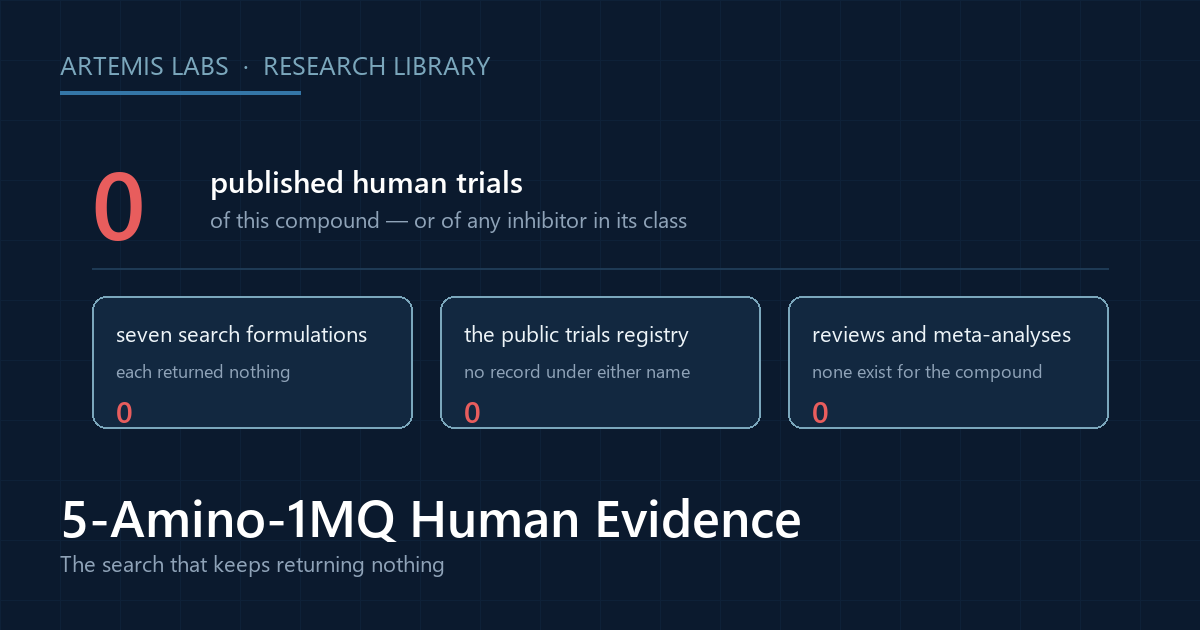
5-Amino-1MQ — answer capsule: There are no published human studies of 5-Amino-1MQ. There are also none for any other inhibitor of the enzyme it targets, nicotinamide N-methyltransferase (NNMT), which makes the gap a class-wide gap rather than a gap in one company’s material. That zero was checked seven different ways in PubMed and then checked again directly against the ClinicalTrials.gov registry, which returns a total count of zero for both of the compound’s chemical names. Two published reviews say the same thing in their own words. The entire evidence base for 5-Amino-1MQ is rodent studies and cell culture, and almost all of the rodent work used male mice only.
Key findings
- Zero human administrations of 5-Amino-1MQ appear in PubMed. Filtering the compound’s whole literature by clinical-trial publication types returns zero records; so does filtering for meta-analyses, and so does filtering for systematic reviews.
- Widening from the compound to the entire enzyme target does not change the answer. The search “nicotinamide N-methyltransferase” AND inhibitor returns 149 records; adding a clinical-trial or randomized-controlled-trial filter returns zero.
- ClinicalTrials.gov returns a total count of zero for both “5-amino-1MQ” and “5-amino-1-methylquinolinium”.
- A 2026 review of the class states that “insufficient target engagement, reduced bioavailability, and unknown safety profiles have led to limited preclinical success across diseases” (PMID 42067476).
Why report the search method at all?
Because a zero is only worth something if you can see how it was reached. Anyone can write “no human trials.” The claim is checkable only if the searches are named, and a reader who repeats them should get the same counts we did.
There is a second reason specific to this compound. Its name is unstable in the literature. Searching PubMed for the exact string “5-amino-1MQ” returns zero records — not because nothing has been published, but because the papers do not use the trade shorthand. The systematic name 5-amino-1-methylquinolinium returns three records. The abbreviation 5A1MQ returns one. The informal research abbreviation NNMTi is what actually pulls the animal papers. A single search on the name a buyer knows would produce a misleading zero for the wrong reason, so the honest framing is that this compound’s literature is indexed under the enzyme, not under the compound.
The seven search formulations, and what each returned
All counts below were read from the PubMed search interface on August 27, 2026.
| Exact string “5-amino-1MQ” | 0 records |
| The same string restricted to titles and abstracts | 0 records |
| Systematic name 5-amino-1-methylquinolinium | 3 records, all preclinical or cell work |
| Abbreviations 5A1MQ or 5A-1MQ | 1 record, a mouse study |
| Broadest compound sweep: seven name variants plus NNMTi | 13 records |
| That sweep filtered by clinical trial, randomized controlled trial, controlled clinical trial or observational study publication types | 0 records |
| That sweep filtered by meta-analysis publication type, and separately by the systematic-review subset | 0 records each |
One further filter is worth reporting because of how easily it misleads. Adding the terms double-blind or placebo to the compound sweep returns exactly one record — and that record is an animal study whose own methods line reads “Male BALB/cJ mice (n = 24) were randomized to either placebo or a NNMT inhibitor” (PMID 41108586). A placebo arm is not the same thing as a human trial. Anyone scanning search results for the word “placebo” would find this paper and could easily misread it.
What happens when you stop searching for the compound and search for the target?
The gap gets wider, not narrower. The search “nicotinamide N-methyltransferase” AND inhibitor returns 149 records. Adding a clinical-trial or randomized-controlled-trial publication filter to that same search returns zero. A separate search combining NNMTi or “NNMT inhibitor” with volunteers, healthy subjects, phase 1 or phase I also returns zero.
Only four records exist in which the enzyme’s name co-occurs with any clinical-trial publication type at all, and all four were read individually. None of them involves an inhibitor. They are a renal-cell-carcinoma diagnostic biomarker study, a gene-polymorphism association study in hyperlipidaemia, an observational study of the enzyme’s messenger RNA in human adipose tissue, and a genetic-epidemiology study of a polymorphism and congenital heart defects. Each is a study of the enzyme’s natural variation in people. None gave anybody a drug that blocks it.
What does the trials registry say?
The registry was queried directly rather than browsed. For “5-amino-1MQ” the total count is zero. For “5-amino-1-methylquinolinium” the total count is zero. Searching the enzyme abbreviation NNMT returns two records, and neither is an inhibitor study: one is an endometrial-biopsy gene-expression study and the other is a study of hydroxychloroquine before surgery in renal cell carcinoma. Searching the phrase “nicotinamide N-methyltransferase inhibitor” returns one record, and it is a trial of a cornelian cherry food supplement in metabolic syndrome — not an NNMT inhibitor at all.
The compound’s PubChem record tells a matching story. Its entry has no drug and medication information section, no FDA Orange Book section, no DrugBank section and no clinical-trials section. It is a chemistry record with patents and vendor listings attached, which is what a molecule looks like before anyone has taken it into people.
Two published reviews say it in their own words
We are not the only ones reporting this. A 2025 review states plainly that “no clinical trials have yet targeted NNMT specific” (PMID 41008588). A 2021 review, four years earlier, wrote that “the exact mechanisms underlying these phenomena are not yet fully understood” and that “clinical trials targeting NNMT have not been reported until now” (PMID 34368359).
The 2026 class review is the harder read of the three, and it is the one worth quoting at length because it names the reasons: “small-molecule inhibitors targeting NNMT have been developed to reduce this elevated activity, but insufficient target engagement, reduced bioavailability, and unknown safety profiles have led to limited preclinical success across diseases” (PMID 42067476). That sentence is about the whole class, written by researchers who work on it, and it is not describing a field on the edge of a human trial.
Some papers are tagged “Humans.” What are they actually?
Eight of the thirteen compound-level records carry the human MeSH tag, which looks at a glance like human evidence. Every one was checked, and each falls into one of three categories.
Some used human sequencing datasets while the intervention happened in mice — a 2024 sarcopenia paper used human transcriptomics for biomarker discovery and tested the inhibitor in mice (PMID 38838088), and the 2025 ischaemia paper used human muscle datasets alongside its male mouse experiment (PMID 41108586). Some used human tissue collected for association analysis, such as a 2022 study of renal-carcinoma tumour tissue (PMID 35678045). And one applied the compound to human cell lines in a dish — HeLa and HEK-293 cells (PMID 33645410). Cells that came from a person years ago are not a person.
What the research does not show
An all-rodent record does not permit a conclusion about people, in either direction. It does not show that 5-Amino-1MQ works in a human being, and it does not show that it fails. It shows that nobody has run the experiment.
What the animal record specifically cannot settle: whether an effect measured in a mouse appears at all in human physiology, whether the compound behaves the same way in a female body — seven of the compound’s in-vivo studies are indexed male-only — whether there are effects that only appear over longer periods than a mouse study runs, and what the safety profile is. On that last point the class review’s phrase is “unknown safety profiles,” and no formal toxicology, dose-range-finding, genotoxicity or reproductive study for this compound appears in any search.
The animal record is also not uniformly positive. The 2025 ischaemia study reported that treatment “did not affect limb perfusion recovery or capillary density” and that “Muscle mass and myofiber size were unchanged by treatment,” while strength, power and total work did improve in the ischaemic limbs (PMID 41108586). Those nulls are part of the record and we report them on our page covering 5-Amino-1MQ muscle and metabolism research. For what the compound is and what its enzyme target does, start with what 5-Amino-1MQ is studied for. The research material itself is listed at 5-Amino-1MQ.
Frequently asked questions
Are there any human clinical trials of 5-Amino-1MQ?
No. Seven PubMed search formulations return no clinical-trial publication type, no meta-analysis and no systematic review for the compound, and ClinicalTrials.gov returns a total count of zero for both of its chemical names.
Is the lack of trials specific to 5-Amino-1MQ?
No, it is class-wide. The full search “nicotinamide N-methyltransferase” AND inhibitor returns 149 papers, and adding a clinical-trial filter to that search returns zero. Two published reviews state the same finding independently.
Does “no human trials” mean the compound does not work?
It means nothing has been tested in people, so there is no basis for a conclusion in either direction. Absence of evidence is not evidence of absence, and it is not evidence of effect either.
Why do some of the papers say “Humans” in their indexing?
Because they used human sequencing datasets, human tumour tissue, or human-derived cell lines, while the compound itself was given to mice or applied to cells in a dish. Every one of those records was read individually and none describes administration to a person.
References
- Emerging opportunities for nicotinamide N-methyltransferase (NNMT) inhibitor clinical translation. Trends Pharmacol Sci, 2026. PMID 42067476 · doi:10.1016/j.tips.2026.04.002 — the class review quoted above.
- Biomolecules, 2025 (review). PMID 41008588 — source of the statement that no clinical trials have yet targeted NNMT.
- BioMed Res Int, 2021 (review). PMID 34368359 — source of the statement that trials targeting NNMT have not been reported.
- Physiol Rep, 2025. PMID 41108586 · doi:10.14814/phy2.70615 — NNMT inhibitor versus placebo in male BALB/cJ mice with hindlimb ischaemia, alongside human muscle datasets.
- Liang, 2024. Aging Cell. PMID 38838088 · doi:10.1111/acel.14236 — human transcriptomics for sarcopenia biomarker discovery; the intervention arm is mice.
- Clin Transl Med, 2022. PMID 35678045 · doi:10.1002/ctm2.883 — human renal-carcinoma tumour tissue and cell models; no administration to people.
- J Obstet Gynaecol, 2021. PMID 33645410 · doi:10.1080/01443615.2020.1854696 — HeLa and HEK-293 human cell lines.
- PubMed search counts and ClinicalTrials.gov registry counts as tabulated above. Retrieved August 27, 2026.
Methodology: every count on this page comes from a PubMed or ClinicalTrials.gov query run directly against those databases, with each record carrying a clinical-trial publication type read individually; last verified August 27, 2026.
All compounds sold by Artemis Labs are for laboratory research use only. Nothing on this page is medical advice, and no statement has been evaluated by the FDA.
