
5-Amino-1MQ Muscle and Metabolism Research | Artemis Labs
Aug
5-Amino-1MQ muscle and metabolism research: what was measured, and in what
Published August 26, 2026 · Artemis Labs
5-Amino-1MQ — answer capsule: The best-known result for 5-Amino-1MQ comes from a 2019 study in 24-month-old male mice whose tibialis anterior muscle — the shin muscle — was deliberately injured with barium chloride at the start of the experiment. In those mice, in-vivo peak torque of the injured muscle rose by about 70 percent against saline controls, alongside regrowing muscle fibres of nearly twice the cross-sectional area. That is a recovery-after-injury result in aged male mice, not a strength result in intact muscle, and the published abstract states no group sizes, so no honest page can print an n for it. A separate 2024 study in aged mice reported grip-strength gains larger than exercise alone, and the same literature also contains four explicit negative results, a metabolite whose suppression may itself be a cost, and a human cell line in which a sirtuin protein went down rather than up.
Key findings
- The 2019 aged-mouse study reported that “the peak torque of the TA increased by ∼70% in NNMTi-treated mice compared to controls” after chemical injury to that muscle, with “nearly 2-fold greater CSA” in regenerating fibres. The abstract publishes no group sizes (PMID 30753815).
- A 2024 aged-mouse study reported that “NNMTi-treated aged sedentary mice showed ~ 40% greater grip strength than sedentary controls, while aged exercised mice only showed a 20% increase relative to controls,” and that the two were additive at 60 percent combined (PMID 38969654).
- Selectivity is genuinely good at the enzyme-panel level: a 2018 study reported that “methylquinolinium analogues displayed high selectivity, not inhibiting related SAM-dependent methyltransferases or enzymes in the NAD+ salvage pathway” (PMID 29155147).
- The metabolite this compound suppresses is not purely harmful. A 2025 review describes a “complex duality” in which “its metabolite 1-MNA can exert protective effects (via NRF2 activation and anti-thrombotic mechanisms)” (PMID 41008588).
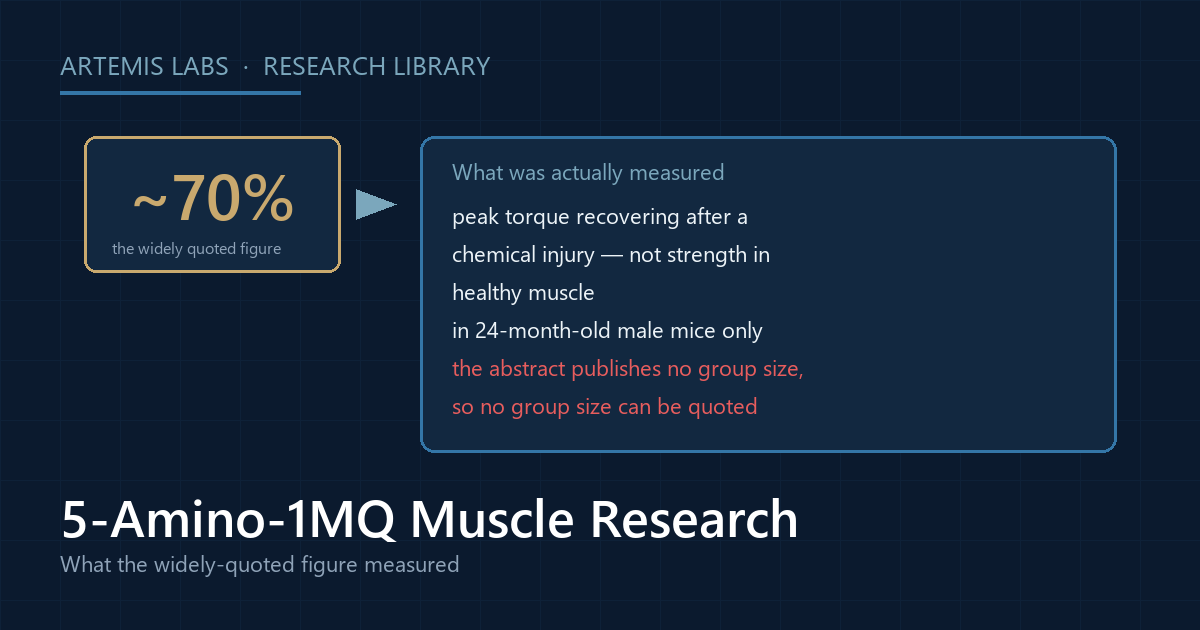
The ~70% figure: what was actually measured?
In a 2019 study, 24-month-old mice — old animals, roughly the rodent equivalent of late life — were given either saline or an NNMT inhibitor. Before treatment, every animal received an acute chemical injury to one muscle. The paper’s own methods sentence reads: “All mice underwent an acute muscle injury (barium chloride injection) locally to the tibialis anterior (TA) muscle.” Barium chloride destroys muscle fibres on contact. In rodent work it is a standard way to create an injury of known size and location, so that an experiment can watch the muscle rebuild.
What was measured afterwards, in the paper’s words: “In vivo contractile function measurements were conducted on the injured TA muscle and tissues collected for ex-vivo analyses, including myofiber cross-sectional area (CSA) measurements to assess muscle recovery.” And the headline result: “improved muSC activity translated not only to larger myofibers after injury but also to greater contractile function, with the peak torque of the TA increased by ∼70% in NNMTi-treated mice compared to controls” (PMID 30753815).
Four things travel with that number and should never be trimmed off it. The muscle was injured on purpose, so this measures recovery from damage rather than strength in healthy tissue. The tilde is the authors’ own — the figure is approximate, against saline controls. The animals were male; PubMed indexes the record with the Male term and no Female term. And the abstract reports no group sizes at all, which is why no n appears anywhere on this page. Randomisation is confirmed by the record’s indexing, but the number of animals per arm is not in the public abstract, and inventing one would be worse than admitting the gap.
The exercise comparison, quoted exactly
A 2024 study in Scientific Reports ran a different design: aged mice received the inhibitor, intensive exercise, or both, and were compared on grip strength, running capacity, plantarflexor peak torque, fatigue, muscle mass, fibre type, cross-sectional area and intramyocellular lipid (IMCL) content.
The result, in the authors’ own sentence including their own adverb: “Remarkably, NNMTi-treated aged sedentary mice showed ~ 40% greater grip strength than sedentary controls, while aged exercised mice only showed a 20% increase relative to controls. Importantly, the grip strength improvements resulting from NNMTi treatment and exercise were additive, with NNMTi-treated exercised mice developing a 60% increase in grip strength relative to sedentary controls” (PMID 38969654).
Read it as written. It compares arms inside one aged-mouse experiment. It says nothing about a person, and the authors close on a forward-looking hedge — that such drugs “will be beneficial” in treating age-related muscle conditions, an aspiration for a research programme rather than a delivered result. PubMed indexes this record as male and the abstract does not state the sex of the animals; some secondary write-ups report female mice. Where a source and its indexing disagree, we say so rather than pick the more convenient one.
The strength effect is not confined to one laboratory. A 2024 study from an independent group reported that “inhibition of NNMT improved the grip strength in aging mice and alleviated age-related decline in the mass index of the quadriceps femoris muscles and whole-body lean mass index” (PMID 38838088). Replication across labs is a real point in the compound’s favour, and omitting it would overstate our own caution.
The metabolic studies, with the wording that matters
A 2024 study in Diabetes, Obesity & Metabolism reported that in diet-induced obese male mice, inhibitor treatment across a 28-day study “dose-dependently limited body weight and fat mass gains, improved oral glucose tolerance and insulin sensitivity, and suppressed hyperinsulinaemia in DIO mice,” with liver histology showing “attenuated hepatic steatosis and macrophage infiltration” (PMID 39161060). The phrase to hold onto is “limited body weight and fat mass gains.” In animals eating a high-fat diet, the treated group gained less than controls — not the same claim as a reduction, and copy that swaps one for the other has changed the finding.
A 2021 study in male obese mice reported that the inhibitor combined with a lean-diet substitution “increased whole-body lean mass to body weight ratio, reduced liver and epididymal white adipose tissue weights, decreased liver adiposity, and improved hepatic steatosis, relative to a lean diet substitution alone” (PMID 33707534). A 2022 study of the gut microbiome in the same model found a distinct bacterial pattern in treated animals while recording its own null in the same breath — “While alpha diversity measures did not significantly differ between groups” — and closed by saying the results “provide a novel foundation for future investigations” (PMID 35013352).
One frequently cited paper is not a study of the compound at all. The 2014 Nature paper that established the enzyme as a metabolic target used gene knockdown — the enzyme was switched down genetically, and no compound was administered (PMID 24717514). It is target-validation work. Calling it the foundational 5-Amino-1MQ study, as a good deal of vendor copy does, mistakes a genetic experiment for a drug experiment.
Selectivity: the honest point in the compound’s favour
Honesty runs in both directions, so the strongest datum belongs here too. The 2018 study reported, verbatim: “Importantly, methylquinolinium analogues displayed high selectivity, not inhibiting related SAM-dependent methyltransferases or enzymes in the NAD+ salvage pathway.” The same paper contains the only tolerability sentence in the compound’s whole literature: “administration of NNMT inhibitors did not impact total food intake nor produce any observable adverse effects” (PMID 29155147).
Both statements need their boundaries stated. The selectivity result is an in-vitro panel against related enzymes, not a broad off-target screen. The tolerability sentence is an observation in a mouse experiment, not a toxicology study. And a 2025 class review takes the opposite general view, noting that “challenges persist in achieving cellular specificity, optimizing blood-brain barrier penetration, and mitigating off-target effects” (PMID 40221009).
What the research does not show
No human being has received 5-Amino-1MQ, or any NNMT inhibitor, in a published study or a registered trial. That zero holds for the entire inhibitor class and was verified across seven PubMed search formulations plus a direct registry query, which our page on 5-Amino-1MQ human evidence reports in full. Every finding above is a mouse or a dish.
The animal record carries four explicit negative results that vendor copy usually omits. A 2025 ischaemia study reported that treatment “did not affect limb perfusion recovery or capillary density” and that “Muscle mass and myofiber size were unchanged by treatment,” while strength, power and total work did improve in the ischaemic limbs (PMID 41108586). The microbiome study found no significant difference in alpha diversity between groups (PMID 35013352). Note what the ischaemia paper shows and does not: functional improvement without any change in muscle size.
Three mechanistic problems are open. First, the metabolite this compound suppresses may not be waste. A 2025 review describes “a complex duality” in which the enzyme’s “activity is often pathogenic (via NAD+/SAM consumption and homocysteine production)” while “its metabolite 1-MNA can exert protective effects (via NRF2 activation and anti-thrombotic mechanisms),” and concludes that the duality “highlights the need to delineate the molecular processes that balance these opposing actions” (PMID 41008588). Inhibiting the enzyme suppresses that metabolite by design.
Second, the assumption that benefit comes from raising NAD+ is contested by a 2025 study in aged female mice which reported that its inhibitor “did not affect NAD levels” in the model while sharply lowering the downstream metabolites — and produced a functional effect anyway. That study used a different inhibitor chemotype, 4-amino-6-methoxynicotinamide, and the caveat must travel with the finding (PMID 40484359). Third, the sirtuin story is not one-directional: in HeLa cells, a 2021 study reported that expression of “phospho-Akt and SIRT1 were decreased” after treatment (PMID 33645410). A flat claim that the compound raises sirtuin activity is not supportable from this literature.
Finally, sex. Seven of the compound’s in-vivo studies are indexed as male-only. The single female-animal study used a different inhibitor. Nothing published describes what this compound does in a female animal, let alone a female body. For what the compound is and what its target enzyme does, see what 5-Amino-1MQ is studied for; the research material is listed at 5-Amino-1MQ.
Frequently asked questions
Did 5-Amino-1MQ increase muscle strength by 70% in the studies?
No. The ~70% figure is peak torque in a deliberately injured shin muscle of 24-month-old male mice, measured during recovery and compared with saline controls. It is a regeneration-after-injury measurement, not strength in intact muscle.
How many mice were in that study?
Unknown from the public record. The published abstract states no group sizes. Any page printing a specific number for that study is printing something the abstract does not contain.
Did the compound beat exercise?
In one aged-mouse experiment, treated sedentary animals showed about 40 percent greater grip strength than sedentary controls while exercised animals showed 20 percent, and the two effects were additive at 60 percent combined. That is a comparison between arms of a mouse study and does not transfer to people.
Are there negative results in this literature?
Yes, four of them: no effect on limb perfusion recovery, no effect on capillary density, no change in muscle mass or fibre size in the ischaemia model, and no significant difference in gut microbial alpha diversity.
References
- Small molecule nicotinamide N-methyltransferase inhibitor activates senescent muscle stem cells and improves regenerative capacity of aged skeletal muscle. Biochem Pharmacol, 2019. PMID 30753815 · doi:10.1016/j.bcp.2019.02.008
- Nicotinamide N-methyltransferase inhibition mimics and boosts exercise-mediated improvements in muscle function in aged mice. Sci Rep, 2024. PMID 38969654 · doi:10.1038/s41598-024-66034-9
- Neelakantan, 2018. Selective and membrane-permeable small molecule inhibitors of nicotinamide N-methyltransferase reverse high fat diet-induced obesity in mice. Biochem Pharmacol. PMID 29155147 · doi:10.1016/j.bcp.2017.11.007
- Nicotinamide N-methyltransferase inhibition mitigates obesity-related metabolic dysfunction. Diabetes, Obesity & Metabolism, 2024. PMID 39161060 · doi:10.1111/dom.15879
- Sci Rep, 2021. PMID 33707534 · doi:10.1038/s41598-021-85051-6 — NNMT inhibition with lean-diet substitution in male obese mice.
- Reduced calorie diet combined with NNMT inhibition establishes a distinct microbiome in DIO mice. Sci Rep, 2022. PMID 35013352 · doi:10.1038/s41598-021-03670-5
- Kraus, 2014. Nicotinamide N-methyltransferase knockdown protects against diet-induced obesity. Nature. PMID 24717514 · doi:10.1038/nature13198 — gene knockdown; no compound administered.
- Liang, 2024. Aging Cell. PMID 38838088 · doi:10.1111/acel.14236 — independent replication of the grip-strength effect in aging mice; human transcriptomics used for biomarker discovery.
- Physiol Rep, 2025. PMID 41108586 · doi:10.14814/phy2.70615 — NNMT inhibitor versus placebo in male BALB/cJ mice with hindlimb ischaemia; source of the perfusion, capillary-density and muscle-mass nulls.
- Biomolecules, 2025 (review). PMID 41008588 — source of the 1-MNA duality passage.
- Pharmacol Res, 2025. PMID 40484359 · doi:10.1016/j.phrs.2025.107820 — a different NNMT-inhibitor chemotype, 4-amino-6-methoxynicotinamide, in aged female mice.
- J Obstet Gynaecol, 2021. PMID 33645410 · doi:10.1080/01443615.2020.1854696 — HeLa and HEK-293 human cell lines; source of the decreased SIRT1 finding.
- Exp Neurol, 2025 (review). PMID 40221009 — names the class’s outstanding specificity and off-target challenges.
Methodology: every study on this page was read from its published abstract and PubMed indexing, with species, sex and study design taken from the record itself; last verified August 27, 2026.
All compounds sold by Artemis Labs are for laboratory research use only. Nothing on this page is medical advice, and no statement has been evaluated by the FDA.
