
5-Amino-1MQ Salt Forms: Chloride vs Iodide | Artemis Labs
Aug
5-Amino-1MQ salt forms and identity: chloride, iodide, and the 1.47× arithmetic trap
Published August 26, 2026 · Artemis Labs
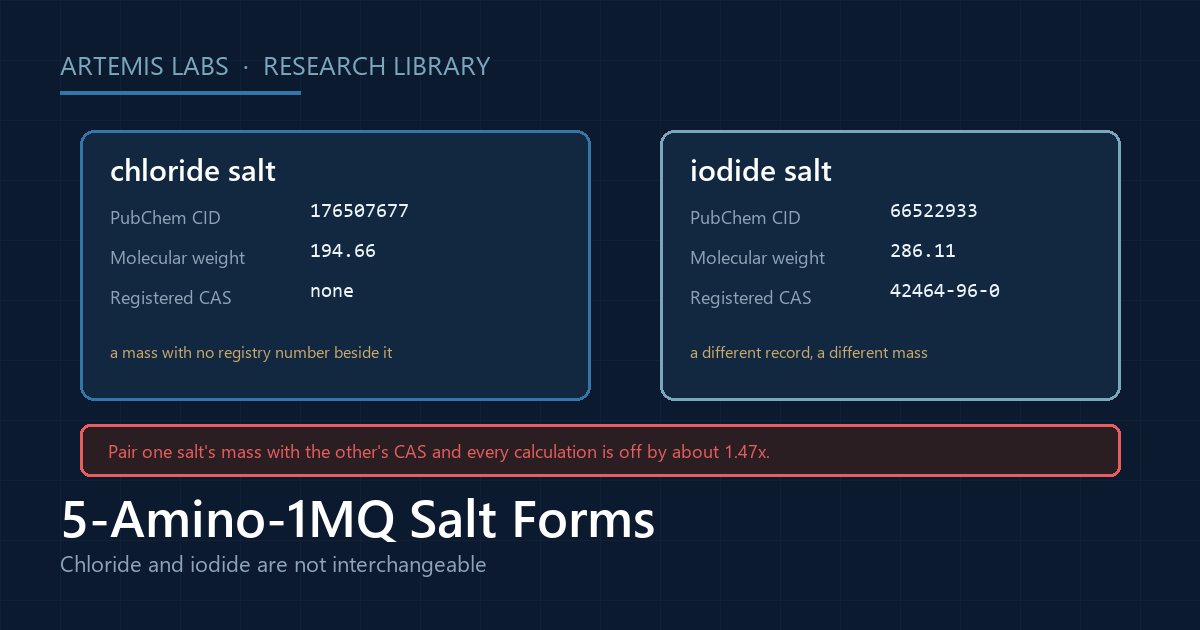
5-Amino-1MQ — answer capsule: 5-Amino-1MQ is sold as a salt, and the two salt forms in circulation are not interchangeable on paper. The chloride salt is PubChem CID 176507677, formula C10H11ClN2, molecular weight 194.66, and PubChem returns no registered CAS number for it at all. The iodide salt is PubChem CID 66522933, formula C10H11IN2, molecular weight 286.11, and it is the form that carries CAS 42464-96-0. When a specification sheet pairs the chloride’s molecular weight with the iodide’s CAS number, anyone computing a molar concentration from that sheet is off by a factor of about 1.47. This page shows the check that catches it in under a minute on any vendor’s sheet.
Key findings
- Chloride salt: CID 176507677, C10H11ClN2, molecular weight 194.66, exact mass 194.0610761, UNII KK7LU6YQL5, InChIKey PMNZHMVGGDMBFJ-UHFFFAOYSA-N. PubChem lists four synonyms for this record and no CAS number among them.
- Iodide salt: CID 66522933, C10H11IN2, molecular weight 286.11, exact mass 285.99670, CAS 42464-96-0, UNII K9G33W2TTZ, InChIKey JPEZFBFIRRAFNR-UHFFFAOYSA-N.
- The bare cation — the part that acts on the enzyme — is CID 950107, C10H11N2+, molecular weight 159.21, charge +1, CAS 685079-15-6. That third number is different again and is rarely printed anywhere.
- Searching PubChem for the trade name “5-Amino-1MQ” returns a 404 with the message “No CID found that matches the given name.” The systematic name resolves; the trade name does not.
Why does the salt form matter at all?
The molecule that interacts with the enzyme carries a permanent positive charge. A positively charged ion cannot sit in a bottle alone, so it is paired with a negatively charged partner — a counter-ion — and the pair is what gets weighed out. Chloride and iodide are two different partners.
The partner does not change what the active part is. It does change what a gram of the material contains, because iodine is a heavy atom and chlorine is a light one. The active cation weighs 159.21. Add chlorine and the salt weighs 194.66. Add iodine instead and it weighs 286.11. Same active part, very different weights per unit of material.
That is why a molecular weight without a form named beside it is not usable information for calculating concentrations, and why every number on this page is printed with the PubChem CID it came from. Our page on what 5-Amino-1MQ is studied for covers the compound itself and what its enzyme target does; the material is listed at 5-Amino-1MQ.
The two salt records, side by side
Every value below was read directly from the named PubChem compound record on August 27, 2026.
| Chloride | Iodide | |
| PubChem CID | 176507677 | 66522933 |
| Molecular formula | C10H11ClN2 | C10H11IN2 |
| Molecular weight | 194.66 | 286.11 |
| Exact / monoisotopic mass | 194.0610761 | 285.99670 |
| CAS number | none returned by PubChem | 42464-96-0 |
| UNII | KK7LU6YQL5 | K9G33W2TTZ |
| InChIKey | PMNZHMVGGDMBFJ-UHFFFAOYSA-N | JPEZFBFIRRAFNR-UHFFFAOYSA-N |
| IUPAC name | 1-methylquinolin-1-ium-5-amine chloride | 1-methylquinolin-1-ium-5-amine iodide |
Two details in that table are easy to skim past. First, the chloride record’s complete synonym list has four entries — its UNII and three name variants — and no CAS number appears among them. If a document prints a CAS for a chloride, that number did not come from PubChem’s chloride record. Second, the iodide record’s synonyms include the informal research abbreviation NNMTi and the medicinal-chemistry label “Compound 1k, NNMT inhibitor,” which is a clue about which form the published literature actually used.
The 1.47× molarity trap, worked through
Here is how the error happens, and it does not require anyone to be careless.
A specification sheet says: salt form chloride, molecular weight 194.66, CAS 42464-96-0. Those three lines look consistent because they sit in the same table. They are not consistent. The 194.66 belongs to the chloride record and 42464-96-0 belongs to the iodide record — two different substances.
Now follow a researcher who trusts the sheet. They order against the CAS, because a CAS number is how chemical supply works, and what arrives is the iodide at 286.11 g/mol. They then calculate their molar concentrations from the sheet’s stated 194.66. The ratio between the two weights is 286.11 divided by 194.66, which is about 1.47. Every solution they prepare contains roughly 32 percent less of the active cation than their notebook says it does. Nothing in the experiment announces the problem; the numbers simply come out wrong, quietly, in the same direction, for as long as that sheet is in use.
This is not a hypothetical worked example. Our own published specification table carried exactly this mispairing — chloride salt form and molecular weight beside the iodide’s CAS number — and we corrected it on August 27, 2026, in all three places it appeared. We are describing the failure because we made it, not because we spotted it in somebody else’s catalogue. Documents in this corner of the research-chemical market conflate the two salt forms routinely, and we are naming the failure mode rather than any particular seller.
The check to run on any vendor’s specification sheet
Four steps, in order, for this compound or any other salt-form material.
1. Read the salt form and the molecular weight as a pair. For this compound, 194.66 means chloride and 286.11 means iodide. If the stated salt form and the stated weight point at different forms, stop there — the sheet has already contradicted itself and nothing further on it can be trusted.
2. Check the CAS against the same form. 42464-96-0 is the iodide’s number. If it appears next to 194.66, the sheet has combined two records. And if a sheet claims a CAS for the chloride, ask where it came from, because PubChem’s chloride record returns none.
3. Prefer the CID and the InChIKey over the name. A CID resolves to exactly one structure. An InChIKey is a fingerprint calculated from the structure itself, so two documents describing the same substance carry the same key. Names do not behave that way — searching PubChem for the trade name “5-Amino-1MQ” returns a 404 reading “No CID found that matches the given name,” so a sheet cannot be checked by its trade name alone.
4. Do the division before you do the chemistry. If you have any doubt about which form is in the bottle, the two candidate weights differ by a factor you can compute in one step. Knowing that the answer is about 1.47 is what makes the discrepancy visible instead of invisible.
Which salt form does the published literature use?
Where the papers name a form, it is generally the iodide. A 2024 oncology study names its inhibitor as “5-Amino-1-methylquinolinium iodide” (PMID 39067875), and the iodide’s own PubChem synonym set carries the research shorthand used across the field. Many papers name no salt at all and refer only to the enzyme abbreviation NNMTi, which is one reason the compound’s literature is hard to search by name.
A related naming hazard sits one step further out. A 2021 cell-line paper defines “5-amino-1-methylquinolinium (5MQ)” in its impact statement and then writes “5-methylquinolinium (5MQ)” in the first line of its own abstract (PMID 33645410). We report the slip rather than silently correcting it, because a reader comparing that abstract against a specification sheet needs to know the inconsistency is in the paper.
What the research does not show
An identifier settles what a substance is. It settles nothing about what that substance does, and no number on this page is evidence of an effect.
For this compound in particular, precise chemistry sits on top of an unusually thin evidence base, and the two are easy to confuse. There are no published human studies of 5-Amino-1MQ and none for any other NNMT inhibitor — a zero verified across seven PubMed search formulations and confirmed by a direct registry query returning a total count of zero for both chemical names. Our page on 5-Amino-1MQ human evidence reports that method in full. The animal record is almost entirely male mice and contains explicit negative results, which we set out on our page covering 5-Amino-1MQ muscle and metabolism research.
The compound’s PubChem entry is itself a signal about how thinly it is annotated. Its complete heading list contains structures, names, computed properties, patents, vendors and classification — and no drug and medication information section, no FDA Orange Book section, no DrugBank section, no clinical-trials section, and no consolidated literature section at all.
One limit on this page specifically: everything above describes public database records, not any particular batch of material. A database record cannot describe what is in a bottle. Only analysis of that specific batch can do that, and the checks described here are checks on a document, not on a substance.
Frequently asked questions
What is the correct CAS number for 5-Amino-1MQ?
It depends on the form. The iodide is 42464-96-0. The bare cation is 685079-15-6. PubChem returns no CAS at all for the chloride record, so a chloride sheet printing a CAS is printing a number that did not come from there.
Is 194.66 or 286.11 the molecular weight?
Both are correct, for different substances. 194.66 is the chloride at CID 176507677 and 286.11 is the iodide at CID 66522933. Neither number identifies the material on its own; the form has to be stated alongside it.
Why does searching “5-Amino-1MQ” on PubChem fail?
Because it is a trade shorthand, not an indexed chemical name. The query returns a 404 with the message “No CID found that matches the given name.” Searching 5-amino-1-methylquinolinium chloride or 5-amino-1-methylquinolinium iodide resolves to the specific salt records.
Does the salt form change how the compound behaves?
The active cation is the same in both. What changes is the weight of material per unit of that cation, which is a calculation problem rather than a chemistry problem — but an uncorrected calculation problem runs through every result derived from it.
References
- PubChem Compound Summary, CID 176507677 (5-amino-1-methylquinolinium chloride). https://pubchem.ncbi.nlm.nih.gov/compound/176507677 — C10H11ClN2, molecular weight 194.66, exact mass 194.0610761, UNII KK7LU6YQL5, InChIKey PMNZHMVGGDMBFJ-UHFFFAOYSA-N, four synonyms, no CAS returned. Retrieved August 27, 2026.
- PubChem Compound Summary, CID 66522933 (5-amino-1-methylquinolinium iodide). https://pubchem.ncbi.nlm.nih.gov/compound/66522933 — C10H11IN2, molecular weight 286.11, exact mass 285.99670, CAS 42464-96-0, UNII K9G33W2TTZ, InChIKey JPEZFBFIRRAFNR-UHFFFAOYSA-N. Retrieved August 27, 2026.
- PubChem Compound Summary, CID 950107 (5-amino-1-methylquinolinium cation). https://pubchem.ncbi.nlm.nih.gov/compound/950107 — C10H11N2+, molecular weight 159.21, exact mass 159.092223359, charge +1, CAS 685079-15-6, UNII PMX593N4N3, InChIKey ZMJBCEIHNOWCMC-UHFFFAOYSA-O. Retrieved August 27, 2026.
- PubChem name query for “5-Amino-1MQ”, returning “No CID found that matches the given name.” Retrieved August 27, 2026.
- Yang, 2024. PMID 39067875 · doi:10.1136/jitc-2024-009281 — names its inhibitor as 5-Amino-1-methylquinolinium iodide; urothelial bladder cancer models.
- J Obstet Gynaecol, 2021. PMID 33645410 · doi:10.1080/01443615.2020.1854696 — HeLa and HEK-293 human cell lines; source of the 5MQ naming inconsistency described above.
Methodology: every identifier on this page was fetched directly from the named PubChem compound record and read from its curated identifier and synonym headings, and the trials-registry counts referenced here come from direct queries to ClinicalTrials.gov; last verified August 27, 2026.
All compounds sold by Artemis Labs are for laboratory research use only. Nothing on this page is medical advice, and no statement has been evaluated by the FDA.
