
MOTS-c Exercise and Metabolism Research Reviewed | Artemis Labs
Aug
MOTS-c exercise and metabolism research: what the studies actually report
Published August 26, 2026 · Artemis Labs
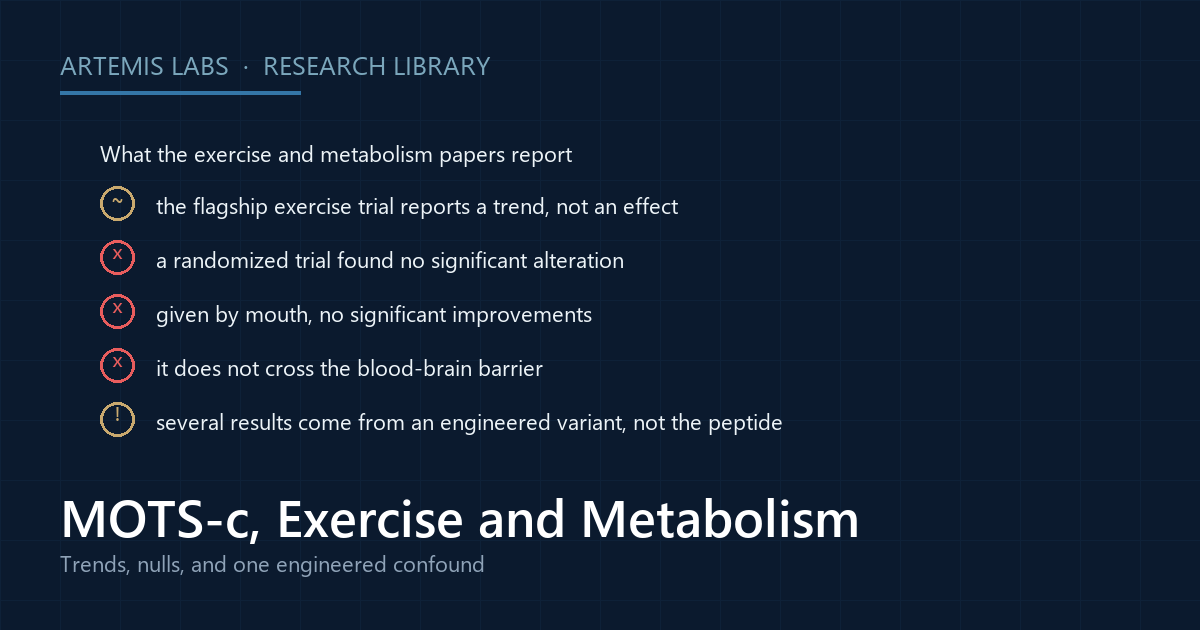
MOTS-c — answer capsule: The MOTS-c metabolism literature is overwhelmingly preclinical. The findings that anchor the field — glucose tolerance in high-fat-fed mice, physical performance in aged mice, activation of the energy-sensing enzyme AMPK — come from mice and cultured cells, and the authors of those papers say so. In humans, MOTS-c has only ever been measured as a blood marker during exercise or other interventions, never supplied. The most-cited human exercise study reports that MOTS-c “showed a trend to increase,” which is not a significant finding, and two other human studies found no change at all. Two published papers report that unmodified MOTS-c did not cross the blood-brain barrier and that giving it orally produced no significant improvement in a mouse colitis model.
Key findings
- The founding metabolic result is a mouse result: MOTS-c treatment “prevented age-dependent and high-fat-diet-induced insulin resistance, as well as diet-induced obesity” in mice (Cell Metab 2015, PMID 25738459).
- The most-cited human exercise study, a randomized three-arm design in 30 participants, reports for MOTS-c only that levels “showed a trend to increase after EE” (PMID 34351816).
- A 2021 study reports that “peripheral administration of MOTS-c does not cross the blood-brain barrier (BBB)” in its mouse model — a finding published by the group that then built a modified carrier version to get around it (PMID 33861582).
- A 2023 mouse colitis study states: “Notably, oral administration of MOTS-c did not result in any significant improvements.” The improvement in that paper came from a conjugate, not from MOTS-c (PMID 36528071).
The preclinical record, by species
Three papers carry most of the weight, and each one is worth reading with its model system attached.
Mouse and cell culture, 2015. The discovery paper reported the peptide, its 16-amino-acid sequence and its origin in mitochondrial DNA, then tested it in mice. Its own hedges are instructive: the primary target organ “appears to be” skeletal muscle, and the results “suggest” that mitochondria “may” actively regulate metabolic balance (PMID 25738459).
Cell lines and mouse, 2018. A follow-up from the same laboratory reported that MOTS-c “translocates to the nucleus and regulates nuclear gene expression following metabolic stress” in an AMPK-dependent way, and that it interacted with stress-responsive transcription factors including NRF2 (PMID 29983246). This is the mechanistic backbone of most MOTS-c marketing, and it is cell and mouse work.
Mouse, 2021. A study reported that MOTS-c “can significantly enhance physical performance in young (2 mo.), middle-age (12 mo.), and old (22 mo.) mice,” and that late-life intermittent treatment “can increase physical capacity and healthspan in mice” (PMID 33473109). The same paper’s human component is separate and much narrower: it reports that in humans, exercise raises the body’s own MOTS-c. It does not report giving MOTS-c to anyone.
A 2026 mouse study using two transgenic strains reported that administration “augments muscle mitochondrial bioenergetic performance” through both PGC-1α and AMPK (PMID 41520850). That paper also contains a human measurement that points the other way, covered below.
One 2021 mouse experiment is the sharpest single argument for reading model systems carefully. High-fat-fed male mice given MOTS-c “showed reduced weight and improved glucose tolerance, but not K14Q-MOTS-c treated mice” — and K14Q differs from MOTS-c by one amino acid (PMID 33468709). Female mice in that experiment “were unaffected” in either group.
What the human exercise studies report
Five human studies have measured circulating MOTS-c around exercise. They do not agree.
The most cited is a randomized study in 30 participants assigned to endurance exercise, resistance exercise, or control. Its verbatim result for MOTS-c is: “MOTS-C levels showed a trend to increase after EE.” The peptide that rose significantly in that study was humanin, not MOTS-c. The same paper adds that “plasma levels of MDPs were not correlated to fitness outcomes,” including maximal oxygen uptake, leg strength and muscle mitochondrial DNA copy number (PMID 34351816). A trend is a direction that did not reach significance. Reporting it as an effect is the single most common error made with this compound.
A human interventional study that included an eight-week training block found nothing: “eight weeks of moderate exercise training did not show any changes in circulating MOTS-c levels in healthy controls and in women with PCOS” (PMID 31066084). A 2026 human study of acute endurance exercise across three groups reported that “circulating MDPs showed no or only modest changes across groups” (PMID 42349896).
A 16-week randomized exercise intervention in breast cancer survivors split by group: MOTS-c “significantly increased” against baseline and usual care among non-Hispanic White participants but “not among Hispanic breast cancer survivors,” and the two groups differed at baseline in age, adiposity, cancer stage and metabolic profile (PMID 34413391). A 2025 randomized study of repeated heat treatment in 19 physically active men reported that heat “upregulated the circulating MOTS-c (P = 0.033)” while immobilization “did not induce any effect on mitokine levels” (PMID 40674654).
A 2026 human measurement complicates the premise underneath all of this. Researchers measured the difference in MOTS-c concentration between blood entering and leaving an exercising leg and found “no change was observed in the arterio-venous difference during one-legged knee extensor exercise in humans,” concluding that skeletal muscle “may not be the source of circulating MOTS-c in response to exercise” (PMID 41520850).
The delivery findings, quoted as written
Two papers are routinely cited as evidence that MOTS-c reaches the brain or works when swallowed. Both papers report the opposite about unmodified MOTS-c, and both had to build a modified molecule to get an effect.
The first states that “peripheral administration of MOTS-c does not cross the blood-brain barrier (BBB)” in its mouse model, and describes screening a cell-penetrating carrier peptide to move MOTS-c into the brain (PMID 33861582). The construct it tested is a conjugate, not MOTS-c. The second, in a mouse colitis model, states: “Notably, oral administration of MOTS-c did not result in any significant improvements.” Its positive result belongs to the same conjugate design, described as having “better penetration into the colon epithelium” and a longer half-life than MOTS-c (PMID 36528071).
The brain-entry question is not settled in one direction. A 2024 mouse study of traumatic brain injury reported that MOTS-c “could enter the brain tissue after TBI” (PMID 39050800), and a 2026 rat study restates the negative as “reportedly does not cross the blood-brain barrier” while reporting its own null on plasma BDNF (PMID 41706383). Three rodent studies, two directions.
The R13A confound, named every time it appears
R13A-MOTS-c is an engineered variant — a laboratory-made version of the peptide with one residue deliberately changed. It is real and it is published: a 2026 Redox Biology paper is titled “LAT1-mediated delivery of engineered R13A-MOTS-c attenuates radiation-induced lung injury via Nrf2 activation and mitochondrial protection” (PMID 42142418). That study tested the engineered R13A variant inside a targeted delivery construct in a lung-injury model. It is not a study of MOTS-c, and its findings cannot be attributed to MOTS-c.
R13A should not be confused with K14Q. K14Q is a naturally occurring human variant produced by the mitochondrial DNA change m.1382A>C — a version some people are simply born with, not a laboratory construct (PMID 33468709). Engineered variant, natural variant: two different things, two different literatures, and neither is interchangeable with MOTS-c itself. The identity page covers how to tell them apart on paper: MOTS-c sequence and identity. The compound itself is catalogued as MOTS-c.
What the research does not show
There are zero published human interventional trials of MOTS-c. Nothing in this page’s exercise or metabolism literature involves giving the peptide to a person, and the human papers here measured it as a marker inside somebody else’s intervention. The full registry picture, including the Phase 2a that began recruiting in February 2026 with no results reported, is on our MOTS-c human evidence page; the plain-language introduction is what MOTS-c is studied for.
The reviews of this literature reach the same verdict from different directions. A 2026 systematic review of MOTS-c and exercise included nine studies and stated that “current evidence is limited, particularly in human studies,” calling for controlled clinical trials (PMID 42640735). A 2021 review found the evidence on exercise training and mitochondrial-derived peptides “conflicting” (PMID 34520826). A 2024 systematic review and pooled analysis of 602 participants across six case-control studies and one cross-sectional study reported “opposite results” for MOTS-c in obesity and in type 2 diabetes (PMID 39160573).
One further counter-finding belongs here because it targets the mechanism directly. A 2026 Mayo Clinic study reported that MOTS-c activated AMPK signalling in human mesenchymal stromal cells and that the functional outcome still worsened — “reduced proliferation, increased expression of senescence-associated genes (p16, p21), and upregulated TNF-α,” with the authors describing “a dissociation between metabolic activation and functional stemness” (PMID 42324588). AMPK activation is not by itself a benefit.
Frequently asked questions
Does exercise raise MOTS-c in people?
Inconsistently. The most-cited randomized study reports only a “trend to increase” after endurance exercise, an eight-week training study found no change, and a 2026 acute-exercise study found “no or only modest changes.” A 2026 study measuring blood across an exercising leg concluded muscle may not even be the source.
Is MOTS-c an exercise mimetic?
That framing comes from mouse studies of physical performance and healthspan. It has never been tested in a published human interventional study, and the human measurement of where circulating MOTS-c comes from during exercise did not support the muscle-source premise.
Can MOTS-c reach the brain?
The published rodent findings conflict. Two papers state that unmodified MOTS-c does not cross the blood-brain barrier; a third reports that it could enter brain tissue after traumatic brain injury in mice. No human data addresses the question.
Why do you keep flagging R13A?
Because R13A-MOTS-c is an engineered variant, and one-residue changes to this peptide have abolished its effect in a published mouse experiment. A result obtained with R13A is a result about R13A.
References
- The mitochondrial-derived peptide MOTS-c promotes metabolic homeostasis and reduces obesity and insulin resistance. Cell Metab, 2015. Mouse and cell culture. PMID 25738459 · doi:10.1016/j.cmet.2015.02.009
- The Mitochondrial-Encoded Peptide MOTS-c Translocates to the Nucleus to Regulate Nuclear Gene Expression in Response to Metabolic Stress. Cell Metab, 2018. Cell lines and mouse. PMID 29983246 · doi:10.1016/j.cmet.2018.06.008
- MOTS-c is an exercise-induced mitochondrial-encoded regulator of age-dependent physical decline and muscle homeostasis. Nat Commun, 2021. Mouse, with a separate human observation. PMID 33473109 · doi:10.1038/s41467-020-20790-0
- A pro-diabetogenic mtDNA polymorphism in the mitochondrial-derived peptide, MOTS-c. Aging (Albany NY), 2021. Human genetic association plus mouse. PMID 33468709 · doi:10.18632/aging.202529
- MOTS-c improves intrinsic muscle mitochondrial bioenergetic health and efficiency in a PGC-1α/AMPK-dependent manner. Free Radic Biol Med, 2026. Mouse, with a human arterio-venous sub-experiment. PMID 41520850 · doi:10.1016/j.freeradbiomed.2026.01.002
- Acute endurance exercise stimulates circulating levels of mitochondrial-derived peptides in humans. J Appl Physiol (1985), 2021. Human randomized. PMID 34351816 · doi:10.1152/japplphysiol.00706.2019
- Lipids and insulin regulate mitochondrial-derived peptide (MOTS-c) in PCOS and healthy subjects. Clin Endocrinol (Oxf), 2019. Human interventional, MOTS-c measured as a marker. PMID 31066084 · doi:10.1111/cen.14007
- Circulating mitochondrial-derived microproteins at rest and in response to an acute bout of endurance exercise in individuals with cerebral palsy. Exp Physiol, 2026. Human interventional, marker measurement. PMID 42349896 · doi:10.1113/EP093298
- Effect of aerobic and resistance exercise on the mitochondrial peptide MOTS-c in Hispanic and Non-Hispanic White breast cancer survivors. Sci Rep, 2021. Human randomized, secondary analysis. PMID 34413391 · doi:10.1038/s41598-021-96419-z
- Repeated Heat Stress Modulates the Levels of the Mitokines MOTS-C and FGF21 in Active Men during Calf Muscle Immobilization. Med Sci Sports Exerc, 2025. Human randomized, 19 men. PMID 40674654 · doi:10.1249/MSS.0000000000003825
- Cell-penetrating peptide carrier study reporting that peripheral MOTS-c does not cross the blood-brain barrier. ACS Chem Neurosci, 2021. Mouse. PMID 33861582 · doi:10.1021/acschemneuro.0c00782
- Conjugate study in DSS-induced colitis reporting no significant improvement from oral MOTS-c. Eur J Pharmacol, 2023. Mouse. PMID 36528071 · doi:10.1016/j.ejphar.2022.175469
- Traumatic brain injury study reporting brain-tissue entry. Drug Des Devel Ther, 2024. Mouse. PMID 39050800 · doi:10.2147/DDDT.S460265
- Valproic-acid model study restating the blood-brain barrier finding, with its own plasma BDNF null. Mol Neurobiol, 2026. Rat. PMID 41706383 · doi:10.1007/s12035-026-05741-y
- LAT1-mediated delivery of engineered R13A-MOTS-c attenuates radiation-induced lung injury via Nrf2 activation and mitochondrial protection. Redox Biol, 2026, vol. 94. Engineered variant. PMID 42142418 · doi:10.1016/j.redox.2026.104204
- Systematic review of MOTS-c and exercise. Physiol Int, 2026. Nine studies included. PMID 42640735 · doi:10.1556/2060.2026.00863
- Review of exercise training and mitochondrial-derived peptides. Biochim Biophys Acta Gen Subj, 2021. PMID 34520826 · doi:10.1016/j.bbagen.2021.130011
- Systematic review and pooled analysis of circulating MOTS-c, 602 participants. Diabetol Metab Syndr, 2024. Human observational studies. PMID 39160573 · doi:10.1186/s13098-024-01405-w
- Mitochondrial-derived peptide MOTS-c activates metabolic signaling but blunts reparative function in human mesenchymal stromal cells. Inflamm Regen, 2026. Human cells and mouse. PMID 42324588 · doi:10.1186/s41232-026-00431-7
Methodology: every study on this page is cited from the Artemis Labs MOTS-c fact base, built from PubMed primary records with model system and evidence class read from each abstract, last verified August 27, 2026.
All compounds sold by Artemis Labs are for laboratory research use only. Nothing on this page is medical advice, and no statement has been evaluated by the FDA.
