
MOTS-c Human Evidence: Zero Published Trials | Artemis Labs
Aug
MOTS-c human evidence: what has and has not been tested in people
Published August 26, 2026 · Artemis Labs
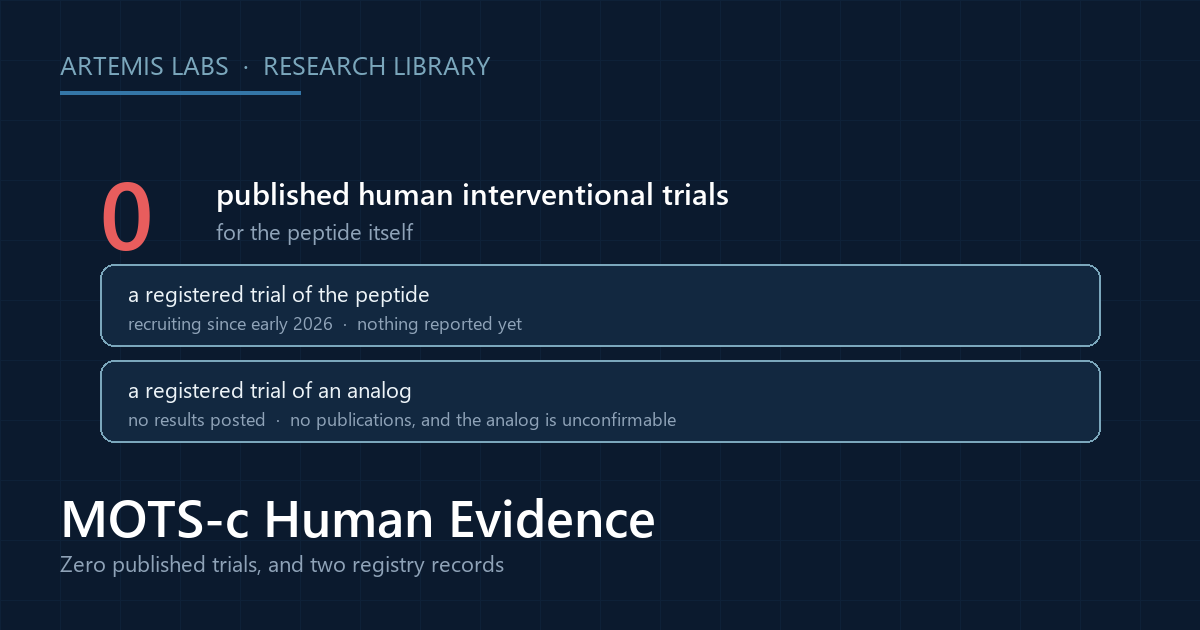
MOTS-c — answer capsule: There are zero published human interventional trials of MOTS-c. Roughly thirty published human MOTS-c papers exist, and every one of them either measured MOTS-c as a blood marker inside somebody else’s intervention or was purely observational. Two interventional studies appear on the public trial registry: NCT03998514, completed in 2021 by CohBar under the internal drug code CB4211, which posted no results and produced no publication and whose tested article cannot be confirmed to be MOTS-c; and NCT07505745, a Phase 2a study of MOTS-c itself that began recruiting in February 2026 and has reported nothing. A PubMed search for MOTS-c paired with the publication type meta-analysis returns zero records, and paired with double-blind returns zero. No published human safety data for MOTS-c exists.
Key findings
- Published human interventional trials of MOTS-c: zero. Every human paper indexed in PubMed falls into one of two classes — MOTS-c measured as a marker during another intervention, or observational.
- NCT03998514 (CohBar, completed April 2021) records an actual enrolment of 88, a registered condition of nonalcoholic fatty liver disease, six primary endpoints all of which are safety endpoints, and
hasResults: False. A PubMed search for its drug code returns zero records. - That drug code returns “no CID found” in PubChem. Its structure, formula and sequence are unverifiable from any primary chemical database, so it cannot be established as a MOTS-c analog at all.
- NCT07505745 (Hudson Biotech) is a quadruple-masked Phase 2a of MOTS-c in adults with prediabetes and overweight or obesity, estimated enrolment 120, recruiting since February 2, 2026, with no results posted and no PubMed record.
The two registry records, stated precisely
Both are on ClinicalTrials.gov, the public trial register. Neither one is evidence about what MOTS-c does in a person, and they fail that test for different reasons.
NCT03998514. Sponsored by CohBar, Inc., registered as a Phase 1a/1b study of an article the registration names only as CB4211 — an internal company code. Its official title describes a study of “Safety, Tolerability, and Pharmacokinetics.” Status: completed, with an actual completion date of April 19, 2021. Actual enrolment: 88 participants. Registered condition: nonalcoholic fatty liver disease. All six primary outcome measures are safety measures, covering adverse events, laboratory evaluations, vital signs, ECG parameters and physical examinations. The registry field hasResults reads False. A PubMed search for the drug code returns zero records, and a search for the sponsor as an author affiliation also returns zero.
So the trial’s outcome is not merely unimpressive. It is unknown. Nothing has been posted and nothing has been published, which means no statement about what that study showed can be sourced to anything.
There is a second and more fundamental problem. The registration nowhere states the tested article’s structure, sequence or modification. PubChem returns “No CID found that matches the given name” for both spellings of that code, and PubMed returns zero. It therefore cannot be verified from any primary source that the article was a MOTS-c analog, let alone MOTS-c itself. A distinct drug code owned by a biotech sponsor is, by default, a modified molecule.
NCT07505745. Sponsored by Hudson Biotech, acronym MOTS-MET, registered as a Phase 2a randomized, double-blind, placebo-controlled study of MOTS-c in adults with prediabetes and overweight or obesity. Masking: quadruple. Estimated enrolment: 120. Actual start date: February 2, 2026. Primary outcomes: change from baseline in an OGTT-derived measure of insulin sensitivity, and incidence of treatment-emergent adverse events. Estimated primary completion: February 14, 2027. hasResults reads False, and a PubMed search for the identifier returns zero records.
The sponsor’s own registry rationale is worth reading for its hedges. It states that MOTS-c “has been reported to regulate insulin sensitivity and metabolic homeostasis in preclinical studies,” with AMPK activation “proposed” as a mechanism, and that the trial is designed to “test the hypothesis” that MOTS-c can improve insulin sensitivity in humans. The company running the study does not claim human efficacy. This trial is evidence that a Phase 2a is underway. It is evidence of nothing else.
Why an analog’s trial cannot stand in for the peptide
This is not a technicality, and the literature contains a clean demonstration of why. In a 2021 study, high-fat-fed male mice given MOTS-c “showed reduced weight and improved glucose tolerance, but not K14Q-MOTS-c treated mice” (PMID 33468709). K14Q differs from MOTS-c by a single amino acid. One letter was enough to abolish the effect in that model.
If one residue can do that, then an unidentified corporate analog cannot be assumed to behave like MOTS-c, and its trial results — had any been posted — could not be transferred. The compound in the vial is the subject, or the citation is not about the compound in the vial. The identifiers that pin down which molecule is which are on our MOTS-c sequence and identity page, and the compound itself is catalogued as MOTS-c.
Levels tracking a disease is not the same as supplying the peptide
Most of what circulates online as “human MOTS-c research” is biomarker correlation. A study measures how much MOTS-c is in someone’s blood and compares that number between groups — people with heart disease and people without, people on dialysis and controls, athletes and sedentary participants. Dozens of such studies exist and several are well conducted.
They answer a different question. A correlation between low MOTS-c and a disease tells you that the body’s own level tracks that condition. It does not tell you that raising the level changes the condition, and it does not tell you what happens if MOTS-c is supplied from outside. Those are three separate claims and only the first has been studied in people.
The direction of these correlations is also less consistent than the marketing suggests. In 94 haemodialysis patients, “MOTS-c levels were higher in HD patients than in controls” and were “even more elevated” in the 53 who reached the study’s combined endpoint — higher levels tracked with worse outcomes (PMID 39111290). In an observational study of 85 people, there was “no significant difference in serum MOTS-c levels between individuals with obesity and those with normal body mass index,” and levels rose rather than fell with insulin resistance (PMID 41004666). Two observational studies of myocardial infarction disagree outright: one reported significantly lower levels in the infarction group, the other “no significant change in MOTS-c levels between the control and the MI group” (PMID 36629605; PMID 40353474).
The measurement problem underneath all of it
An anti-doping laboratory at the German Sport University Cologne developed a mass-spectrometry method for MOTS-c in plasma, validated to the World Anti-Doping Agency’s International Standard for Laboratories, and compared it against the commercial antibody test that most published studies rely on. The report states that endogenous levels in a reference population of 20 healthy subjects measured by that antibody test “could not be confirmed by LC/MS,” and that “considerable differences in measured MOTS-c levels were observed” (PMID 30394592).
The consequence is visible in the published numbers. Reported values in nominally healthy control groups span roughly four orders of magnitude across studies. Every “MOTS-c is low in condition X” claim inherits that uncertainty, and comparing a value from one study against a value from another is not a defensible operation.
What the research does not show
No published human interventional evidence exists for MOTS-c. No published human safety data exists either: the only registered trial with safety endpoints as its primary purpose posted no results and produced no publication, and a 2026 sports-medicine review states directly that “rigorous human safety data are scarce” for the unapproved peptides it surveys, MOTS-C among them (PMID 41966639). A PubMed search for MOTS-c with the publication type meta-analysis returns zero. With “double-blind” it returns zero. No independent replication study of any MOTS-c finding is indexed, in either direction.
Three findings cut against the compound and are published here because omitting them would misrepresent the record. A 2026 Mayo Clinic study in human mesenchymal stromal cells and a mouse model of renal artery stenosis found that MOTS-c “reduced proliferation, increased expression of senescence-associated genes (p16, p21), and upregulated TNF-α,” that treated cells “failed to improve renal perfusion, fibrosis, or tubular injury,” and that the treatment “may paradoxically exacerbate senescence and inflammation” (PMID 42324588). A randomized trial in HER2-positive breast cancer measuring circulating MOTS-c reported that the investigators “failed to find any significant alteration of circulating MOTS-c” over 24 weeks of treatment with or without metformin (PMID 36490309). And the randomized exercise study most often cited as showing that exercise raises MOTS-c reports, in its own words, that “MOTS-C levels showed a trend to increase after EE” — a trend, not a significant effect (PMID 34351816). That study is covered in full on our MOTS-c exercise and metabolism research page, and the plain-language introduction is what MOTS-c is studied for.
Frequently asked questions
Has MOTS-c been through a human clinical trial?
One is underway and has reported nothing. NCT07505745 began recruiting on February 2, 2026 with an estimated 120 participants. No trial of MOTS-c has ever produced a published result.
What about the earlier company trial that finished in 2021?
NCT03998514 completed in April 2021 with 88 participants enrolled and nonalcoholic fatty liver disease as its registered condition. It posted no results, produced no publication, and the article it tested is identified only by an internal code that cannot be found in PubChem or PubMed. Its outcome is unknown and it cannot be established as a MOTS-c study.
Do the studies showing MOTS-c is low in disease count as evidence?
They are evidence about the body’s own MOTS-c levels, not about supplying the peptide. Their directions also conflict — higher levels tracked with worse outcomes in a dialysis cohort, and two studies of myocardial infarction reached opposite conclusions.
Is MOTS-c banned in sport?
We do not publish a listing status, because we were not able to verify one from the source that governs it. What is verifiable is that an anti-doping laboratory has published a detection method for synthetic MOTS-c in plasma, validated to the World Anti-Doping Agency’s International Standard for Laboratories (PMID 30394592).
References
- ClinicalTrials.gov record NCT03998514 (CohBar, Inc.). Phase 1a/1b, interventional, actual enrolment 88, condition nonalcoholic fatty liver disease, six safety primary outcomes, completed April 19, 2021,
hasResults: False. Retrieved August 27, 2026. - ClinicalTrials.gov record NCT07505745 (Hudson Biotech). Phase 2a, quadruple-masked, estimated enrolment 120, prediabetes with overweight or obesity, recruiting since February 2, 2026,
hasResults: False. Retrieved August 27, 2026. - A pro-diabetogenic mtDNA polymorphism in the mitochondrial-derived peptide, MOTS-c. Aging (Albany NY), 2021. Human genetic association plus mouse. PMID 33468709 · doi:10.18632/aging.202529
- The Mitochondrial-Derived Peptide MOTS-c May Refine Mortality and Cardiovascular Risk Prediction in Chronic Hemodialysis Patients: A Multicenter Cohort Study. Blood Purif, 2024. Human observational, n = 94. PMID 39111290 · doi:10.1159/000540303
- Serum MOTS-C levels in individuals with and without obesity. Arch Endocrinol Metab, 2025. Human observational, n = 85. PMID 41004666 · doi:10.20945/2359-4292-2025-0063
- Evaluation of Coronary Flow Level with Mots-C in Patients with STEMI Undergoing Primary PCI. Arq Bras Cardiol, 2023. Human observational. PMID 36629605 · doi:10.36660/abc.20220358
- MOTS-c as a Potential Diagnostic-prognostic Biomarker for Myocardial Infarction. Cardiovasc Hematol Agents Med Chem, 2025. Human observational. PMID 40353474
- Detection of MOTS-c in plasma by LC/MS for doping control purposes. Rapid Commun Mass Spectrom, 2019. Analytical validation study. PMID 30394592
- Mitochondrial-derived peptide MOTS-c activates metabolic signaling but blunts reparative function in human mesenchymal stromal cells. Inflamm Regen, 2026. Human cells and mouse. PMID 42324588 · doi:10.1186/s41232-026-00431-7
- Circulating levels of MOTS-c in patients with breast cancer treated with metformin. Aging (Albany NY), 2022. Human randomized, MOTS-c measured as a marker. PMID 36490309 · doi:10.18632/aging.204423
- Acute endurance exercise stimulates circulating levels of mitochondrial-derived peptides in humans. J Appl Physiol (1985), 2021. Human randomized. PMID 34351816 · doi:10.1152/japplphysiol.00706.2019
- Review of approved and unapproved peptides marketed direct to patients. Sports Med, 2026. PMID 41966639 · doi:10.1007/s40279-026-02437-0
Methodology: registry facts on this page were read from ClinicalTrials.gov API records for NCT03998514 and NCT07505745, and every study is cited from the Artemis Labs MOTS-c fact base built on PubMed and PubChem primary records, last verified August 27, 2026.
All compounds sold by Artemis Labs are for laboratory research use only. Nothing on this page is medical advice, and no statement has been evaluated by the FDA.
