
What Is MOTS-c Studied For? The Honest Scope | Artemis Labs
Aug
What is MOTS-c, and what has research actually studied it for?
Published August 26, 2026 · Artemis Labs
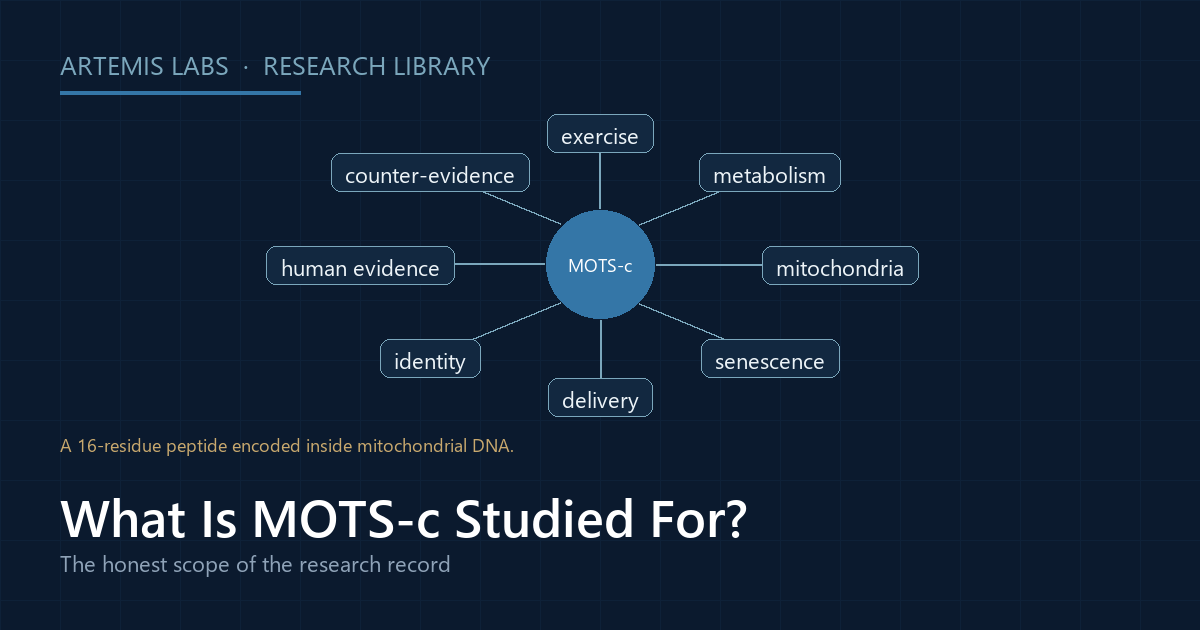
MOTS-c — answer capsule: MOTS-c is a peptide of 16 amino acids whose coding instructions sit inside mitochondrial DNA rather than inside the DNA in a cell’s nucleus. A group at the University of Southern California reported it in 2015, describing a short reading frame tucked inside the mitochondrial 12S ribosomal RNA gene. Published MOTS-c research falls into three areas: metabolism and energy signalling studied in mice and in cell culture, MOTS-c measured as a blood marker in people during exercise or illness, and a natural human mitochondrial DNA variant that changes one letter of the peptide. No published human interventional trial of MOTS-c exists in any of those areas. A Phase 2a trial of the peptide itself began recruiting in February 2026 and has reported nothing.
Key findings
- The discovery paper (mouse and cell-culture work, Cell Metab 2015, PMID 25738459) reports “a sORF within the mitochondrial 12S rRNA encoding a 16-amino-acid peptide named MOTS-c” — a short reading frame in mitochondrial DNA, not nuclear DNA.
- Every efficacy statement in that founding paper is a mouse result, in the authors’ own words: “MOTS-c treatment in mice prevented age-dependent and high-fat-diet-induced insulin resistance” (PMID 25738459).
- Roughly thirty published human MOTS-c papers exist, and none of them gave MOTS-c to a person. Each either measured MOTS-c as a blood marker inside somebody else’s intervention, or was observational.
- A 2026 systematic review of MOTS-c and exercise (human and animal studies, Physiol Int 2026, PMID 42640735) included nine studies in total and concluded “current evidence is limited, particularly in human studies.”
What is MOTS-c, in plain words?
A peptide is a short chain of amino acids — the same building blocks proteins are made from, just fewer of them. MOTS-c has 16, in this order: Met-Arg-Trp-Gln-Glu-Met-Gly-Tyr-Ile-Phe-Tyr-Pro-Arg-Lys-Leu-Arg. Written in the one-letter shorthand chemists use, that is MRWQEMGYIFYPRKLR.
What makes it unusual is where the instructions for building it are kept. Almost every protein in the body is coded in the DNA inside a cell’s nucleus. Mitochondria — the small compartments inside cells that produce most of a cell’s usable energy — carry their own tiny separate loop of DNA, and MOTS-c is coded there. The specific stretch is a gene called MT-RNR1, better known as the 12S ribosomal RNA gene. Two independent reviews state this plainly: “The 12S ribosomal RNA (MT-RNR1) gene harbors the sequence for MOTS-c” (PMID 32776825), and “MOTS-c sequence is hidden in the 12 S rRNA gene (MT-RNR1)” (PMID 37437978).
The name is an abbreviation of that origin story: mitochondrial open reading frame of the 12S rRNA type-c. MOTS-c belongs to a small family called mitochondrial-derived peptides; humanin was the first one described, and the rest come from a different mitochondrial gene. The exact chemical identifiers — formula, registry number, database record — are on our MOTS-c sequence and identity page, and the compound itself is catalogued as MOTS-c.
What research areas has it been studied in?
Three, and they are not equally strong.
Metabolism and cellular energy signalling. This is the largest area and it is almost entirely preclinical. The 2015 discovery paper reported that in mice, MOTS-c treatment “prevented age-dependent and high-fat-diet-induced insulin resistance, as well as diet-induced obesity,” and proposed that it acts through an energy-sensing enzyme called AMPK (PMID 25738459). A 2018 cell-culture and mouse study reported that MOTS-c “translocates to the nucleus and regulates nuclear gene expression following metabolic stress” (PMID 29983246). A 2021 mouse study reported that late-life intermittent treatment “can increase physical capacity and healthspan in mice” (PMID 33473109). Read those three sentences again and notice what they all have in common: mice and cells.
MOTS-c as a blood marker. Researchers can measure how much MOTS-c is circulating in a person’s blood, and dozens of studies have done exactly that: at rest and again following an exercise session, in people with diabetes, kidney disease, heart attacks, cancer and more. These studies are informative about the body’s own MOTS-c. They are not tests of giving anyone MOTS-c, and the measurement itself has a serious problem covered below.
Human genetics. This is the strongest human evidence, and it is not interventional either. A single-letter change in mitochondrial DNA, written m.1382A>C, produces a version of the peptide called K14Q. A meta-analysis of three Japanese cohorts totalling 27,527 people reported that “males but not females with the C-allele exhibit a higher prevalence of T2D” (PMID 33468709). Later genetic studies in Japanese and Korean populations found the same variant associated with higher, not lower, measured muscle strength in men. The genetics are interesting and internally contradictory; they are covered further on our MOTS-c exercise and metabolism research page.
What has been tested in people?
Nothing has been published. That is the whole answer, and it is worth stating without softening.
Two interventional trials involving MOTS-c or a related article exist on the public registry. One completed in 2021, was run by a company under an internal drug code, posted no results, and produced no publication — and the article it tested cannot be confirmed to be MOTS-c at all. The other, NCT07505745, is a Phase 2a study of MOTS-c itself, sponsored by Hudson Biotech, quadruple-masked, with an estimated 120 participants in prediabetes and overweight or obesity. It began recruiting on February 2, 2026. Its registry record shows no results. The full registry detail on both is on our MOTS-c human evidence page, and MOTS-c sits alongside the other compounds in this area on our longevity and cellular research topic page.
What the research does not show
There is no published human interventional evidence for MOTS-c of any kind. A search of PubMed for MOTS-c paired with the publication type “meta-analysis” returns zero records; paired with “double-blind” it returns zero. No independent replication study of any MOTS-c finding is indexed in PubMed, in either direction. No published human safety data exists — the only registered trial with safety as its primary purpose posted no results.
Two findings run directly against the way this compound is usually marketed, and both belong on an introductory page. A 2026 study from the Mayo Clinic in human mesenchymal stromal cells and a mouse model found that MOTS-c “reduced proliferation, increased expression of senescence-associated genes (p16, p21), and upregulated TNF-α,” and concluded it “may paradoxically exacerbate senescence and inflammation” (PMID 42324588). A 2018 review of senescent cells carries the title Mitochondrial-Derived Peptides Exacerbate Senescence and reports that humanin and MOTS-c both increase the release of inflammatory signals from those cells (PMID 30058454).
The blood-marker literature also rests on shakier ground than it looks. An anti-doping laboratory in Cologne built a mass-spectrometry method for MOTS-c and compared it against the commercial antibody test that nearly every published study uses. Their report states that endogenous levels measured by that antibody test “could not be confirmed by LC/MS,” with “considerable differences in measured MOTS-c levels” (PMID 30394592). Published healthy-control values across studies span roughly four orders of magnitude for the same substance.
Frequently asked questions
Is MOTS-c a peptide or something else?
A peptide — a 16-amino-acid chain. What sets it apart is that its coding sequence sits in mitochondrial DNA rather than in the nucleus.
Has MOTS-c ever been given to people in a published study?
No. Every published human MOTS-c paper either measured the peptide as a blood marker during a different intervention, or was observational. A Phase 2a trial of the peptide has been recruiting since February 2026 and has reported nothing.
Does the body make MOTS-c on its own?
Yes — that is how it was discovered, and it is why it can be measured in blood. Whether exercise reliably raises it is contested: one randomized study reported only that MOTS-c “showed a trend to increase” after endurance exercise (PMID 34351816), and eight weeks of training in another study “did not show any changes” (PMID 31066084).
Is MOTS-c approved for anything?
No. Its PubChem record carries no FDA Orange Book entry, no drug indication and no labelling data. A 2026 sports-medicine review lists MOTS-C among “unapproved peptides marketed direct to patients” and states that “rigorous human safety data are scarce” (PMID 41966639).
References
- The mitochondrial-derived peptide MOTS-c promotes metabolic homeostasis and reduces obesity and insulin resistance. Cell Metab, 2015. Mouse and cell culture. PMID 25738459 · doi:10.1016/j.cmet.2015.02.009
- Mitochondrial-derived peptides in aging and healthspan. Am J Physiol Endocrinol Metab, 2020. Review; source of the MT-RNR1 gene attribution. PMID 32776825 · doi:10.1152/ajpendo.00249.2020
- Mitochondrial-derived peptides. Adv Protein Chem Struct Biol, 2023. Review. PMID 37437978
- The Mitochondrial-Encoded Peptide MOTS-c Translocates to the Nucleus to Regulate Nuclear Gene Expression in Response to Metabolic Stress. Cell Metab, 2018. Cell lines and mouse. PMID 29983246 · doi:10.1016/j.cmet.2018.06.008
- MOTS-c is an exercise-induced mitochondrial-encoded regulator of age-dependent physical decline and muscle homeostasis. Nat Commun, 2021. Mouse, with a human observational component. PMID 33473109 · doi:10.1038/s41467-020-20790-0
- A pro-diabetogenic mtDNA polymorphism in the mitochondrial-derived peptide, MOTS-c. Aging (Albany NY), 2021. Human genetic association (n = 27,527) plus mouse. PMID 33468709 · doi:10.18632/aging.202529
- Acute endurance exercise stimulates circulating levels of mitochondrial-derived peptides in humans. J Appl Physiol (1985), 2021. Human randomized. PMID 34351816 · doi:10.1152/japplphysiol.00706.2019
- Lipids and insulin regulate mitochondrial-derived peptide (MOTS-c) in PCOS and healthy subjects. Clin Endocrinol (Oxf), 2019. Human interventional, MOTS-c measured as a marker. PMID 31066084 · doi:10.1111/cen.14007
- Mitochondrial-derived peptide MOTS-c activates metabolic signaling but blunts reparative function in human mesenchymal stromal cells. Inflamm Regen, 2026. Human cells and mouse. PMID 42324588 · doi:10.1186/s41232-026-00431-7
- Mitochondrial-Derived Peptides Exacerbate Senescence. Rejuvenation Res, 2018. Review of senescent-cell findings. PMID 30058454
- Detection of MOTS-c in plasma by LC/MS for doping control purposes. Rapid Commun Mass Spectrom, 2019. Analytical validation study. PMID 30394592
- Systematic review of MOTS-c and exercise. Physiol Int, 2026. Nine studies included. PMID 42640735 · doi:10.1556/2060.2026.00863
- Review of approved and unapproved peptides marketed direct to patients. Sports Med, 2026. PMID 41966639 · doi:10.1007/s40279-026-02437-0
- ClinicalTrials.gov record NCT07505745, Hudson Biotech, Phase 2a, estimated enrolment 120, recruiting since February 2, 2026, no results posted. Retrieved August 27, 2026.
Methodology: this page draws only on the Artemis Labs MOTS-c fact base, built from PubChem, PubMed and ClinicalTrials.gov primary records, last verified August 27, 2026.
All compounds sold by Artemis Labs are for laboratory research use only. Nothing on this page is medical advice, and no statement has been evaluated by the FDA.
