
MOTS-c Sequence and Identity: CID, CAS, Formula | Artemis Labs
Aug
MOTS-c sequence and identity: the verified identifiers, and the isomer that defeats a weight check
Published August 26, 2026 · Artemis Labs
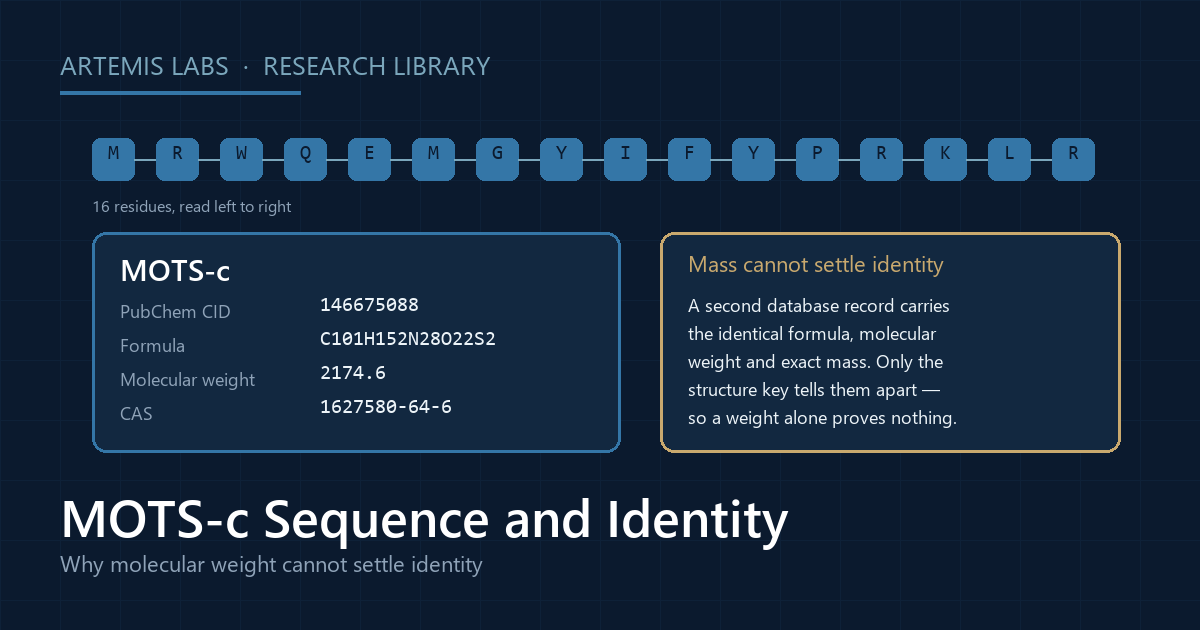
MOTS-c — answer capsule: MOTS-c is a 16-amino-acid peptide with the sequence MRWQEMGYIFYPRKLR, indexed by PubChem as CID 146675088, molecular formula C101H152N28O22S2, molecular weight 2174.6, exact mass 2174.1110958, CAS 1627580-64-6, InChIKey WYTHCOXVWRKRAH-LOKRTKBUSA-N. Searching PubChem by the name “MOTS-c peptide” instead returns a different record, CID 176489569, whose backbone is drawn incorrectly but whose formula, molecular weight and exact mass are all identical to the correct record. Only the InChIKey separates them, which means a document check that compares molecular weight passes on the wrong molecule. Identity for this compound must be verified by CID or InChIKey, or by sequence with mass spectrometry — never by molecular weight alone.
Key findings
- Verified record: CID 146675088 — C101H152N28O22S2, molecular weight 2174.6, exact mass 2174.1110958, monoisotopic mass 2173.1077409, CAS 1627580-64-6, InChIKey WYTHCOXVWRKRAH-LOKRTKBUSA-N.
- Sequence, 16 residues: Met-Arg-Trp-Gln-Glu-Met-Gly-Tyr-Ile-Phe-Tyr-Pro-Arg-Lys-Leu-Arg (MRWQEMGYIFYPRKLR), with a free amino end and a free acid end — the parent record is neither acetylated nor amidated.
- The trap: CID 176489569 carries the identical formula, weight and exact mass but a different InChIKey (ATGVJAXVFWXNLG-ZIEMQXFBSA-N), one synonym, no CAS number, and a mis-drawn backbone at residue 6.
- R13A-MOTS-c is an engineered laboratory variant (PMID 42142418); K14Q is a naturally occurring human variant produced by the mitochondrial DNA change m.1382A>C (PMID 33468709). They are not the same thing and neither is MOTS-c.
The sequence, and why it settles everything else
A peptide is a chain of amino acids, and the chain is the identity. MOTS-c has 16 links, written from the amino end to the acid end: Met-Arg-Trp-Gln-Glu-Met-Gly-Tyr-Ile-Phe-Tyr-Pro-Arg-Lys-Leu-Arg. In one-letter shorthand that is MRWQEMGYIFYPRKLR. PubChem lists the chain in both conventions and in the form H-MRWQEMGYIFYPRKLR-OH, which is the notation for a free amino end and a free acid end.
That last detail is easy to skip and worth keeping. Some peptides are sold with a chemically capped end — an acetyl group at the front, an amide at the back — and those are different molecules with different weights. The parent MOTS-c record is capped at neither end.
The formula follows from the chain. Adding up the standard compositions of those 16 residues and adding one water molecule for the free ends gives C101H152N28O22S2, which is exactly what PubChem returns. The two sulfur atoms come from the two methionines, at positions 1 and 6. That arithmetic is the strongest cross-check available: the formula and the sequence describe the same molecule, so a document that lists this sequence beside a different formula has contradicted itself.
Where the sequence comes from is covered on our introduction to what MOTS-c is studied for; the compound is catalogued as MOTS-c.
The verified identity block
Every value below was read from PubChem record 146675088 on August 27, 2026.
| PubChem CID | 146675088 |
| Record title | Mots-c |
| Sequence | MRWQEMGYIFYPRKLR (16 residues) |
| Molecular formula | C101H152N28O22S2 |
| Molecular weight | 2174.6 |
| Exact mass | 2174.1110958 |
| Monoisotopic mass | 2173.1077409 |
| CAS number | 1627580-64-6 (curated) |
| InChIKey | WYTHCOXVWRKRAH-LOKRTKBUSA-N |
| Terminal chemistry | Free amino end, free acid end — not acetylated, not amidated |
| Encoded by | Mitochondrial 12S ribosomal RNA gene, MT-RNR1 (PMID 32776825) |
Three notes on that table. The CAS number is curated by PubChem and solid; it was previously reported inconsistently across supplier pages, and it is now settled. A UNII code, A5CV6JFB78, does circulate for this molecule, but on PubChem it appears only inside the depositor-supplied synonym list — the record’s curated “Other Identifiers” section contains just the CAS number and a Wikipedia link. It is honest to report the UNII as a depositor synonym; it is not honest to present it as a curated identifier. And the gene attribution comes from published literature, not from PubChem: the PubChem description endpoint for this record returns a title and nothing else.
The isomer trap, and why molecular weight cannot settle identity here
PubChem resolves the name “MOTS-c” to CID 146675088. It resolves the name “MOTS-c peptide” — two words most people would consider equivalent — to CID 176489569. These are not the same record.
| CID 146675088 | CID 176489569 | |
| Molecular formula | C101H152N28O22S2 | C101H152N28O22S2 — identical |
| Molecular weight | 2174.6 | 2174.6 — identical |
| Exact mass | 2174.1110958 | 2174.1110958 — identical |
| InChIKey | WYTHCOXVWRKRAH-LOKRTKBUSA-N | ATGVJAXVFWXNLG-ZIEMQXFBSA-N — different |
| Synonyms held | 20, including the CAS number | One: “MOTS-c Peptide” |
The second record is a structural isomer, meaning it contains the same atoms arranged differently. The difference is in the backbone. In CID 176489569 the methionine at position 6 is not joined by an ordinary peptide bond; it is drawn as a side group hanging off a urea-type nitrogen. That is a drawing error, not a real variant of the biological peptide.
Now consider what a routine check would do with that. Formula: matches. Molecular weight: matches. Exact mass: matches. Every field a spreadsheet or a supplier document usually carries agrees, and the check passes on the wrong molecule. The only field that disagrees is the InChIKey — a fixed-length fingerprint calculated from the structure itself, where the first block encodes the skeleton and the later blocks encode stereochemistry and charge.
So the rule for this compound is specific: verify by CID or InChIKey, or by confirming the sequence with high-resolution mass spectrometry and fragmentation. A molecular weight comparison is not a verification here, and neither is a name search.
Two smaller hazards sit on the same record. PubChem’s depositor synonym list contains the string “amide-Met-Arg-Trp-Gln-Glu-Met-Gly-Tyr-Ile-Phe-Tyr-Pro-Arg-Lys-Leu-Arg-acid”, which asserts an amide end and an acid end on the same molecule — internally contradictory, and it should never be quoted. And for anyone pulling these fields programmatically, PubChem now returns the connectivity structure under the key ConnectivitySMILES; code asking for the older CanonicalSMILES key receives nothing back, with no error raised.
A correction we made to our own record
Until August 27, 2026 our published formula for MOTS-c carried one carbon atom and six hydrogen atoms too many. The molecular weight we published alongside it, around 2,174.7, was close enough to the true 2174.6 that the formula error survived every weight-based check for as long as it was on the page. It was caught by re-fetching the PubChem record and re-deriving the formula from the sequence, and it has been corrected everywhere it appeared.
We publish that because it is the same failure mode this page warns about, found on our own site. A weight that looks right is not a molecule that is right.
R13A and K14Q are different things, and neither is MOTS-c
R13A-MOTS-c is engineered — made in a laboratory by changing one residue on purpose. It appears in a 2026 Redox Biology paper titled “LAT1-mediated delivery of engineered R13A-MOTS-c attenuates radiation-induced lung injury via Nrf2 activation and mitochondrial protection” (PMID 42142418). It has no PubChem record of its own.
K14Q-MOTS-c is natural — a version carried by people with the mitochondrial DNA change m.1382A>C, described in a 2021 human genetic study of three Japanese cohorts totalling 27,527 participants (PMID 33468709). It also has no PubChem record.
The reason to keep them straight is not pedantry. In that same 2021 paper, high-fat-fed male mice given MOTS-c “showed reduced weight and improved glucose tolerance, but not K14Q-MOTS-c treated mice.” A single amino-acid change removed the effect in that model. Results obtained with a variant belong to that variant.
What the research does not show
An identifier tells you what a molecule is. It tells you nothing about what that molecule does, and nothing on this page should be read as evidence of an effect.
The evidence base behind this compound is thin, which is worth saying on an identity page precisely because precise chemistry is so often mistaken for strong evidence. There are zero published human interventional trials of MOTS-c. A PubMed search paired with the publication type meta-analysis returns zero records, and paired with “double-blind” returns zero. No independent replication of any MOTS-c finding is indexed. The registry detail — a company trial that completed in 2021 without posting results, and a Phase 2a recruiting since February 2026 with nothing reported — is on our MOTS-c human evidence page.
PubChem’s own regulatory annotations for CID 146675088 are empty in every direction that would matter. The FDA Orange Book heading returns “no data found.” So does the drug indication heading. There is no DrugBank section and no labelling data. The single drug-related section on the record contains only a pointer to a clinical trial registry — which is a record that approval has not been granted, not evidence that it has.
Finally, the database record describes a curated structure, not any vendor’s material. Only analysis of a specific batch can describe that batch, and no identifier on this page substitutes for one.
Frequently asked questions
What is the correct molecular formula for MOTS-c?
C101H152N28O22S2, from PubChem CID 146675088, with a molecular weight of 2174.6 and an exact mass of 2174.1110958. A variant formula carrying one extra carbon and six extra hydrogens circulates and is wrong — it sat on this site until recently, and it is corrected.
Why is a molecular weight check not enough?
Because a mis-drawn isomer indexed under the name “MOTS-c peptide” carries the identical formula, molecular weight and exact mass. Only the InChIKey distinguishes the two records.
Does MOTS-c have a CAS number?
Yes: 1627580-64-6, curated on PubChem. A CAS number identifies a substance. It is not a purity level, a quality grade or an approval.
Is R13A-MOTS-c the same as the K14Q variant?
No. R13A is engineered in a laboratory and appears in a 2026 lung-injury study; K14Q occurs naturally in people carrying the m.1382A>C mitochondrial DNA change. Neither is MOTS-c, and results from either cannot be transferred to it.
References
- PubChem Compound Summary, CID 146675088 (Mots-c). https://pubchem.ncbi.nlm.nih.gov/compound/146675088 — sequence MRWQEMGYIFYPRKLR, formula C101H152N28O22S2, molecular weight 2174.6, exact mass 2174.1110958, monoisotopic mass 2173.1077409, CAS 1627580-64-6, InChIKey WYTHCOXVWRKRAH-LOKRTKBUSA-N. Retrieved August 27, 2026.
- PubChem Compound Summary, CID 176489569 (“MOTS-c Peptide”). https://pubchem.ncbi.nlm.nih.gov/compound/176489569 — identical formula, molecular weight and exact mass to CID 146675088; InChIKey ATGVJAXVFWXNLG-ZIEMQXFBSA-N; one synonym; no CAS number; residue 6 drawn as a side group on a urea-type nitrogen rather than as a peptide-bonded residue. Retrieved August 27, 2026.
- PubChem heading enumeration for CID 146675088: FDA Orange Book and Drug Indication headings both return “No data found”; no DrugBank section; the sole drug-related section is a ClinicalTrials.gov pointer. Curated “Other Identifiers” contains CAS and Wikipedia only; the UNII A5CV6JFB78 appears in the depositor-supplied synonym list. Retrieved August 27, 2026.
- Mitochondrial-derived peptides in aging and healthspan. Am J Physiol Endocrinol Metab, 2020. Source of the MT-RNR1 gene attribution. PMID 32776825 · doi:10.1152/ajpendo.00249.2020
- The mitochondrial-derived peptide MOTS-c promotes metabolic homeostasis and reduces obesity and insulin resistance. Cell Metab, 2015. Discovery paper; mouse and cell culture. PMID 25738459 · doi:10.1016/j.cmet.2015.02.009
- A pro-diabetogenic mtDNA polymorphism in the mitochondrial-derived peptide, MOTS-c. Aging (Albany NY), 2021. Human genetic association plus mouse; source of the K14Q variant. PMID 33468709 · doi:10.18632/aging.202529
- LAT1-mediated delivery of engineered R13A-MOTS-c attenuates radiation-induced lung injury via Nrf2 activation and mitochondrial protection. Redox Biol, 2026, vol. 94. Engineered variant. PMID 42142418 · doi:10.1016/j.redox.2026.104204
Methodology: every identifier on this page was fetched directly from PubChem’s compound records for CID 146675088 and CID 176489569 and read from curated identifier headings rather than depositor synonym lists, with the formula independently re-derived from the sequence; last verified August 27, 2026.
All compounds sold by Artemis Labs are for laboratory research use only. Nothing on this page is medical advice, and no statement has been evaluated by the FDA.
