NAD+ vs Precursor Trials: Whose Evidence Is Whose? | Artemis Labs
Aug
NAD+ direct evidence vs precursor evidence: whose results are whose?
Published August 26, 2026 · Artemis Labs
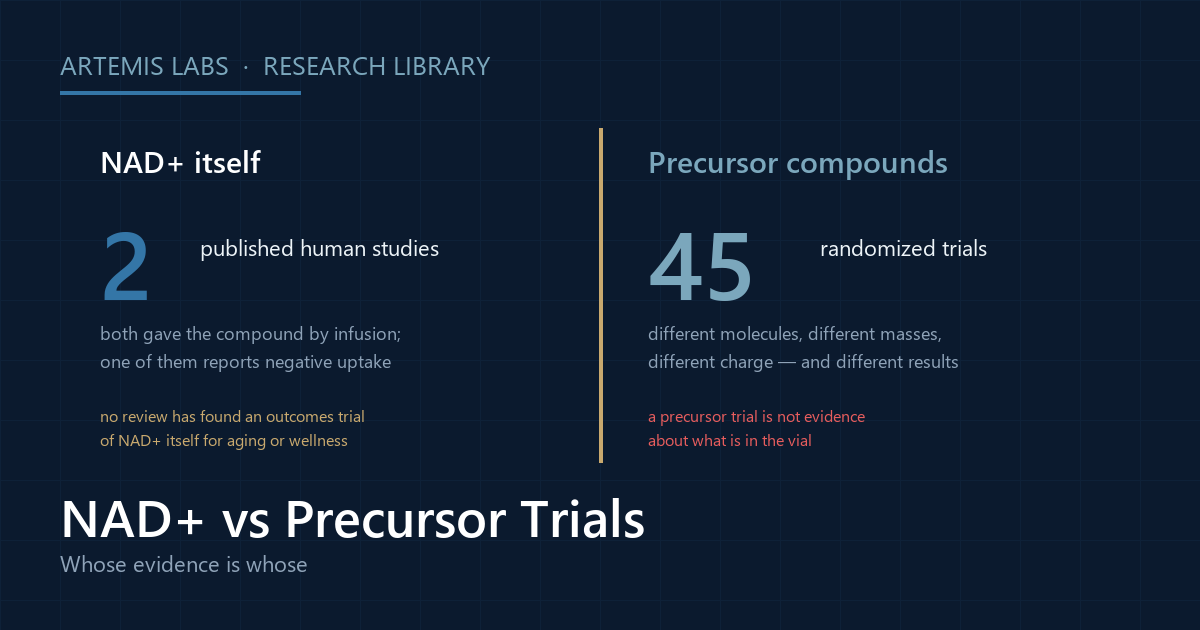
NAD+ direct versus precursor evidence — answer capsule: exactly two published human studies have administered NAD+ (nicotinamide adenine dinucleotide) itself, both by intravenous infusion: a 180-patient randomized placebo-controlled heart-failure trial and an eleven-person open-label pharmacokinetic pilot. By contrast, roughly 45 randomized human trials have tested the precursor molecules nicotinamide riboside (NR) or nicotinamide mononucleotide (NMN). NR, NMN, and NAD+ are three different molecules with three different masses, and a trial of one is not evidence about another. A 2026 PRISMA-guided systematic review, searching the literature through October 2025, found no eligible outcomes trial of NAD+ given directly for aging or wellness indications. Nearly everything sold to consumers as “NAD+ research” is research on something else.
Key findings
- The ratio is the story: 2 versus 45. Two published human studies of NAD+ itself, both intravenous (direct NAD+: PMID 40954388, n=180; PMID 31572171, n=11), against a PubMed count of 45 randomized controlled trials of the precursors NR or NMN in humans.
- The 2026 systematic review found no eligible outcomes trial of NAD+ given directly for aging or wellness indications, searching through October 2025 — its verbatim sentence is quoted in full below (PRISMA-guided review spanning both direct and precursor studies, PMID 41655607).
- Three molecules, three masses. NAD+ is PubChem CID 5892, molecular weight 663.4. NMN is CID 14180, weight 334.22. NR is CID 439924, weight 255.25 and permanently charged. These are not close, and results do not transfer among them.
- The conflation is baked into the sources themselves. A completed registered trial whose title opens with the words “NAD Therapy” (NCT03482167) administered oral nicotinamide riboside capsules — a precursor, not NAD+. Citing it by title publishes NAD+ evidence that does not exist; the full title is quoted below.
Why are NAD+ and its precursors different questions?
A precursor is a starting material: a molecule a cell can take in and convert, through its own enzymes, toward NAD+. The two precursors that dominate the human literature are nicotinamide riboside (NR) and nicotinamide mononucleotide (NMN). Chemically, the relationship is simple to state. NMN is roughly half of an NAD+ molecule. NR is NMN without its phosphate group. In PubChem’s records, NAD+ weighs 663.4 (CID 5892), NMN weighs 334.22 (CID 14180), and NR weighs 255.25 with a permanent positive charge (CID 439924).
Because a cell processes each of these differently, a study of one answers a question about that one. An NR pill trial measures what swallowed NR does. It cannot measure what NAD+ itself does when delivered as NAD+, because the swallowed material is a different compound taking a different path. This is the whole reason the distinction is worth a page: our page on what NAD+ is studied for covers the compound broadly, but the evidence question turns entirely on who was actually given what.
How much human evidence exists on each side of the line?
On the direct side: two published studies, both intravenous. The larger is a randomized, placebo-controlled, single-center trial in 180 adults with heart failure from ischemic cardiomyopathy, in which the one primary endpoint reached statistical significance and every secondary measure was a non-significant trend (direct NAD+, PMID 40954388). The smaller is an eleven-person open-label pilot whose central finding was that infused NAD+ was rapidly and completely removed from the plasma for at least the first two hours (direct NAD+, PMID 31572171). Both are reported in full detail, both halves of each, on our NAD+ human evidence page.
On the precursor side: a PubMed search for randomized controlled trials of NR or NMN in humans returns a count of 45.
The 2026 PRISMA-guided systematic review of the whole field identified 113 eligible studies — 33 human intervention studies and 80 rodent studies — and its finding on direct administration reads, verbatim: No eligible outcomes trials evaluated intravenous or intramuscular NAD⁺ itself for anti-aging or wellness indications. (PMID 41655607.) One precision point so the record stays straight: that review searched through October 2025, and the 180-patient trial was published in 2026 for a heart-failure indication. Both statements are true at once. There are zero direct-NAD+ trials for aging or wellness outcomes, and exactly one direct-NAD+ randomized trial overall, in cardiology. The review also classified the eleven-person pilot as contextual evidence only, its own words.
Why can’t a precursor pill trial speak for NAD+ in a vial?
Because the confusion is not just a marketing habit — it is written into the titles of the primary records, and only opening each record catches it.
Trap one: a trial titled “NAD Therapy” that gave no NAD+. NCT03482167, a completed University of Delaware trial in 64 older adults, is registered under the title NAD Therapy for Improving Memory and Brain Blood Flow in Older Adults With Mild Cognitive Impairment. Its registered intervention is Niagen — oral nicotinamide riboside capsules. That is a precursor trial wearing an NAD+ title.
Trap two: an “intravenous NAD⁺” paper that is neither NAD+ nor human. A 2026 paper on the agent MP-04 carries intravenous and NAD⁺ augmentation in its title, and its authors describe MP-04 as a novel intravenous formulation of dihydronicotinamide riboside (NRH) — a precursor — tested in cell lines, rats, mice, and dogs, with no human administration whatsoever (precursor, preclinical only, PMID 42358367).
Trap three: “NAD” doesn’t always mean NAD. Inside the eleven PubMed records matching “NAD infusion”-type phrases sits a paper in anesthetized dogs where NAD stands for noradrenaline. Raw keyword counts in this field cannot be trusted without reading each record.
What do the precursor trials themselves show — and why does it cut both ways?
The honest answer is: target engagement, mixed function. Precursor trials reliably raise NAD+ levels in blood. What they have often failed to change is anything a person could feel or a clinician could treat. The examples below are all randomized human trials of oral NR — precursor evidence, labeled as such, never NAD+ evidence:
- A randomized placebo-controlled trial of oral NR in obese men (precursor) found insulin sensitivity, glucose metabolism, resting energy expenditure, and body composition
not improved by NR supplementation(PMID 29992272). - A randomized trial of oral NR in healthy obese adults (precursor) found
no effects of NRon insulin sensitivity, mitochondrial function, cardiac energy status, blood pressure, inflammation markers, or energy metabolism (PMID 32320006). - A randomized double-blind crossover trial of oral NR in chronic kidney disease (precursor) found no differences in peak oxygen uptake or total work, and one measure moved significantly in the wrong direction (PMID 37159264).
- A randomized trial of oral NR in aged human muscle (precursor) raised the muscle’s NAD+ metabolome
without altering mitochondrial bioenergetics— the null is inside the positive-sounding title (PMID 31412242). - A 2025 randomized precursor trial of NR in long-COVID patients raised whole-blood NAD+ to 2.6–3.1 times baseline with no significant cognitive or symptom benefit (PMID 41357333) — the clearest demonstration that lifting the level and changing an outcome are separate events.
Notice what this caution does in both directions. The precursor positives cannot be borrowed to make the vial look proven. But the precursor nulls cannot be borrowed to make the vial look disproven, either. They are results about NR and NMN. NAD+ itself has been tested in humans twice, and that thin direct record — not the precursor record, glowing or gloomy — is the evidence base for the compound in the vial.
What the research does not show
No published human study of NAD+ itself has measured an aging, longevity, cognition, or energy outcome. The two direct studies had a cardiology endpoint and a pharmacokinetic endpoint, and the 2026 systematic review found no eligible direct-administration outcomes trial for aging or wellness indications through October 2025 (PMID 41655607).
- No head-to-head result exists. The only registered trial designed to compare intravenous NAD+ against an intravenous precursor (NCT06382688) has a status of unknown and no located results. It is a registered design, not a finding.
- Precursor “target engagement” is not a functional claim. The systematic review’s own summary: effects on functional, metabolic, vascular, and other healthspan-relevant outcomes were
heterogeneous and often null or endpoint-specific. - Nothing here establishes what a raised NAD+ level means. The long-COVID precursor trial raised blood NAD+ roughly threefold and changed no functional outcome. A number moving in a blood test is not, by itself, a benefit.
Frequently asked questions
If NR and NMN raise NAD+ levels, isn’t that the same as giving NAD+?
No. Raising a level through a cell’s own conversion machinery and delivering the finished molecule from outside are different events, studied in different trials with different results. The one human study that measured infused NAD+ directly found it was cleared from plasma for the first two hours rather than raising the level (direct NAD+, PMID 31572171).
Do the 45 precursor trials prove the precursors work?
They prove the precursors raise NAD+-related blood measures and are generally tolerated over weeks to months. On outcomes that matter functionally, the 2026 systematic review found results heterogeneous and often null. Several of the cleanest trials, quoted above, found no improvement on any primary measure.
Why does a research supplier care about this distinction?
Because attribution is the product. A researcher choosing a compound needs to know which literature belongs to it. Merging precursor trials into the NAD+ column would misstate the evidence for every molecule involved.
References
- Effects of nicotinamide riboside on NAD+ levels, cognition, and symptom recovery in long-COVID: a randomized controlled trial. EClinicalMedicine, 2025. PMID 41357333
- Am J Cardiovasc Drugs, 2026. Randomized, placebo-controlled, single-center trial of intravenous NAD+ in 180 adults with ischemic-cardiomyopathy heart failure (direct NAD+). PMID 40954388 · DOI 10.1007/s40256-025-00764-7
- Front Aging Neurosci, 2019.
A Pilot Study Investigating Changes in the Human Plasma and Urine NAD+ Metabolome During a 6 Hour Intravenous Infusion of NAD.n=11, open-label (direct NAD+). PMID 31572171 · DOI 10.3389/fnagi.2019.00257 - Ageing Res Rev, 2026. PRISMA-guided systematic review of NAD-related compounds, human and rodent intervention studies, January 2010–October 2025; title-free citation. PMID 41655607 · DOI 10.1016/j.arr.2026.103057
- Am J Clin Nutr, 2018. Randomized placebo-controlled trial of oral nicotinamide riboside in obese men (precursor), University of Copenhagen. PMID 29992272 · DOI 10.1093/ajcn/nqy132
- Am J Clin Nutr, 2020. Randomized trial of oral nicotinamide riboside in healthy obese humans (precursor), Maastricht University. PMID 32320006 · DOI 10.1093/ajcn/nqaa072
- JCI Insight, 2023. Randomized, double-blind, placebo-controlled crossover trial of coenzyme Q10 and nicotinamide riboside in chronic kidney disease (precursor), UC Davis. PMID 37159264 · DOI 10.1172/jci.insight.167274
- Cell Rep, 2019. Randomized trial of oral nicotinamide riboside in aged human skeletal muscle (precursor), University of Birmingham. PMID 31412242 · DOI 10.1016/j.celrep.2019.07.043
- Front Pharmacol, 2026. Preclinical profiling of MP-04, an intravenous formulation of dihydronicotinamide riboside (precursor; cell lines, rats, mice, dogs; no human administration). PMID 42358367 · DOI 10.3389/fphar.2026.1832979
- ClinicalTrials.gov records NCT03482167 (oral nicotinamide riboside, University of Delaware, completed, n=64) and NCT06382688 (registered intravenous head-to-head design, status unknown, no results located); retrieved via API v2, August 27, 2026.
- PubChem Compound records CID 5892 (NAD+), CID 14180 (NMN), CID 439924 (NR); retrieved August 27, 2026.
Methodology: this page draws on PubMed records and search counts retrieved through NCBI E-utilities, ClinicalTrials.gov API v2 records verified individually, PubChem PUG REST records, and publisher full text for one pilot study, with every quoted string transcribed verbatim from the named source; last verified August 27, 2026.
All compounds sold by Artemis Labs are for laboratory research use only. Nothing on this page is medical advice, and no statement has been evaluated by the FDA.
