
NAD+ Human Evidence: The Two Direct Studies | Artemis Labs
Aug
NAD+ human evidence: what the two direct studies actually found
Published August 26, 2026 · Artemis Labs
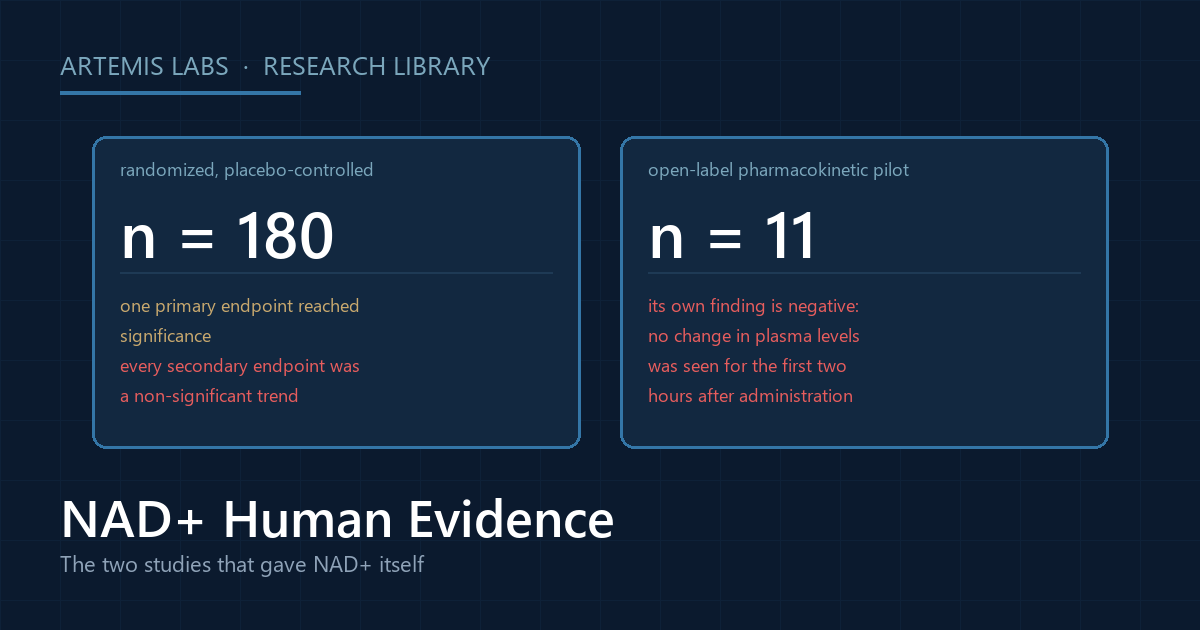
NAD+ human evidence — answer capsule: two published human studies have administered NAD+ (nicotinamide adenine dinucleotide) itself, both by intravenous infusion. The first is a 2026 randomized, placebo-controlled, single-center trial in 180 heart-failure patients in China, in which the primary endpoint — an ultrasound measure of the heart’s pumping fraction — reached statistical significance at p=0.024 while every secondary measure was a non-significant trend. The second is a 2019 open-label pilot in eleven Australian men whose central finding was negative: infused NAD+ produced no measurable change in plasma NAD+ or its breakdown products for the first two hours, and the authors’ own word for this was “Surprisingly.” No published human study of NAD+ itself has measured an aging, cognition, or energy outcome. Artemis Labs supplies NAD+ as a laboratory research compound.
Key findings
- One significant endpoint, five non-significant ones, in the same trial. The n=180 randomized placebo-controlled trial of intravenous NAD+ (direct NAD+) reported a significantly greater improvement in left-ventricular ejection fraction at one month,
45.44 ± 8.55% vs. 42.44 ± 9.09%, p = 0.024— and every secondary measure, from a heart-stress blood marker to six-month hospitalizations, carried a p-value above 0.05 (PMID 40954388). - The pharmacokinetic pilot’s finding is negative bioavailability. In the eleven-person open-label infusion pilot (direct NAD+),
no change in plasma (NAD+) or metabolites … were observed until after 2 h; the infused compound wasrapidly and completely removed from the plasma(PMID 31572171). - Neither study measured a longevity outcome. One tested a heart-failure indication; the other measured blood and urine chemistry. A 2026 PRISMA-guided systematic review found no eligible outcomes trial of directly administered NAD+ for aging or wellness indications through October 2025 (PMID 41655607).
- How NAD+ enters cells — or whether it does intact — is genuinely contested in the published literature, with the pilot’s authors proposing channel-mediated entry and independent reviews documenting that a surface enzyme, CD38, breaks extracellular NAD+ down (PMIDs 31783629, 32668623).
What did the randomized heart-failure trial find?
The larger of the two direct-NAD+ studies was published in 2026 by a cardiology group at the University of Science and Technology of China (PMID 40954388). It enrolled 180 adults with heart failure caused by ischemic cardiomyopathy — heart muscle weakened by poor blood supply — whose ejection fraction (the share of blood the heart pumps out per beat) was 45% or below. Patients were randomly assigned to seven days of intravenous NAD+ or a matching placebo. Randomized: yes. Placebo-controlled: yes. Blinded: not stated anywhere in the abstract, and placebo-controlled is not the same claim as double-blind. Single center, one country.
The result comes in two halves, and honesty requires both in the same breath. The primary endpoint was met: at one month the NAD+ group’s ejection fraction improved more than placebo’s, 45.44 ± 8.55% vs. 42.44 ± 9.09%, p = 0.024. And every secondary measure fell short of significance. The heart-stress marker NT-proBNP showed a trend towards decreased levels at day 7 (p=0.102). The six-month rate of major adverse events appeared lower (14.6% vs 24.7%, p=0.089), driven by a trend toward fewer unplanned heart-failure hospitalizations (p=0.078). Improvement in symptom class was non-significant at one month (p=0.088) and six months (p=0.115). Structural heart measurements showed no significant differences. The hedged words are the authors’ own, and every one of those p-values sits above 0.05.
Two more cautions belong here. The abstract’s closing sentence claims the study “confirmed” an effect on cardiac function; a single-center trial with one significant endpoint cannot confirm anything, so we quote the numbers and not that sentence. And the indication was heart failure — not aging, not wellness, not cognition, not energy. The authors themselves note that human research is limited and call for more extensive multicenter trials. What this trial says about the questions NAD+ is usually sold on is: nothing.
What did the infusion pilot find?
The second study, from the Australasian Research Institute in Sydney, is declared a pilot in its own title: A Pilot Study Investigating Changes in the Human Plasma and Urine NAD+ Metabolome During a 6 Hour Intravenous Infusion of NAD. (PMID 31572171). Eleven men aged 30 to 55 took part — eight received NAD+, three received saline. It was open-label, meaning everyone knew who got what, and it is not tagged as a clinical trial of any kind in PubMed. It measured chemistry, not health outcomes.
Its finding is the most commercially inconvenient sentence in the whole NAD+ literature, and the authors flagged their own surprise, verbatim: Surprisingly, no change in plasma (NAD+) or metabolites [nicotinamide, methylnicotinamide, adenosine phosphoribose ribose (ADPR) and nicotinamide mononucleotide (NMN)] were observed until after 2 h. Their numbered conclusions state that NAD+ is rapidly and completely removed from the plasma for at least the first 2 h, that the breakdown products match the work of two NAD+-destroying enzyme families, and that the urine of infused participants contained NAD+ itself and methyl nicotinamide (meNAM) but not NAM — some of the infused compound left the body unchanged.
Read plainly: the one human study that measured what an NAD+ infusion does to blood NAD+ levels found the levels did not rise for two hours, with a chemical signature consistent with the compound being broken down. The 2026 systematic review classified this study as contextual evidence only, and a 2026 narrative review’s verdict on the route is blunt: intravenous NAD+ is less well characterized and lacks robust clinical validation (review, PMID 42489969). This finding is why precursor trials cannot stand in for the vial in either direction — the full accounting is on our direct-versus-precursor evidence page.
Can NAD+ get into cells from outside? The debate, both sides
Why would infused NAD+ vanish from plasma without raising measured levels? The published literature holds two positions, and neither has settled the matter.
Position one — intact entry through channels. The pilot’s authors write that NAD+ is unable to cross cellular membranes passively and therefore must be actively transported across the membrane, and they propose entry of the intact molecule through named channel proteins (P2X7, connexin 43). Those proposed routes are their discussion’s hypothesis, not an established transport finding. One chemistry note: the paper attributes this to the molecule’s negative charge, while PubChem records the net charge of NAD+ as zero — the molecule carries internal positive and negative charges that cancel. The functional point (it cannot simply diffuse through a membrane) is the citable one; “NAD+ is negatively charged” as a bare fact is not. Our identity page unpacks that chemistry.
Position two — destruction at the surface. Independent reviews document that the cell-surface enzyme CD38 metabolizes extracellular NAD+, generating ADPR and cyclic ADPR (review, PMID 31783629), and that surface enzymes including CD38 and CD39 regulate the concentrations of nucleotides outside cells (review, PMID 32668623). A 2026 Mayo Clinic review adds that CD38 acts through NAD+ hydrolysis in immune settings (PMID 41710886).
What is settled: extracellular NAD+ gets broken down at cell surfaces. What is not settled: whether breakdown must happen before anything enters, or whether intact NAD+ also gets in through channels. Neither review states that degradation is a prerequisite for uptake, and the pilot’s channel proposal is unconfirmed. We report the disagreement rather than picking a winner.
What the research does not show
No published human study of NAD+ itself has measured an aging, longevity, cognition, or energy outcome. The direct-NAD+ human record consists of one cardiology trial and one pharmacokinetic pilot, and the 2026 PRISMA-guided review found no eligible direct-administration outcomes trial for aging or wellness indications through October 2025 (PMID 41655607).
- Safety is not established. The pilot reported
No adverse events were observed during the 6 h infusion— eleven men, six hours, open-label. That is a tolerability observation, not a safety record. The 180-patient trial’s abstract reports no safety or adverse-event data at all, an absence we record rather than assume benign. - The claim “an NAD+ infusion raises your NAD+ levels” is contradicted by the only human study that measured it, for at least the first two hours of measurement.
- Blinding of the heart-failure trial is unknown. Randomized and placebo-controlled are verified; double-blind is nowhere stated and may not be written.
- No human data exist for NAD+ by mouth or by any route other than intravenous infusion. The verification pass behind this page searched and located none.
Frequently asked questions
Is there really no other human trial of NAD+ itself?
None published, by any route. Targeted PubMed searches for infused or intravenous NAD+ combined with trial and review filters each resolved to the same two studies plus animal work, reviews, and one false positive where “NAD” meant noradrenaline. A registered Chinese trial in a blood disorder (NCT06776510) mixes direct NAD+ and a precursor in a single study design, so its arms cannot be cleanly attributed, and it has no published results.
Did the heart-failure trial show NAD+ works?
It showed one significant result on one primary endpoint at one month in one center, alongside five secondary measures that all fell short of significance. That is a real signal worth a larger trial — the authors say exactly that — and it is far short of demonstrated benefit. It also says nothing about any use outside heart failure.
Why publish the negative pilot finding on a page about a product we sell?
Because it is the only direct human measurement of the question, and reporting the literature whole — including the parts that cut against the compound — is the standing rule for every research page we write.
References
- Am J Cardiovasc Drugs, 2026.
Effect of Nicotinamide Adenine Dinucleotide on Heart Failure Caused by Ischemic Cardiomyopathy: A Randomized, Placebo-Controlled Trial.n=180, single-center, University of Science and Technology of China (direct NAD+). PMID 40954388 · DOI 10.1007/s40256-025-00764-7 - Front Aging Neurosci, 2019.
A Pilot Study Investigating Changes in the Human Plasma and Urine NAD+ Metabolome During a 6 Hour Intravenous Infusion of NAD.n=11 (test 8, control 3), male, open-label, Australasian Research Institute, Sydney (direct NAD+). PMID 31572171 · DOI 10.3389/fnagi.2019.00257 - Ageing Res Rev, 2026. PRISMA-guided systematic review of NAD-related compounds, human and rodent intervention studies, January 2010–October 2025; title-free citation. PMID 41655607 · DOI 10.1016/j.arr.2026.103057
- Mol Biol Rep, 2026.
NAD⁺ biology and supplementation: From mechanisms to clinical perspectives.Review, University of Pavia, Italy. PMID 42489969 · DOI 10.1007/s11033-026-12351-3 - Cells, 2019. Review of CD38, including metabolism of extracellular NAD+, IRCCS Istituto Giannina Gaslini, Genova, Italy. PMID 31783629 · DOI 10.3390/cells8121527
- Int J Mol Sci, 2020.
P2X7 Receptor at the Crossroads of T Cell Fate.Review, Universidad de Chile. PMID 32668623 · DOI 10.3390/ijms21144937 - Front Immunol, 2026. Review of CD38 in the tumor microenvironment, Mayo Clinic, Jacksonville. PMID 41710886 · DOI 10.3389/fimmu.2026.1745988
- ClinicalTrials.gov record NCT06776510 (mixed direct-NAD+/precursor protocol, recruiting, no results); retrieved via API v2, August 27, 2026.
Methodology: this page draws on PubMed records retrieved through NCBI E-utilities, publisher full text for the pilot study’s design details, ClinicalTrials.gov API v2 records, and PubChem record CID 5892, with every quoted string transcribed verbatim from the named source; last verified August 27, 2026.
All compounds sold by Artemis Labs are for laboratory research use only. Nothing on this page is medical advice, and no statement has been evaluated by the FDA.
