
What Is NAD+ Studied For? A Coenzyme, Not a Peptide | Artemis Labs
Aug
What is NAD+ studied for?
Published August 26, 2026 · Artemis Labs
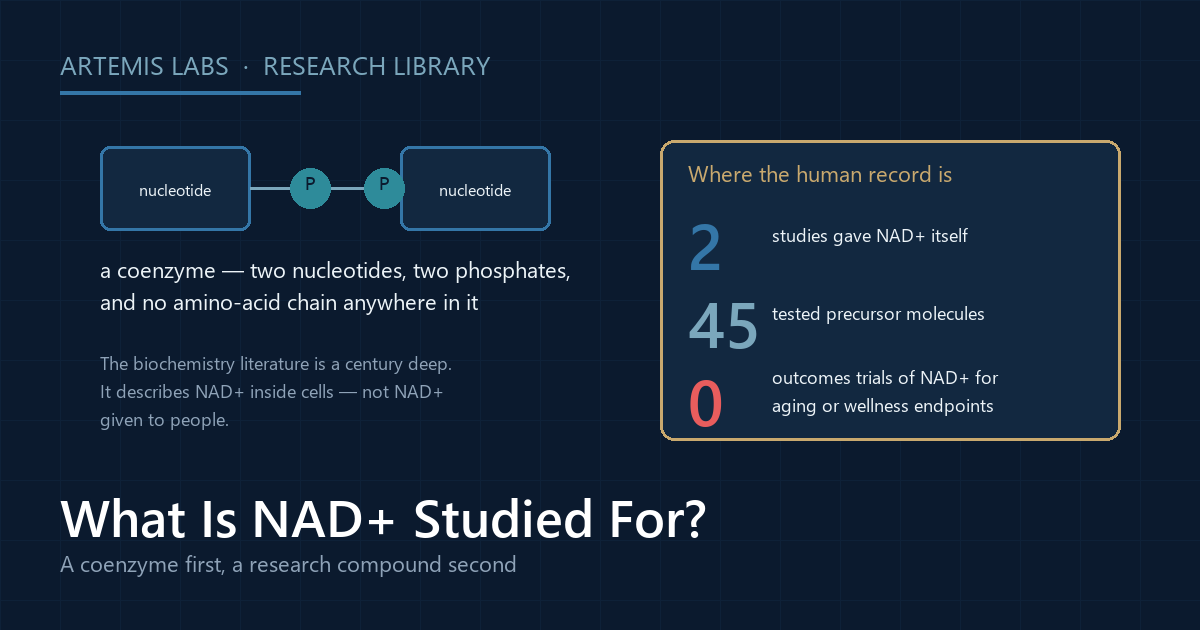
NAD+ — answer capsule: NAD+ (nicotinamide adenine dinucleotide) is a coenzyme, a small helper molecule that enzymes use to do their work. It is not a peptide, even though it is often sold alongside peptides; its structure is two nucleotides joined by phosphate groups, with no amino-acid chain anywhere in it. PubChem, the public chemistry database run by the US National Library of Medicine, lists it as CID 5892, molecular weight 663.4. The general biochemistry literature on NAD+ is enormous — a PubMed search for the full name returns 17,018 records — but that is a century of work on NAD+ as a molecule inside cells, not research on giving NAD+ to people. Exactly two published human studies have administered NAD+ itself, both by intravenous infusion, while roughly 45 randomized human trials have tested precursor compounds such as nicotinamide riboside or nicotinamide mononucleotide, which are different molecules. Artemis Labs supplies NAD+ as a laboratory research compound.
Key findings
- NAD+ is a dinucleotide, not a peptide. Its PubChem record (CID 5892) shows a formula of C21H27N7O14P2 — two phosphorus atoms, which no peptide contains — and no amino-acid sequence of any kind. The record’s own title is
Nadide, the compound’s international nonproprietary name. - The huge NAD+ literature is biochemistry, not product research. The 17,018 PubMed records for
"nicotinamide adenine dinucleotide"describe NAD+ as a coenzyme in metabolism and cell biology. Only two published human studies gave NAD+ itself to people: an n=180 randomized placebo-controlled intravenous trial in heart failure (direct NAD+, PMID 40954388) and an n=11 open-label intravenous pilot (direct NAD+, PMID 31572171). - Most “NAD+ research” in humans is precursor research. A PubMed search for randomized controlled trials of the precursors nicotinamide riboside or nicotinamide mononucleotide returns 45 records. Those trials tested different molecules, with different masses and charges, and a 2026 systematic review found their functional results
heterogeneous and often null or endpoint-specific(PMID 41655607). - A 2026 review states the direct-administration gap plainly. Its words for intravenous NAD+:
less well characterized and lacks robust clinical validation(review, PMID 42489969).
What is NAD+, in plain words?
A nucleotide is one of the building blocks of DNA and RNA: a sugar, a phosphate group, and a ring-shaped base. NAD+ is two of them joined together — a dinucleotide. One half carries adenine, the same base found in DNA; the other half carries nicotinamide, a form of vitamin B3. A bridge of two phosphate groups holds the halves together.
That structure is why NAD+ is not a peptide. A peptide is a chain of amino acids. The PubChem record for NAD+ (CID 5892) contains no amino-acid backbone, no sequence, and no amino-acid names among its synonyms, and its formula includes two phosphorus atoms, an element peptides do not contain. The point matters here because NAD+ sits in a catalog of research peptides, and a buyer could reasonably assume it is one. It is not. It is a small-molecule coenzyme with its own registry numbers: CID 5892, CAS 53-84-9, molecular weight 663.4. We keep a separate page on exactly what those identifiers mean, including the lookalike forms that get confused with it.
What does NAD+ do inside a cell?
A coenzyme is a molecule an enzyme needs beside it to carry out a reaction, the way some tools need a battery. NAD+ has been studied in that role for about a century, which is where the 17,018-record literature comes from: enzymology, metabolism, and cell biology, with NAD+ as a working part of the cell rather than as something administered. Reporting that count as “17,000 studies on NAD+” in a product sense would be misleading, and we won’t do it.
Two verified pieces of that biology are worth explaining plainly. First, NAD+ has a chemical partner called NADH. They are the oxidized and reduced forms of the same molecule — NAD+ can accept electrons and become NADH, and NADH can give them back — and the two differ by only about 2 mass units (663.4 versus 665.4 in PubChem). Second, NAD+ that ends up outside cells does not simply sit there: published reviews report that an enzyme on the cell surface called CD38 metabolizes extracellular NAD+, generating ADPR and cyclic ADPR (review of human and cell biology, PMID 31783629). That fact becomes important when anyone asks what happens to NAD+ delivered from outside the body, a question our direct-versus-precursor evidence page takes up in full.
If cells use NAD+, does adding more from outside do anything?
This is the question the market answers loudly and the literature answers carefully. It splits into two questions that are usually blurred together.
Question one: precursors. Most human trials give a precursor — nicotinamide riboside (NR) or nicotinamide mononucleotide (NMN), smaller molecules a cell can use to build its own NAD+. A 2026 review of the field summarizes the precursor evidence this way: oral NR and NMN can increase circulating NAD⁺ levels, although their clinical benefits remain variable and context-dependent (review, PMID 42489969). A precursor trial is a trial of the precursor. It is not evidence about NAD+ itself, in either direction.
Question two: NAD+ itself. Here the human record is two studies, both intravenous. One is a randomized placebo-controlled trial in 180 heart-failure patients whose one primary endpoint reached significance while every secondary measure did not (direct NAD+, PMID 40954388). The other is an eleven-person open-label pilot whose central measurement was that infused NAD+ produced no change in plasma (NAD+) or metabolites for the first two hours (direct NAD+, PMID 31572171). Both are reported precisely on this cluster’s companion pages, and the broader research area lives on our longevity and cellular research hub.
One more honest complication: NAD+ has no single regulatory identity. PubChem’s record for it simultaneously carries an investigational-drug annotation (ChEMBL lists a maximum development phase of Phase 2, explicitly not approved), entries from the NIH label database showing NAD+ appears on US dietary-supplement labels, a food-database entry (it occurs naturally in foods), and page after page of laboratory-reagent catalog names sold by purity grade. Copy that picks one of those framings and calls it “the” status of NAD+ is wrong. We supply it under the last framing: a research reagent.
What the research does not show
No published human study of NAD+ itself has measured a longevity, healthspan, cognition, or energy outcome. The two direct human studies had a cardiology endpoint and a pharmacokinetic endpoint. A 2026 PRISMA-guided systematic review searching through October 2025 found no eligible outcomes trial of NAD+ given directly for aging or wellness indications (PMID 41655607).
- Precursor results do not transfer. The 45 randomized NR/NMN trials studied different molecules. Their positives are not NAD+ positives, and their frequent nulls are not NAD+ nulls.
- No human data exist for NAD+ taken by mouth. The verification pass behind this page searched for oral NAD+ pharmacokinetics in humans and located no primary source at all. That is an absence finding, recorded as such.
- Safety is not established. The eleven-person pilot reported no adverse events over a six-hour infusion, which is a tolerability observation in eleven men, not a safety record. The 180-patient trial’s abstract reports no safety data.
Frequently asked questions
Is NAD+ a peptide?
No. It is a dinucleotide coenzyme. Its structure contains two nucleotides and two phosphorus atoms and no chain of amino acids. It appears in peptide catalogs, including ours, because the same research customers study it — not because it belongs to the peptide family.
Is NAD+ the same thing as NMN or NR?
No. NMN (PubChem CID 14180, molecular weight 334.22) and NR (CID 439924, molecular weight 255.25) are precursors — smaller molecules cells can convert toward NAD+ (CID 5892, molecular weight 663.4). Three molecules, three masses, three separate evidence bases.
Does a big research literature mean NAD+ is proven to work?
No. The large literature describes what NAD+ does as a working part of cells. Studies of administering NAD+ to people number exactly two, and neither measured an aging or wellness outcome.
References
- PubChem Compound record CID 5892 (Nadide; C21H27N7O14P2; MW 663.4; CAS 53-84-9), and CID 14180 (NMN), CID 439924 (NR), CID 439153 (NADH); retrieved via PUG REST and PUG-View, August 27, 2026.
- Am J Cardiovasc Drugs, 2026. Randomized, placebo-controlled, single-center trial of intravenous NAD+ in 180 adults with ischemic-cardiomyopathy heart failure (direct NAD+). PMID 40954388 · DOI 10.1007/s40256-025-00764-7
- Front Aging Neurosci, 2019.
A Pilot Study Investigating Changes in the Human Plasma and Urine NAD+ Metabolome During a 6 Hour Intravenous Infusion of NAD.n=11, open-label (direct NAD+). PMID 31572171 · DOI 10.3389/fnagi.2019.00257 - Ageing Res Rev, 2026. PRISMA-guided systematic review of NAD-related compounds in human and rodent intervention studies, 2010–October 2025; title-free citation. PMID 41655607 · DOI 10.1016/j.arr.2026.103057
- Mol Biol Rep, 2026.
NAD⁺ biology and supplementation: From mechanisms to clinical perspectives.Review, University of Pavia, Italy. PMID 42489969 · DOI 10.1007/s11033-026-12351-3 - Cells, 2019. Review of CD38 biology including hydrolysis of extracellular NAD+, IRCCS Istituto Giannina Gaslini, Genova, Italy. PMID 31783629 · DOI 10.3390/cells8121527
Methodology: this page draws on PubChem record CID 5892 retrieved through PUG REST and PUG-View, PubMed records and search counts retrieved through NCBI E-utilities, and publisher full text for one pilot study, with every quoted string transcribed verbatim from the named source; last verified August 27, 2026.
All compounds sold by Artemis Labs are for laboratory research use only. Nothing on this page is medical advice, and no statement has been evaluated by the FDA.
This article is part of the Mitochondrial & NAD+ Research product class. The class page lists every compound in it with sequence, molecular weight and the sources cited.
