
Cartalax and the Khavinson Short Peptides, Explained | Artemis Labs
Aug
Cartalax and the Khavinson Short Peptides, Explained
Published August 28, 2026 · Artemis Labs
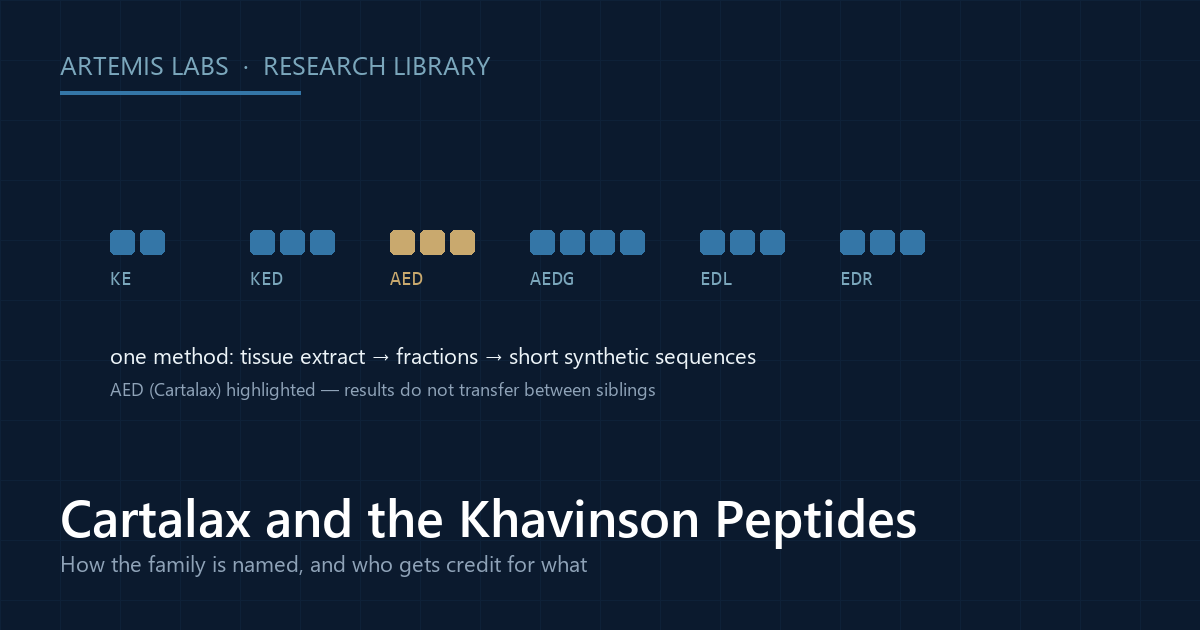
Cartalax (AED) is one member of a family of very short synthetic peptides developed at the St. Petersburg Institute of Bioregulation and Gerontology in Russia, often called the Khavinson peptides or short peptide bioregulators. The family was built by extracting protein mixtures from animal tissues, fractionating them, and synthesising two-, three- and four-residue sequences. Cartalax came from cartilage. Its siblings in the published AED papers include KE, KED, EDL, EDR, AEDG (Epitalon) and AB-9. Reading Cartalax correctly means knowing which of these peptides each study actually credits.
Key findings
- The family’s names encode either the source tissue (Cartalax from cartilage) or the sequence itself (KE, KED, AED, AEDG).
- Five of the AED papers are multi-peptide experiments. In at least three of them the effect belonged to a sibling peptide, not to AED.
- The nuclear-entry experiments that ground the family’s proposed mechanism tested AEDG, EDR, KEDG and AEDL. AED was not among them.
- The whole tissue-derived complex often matched or beat the isolated short peptide in the group’s own comparisons.
How was the peptide family made?
The method is the same across the family. Researchers took a tissue, extracted its polypeptides, separated the mixture into fractions, and identified short sequences within the fractions. Those sequences were then made synthetically and tested on their own. Cartalax was derived from cartilage tissue, and its name records that origin. Epitalon was derived from the pineal gland. The Artemis Labs catalog record describes this derivation for Cartalax, and the group’s own 2020 reviews describe it for the class (Khavinson 2020, PMID 31808038; Khavinson 2020, PMID 32362083).
This is why the names can mislead. A peptide named after cartilage was not shown to act on cartilage in a living organism. It was found in cartilage. The summary of what Cartalax is studied for keeps that distinction throughout.
How do the names and codes work?
Two naming systems run side by side. Trade names like Cartalax and Epitalon come from the source tissue or the intended research area. Sequence codes use the one-letter amino-acid alphabet: K is lysine, E is glutamic acid, D is aspartic acid, A is alanine, G is glycine, L is leucine, R is arginine. So KE is the dipeptide Lys-Glu, KED is Lys-Glu-Asp, AED is Ala-Glu-Asp, and AEDG is Ala-Glu-Asp-Gly. Some peptides also carry a laboratory designation from older Russian papers; Cartalax is T-31, a link established in a 2015 kidney study (Chalisova 2015, PMID 26033601).
The sequence codes matter because two members of this family differ by a single residue. AED and AEDG are Cartalax and Epitalon. They are different molecules with different weights, and confusing them inflates Cartalax’s literature many times over. The Cartalax vs Epitalon page covers that pair field by field.
Which peptide does each multi-peptide study actually credit?
Most of the AED literature tests several family members at once. That design is efficient, but it means the headline result of a paper often belongs to a different peptide than the one a reader came looking for. Here is the AED record read that way.
| Study | Peptides tested | What was credited to AED | What was credited to a sibling |
|---|---|---|---|
| Lin’kova 2016, skin fibroblasts (PMID 27259496) | KE, KED, AED, AEDG | MMP-9 inhibition, higher Ki-67 and CD98hc (all four); caspase-3 apoptosis suppression (AED and AEDG) | Shared results; nothing exclusive to AED |
| Fridman 2020, skin fibroblasts (PMID 33231794) | KE, AED | Sirtuin-1, sirtuin-6, collagen I synthesis | Reduced IL-1, NF-κB, TGF-β: KE |
| Ashapkin 2020, bone-marrow stem cells (PMID 32399807) | AED, KED, KE | IGF1 up 3.5 to 5.6-fold, NF-κB up (shared) | FOXO1, TNKS2: KED and KE. TERT difference: the model, not a peptide |
| Khavinson 2014, renal cell culture (PMID 25946838) | AED, EDL | Proliferation up, p16/p21/p53 down, SIRT-6 up (both) | Shared results |
| Zamorskii 2018, old rats (PMID 30607912) | AED, EDL | Diuresis up 1.2 to 1.4-fold (both) | Shared results |
| Zamorskii 2015, cisplatin kidney injury (PMID 26515176) | AED, EDL | Nothing | Nephroprotection: EDL |
| Lin’kova 2011, aging thymocytes (PMID 22238759) | AED, AB-9 and others | Nothing | Geroprotective effect: AB-9 only |
| Caputi 2019, neuronal differentiation (PMID 30791821) | AED, KED, combination | Nothing on its own | GAP43 increase: KED and the combination |
Read as a table, the pattern is clear. AED’s own results are shared with a sibling in most experiments, and in three studies it was the peptide that did nothing while another one worked. That is not a criticism of the compound. It is what the group’s own papers say, and it is the reason a sentence like “Khavinson peptides reduce inflammation” cannot be attached to Cartalax.
Whose mechanism is it?
The family’s central idea is that short peptides pass into the cell nucleus and bind DNA, changing gene activity with no receptor involved. The experiments that support this used fluorescence-labeled AEDG, EDR, KEDG and AEDL in HeLa cells, where the peptides entered the nucleus and bound preferentially to CNG methylation-target motifs (Fedoreyeva 2011, PMID 22117547). Follow-up work reported site-specific binding effects on endonuclease activity (Khavinson 2011, PMID 22442805) and interaction with histones (Fedoreyeva 2013, PMID 23581987).
AED was tested in none of those three experiments. For Cartalax, the DNA-binding claim comes from molecular docking, a computer model that assigned AED a preferred binding site (Khavinson 2016, PMID 27909961). A model is a prediction to be tested, not a measurement. The review of the Cartalax record explains why that gap is the most important one in the literature.
Does the isolated peptide beat the tissue extract it came from?
Often not. The group compared the short peptide against the whole polypeptide complex it was derived from in several models. In rat kidney explants, T-31 raised Ki-67 and lowered p53 to a lesser degree than the whole complex (PMID 26033601). In a rat bone-loss model, the cartilage-extract preparation was significantly more effective than T-31 (Povorozniuk 2007, PMID 18306703). In the chondrocyte SASP work the two were broadly comparable (Myakisheva 2023, PMID 37356100), while in the stem-cell differentiation study the isolated peptide was active at about a tenth of the complex’s concentration (Myakisheva 2023, PMID 37782646). The case for the isolated tripeptide over its source mixture is open.
What the research does not show
No human study exists for Cartalax, and Artemis Labs has not built a verified fact base for any other member of the family. This page does not describe what Epitalon, KE, KED, EDL, EDR or AB-9 do; they appear here only where an AED paper reports them alongside AED. Everything in this family that is cited on this page comes from a single institute in St. Petersburg, and no unaffiliated laboratory has replicated the AED work. When the group reviewed peptides that steer stem cells toward cartilage in 2023, it named nine candidates and did not include AED (Linkova 2023, PMID 37176122).
Frequently asked questions
Is Cartalax a “Khavinson peptide”?
Yes. It was developed at the institute Vladimir Khavinson led, by the method described above, and he is an author on most of the AED papers.
Are the Khavinson peptides all the same thing?
No. They are different sequences from different tissues, and the group’s own experiments show them behaving differently in the same dish. Results do not transfer from one to another.
Which sibling peptides does Artemis Labs sell?
None. The Cartalax product page is the only bioregulator-class compound in the catalog. Its analytical identity is on the sequence and identity page.
Where does the family sit in the research library?
Under cellular and mitochondrial research, because the AED endpoints are markers of cell aging, not a receptor pathway.
References
- Khavinson V et al. Stem Cell Reviews and Reports. 2020. PMID 31808038
- Khavinson VK et al. Advances in Gerontology. 2020. PMID 32362083
- Chalisova NI et al. Bulletin of Experimental Biology and Medicine. 2015. PMID 26033601
- Lin’kova NS et al. Bulletin of Experimental Biology and Medicine. 2016. PMID 27259496
- Fridman NV et al. Bulletin of Experimental Biology and Medicine. 2020. PMID 33231794
- Ashapkin V et al. Molecular Biology Reports. 2020. PMID 32399807
- Khavinson VKh et al. Advances in Gerontology. 2014. PMID 25946838
- Zamorskii II et al. Advances in Gerontology. 2018. PMID 30607912
- Zamorskii II et al. Bulletin of Experimental Biology and Medicine. 2015. PMID 26515176
- Lin’kova NS et al. Bulletin of Experimental Biology and Medicine. 2011. PMID 22238759
- Caputi S et al. International Journal of Immunopathology and Pharmacology. 2019. PMID 30791821
- Fedoreyeva LI et al. Biochemistry (Moscow). 2011. PMID 22117547
- Khavinson VKh et al. Bulletin of Experimental Biology and Medicine. 2011. PMID 22442805
- Fedoreyeva LI et al. Biochemistry (Moscow). 2013. PMID 23581987
- Khavinson VK et al. Bulletin of Experimental Biology and Medicine. 2016. PMID 27909961
- Povorozniuk VV et al. Advances in Gerontology. 2007. PMID 18306703
- Myakisheva SN et al. Advances in Gerontology. 2023. PMID 37356100
- Myakisheva SN et al. Advances in Gerontology. 2023. PMID 37782646
- Linkova N et al. International Journal of Molecular Sciences. 2023. PMID 37176122
Methodology: every PMID above was re-verified through NCBI E-utilities on August 28, 2026. Sibling-peptide results are stated only as they appear in AED papers; no separate literature for any sibling was consulted.
All compounds sold by Artemis Labs are for laboratory research use only. Nothing on this page is medical advice, and no statement has been evaluated by the FDA.
