
What Is 5-Amino-1MQ Studied For? Plain Guide | Artemis Labs
Aug
What is 5-Amino-1MQ studied for? A small molecule, not a peptide
Published August 26, 2026 · Artemis Labs
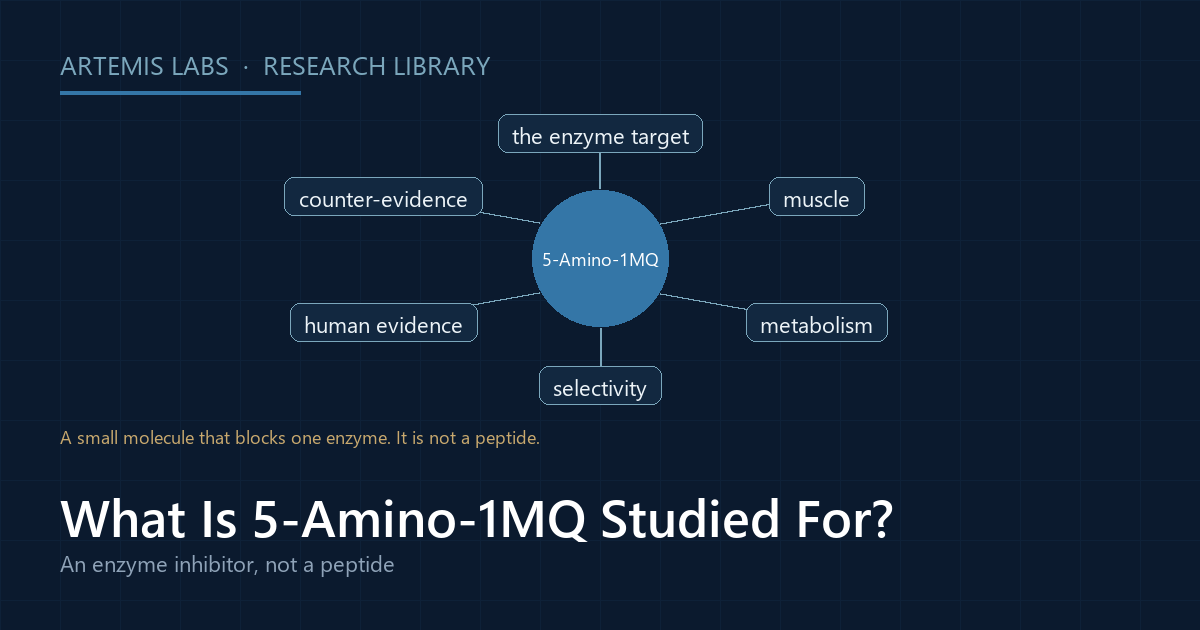
5-Amino-1MQ — answer capsule: 5-Amino-1MQ is a small chemical compound, not a peptide, sold as a research material and studied as an inhibitor of an enzyme called nicotinamide N-methyltransferase, or NNMT. NNMT is a cytosolic enzyme — it works in the fluid inside a cell, not inside the mitochondria — and it attaches a methyl tag to nicotinamide, a form of vitamin B3, which marks the tagged form for excretion. Blocking that enzyme is therefore not the same as adding anything to a cell; in cultured fat cells an inhibitor of this chemical family lowered intracellular 1-methylnicotinamide and raised intracellular NAD+ and SAM. Everything published about 5-Amino-1MQ’s effects comes from rodent studies and cell culture, and almost all of the animal work used male mice only. No human being has been given 5-Amino-1MQ, or any other NNMT inhibitor, in any published study or registered trial.
Key findings
- 5-Amino-1MQ is a quinolinium small molecule, not a peptide and not a hormone. PubChem indexes the chloride salt as CID 176507677 at molecular weight 194.66 and the iodide salt as CID 66522933 at 286.11.
- NNMT is described in a 2017 review as the enzyme responsible for methylating nicotinamide, one of the forms of vitamin B3, and the review states that “Methylated NAM is eventually excreted from the body” (PMID 28291578).
- In cultured adipocytes and in mice, a 2018 study of this chemical family reported that “NNMT inhibitors reduced intracellular 1-MNA, increased intracellular NAD+ and S-(5′-adenosyl)-l-methionine (SAM), and suppressed lipogenesis in adipocytes” (PMID 29155147).
- The published record for this compound is entirely preclinical. A 2026 review of the whole NNMT-inhibitor class states that “insufficient target engagement, reduced bioavailability, and unknown safety profiles have led to limited preclinical success across diseases” (PMID 42067476).
Is 5-Amino-1MQ a peptide?
No, and the distinction is worth making up front because 5-Amino-1MQ is usually sold alongside peptides and often described as one. A peptide is a short chain of amino acids. 5-Amino-1MQ is a single small organic molecule built on a quinolinium ring, carrying a permanent positive charge on its nitrogen. Its active part — the cation — has the formula C10H11N2+ and a molecular weight of 159.21 (CID 950107). There is no sequence to state, because there are no amino acids in it.
That charge is also why one detail in the 2018 study is notable. A permanently charged molecule is normally expected to cross membranes poorly, yet the paper reported that “Methylquinolinium scaffolds with primary amine substitutions displayed high permeability from passive and active transport across membranes” (PMID 29155147). That is a laboratory measurement in cell systems, not a statement about anything in a person.
Because the compound is a salt, it comes in more than one form, and the forms have different weights and different registry numbers. Our page on 5-Amino-1MQ salt forms and identity covers that in detail, including the arithmetic error that follows when a document mixes the two. The material itself is listed at 5-Amino-1MQ.
What does NNMT actually do?
Start with the enzyme, because the compound only makes sense through it.
Cells hold a pool of nicotinamide, which is one of the forms of vitamin B3. Nicotinamide has two possible fates. It can be recycled into NAD+, a cofactor that a 2014 Nature paper describes as “an important cofactor linking cellular redox states with energy metabolism.” Or NNMT can attach a methyl group to it, which is a disposal tag — the methylated form leaves the body (PMID 28291578).
The tagging step is not free. The methyl group has to come from somewhere, and it comes from S-adenosylmethionine, usually written SAM. The same Nature paper states that “SAM provides propylamine for polyamine biosynthesis and donates a methyl group for histone methylation” (PMID 24717514). So every time the enzyme runs, the cell spends two things at once: a molecule it could have recycled into NAD+, and one unit of its general-purpose methyl donor.
A 2024 review states the same idea as a bridge: NNMT “serves as a crucial link between cellular metabolism and epigenetics by catalyzing nicotinamide methylation using the universal methyl donor S-adenosyl-L-methionine” (PMID 39604638). One more location detail is worth correcting where it circulates wrongly: two independent sources describe NNMT as a cytosolic enzyme (PMID 29155147; PMID 40221009). It does its work in the cell’s fluid interior, not inside the mitochondria.
What does “inhibiting NNMT” mean, in plain terms?
An inhibitor is a molecule that sits in an enzyme’s way so the enzyme runs less often. It adds nothing. It removes nothing that was already there. It slows one specific chemical step.
So the research idea behind 5-Amino-1MQ is not “supply more NAD+.” It is “stop one disposal route and see whether the pools upstream of it change.” In cultured fat cells and in mice, the 2018 study measured exactly that and reported lower intracellular 1-methylnicotinamide with higher NAD+ and SAM (PMID 29155147). Where does the compound sit on the enzyme? A 2017 medicinal-chemistry paper reported that computational docking of quinolinium analogues showed “selective binding to the NNMT substrate-binding site residues” — that is, the pocket the enzyme normally uses for nicotinamide (PMID 28548833).
That mechanism is a description of a measured chemical event in laboratory systems. It is not a claim about what happens in a person, and no published study has measured it in one.
What research areas has 5-Amino-1MQ appeared in?
Three, and all three are rodent or cell work.
Metabolism in obese mice. A 2024 study in Diabetes, Obesity & Metabolism gave the inhibitor to diet-induced obese male mice across a 28-day study and reported that treatment “dose-dependently limited body weight and fat mass gains, improved oral glucose tolerance and insulin sensitivity, and suppressed hyperinsulinaemia in DIO mice” (PMID 39161060). Note the exact wording: it limited the gains in animals eating a high-fat diet. That is a different statement from a reduction, and the difference matters.
Aged skeletal muscle. A 2019 study in 24-month-old male mice deliberately injured one leg muscle and then measured its recovery, reporting peak torque of that injured muscle “increased by ∼70% in NNMTi-treated mice compared to controls” (PMID 30753815). Our page on 5-Amino-1MQ muscle and metabolism research states that finding precisely, including what was injured and what was not measured.
Cancer biology. The enzyme is heavily studied in tumour tissue, and inhibitor work there is done in tumour-bearing animal models and cell lines. Those are oncology development results in disease models. They say nothing about a healthy system, and none of them involved a person receiving the compound.
What the research does not show
There is no human evidence for 5-Amino-1MQ. Not weak human evidence, not preliminary human evidence — none. Searching PubMed under seven different name formulations returns no clinical-trial record, no meta-analysis and no systematic review for this compound, and a direct query to the ClinicalTrials.gov registry returns a total count of zero for both of its chemical names. The absence holds for the whole NNMT-inhibitor class, not only this molecule: a 2025 review states that “no clinical trials have yet targeted NNMT specific” (PMID 41008588), and a 2021 review states that “clinical trials targeting NNMT have not been reported until now” (PMID 34368359). Our page on 5-Amino-1MQ human evidence reports how that zero was verified, because the method is the point.
The animal record has its own limits. Seven of the compound’s in-vivo mouse studies are indexed as male-only, so nothing published describes what happens in female animals. The record also contains explicit negative results — a 2025 mouse study reported that inhibitor treatment “did not affect limb perfusion recovery or capillary density” and that “Muscle mass and myofiber size were unchanged by treatment” (PMID 41108586).
Safety data is thin and the class review says so plainly, naming “unknown safety profiles” among the reasons for “limited preclinical success across diseases” (PMID 42067476). No formal toxicology study, dose-range-finding study, genotoxicity study or reproductive study for 5-Amino-1MQ appears in any search of the published literature. For how this compound sits beside the other thin-evidence longevity materials, see our longevity and cellular research overview.
Frequently asked questions
Is 5-Amino-1MQ a peptide?
No. It is a single small organic molecule with a quinolinium ring and a permanent positive charge, with the cation formula C10H11N2+ and a molecular weight of 159.21. It contains no amino acids and has no sequence.
Does blocking NNMT raise NAD+?
In some systems it was measured to. A 2018 study reported increased intracellular NAD+ in adipocytes after NNMT inhibition (PMID 29155147). But a 2025 study of a different NNMT-inhibitor chemotype in aged female mice reported that treatment “did not affect NAD levels” while still producing a functional effect (PMID 40484359). The mechanism is not settled.
Why does searching “5-amino-1MQ” in PubMed return nothing?
Because the literature is indexed under the enzyme rather than the trade shorthand. The exact string “5-amino-1MQ” returns zero PubMed records; the systematic name 5-amino-1-methylquinolinium returns three, and the informal abbreviation NNMTi is what actually pulls the in-vivo papers.
Has any person taken 5-Amino-1MQ in a study?
No published study and no registered trial describes administration of 5-Amino-1MQ, or any NNMT inhibitor, to a human being. Human tissue and human sequencing datasets appear in several papers, but the compound in those papers was given to mice or applied to cells.
References
- Pissios, 2017 (review). PMID 28291578 — source of the vitamin B3 methylation and excretion description.
- Kraus, 2014. Nicotinamide N-methyltransferase knockdown protects against diet-induced obesity. Nature. PMID 24717514 · doi:10.1038/nature13198 — a gene-knockdown study; no compound was administered.
- Neelakantan, 2018. Selective and membrane-permeable small molecule inhibitors of nicotinamide N-methyltransferase reverse high fat diet-induced obesity in mice. Biochem Pharmacol. PMID 29155147 · doi:10.1016/j.bcp.2017.11.007
- Small molecule nicotinamide N-methyltransferase inhibitor activates senescent muscle stem cells and improves regenerative capacity of aged skeletal muscle. Biochem Pharmacol, 2019. PMID 30753815 · doi:10.1016/j.bcp.2019.02.008
- Nicotinamide N-methyltransferase inhibition mitigates obesity-related metabolic dysfunction. Diabetes, Obesity & Metabolism, 2024. PMID 39161060 · doi:10.1111/dom.15879
- Park, 2024 (review). PMID 39604638 · doi:10.1007/s12272-024-01519-9 — source of the metabolism-to-epigenetics bridge description.
- Emerging opportunities for nicotinamide N-methyltransferase (NNMT) inhibitor clinical translation. Trends Pharmacol Sci, 2026. PMID 42067476 · doi:10.1016/j.tips.2026.04.002
- Physiol Rep, 2025. PMID 41108586 · doi:10.14814/phy2.70615 — NNMT inhibitor in male BALB/cJ mice with hindlimb ischaemia, alongside human muscle datasets.
- Biomolecules, 2025 (review). PMID 41008588 — source of the 1-MNA duality passage and the statement that no clinical trials have yet targeted NNMT.
- BioMed Res Int, 2021 (review). PMID 34368359 — source of the statement that trials targeting NNMT have not been reported.
- Pharmacol Res, 2025. PMID 40484359 · doi:10.1016/j.phrs.2025.107820 — a different NNMT-inhibitor chemotype, 4-amino-6-methoxynicotinamide, in aged female mice.
- Exp Neurol, 2025 (review). PMID 40221009 — describes NNMT as a cytosolic enzyme and names the class’s outstanding specificity challenges.
- J Med Chem, 2017. PMID 28548833 — docking and structure-activity work placing quinolinium analogues at the NNMT substrate-binding site.
- PubChem Compound Summary, CID 950107 (cation), CID 176507677 (chloride) and CID 66522933 (iodide). Retrieved August 27, 2026.
Methodology: this page draws only on the Artemis Labs 5-Amino-1MQ fact base, built from PubChem records, PubMed abstracts and MeSH indexing, and ClinicalTrials.gov registry queries, last verified August 27, 2026.
All compounds sold by Artemis Labs are for laboratory research use only. Nothing on this page is medical advice, and no statement has been evaluated by the FDA.
