
GHK-Cu Hair Research: Every Study Is Multi-Ingredient
Aug
What hair research on GHK-Cu actually found
Published August 26, 2026 · Artemis Labs
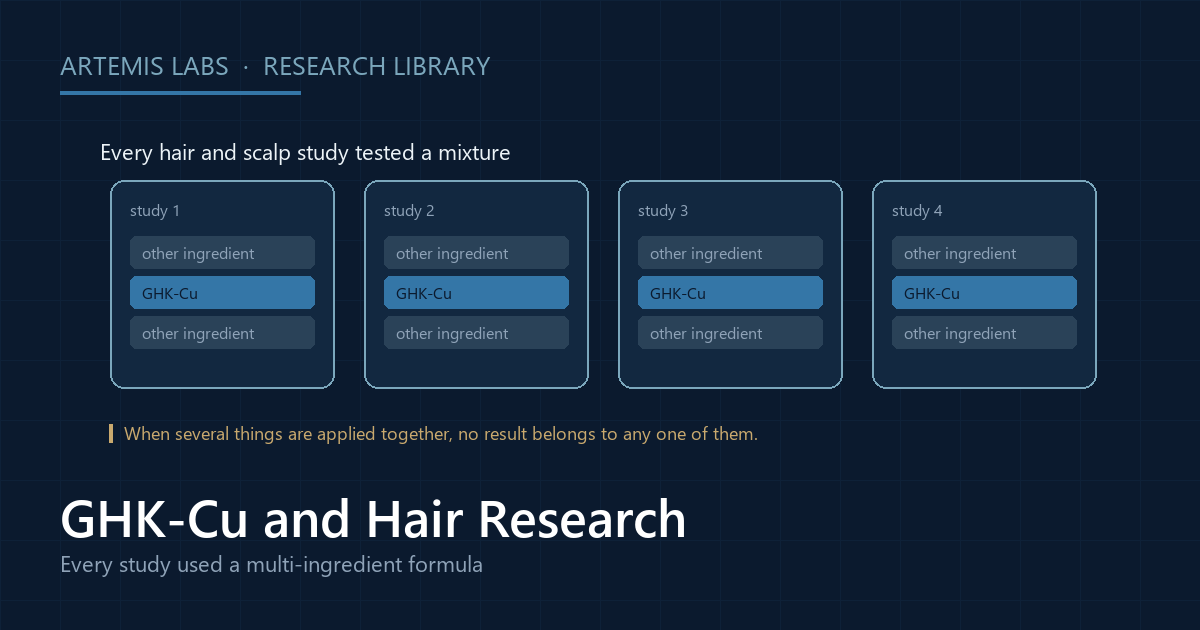
GHK-Cu hair research — answer capsule: GHK-Cu is a copper-bound tripeptide (PubChem CID 71587328) that appears in several human hair and scalp studies, and in every one of them it was combined with other active ingredients. No human hair study of GHK-Cu on its own is indexed in PubMed. That is the finding: not a weak result, and not a strong one, but an absence of any study designed so that a result could be assigned to this compound. Two of the mixed-formulation studies had no control group at all, one was run by the company selling the product, and the placebo-controlled one tested the copper-free version of the peptide rather than the copper complex. This page is short because the record is short.
Key findings
- No isolated human hair study exists. Every human hair or scalp record located combines GHK or GHK-Cu with at least one other active ingredient, so no result can be attributed to the peptide alone.
- The one placebo-controlled hair study tested a different molecule. It used
ALAVAX, described as a complex of 5-aminolevulinic acid and GHK — the copper-free tripeptide (CID 73587), not the copper complex (PMID 27489425). - The largest human record has no control arm. A 2018 pilot described itself as
open-label, prospective, single-armand used a six-component formulation in which copper tripeptide-1 was one ingredient (PMID 29482481). - The chemical database indexing this compound calls it a cosmetic ingredient. PubChem’s whole drug indication field for both the free peptide and the copper complex reads:
Commonly used in cosmetic products for the skin and hair.
What did the placebo-controlled hair study find?
A 2016 study from the Department of Dermatology at Kyungpook National University School of Medicine in Daegu, Korea is the only hair study in the record with a placebo group. Its design, verbatim: Forty-five patients with male pattern hair loss were treated with ALAVAX 100 mg/ml (group A), ALAVAX 50 mg/ml (group B) or placebo (group C) once a day for 6 months.
Three things about that sentence matter, and they usually go missing. First, the product is a complex of 5-aminolevulinic acid and GHK — two actives, and 5-aminolevulinic acid is a photodynamic agent with its own separate hair literature. Nothing in the result can be split between the two components. Second, the peptide named is GHK, the copper-free tripeptide, which is a different molecule from the copper complex sold as GHK-Cu. Third, the record carries no MeSH indexing headings at all.
The reported result: An increase in hair count for 6 months was 52.6 (p<0.05) in group A, 71.5 (p<0.05) in group B, and 9.6 in group C. Read the group order carefully — the weaker preparation out-performed the stronger one, and only the weaker one reached significance against placebo on the ratio comparison. The abstract does not explain that reversal. Two measures came out flat: There was no statistically significant difference in hair length and hair thickness among 3 groups at 6 months. The authors’ own conclusion is hedged, and we keep the hedge: the complex may be considered as one of the complementary agents.
What about the larger scalp studies?
Two of them exist, both without a control group, and both testing formulations with several actives.
The 2018 study, from a cosmetic dermatology practice in Mumbai, India, is the largest human record involving this peptide. Its own words describe both the design and the problem: This was an open-label, prospective, single-arm interventional pilot study, and the material given was a formulation that contains vascular endothelial growth factor, basic fibroblast growth factor, insulin-like growth factor, keratinocyte growth factor, thymosin β4, and copper tripeptide-1. Six actives, delivered into the scalp skin. There is no comparison group, nobody was blinded, and copper tripeptide-1 is one component of six. Nothing observed in that study can be assigned to it.
A 2024 study from a contract research organisation in Ahmedabad, India tested a branded scalp regimen for dandruff over 15 days. It describes itself as prospective, interventional, open-label, single-center — again no control arm — and the serum it used contained copper tripeptide-1, witch hazel (Hamamelis virginiana), hesperidin, hyaluronic acid, and pea protein (Pisum sativum), applied alongside a separate acid-based scrub. That is five actives in one bottle plus a second product. The paper reports gains in hair density and hair thickness by 12.48% (p<0.0001) and 25.36% (p<0.0001) over 15 days and names the commercial regimen in its conclusion. A two-product, six-ingredient, uncontrolled brand study cannot attribute those numbers to any single ingredient.
Two further hair records involve GHK in combination rather than alone: a 2020 paper on the QR678 & QR678 Neo Hair Growth Formulations, and a 2026 paper on an EGCG-Biotin-Pal-GHK composition — the latter using a fat-modified derivative of the peptide rather than the copper complex. The remaining hair-related literature in the index is review articles and delivery-system papers, not studies in people.
What the research does not show
No controlled human study of GHK-Cu by any non-topical route has ever been published — every search formulation for one returned zero records. On hair specifically, four further limits belong on the record:
- There is no single-agent human hair study. This is a searched, recorded negative finding, not an oversight. Every human hair record combines the peptide with something else.
- Two of the four human studies had no control group. Without a comparison arm, a 15-day or 6-month change cannot be separated from seasonal shedding cycles, measurement drift, or the effect of paying attention to your scalp.
- The one placebo-controlled study used the copper-free peptide. GHK (CID 73587, molecular weight 340.38) and GHK-Cu (CID 71587328, molecular weight 402.92) are different molecules, and results from one do not transfer to the other.
- Positive hair results and marketing overlap. One study names the branded regimen it tested in its own conclusion; another is a manufacturer-adjacent formulation paper. That does not make either wrong, but it is part of the record a reader should have.
Why cosmetic-formulation results say so little about research-vial material is the subject of our page on topical versus systemic GHK-Cu evidence, and the plain-language overview is at what GHK-Cu is studied for. GHK-Cu is supplied here as a laboratory reference compound.
Frequently asked questions
Is there a human study of GHK-Cu alone for hair?
No. Every human hair or scalp study located pairs it with other active ingredients, so none of them is designed to show what the peptide does by itself.
Did the 45-person study test GHK-Cu?
It tested a two-component complex containing GHK, the copper-free tripeptide, together with 5-aminolevulinic acid. It is not a study of the copper complex, and it is not a study of a single agent.
Why is the record this thin?
Because nobody has run the study. The peptide is indexed as a cosmetic ingredient rather than a drug, and cosmetic products are usually tested as finished formulations, not as isolated components against placebo.
References
- Efficacy of a Complex of 5-Aminolevulinic Acid and Glycyl-Histidyl-Lysine Peptide on Hair Growth. Ann Dermatol, 2016. Department of Dermatology, Kyungpook National University School of Medicine, Daegu, Korea. PMID 27489425 · DOI 10.5021/ad.2016.28.4.438
- 2018 open-label, single-arm pilot of a six-component hair formulation, J Cosmet Laser Ther. Department of Cosmetic Dermatology & Facial Plastic Surgery, The Esthetic Clinics, Mumbai, India. PMID 29482481 · DOI 10.1080/14764172.2018.1439965
- An Assessment of the Safety, Efficacy, and Tolerability of a Novel Scalp Treatment Regimen Combining a Hydroxy Acid-Based Scrub and Copper Tripeptide Serum in the Management of Seborrheic Dermatitis in Adults. Cureus, 2024. Clinical Research, NovoBliss Research Private Limited, Ahmedabad, India. PMID 39449909 · DOI 10.7759/cureus.70108
- 2020 paper on the
QR678 & QR678 Neo Hair Growth Formulations. PMID 32983753 - 2026 paper on an
EGCG-Biotin-Pal-GHK composition. PMID 42575238 - PubChem compound records for glycyl-L-histidyl-L-lysine (CID 73587, molecular weight 340.38) and Prezatide copper (CID 71587328, molecular weight 402.92), retrieved August 27, 2026.
Methodology: this page draws on PubMed records retrieved through NCBI E-utilities and the PubChem records for CID 73587 and CID 71587328, with every quoted string transcribed verbatim from the source named beside it; last verified August 27, 2026.
All compounds sold by Artemis Labs are for laboratory research use only. Nothing on this page is medical advice, and no statement has been evaluated by the FDA.
