
GHK-Cu Gene Expression: Where the Claims Come From
Aug
Where the GHK-Cu gene expression claims come from
Published August 26, 2026 · Artemis Labs
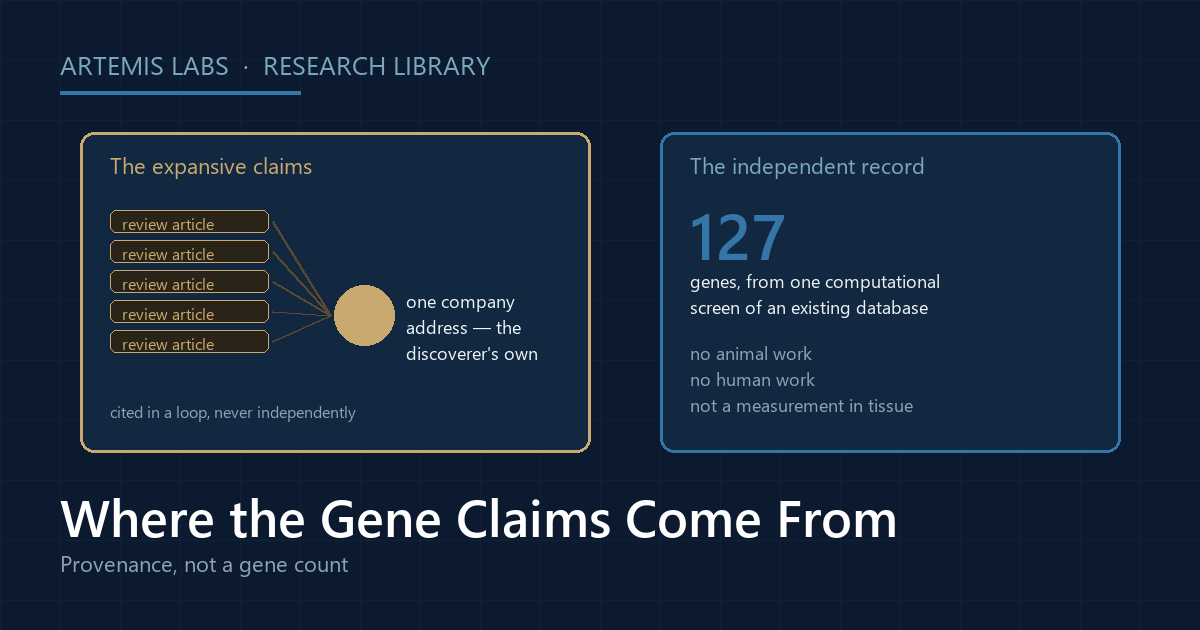
GHK-Cu gene expression research — answer capsule: the striking claims about GHK and GHK-Cu changing large numbers of human genes come from a series of review articles that all carry the same institutional address, and that address belongs to a company that sells GHK-Cu products. This page does not publish a gene number as fact, because the independent record does not contain one. The only primary gene-expression study of GHK with no commercial affiliation is a 2012 paper from Boston University and the University of British Columbia, and it was a computational screen of existing data followed by cell-culture work — no animals and no people were given anything. A PubMed search for transcriptomic profiling of this peptide returns nothing at all. The gap between how confident the claims sound and how thin the independent evidence is, is the subject of this page.
Key findings
- One independent primary study exists. PMID 22937864, from Boston University School of Medicine and the University of British Columbia, is the only gene-expression paper on this peptide with no vendor affiliation.
- It was computational, not a dosing study. GHK entered that paper through the Connectivity Map, a database of gene-expression signatures. There is no animal work and no human in it.
- Six expansive reviews share one address. Every review carrying the large gene-count and DNA-reset framing lists
Skin Biology, 4122 Factoria Boulevard SE, Bellevue, WA 98006— a company that sells GHK-Cu products. - The direct search comes back empty. A PubMed query pairing the indexed concept for glycyl-histidyl-lysine with gene-expression profiling, transcriptomics or RNA sequencing returns zero records.
What did the one independent study actually do?
In 2012, researchers in the Division of Computational Biomedicine at Boston University School of Medicine, working with the James Hogg Research Centre at the University of British Columbia, published a paper on emphysema — the lung disease in which the small air sacs break down. Their method, verbatim: we profiled gene expression in lung tissue samples obtained from regions within the same lung with varying amounts of emphysematous destruction from smokers with COPD (8 regions × 8 lungs = 64 samples).
From that tissue they derived a signature: We identified 127 genes whose expression levels were significantly associated with regional emphysema severity. Read that sentence carefully, because it is the one most often misquoted. The 127 is the number of genes linked to lung damage in those tissue samples. It is not a count of genes that GHK changes. GHK had not entered the study yet.
It entered next, and it entered through software: Using the Connectivity Map, we identified GHK as a compound that can reverse the gene-expression signature associated with emphysematous destruction and induce expression patterns consistent with TGFβ pathway activation. The Connectivity Map is a reference library of gene-expression patterns produced by many compounds. Searching it for something whose pattern is the mirror image of a disease pattern is a screening step: it nominates candidates, and it does not test them in a body.
The authors then did bench work to follow up: Treatment of human fibroblasts with GHK recapitulated TGFβ-induced gene-expression patterns, led to the organization of the actin cytoskeleton, and elevated the expression of integrin β1. Furthermore, addition of GHK or TGFβ restored collagen I contraction and remodeling by fibroblasts derived from COPD lungs. Cells in dishes, taken from human lungs. The authors ended by asking for more: their results suggest the need for additional studies into the mechanisms involved and the effects of this reversal on disease progression. Fourteen years later, no such study is indexed.
Where do the bigger numbers come from?
From reviews, not from experiments — and the reviews share an address.
The sentence that seeded the whole genre appears in a 2015 review: GHK is capable of up- and downregulating at least 4,000 human genes, essentially resetting DNA to a healthier state. We quote it here as the claim under examination, not as a finding, and we do not repeat the number anywhere else on this page. A review article does not generate data; it summarises other papers. So the question is which primary study that sentence summarises, and the honest answer is that we could not find one.
What we could establish is who wrote it. All three authors of that review list the affiliation Skin Biology, Research & Development Department, 4122 Factoria Boulevard, SE Suite No. 200 Bellevue, WA 98006, USA. The same address appears on the 2008, 2012, 2014, 2017 and 2018 reviews that carry the same expansive framing, several with a skinbiology.com contact address in the affiliation field. Skin Biology is a commercial skin-care company that sells GHK-Cu products. Its principal, Loren Pickart, discovered GHK in 1973.
None of that is misconduct, and this page is not alleging any. Discoverers commonly build companies around what they discover, and a scientist writing reviews in their own field is ordinary. The problem is structural: a claim that appears in six review articles from one address, each citing the others, looks like a well-supported consensus when you count papers. Count sources instead and it is one. The 2018 review in that series states its posture plainly — GHK has multiple biological actions, all of which, according to our current knowledge, appear to be health positive. A universal positive with no counter-evidence section is a quality signal in its own right, whoever writes it.
The 2017 review in the same series says GHK has been recommended as a treatment for a list of serious conditions. Follow the recommendation back and it lands on the same authors’ earlier papers. That is a citation loop, not independent corroboration.
What does a direct search return?
Nothing. Pairing PubMed’s own indexed concept for glycyl-histidyl-lysine with gene-expression profiling, transcriptomics or RNA sequencing returns zero records. There is no transcriptomic profiling study of this peptide in the index — not a positive one, not a negative one.
That matters because of how modern gene-expression work is done. A study claiming a compound moves thousands of genes would normally be a sequencing or microarray experiment with a public data deposit anyone can re-analyse. No such deposit is indexed here. Figures for how many genes this peptide affects do circulate, and they disagree with each other by wide margins depending on which secondary source you read — what you would expect from numbers passed between summaries rather than measured once and reported.
One more caution about counting anything in this field: PubMed silently expands a search for the copper complex to also capture papers on the copper-free peptide, so raw search totals for GHK-Cu are inflated. The two are separate molecules — GHK is CID 73587 with a molecular weight of 340.38, and GHK-Cu is CID 71587328 at 402.92 — and much of the gene-expression literature, including the 2012 Boston University paper, studied the copper-free form.
What the research does not show
No controlled human study of GHK-Cu by any non-topical route has ever been published — every search formulation for one returned zero records, and no gene-expression finding in this literature has ever been tested in a person. Four further limits belong on the record:
- No gene count for this peptide is independently established. That is why this page publishes none as fact. The only number in the independent primary paper describes a disease signature, not the peptide’s effect.
- The 2012 study included no animal and no human dosing. A computational screen plus cell culture is a starting point, and its own authors called for the follow-up work that has not happened.
- The direction of the flagship mechanism is contested. The 2012 paper reports patterns
consistent with TGFβ pathway activation, while a 2017 mouse study reports that GHK hassignificant inhibitory effects on transforming growth factor (TGF)-β1 secretion, and a 2026 review describes it assuppressing TGF-β. Independent groups report opposite directions on the same pathway. - Both human trials of this compound were negative. Whatever happens at the gene level in a dish, the two randomized human studies — both topical creams — found no benefit on any objective measurement. That record is set out on our page about GHK-Cu human trials.
An independent 2026 review from the Keck School of Medicine of USC put the translational position in one line: GHK-Cu showed promise in wound healing and anti-inflammatory effects, but no clinical data support its use for musculoskeletal conditions. For the skin evidence in detail see GHK-Cu skin research. GHK-Cu is supplied here as a laboratory reference compound.
Frequently asked questions
How many genes does GHK-Cu affect?
No independently established number exists, so we do not publish one. The figures in circulation come from review articles sharing a single commercial affiliation, and they disagree with each other.
Is the 2012 Boston University study evidence that GHK works?
It is evidence that a computational screen nominated GHK as a candidate whose gene-expression pattern opposed an emphysema signature, and that GHK reproduced certain TGFβ-like effects in cultured human lung fibroblasts. It is not evidence about any outcome in an animal or a person, and the authors said as much.
Does a company affiliation make a review wrong?
No, and we are not claiming it does. It means the claim has not been independently checked. When six reviews from one address cite one another and no outside group has tested the finding, the correct description is unverified, not disproved.
References
- A gene expression signature of emphysema-related lung destruction and its reversal by the tripeptide GHK. Genome Med, 2012. Division of Computational Biomedicine, Boston University School of Medicine; James Hogg Research Centre, University of British Columbia. PMID 22937864 · DOI 10.1186/gm367
- GHK Peptide as a Natural Modulator of Multiple Cellular Pathways in Skin Regeneration. Biomed Res Int, 2015. Skin Biology, Bellevue, Washington. PMID 26236730 · DOI 10.1155/2015/648108
- The human tri-peptide GHK and tissue remodeling. 2008. Skin Biology, Bellevue, Washington. PMID 18644225
- The human tripeptide GHK-Cu in prevention of oxidative stress and degenerative conditions of aging: implications for cognitive health. 2012. Skin Biology, Bellevue, Washington. PMID 22666519
- GHK and DNA: resetting the human genome to health. 2014. Skin Biology, Bellevue, Washington. PMID 25302294
- The Effect of the Human Peptide GHK on Gene Expression Relevant to Nervous System Function and Cognitive Decline. 2017. Skin Biology, Bellevue, Washington. PMID 28212278
- Regenerative and Protective Actions of the GHK-Cu Peptide in the Light of the New Gene Data. 2018. Skin Biology, Bellevue, Washington. PMID 29986520
- GHK Peptide Inhibits Bleomycin-Induced Pulmonary Fibrosis in Mice by Suppressing TGFβ1/Smad-Mediated Epithelial-to-Mesenchymal Transition. Front Pharmacol, 2017. Mouse model. PMID 29311918 · DOI 10.3389/fphar.2017.00904
- The Regenerative Potential of GHK-Cu in Aesthetic Medicine. Aesthet Surg J, 2026. Mohammed Bin Rashid University of Medicine and Health Sciences, Dubai, United Arab Emirates. PMID 42619529 · DOI 10.1093/asj/sjag169
- 2026 review, Keck School of Medicine of USC, Los Angeles, California. PMID 41476424 · DOI 10.1177/03635465251357593
- PubChem compound records for glycyl-L-histidyl-L-lysine (CID 73587, molecular weight 340.38) and Prezatide copper (CID 71587328, molecular weight 402.92), retrieved August 27, 2026.
Methodology: this page draws on PubMed records and search results retrieved through NCBI E-utilities and the PubChem records for CID 73587 and CID 71587328, with every quoted string and every affiliation transcribed verbatim from the source named beside it; last verified August 27, 2026.
All compounds sold by Artemis Labs are for laboratory research use only. Nothing on this page is medical advice, and no statement has been evaluated by the FDA.
