
Sermorelin in Adults: What Exists and What Is a Different Molecule | Artemis Labs
Aug
Sermorelin in adults: what exists, and what is a different molecule
Published August 28, 2026 · Artemis Labs
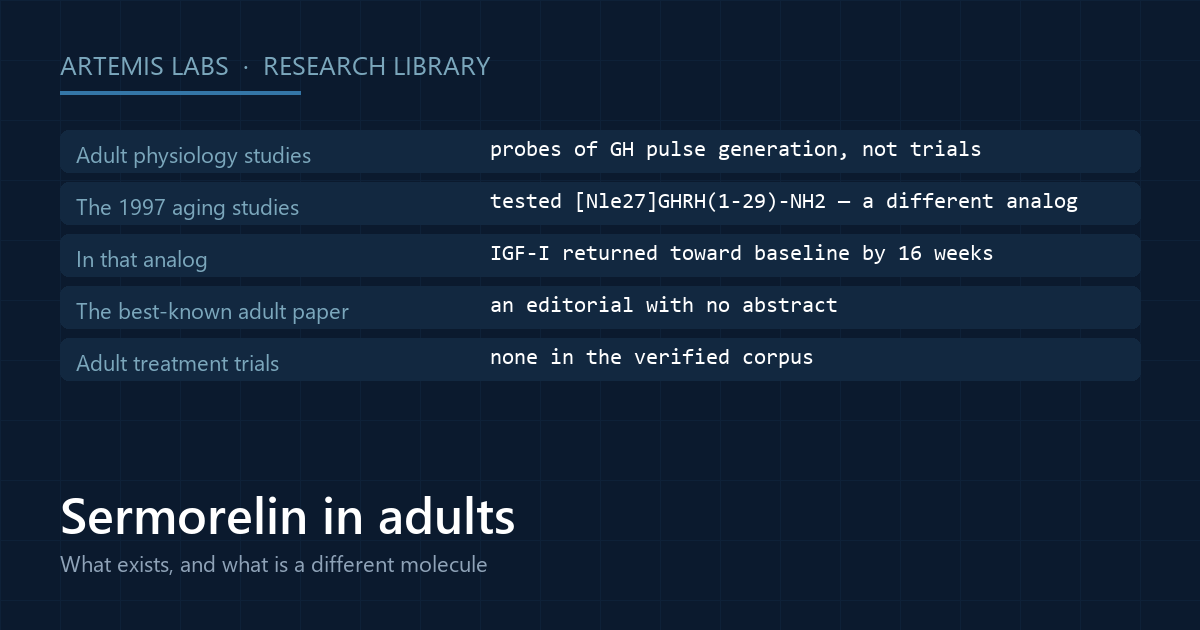
Sermorelin adult research — Sermorelin’s adult literature is thinner than it looks. Most adult studies used GHRH(1-29) as a physiology probe, infusing it to learn how the pituitary generates growth-hormone pulses, not to test it as a treatment. The two studies most often cited for sermorelin in older adults tested a different compound, [Nle27]GHRH(1-29)-NH2, a norleucine-substituted analog. And the best-known statement of a sermorelin case in adults is a 2006 editorial that carries no abstract in PubMed. Reading the adult lane honestly means separating those three things.
Key findings
- The physiology studies are real and are not treatment trials. Continuous infusion amplified peak GH concentrations (median basal peak 21.1 mU/l vs. GHRH 62.0 mU/l, P = 0.008) whilst pulse timing remained unaffected (PMID 10594518).
- The aging studies used a different analog. Both 1997 UCSD papers state their intervention as [Nle27]GHRH-(1-29)-NH2 (PMIDs 9141536, 9360512).
- Even in that analog, the IGF-1 rise faded. IGF-I and IGFBP-3 rose within two weeks and remained elevated for 12 weeks, returning toward baseline by 16 weeks in both genders (PMID 9141536).
- The adult “GH insufficiency” framing is an editorial. PMID 18046908 is tagged Editorial and has no abstract in PubMed.
What did the adult studies actually do?
Four lines of work, all small, all with a specific research question that was not “does this treat adults”.
Pharmacokinetics in healthy men. Thirty healthy men aged 19 to 43 took part in a pharmacokinetic comparison of two delivery routes. The finding worth carrying: the peptide is rapidly eliminated, yet growth-hormone levels stayed elevated for about 3 hours, and nasal bioavailability was only 3-5% (PMID 8329825). That gap between the peptide’s own half-life, which PubChem gives as 11 to 12 minutes, and the duration of the hormone pulse it triggers is a real and repeatedly observed feature of the class.
Dose-response as a diagnostic test. In ten adult male volunteers, escalating amounts produced significant growth-hormone peaks above a threshold, with larger amounts delaying time to peak and prolonging the elevation (PMID 7921207). The purpose was to characterise a stimulation test, not to treat anyone.
Pulse-generation clamps. A University College London group combined continuous GHRH(1-29) with intermittent somatostatin to dissect how growth-hormone pulses are produced, in healthy volunteers and in survivors of childhood brain tumours (PMID 10594518). A companion study found that in adults irradiated in childhood, the GH response to bolus GHRH(1-29)NH(2) is attenuated, which the authors attributed to pituitary damage or the loss of chronic GHRH signalling (PMID 10754477).
Interaction studies. In six normal men, prior treatment with the peptide led to a marked attenuation of the peak serum GH response to clonidine, evidence that alpha-2 adrenergic agonists act partly through pathways other than GHRH (PMID 2147600).
Why the aging studies are not sermorelin studies
Two papers from a University of California, San Diego group in 1997 are the usual citation for sermorelin in older adults. Both describe a single-blind, randomized, placebo-controlled trial of five months’ duration in 19 healthy people aged 55 to 71, with four weeks of placebo followed by sixteen weeks of active treatment. The intervention, in both abstracts’ own words, is [Nle27]GHRH-(1-29)-NH2: the GHRH(1-29) sequence with norleucine substituted at position 27. That is a different molecule from sermorelin, and the substitution exists precisely because it changes the peptide’s properties.
What those studies found is still worth knowing, on their own terms. Nightly administration produced a significant increase in 12-h integrated nocturnal GH levels in both sexes, with IGF-I and IGFBP-3 rising within two weeks. And then, in the same abstract: those levels remained elevated for 12 weeks, returning toward baseline by 16 weeks in both genders (PMID 9141536). The companion immunology paper reported increases in B cells and several lymphocyte markers over sixteen weeks, with no changes in the number of T cells (CD3), T cell subsets (CD4, CD8), or natural killer cell (CD57) (PMID 9360512). Attributing either result to sermorelin overstates the record by substituting one compound for another.
What about the 2006 adult-onset paper?
It is an editorial. PubMed lists PMID 18046908, Sermorelin: a better approach to management of adult-onset growth hormone insufficiency?, published in Clinical Interventions in Aging in 2006, with publication type Editorial and no abstract in the database. An editorial is an argument, not evidence, and its title is a question. It is cited on many vendor pages, including Artemis Labs’ own earlier copy, as though it established an adult indication. It does not, and this cluster does not use it as evidence.
What the research does not show
There is no randomized controlled trial of sermorelin as a treatment in adults in our verified corpus. There is no meta-analysis of sermorelin at all. The aging literature that circulates under its name is about a norleucine analog, and even there the hormone response faded by sixteen weeks. The physiology studies are small, decades old, and designed to answer questions about the axis instead of about a therapy. The 1990s pediatric record, on our trial page, is where the actual treatment evidence lives, and where growth hormone outperformed the peptide. Nothing on this page is a claim about research-grade material or about what any vial does; the compound’s identity record is on the sermorelin research page.
Frequently asked questions
Is there an adult trial of sermorelin?
Not as a treatment, in our verified corpus. The adult studies are physiology and diagnostic-test work in small groups.
What about the well-known 1997 aging studies?
They tested [Nle27]GHRH-(1-29)-NH2, a different analog, and reported that the IGF-1 rise returned toward baseline by 16 weeks.
Does the growth-hormone response persist?
Not indefinitely in the studies that tracked it. See our page on desensitization and antibodies.
Where can I read the identity and regulatory record?
On the identity page and the FDA-record page.
References
- Endocrine and metabolic effects of long-term administration of [Nle27]growth hormone-releasing hormone-(1-29)-NH2 in age-advanced men and women. J Clin Endocrinol Metab. 1997. PMID 9141536 · DOI.
- Effects of [norleucine27]GHRH (1-29)-NH2 administration on the immune system of aging men and women. J Clin Endocrinol Metab. 1997. PMID 9360512 · DOI.
- Sermorelin: a better approach to management of adult-onset growth hormone insufficiency? Clin Interv Aging. 2006 (Editorial; no abstract in PubMed). PMID 18046908.
- Pharmacokinetics of GHRH(1-29)-NH2 and stimulation of GH secretion in healthy subjects. Acta Paediatr Suppl. 1993. PMID 8329825.
- Low-dose growth hormone-releasing hormone tests: a dose-response study. Eur J Endocrinol. 1994. PMID 7921207.
- The relative roles of continuous GHRH(1-29)NH2 and intermittent somatostatin in GH pulse generation. Clin Endocrinol. 1999. PMID 10594518.
- The GH response to low-dose bolus GHRH(1-29)NH2 is attenuated after cranial irradiation. Eur J Endocrinol. 2000. PMID 10754477.
- The interaction between clonidine and growth hormone releasing hormone in the stimulation of growth hormone secretion in man. Clin Endocrinol. 1990. PMID 2147600.
- PubChem. Sermorelin, CID 16132413: Biological Half-Life. pubchem.ncbi.nlm.nih.gov/compound/16132413.
Methodology: every quotation was transcribed from the PubMed abstract of the cited record via NCBI E-utilities on August 28, 2026. Publication types are as PubMed tags them. Last verified August 28, 2026.
All compounds sold by Artemis Labs are for laboratory research use only. Nothing on this page is medical advice, and no statement has been evaluated by the FDA.
