
Tesamorelin Human Trials: What the Phase 3 Record Shows | Artemis Labs
Aug
Tesamorelin human trials: what the Phase 3 record shows, and what it attaches to
Published August 28, 2026 · Artemis Labs
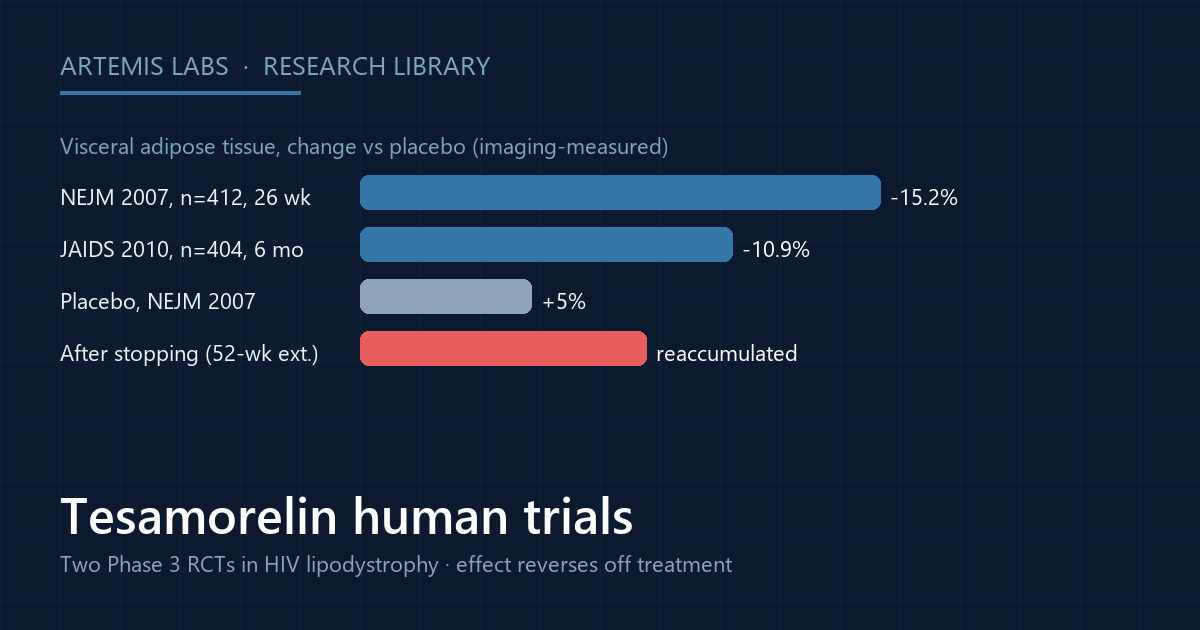
Tesamorelin human trials — Tesamorelin is unusual among research peptides: the molecule has a real, multicenter Phase 3 record, and that record belongs to a licensed pharmaceutical product, EGRIFTA (Theratechnologies Inc., FDA application 022505), tested in adults with HIV and abdominal fat accumulation. Two randomized, placebo-controlled trials of 412 and 404 patients reported reductions in visceral adipose tissue of 15.2% and 10.9% over 26 weeks versus placebo. The same trial program also reported that the effect did not last after treatment stopped, that more patients on tesamorelin withdrew because of an adverse event, and that the compound’s first randomized trial had missed on its visceral-fat comparison. Two 2026 meta-analyses of the same trials disagree on how many trials to include and on the size of the pooled effect.
Key findings
- Two pivotal Phase 3 trials, both in HIV-associated abdominal fat accumulation. A 26-week trial of 412 patients (N Engl J Med 2007, PMID 18057338) and a 12-month, two-phase trial of 404 patients (JAIDS 2010, PMID 20101189), both run from Montreal General Hospital, McGill University.
- The effect is on imaging-measured visceral fat, and it reverses. In the 52-week extension, the authors wrote: Upon discontinuation of tesamorelin, VAT reaccumulated and these effects do not last beyond the duration of treatment (AIDS 2008, PMID 18690162).
- The first randomized trial missed. In the 61-patient Phase 2 dose-ranging study, the visceral fat change was not significant versus placebo (AIDS 2005, PMID 16052083).
- The 2026 meta-analyses disagree. One pooled four RCTs and reported a visceral-fat mean difference of −21.47 cm² (PMID 42538058); the other pooled five and reported −27.71 cm² (PMID 41545261). They also differ on limb fat.
What were the two Phase 3 trials, and what did they measure?
The first Phase 3 trial randomly assigned 412 patients with HIV, 86% of them men, who had an accumulation of abdominal fat, to tesamorelin or placebo for 26 weeks. The primary endpoint was the percent change from baseline in visceral adipose tissue as shown on computed tomography. Visceral adipose tissue, usually abbreviated VAT, is the fat around the internal organs, and it was measured by CT scan instead of by weight. In the trial, VAT decreased by 15.2% in the tesamorelin group and increased by 5.0% in the placebo group; triglycerides fell by 50 mg/dL versus a rise of 9 mg/dL; IGF-I, the hormone downstream of growth hormone, rose 81.0% versus a fall of 5.0% (all P<0.001). The authors’ own conclusion used the word might: the effects might be useful in HIV-infected patients who have treatment-associated central fat accumulation (PMID 18057338).
The same abstract carries the sentence that most summaries drop: Adverse events did not differ significantly between the two study groups, but more patients in the tesamorelin group withdrew from the study because of an adverse event.
The second Phase 3 trial enrolled 404 HIV-infected patients with excess abdominal fat for 12 months in two phases. In the six-month primary phase, VAT decreased by −10.9% (−21 cm²) in the tesamorelin group vs. −0.6% (−1 cm²) in the placebo group, P < 0.0001, with no change in limb or abdominal SC fat and no change in glucose parameters (PMID 20101189). A figure of 18% is often quoted for this program. It belongs to the 12-month continuation arm, a selected group of patients who stayed on treatment, not to the randomized primary phase. Quoting 18% without that qualification overstates the randomized result by about two-thirds.
What did the pooled analysis of 806 patients show?
A pooled secondary analysis combined both trials: 806 antiretroviral-treated HIV patients randomized 2:1 to tesamorelin (n = 543) or placebo (n = 263) for 26 weeks, then re-randomized for a 26-week extension (JCEM 2010, PMID 20554713). At week 26, VAT changed by −24 ± 41 vs. 2 ± 35 cm², a treatment effect of −15.4%; triglycerides by a treatment effect of −12.3%; and IGF-I rose 108 ± 112 vs. −7 ± 64 ng/ml. This is a pooled re-analysis by the sponsor’s institution, not a meta-analysis, and PubMed tags it as a journal article only.
Two things in those numbers deserve plain statement. First, the standard deviation on the VAT change, ±41, is nearly twice the mean of −24: the average patient improved and a substantial minority did not. The trial program later formalised that split with a responder definition, a VAT reduction of at least 8%, which exists because non-response was common (PMID 22495074). Second, the abstract reports that fat under the skin (SC fat) was preserved; the underlying comparison was P = 0.08, a null reframed as a benefit.
What happened when treatment stopped?
The 52-week extension of the first trial re-randomized patients who had been on tesamorelin either to continue (n = 154) or to switch to placebo (n = 50). VAT reduction was sustained at −18% over 52 weeks of treatment in those who continued. In those who switched, the authors reported: Upon discontinuation of tesamorelin, VAT reaccumulated, and concluded that though effects on VAT are sustained during treatment for 52 weeks, these effects do not last beyond the duration of treatment (PMID 18690162). The second trial’s extension found the same: initial improvements were rapidly lost in those switching from tesamorelin to placebo (PMID 20101189). The discontinuation arm was small, 50 patients, but the finding is the trial authors’ own, and it appears in the abstract of the Phase 3 extension. Our page on the reversal finding collects every statement of it in the record.
What do the 2026 meta-analyses say, and why do they disagree?
Two systematic reviews with meta-analysis appeared in 2026. The first (Rawalpindi Medical University and University of South China, PMID 42538058) included four RCTs (909 patients) and reported a VAT mean difference of −21.47, 95%CI [−34.73, −8.22], I2=74%, together with higher discontinuation rates (RR2.25, 95%CI[0.98,5.17], p=0.06). The second (Ain Shams, Benha and Cairo universities, PMID 41545261) included five RCTs and reported −27.71 cm², 95 % CI [−38.37, −17.06], plus no significant reduction in under-skin (SC) adipose tissue or BMI, and no significant change in CD4 + T-cell counts. The first found no change in limb fat; the second found a significant limb-fat reduction. Same underlying trials, searched five months apart, different inclusion decisions, different answers. The honest summary is a range, not a single pooled number, and the I² of 74% in the first review means the trials themselves disagree with each other more than chance would explain.
The discontinuation risk ratio of 2.25 is worth reading carefully. Its confidence interval crosses 1 and its p-value is 0.06, so it is not statistically significant. But a point estimate of roughly double is unfavorable, and reporting it as “no difference” would misstate what the review found.
What came before Phase 3?
The compound’s first randomized test was a 61-patient, double-blind, dose-ranging Phase 2 trial in HIV-infected patients with increased waist circumference (AIDS 2005, PMID 16052083). Visceral fat decreased most in the highest-dose group, the authors wrote, but this change was not significant versus placebo. Trunk fat, lean body mass, the VAT-to-SAT ratio and triglycerides did change significantly. The Phase 3 program then succeeded on the endpoint the Phase 2 trial had missed. Both facts belong in an honest development history.
A 2011 systematic review of the whole growth-hormone-axis class in HIV lipodystrophy, ten RCTs and 1,511 patients, pooled all such drugs together and found VAT reductions with statistically significant side effects included arthralgias and oedema; its authors added that clinicians must decide whether the attributed benefits are clinically significant (HIV Med 2011, PMID 21265979). Its pooled figure is for the class, not for tesamorelin alone.
What the research does not show
Every trial on this page tested a specific licensed product, EGRIFTA, made by Theratechnologies Inc. under FDA application 022505. The results are that product’s results. They do not attach to research-grade material of the same sequence, and nothing on this page is a claim about what any research vial does. The controlled evidence is confined to adults with HIV-associated lipodystrophy; outside that population the record thins to single small trials and nulls, which our page on research outside HIV sets out. The endpoint was imaging-measured visceral fat, a surrogate: no trial measured cardiovascular events or mortality, and the approved product’s own label states that long-term cardiovascular safety of EGRIFTA WR has not been established. There is no trial of the compound in healthy adults for body-composition purposes, and no trial in sport or muscle-building contexts. And the effect, by the trial authors’ own account, does not outlast treatment.
Frequently asked questions
How many tesamorelin trials are there?
PubMed tags 26 records as randomized controlled trials, but most are secondary analyses of the same three or four datasets. The two 2026 meta-analyses found four and five trials respectively that met their criteria.
Is the pooled analysis a meta-analysis?
No. PMID 20554713 pooled the two Phase 3 trials’ patient-level data; it is tagged as a journal article, not a meta-analysis, and it was run from the sponsor’s trial institution.
Did the trials measure weight?
The primary endpoint was visceral adipose tissue measured by CT scan. The 2026 Egyptian meta-analysis found no significant change in BMI (PMID 41545261).
Where is the regulatory record for the product these trials tested?
On our page Is tesamorelin FDA-approved? What application 022505 actually covers. The compound’s identity record is on the tesamorelin research page.
References
- Metabolic effects of a growth hormone-releasing factor in patients with HIV. N Engl J Med. 2007. PMID 18057338 · DOI.
- Effects of tesamorelin, a growth hormone-releasing factor, in HIV-infected patients with abdominal fat accumulation: a randomized placebo-controlled trial with a safety extension. J Acquir Immune Defic Syndr. 2010. PMID 20101189 · DOI.
- Long-term safety and effects of tesamorelin, a growth hormone-releasing factor analogue, in HIV patients with abdominal fat accumulation. AIDS. 2008. PMID 18690162 · DOI.
- Effects of tesamorelin (TH9507), a growth hormone-releasing factor analog, in human immunodeficiency virus-infected patients with excess abdominal fat: a pooled analysis of two multicenter, double-blind placebo-controlled phase 3 trials with safety extension data. J Clin Endocrinol Metab. 2010. PMID 20554713 · DOI.
- A placebo-controlled, dose-ranging study of a growth hormone releasing factor in HIV-infected patients with abdominal fat accumulation. AIDS. 2005. PMID 16052083 · DOI.
- Reduction in visceral adiposity is associated with an improved metabolic profile in HIV-infected patients receiving tesamorelin. Clin Infect Dis. 2012. PMID 22495074 · DOI.
- Efficacy and Safety of Tesamorelin in People Living With HIV (PLWH) With Lipodystrophy: A Systematic Review and Meta-Analysis. J Int Assoc Provid AIDS Care. 2026. PMID 42538058 · DOI.
- Body composition, hepatic fat, metabolic, and safety outcomes of Tesamorelin, a GHRH analogue, in HIV-associated lipodystrophy: A meta-analysis of randomized controlled trials. Obes Res Clin Pract. 2026. PMID 41545261 · DOI.
- Growth hormone axis treatments for HIV-associated lipodystrophy: a systematic review of placebo-controlled trials. HIV Med. 2011. PMID 21265979 · DOI.
Methodology: every trial figure and quotation on this page was transcribed from the PubMed abstract of the cited record via NCBI E-utilities on August 27, 2026, with the study’s own hedges preserved. Last verified August 28, 2026.
All compounds sold by Artemis Labs are for laboratory research use only. Nothing on this page is medical advice, and no statement has been evaluated by the FDA.
