
Tesamorelin and Ipamorelin Together: What the Record Contains | Artemis Labs
Aug
Tesamorelin and ipamorelin together: what the research record actually contains
Published August 28, 2026 · Artemis Labs
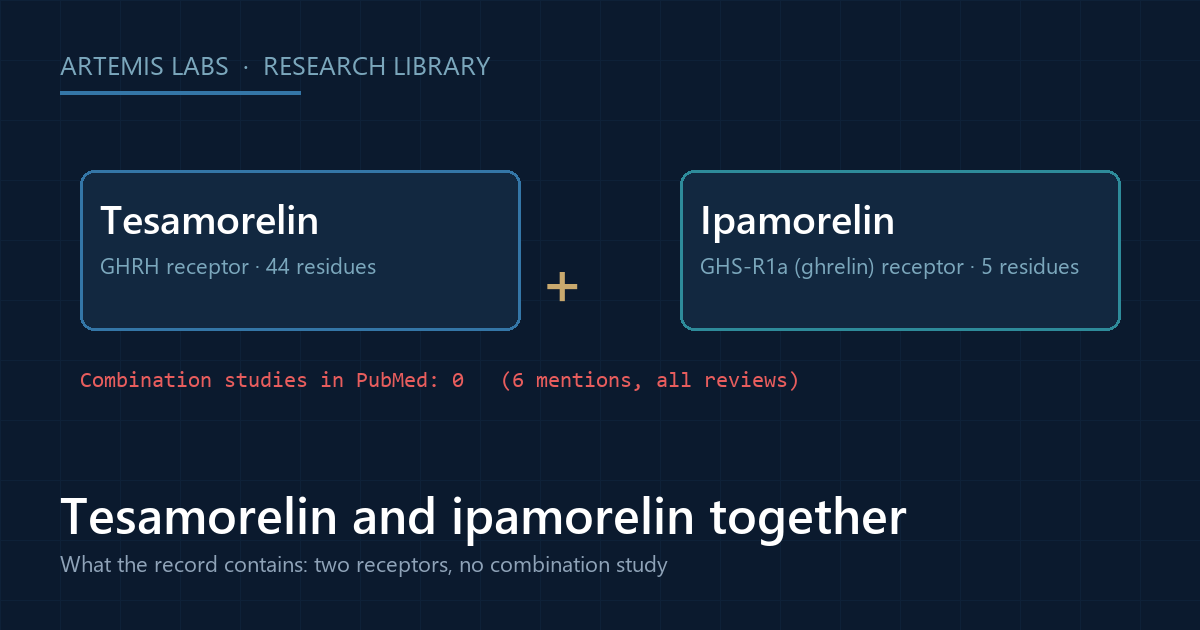
Tesamorelin and ipamorelin — Tesamorelin is a 44-residue analog of growth hormone-releasing hormone that acts on the GHRH receptor. Ipamorelin is a five-residue synthetic peptide that acts on a different receptor, the growth hormone secretagogue receptor also known as the ghrelin receptor. The two are sold together as a blend by several vendors, including Artemis Labs. The published record contains no study of tesamorelin and ipamorelin combined. A PubMed search for both names returns six records, all narrative reviews, none reporting original data on the pair. The one paper sometimes cited for the combination, a 2026 two-patient report, compares tesamorelin with a different drug class and does not mention ipamorelin. This page is the honest one the blend needs: it reports the absence.
Key findings
- Zero combination studies. tesamorelin AND ipamorelin returned 6 PubMed records on August 28, 2026: PMIDs 42395176, 42160466, 42123471, 41966639, 41490200 and 41476424. Every one is a review; none reports a trial, an animal study or a cell study of the two compounds together.
- Two receptors, verified separately. Tesamorelin: FDA established pharmacologic class Growth Hormone Releasing Factor Analog (PubChem CID 16137828). Ipamorelin: a pentapeptide, Aib-His-D-2-Nal-D-Phe-Lys-NH2, that stimulates GH release via a GHRP-like receptor, from the Novo Nordisk paper that first described it (Eur J Endocrinol 1998, PMID 9849822).
- The mis-attributed citation. A 2026 two-case report (PMID 42139091) concerns tesamorelin alongside GLP-1 receptor agonists. It says nothing about ipamorelin and cannot support the blend.
- The reviews that name the pair name it as a grey-market pattern, with one stating the class remain[s] investigational, with uncertain safety profiles, product quality concerns, and widespread antidoping restrictions (JBJS Rev 2026, PMID 42160466).
What are the two compounds, separately?
Tesamorelin is the full 44-residue GHRH sequence with a trans-3-hexenoyl cap on its first residue; PubChem’s pharmacodynamics annotation says it stimulates growth hormone secretion, and subsequently increases IGF-1 and IGFBP-3 levels, and its only controlled human evidence is in adults with HIV-associated lipodystrophy, for a licensed product. Its identity, trial and regulatory records are on the tesamorelin research page and the cluster pages linked there.
Ipamorelin was described in 1998 by a Novo Nordisk group as a pentapeptide (Aib-His-D-2-Nal-D-Phe-Lys-NH2), which displays high GH releasing potency and efficacy in vitro and in vivo, acting via a GHRP-like receptor, and, in swine, releasing growth hormone without raising ACTH or cortisol, which the authors called the first GHRP-receptor agonist with a selectivity for GH release similar to that displayed by GHRH (PMID 9849822). A 1999 pharmacokinetic study in 40 healthy male volunteers measured a short terminal half-life of 2 hours and a single episode of growth-hormone release peaking at 0.67 hours (Pharm Res 1999, PMID 10496658). The receptor it acts on is the growth hormone secretagogue receptor, GHS-R1a, the receptor for the stomach hormone ghrelin. Those are the verified facts this page uses about ipamorelin; the ipamorelin research page carries its own record.
Why are they sold together?
The rationale offered by vendors is that the two act on different receptors that both lead to growth-hormone release, so a blend engages two pathways at once. That is a mechanistic argument, and the literature does contain human studies of GHRH combined with growth-hormone-releasing peptides of the same family as ipamorelin. In eight healthy men, an intravenous combination of GHRH(1-29) with GHRP-2 produced a larger growth-hormone response than either alone, but the authors were not able to demonstrate synergy between the two substances: the combined response was not significantly different from the sum of the separate ones (Clin Endocrinol 1995, PMID 7586605). In nine healthy men, blocking GHRH with an antagonist eliminated most of the GH response to GHRP-6, showing that endogenous GHRH is necessary for most of the GH response to GHRP-6 in humans (JCEM 1998, PMID 9543138). Mayo Clinic groups have studied GHRH/GHRP-2 co-infusion as a research tool for probing growth-hormone regulation in men (PMIDs 18073313, 19240251). None of those studies used tesamorelin, and none used ipamorelin. They describe the receptor biology; they do not describe this blend.
What does the record say about tesamorelin plus ipamorelin specifically?
Nothing, in the sense that matters. The six PubMed records that mention both compounds are all reviews of peptides in sports medicine, aging or endocrinology, and each names the two among many compounds encountered in unregulated self-administration. One primer for orthopaedic surgeons notes that CJC-1295 combined with ipamorelin showed an effect in a mouse model of glucocorticoid-induced muscle loss, and in the same paragraph that tesamorelin … has no supporting orthopaedic evidence (Am J Sports Med 2026, PMID 41476424); that is a different GHRH analog paired with ipamorelin, in mice. A structured review of injectable peptides in sports medicine concludes that growth-hormone-axis secretagogues remain investigational, with uncertain safety profiles, product quality concerns, and widespread antidoping restrictions (PMID 42160466). A Polish review lists tesamorelin among GHRH analogues and ipamorelin among growth hormone secretagogues that are marketed as “research compounds”, and catalogs reported adverse effects across the class (PMID 42395176). No original study of the combination exists in any of them, or anywhere else in PubMed.
What about the 2026 case report sometimes cited for the blend?
PMID 42139091 is a 2026 two-patient therapeutic-pathway illustration, co-affiliated with industry, concerning tesamorelin in relation to GLP-1 receptor agonists, a different drug class entirely. It does not mention ipamorelin. Artemis Labs’ own earlier product copy attached this citation to a tesamorelin-and-ipamorelin pairing; that was an error, it is corrected here, and the citation is named on this page only so that the mis-attribution is on the record. It supports nothing about the blend.
What the research does not show
This section is the page. There is no published trial, animal study or cell study of tesamorelin combined with ipamorelin. There is no pharmacokinetic study of the pair, no safety study of the pair, and no study of whether the two compounds interact in a vial or in a model. The human GHRH-plus-GHRP literature that exists used different peptides, in single intravenous doses, in small groups of healthy men, and its best-known combination study found an additive instead of synergistic response. Tesamorelin’s approval covers a licensed product for one HIV-associated indication and confers nothing on any blend; ipamorelin has no approved product. The reviews that name the pair do so as a pattern of unregulated use, with explicit warnings about safety data and product quality. Artemis Labs sells the blend for laboratory research, and this page states plainly that the research on it has not been done.
Frequently asked questions
Is there a study of tesamorelin and ipamorelin together?
No. The six PubMed records that mention both are reviews (PMIDs 42395176, 42160466, 42123471, 41966639, 41490200, 41476424).
Do GHRH analogs and growth-hormone-releasing peptides act synergistically?
In the one human combination study in our verified record, GHRH(1-29) plus GHRP-2 was additive, and the authors were not able to demonstrate synergy (PMID 7586605). Neither compound in that study was tesamorelin or ipamorelin.
Does tesamorelin’s FDA approval extend to the blend?
No. The approval covers EGRIFTA, a specific licensed product, for one indication; see what application 022505 covers.
Where is the tesamorelin trial evidence?
On the tesamorelin trial-record page, all of it in HIV-associated lipodystrophy.
References
- PubMed search tesamorelin AND ipamorelin, NCBI E-utilities, 2026-08-28: Count 6. Reviews: PMID 42395176; PMID 42160466; PMID 42123471; PMID 41966639; PMID 41490200; PMID 41476424.
- Ipamorelin, the first selective growth hormone secretagogue. Eur J Endocrinol. 1998. PMID 9849822 · DOI. Novo Nordisk-authored.
- Pharmacokinetic-pharmacodynamic modeling of ipamorelin, a growth hormone releasing peptide, in human volunteers. Pharm Res. 1999. PMID 10496658 · DOI.
- GH responses to intravenous bolus infusions of GH releasing hormone and GH releasing peptide 2 separately and in combination in adult volunteers. Clin Endocrinol. 1995. PMID 7586605 · DOI.
- Growth hormone (GH)-releasing peptide-6 requires endogenous hypothalamic GH-releasing hormone for maximal GH stimulation. J Clin Endocrinol Metab. 1998. PMID 9543138 · DOI.
- Gonadal status and body mass index jointly determine GHRH/GHRP synergy in healthy men. J Clin Endocrinol Metab. 2008. PMID 18073313. Determinants of GH-releasing hormone and GH-releasing peptide synergy in men. Am J Physiol Endocrinol Metab. 2009. PMID 19240251.
- PubChem. Tesamorelin, CID 16137828: Pharmacodynamics; FDA Pharmacological Classification. pubchem.ncbi.nlm.nih.gov/compound/16137828.
- The 2026 two-case report cited in error for the pair: PMID 42139091 (tesamorelin and GLP-1 receptor agonists; no ipamorelin content).
Methodology: the combination search and every quotation were retrieved via NCBI E-utilities on August 27–28, 2026; ipamorelin facts are limited to the two primary papers cited. Last verified August 28, 2026.
All compounds sold by Artemis Labs are for laboratory research use only. Nothing on this page is medical advice, and no statement has been evaluated by the FDA.
