
Tesamorelin and Liver Fat: One Trial, Many Papers | Artemis Labs
Aug
Tesamorelin and liver fat: one trial, many papers
Published August 28, 2026 · Artemis Labs
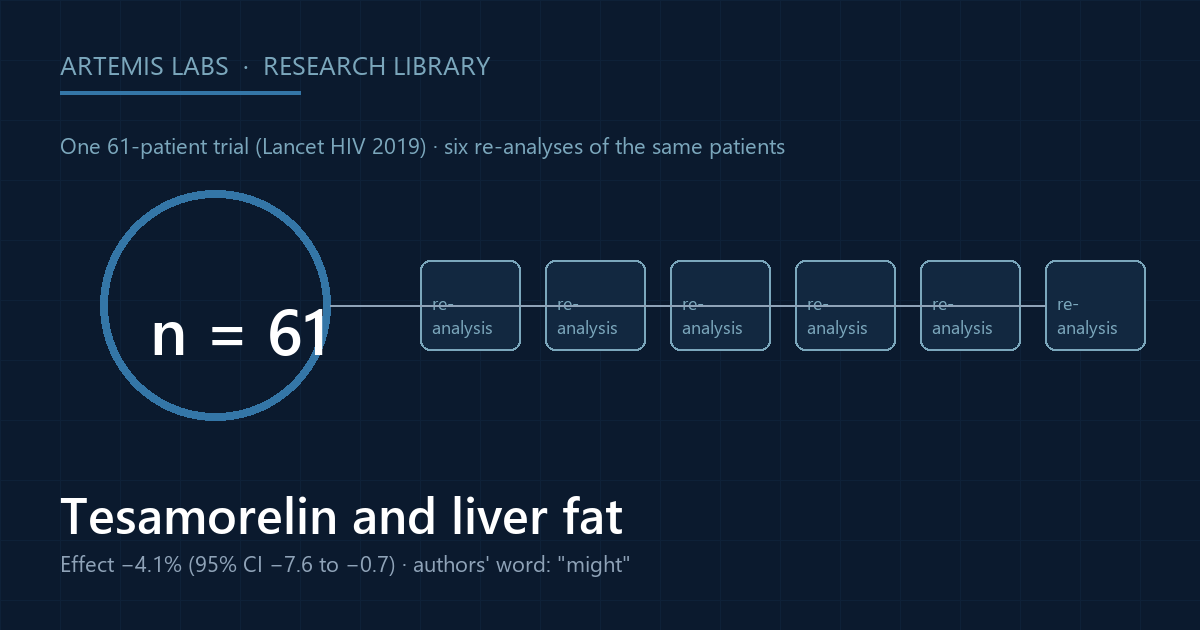
Tesamorelin NAFLD research — The tesamorelin liver-fat literature looks deep and is not. PubMed returns 17 records for tesamorelin and non-alcoholic fatty liver disease, but the controlled evidence is a single randomized, double-blind trial of 61 people with HIV and a hepatic fat fraction of at least 5%, run at two US sites and published in Lancet HIV in 2019. It reported an absolute reduction in hepatic fat fraction of −4.1% (95% CI −7.6 to −0.7) over 12 months, and its authors concluded that tesamorelin might be beneficial. At least six later papers, on hepatic gene expression, immune markers, fibrosis predictors, proteomics and drug-class subgroups, analyze the same 61 patients. They are one trial re-read, not seven studies, and every one of them is in people with HIV.
Key findings
- One randomized trial. 61 patients enrolled between August 2015 and January 2019, 30 to tesamorelin and 30 to placebo, 12 months double-blind then 6 months open-label; primary endpoint change in hepatic fat fraction by proton magnetic resonance spectroscopy (Lancet HIV 2019, PMID 31611038).
- The effect, and its confidence interval. Absolute effect size −4·1% (95% CI −7·6 to −0·7, p=0·018); relative reduction −37% (95% CI −67 to −7); 35% of the tesamorelin group versus 4% of placebo reached a hepatic fat fraction below 5%.
- The authors’ own word is “might”. Tesamorelin might be beneficial in people with HIV and NAFLD. Further studies are needed to determine the long-term effects of tesamorelin on liver histology.
- Six re-analyses of the same 61 patients (PMIDs 32701508, 33852720, 32270862, 36461941, 34006921, 38905488), each carrying the parent trial’s sample size and its limits.
What did the Lancet HIV trial find?
Non-alcoholic fatty liver disease, NAFLD, now often called MASLD, means fat built up in the liver in people who do not drink heavily. The trial enrolled people with HIV infection and a hepatic fat fraction of 5% or more, measured by proton magnetic resonance spectroscopy, a scan that quantifies liver fat without a biopsy. Participants were randomized 1:1 to tesamorelin or an identical placebo for 12 months, followed by a 6-month open-label phase. The primary endpoint was change in hepatic fat fraction at 12 months; the primary safety endpoint was glucose (PMID 31611038).
The result, in the abstract’s own numbers: Patients receiving tesamorelin had a greater reduction of HFF than did patients receiving placebo, with an absolute effect size of −4·1% (95% CI −7·6 to −0·7, p=0·018), corresponding to a −37% (95% CI −67 to −7, p=0·016) relative reduction from baseline. After 12 months, 35% of individuals receiving tesamorelin and 4% receiving placebo had a HFF of less than 5% (p=0·0069). Fasting glucose and glycated haemoglobin did not differ between groups at 12 months, and the tesamorelin group had more injection-site complaints, none judged serious.
Three things bound the finding. It is 61 people, two sites, one country. The confidence intervals are wide: the relative reduction could be as small as 7%. And the authors chose the word might, and asked for studies of long-term effects … on liver histology, which is the tissue-level outcome the scan does not measure. An earlier 50-patient JAMA trial from the same Boston group had reported a liver-fat reduction as a secondary endpoint, described by its own authors as a preliminary study (JAMA 2014, PMID 25038357).
What are the six later papers, and why are they not six studies?
Each of the following draws on the participants of the 2019 trial, and PubMed tags several of them with the parent trial’s randomized-controlled-trial label even though they report secondary or mechanistic analyses:
- Effects of tesamorelin on hepatic transcriptomic signatures in HIV-associated NAFLD (JCI Insight 2020, PMID 32701508): gene-expression patterns in liver samples.
- Growth hormone releasing hormone reduces circulating markers of immune activation in parallel with effects on hepatic immune pathways in individuals with HIV-infection and nonalcoholic fatty liver disease (Clin Infect Dis 2021, PMID 33852720).
- Clinical predictors of liver fibrosis presence and progression in HIV-associated NAFLD (Clin Infect Dis 2021, PMID 32270862): who progressed, within the trial population.
- Delineating tesamorelin response pathways in HIV-associated NAFLD using a targeted proteomic and transcriptomic approach (Sci Rep 2021, PMID 34006921).
- Proteomic analysis of hepatic fibrosis in HIV-associated NAFLD demonstrates up-regulation of immune response and tissue repair pathways (J Infect Dis 2023, PMID 36461941).
- Efficacy and safety of tesamorelin in people with HIV on integrase inhibitors (AIDS 2024, PMID 38905488): a post-hoc subgroup of 38 participants, 31 completers, described by its authors as the first dedicated data in that drug-class subgroup.
Counted as records, that is seven papers. Counted as evidence, it is one trial of 61 people examined from seven angles. None of the re-analyses adds participants, adds a control group, or extends follow-up beyond the parent design. A page that lists “seven studies of tesamorelin in fatty liver” is not wrong about the count and is wrong about the evidence. The transcriptomic paper also reported that tesamorelin reciprocally up- and downregulated curated gene sets associated with favorable and poor hepatocellular carcinoma prognosis (PMID 32701508); that is an expression pattern in about 30 livers, not a cancer outcome in either direction.
Does the finding extend beyond HIV?
Not in the primary record. Every patient in the trial and every re-analysis had HIV. NAFLD in people with HIV has its own drivers, including antiretroviral therapy and the visceral fat accumulation that tesamorelin’s approved product is indicated for. The compound’s approved indication is the reduction of excess abdominal fat in HIV-infected adult patients with lipodystrophy, and there is no approved indication for liver fat in any population. PubMed indexes no randomized trial of tesamorelin in NAFLD or MASLD outside HIV. Our page on research outside HIV sets the liver lane beside the others.
What the research does not show
The record does not show a liver-histology outcome, a fibrosis outcome, or any clinical event; the trial’s endpoint was a scan-measured fat fraction, and its authors asked for histology studies that do not yet exist. It does not show an effect in people without HIV, because none were studied. It does not show durability: the 12-month double-blind phase was followed by open-label treatment, and the wider tesamorelin program reported that its visceral-fat effect did not outlast treatment (PMID 18690162). And it does not show anything about research-grade material, because every paper tested the licensed product in a clinical setting. Our trial-record page holds the wider evidence, and the tesamorelin research page holds the compound’s identity and reference record.
Frequently asked questions
How many trials of tesamorelin in fatty liver are there?
One randomized trial, 61 patients, all with HIV (PMID 31611038), plus a 50-patient trial that measured liver fat as a secondary endpoint (PMID 25038357). The other papers re-analyze the first.
How large was the effect?
An absolute hepatic-fat-fraction reduction of −4.1% (95% CI −7.6 to −0.7) at 12 months, a relative reduction of −37% (95% CI −67 to −7).
Is tesamorelin approved for fatty liver?
No. The only approved indication is HIV-associated lipodystrophy, on our page about what application 022505 covers.
Did the trial find liver damage or benefit at the tissue level?
Neither; it measured fat by spectroscopy, not tissue by biopsy, and its authors called for histology studies.
References
- Effects of tesamorelin on non-alcoholic fatty liver disease in HIV: a randomised, double-blind, multicenter trial. Lancet HIV. 2019. PMID 31611038 · DOI.
- Effect of tesamorelin on visceral fat and liver fat in HIV-infected patients with abdominal fat accumulation: a randomized clinical trial. JAMA. 2014. PMID 25038357 · DOI.
- Effects of tesamorelin on hepatic transcriptomic signatures in HIV-associated NAFLD. JCI Insight. 2020. PMID 32701508.
- Growth Hormone Releasing Hormone Reduces Circulating Markers of Immune Activation in Parallel with Effects on Hepatic Immune Pathways in Individuals with HIV-infection and Nonalcoholic Fatty Liver Disease. Clin Infect Dis. 2021. PMID 33852720.
- Clinical Predictors of Liver Fibrosis Presence and Progression in Human Immunodeficiency Virus-Associated Nonalcoholic Fatty Liver Disease. Clin Infect Dis. 2021. PMID 32270862.
- Delineating tesamorelin response pathways in HIV-associated NAFLD using a targeted proteomic and transcriptomic approach. Sci Rep. 2021. PMID 34006921.
- Proteomic Analysis of Hepatic Fibrosis in Human Immunodeficiency Virus-Associated Nonalcoholic Fatty Liver Disease Demonstrates Up-regulation of Immune Response and Tissue Repair Pathways. J Infect Dis. 2023. PMID 36461941.
- Efficacy and safety of tesamorelin in people with HIV on integrase inhibitors. AIDS. 2024. PMID 38905488 · DOI.
- Long-term safety and effects of tesamorelin. AIDS. 2008. PMID 18690162.
Methodology: trial quotations were transcribed from PubMed abstracts via NCBI E-utilities on August 27, 2026; the six re-analysis titles were verified by esummary on August 28, 2026. Last verified August 28, 2026.
All compounds sold by Artemis Labs are for laboratory research use only. Nothing on this page is medical advice, and no statement has been evaluated by the FDA.
