
Tesamorelin Research Outside HIV: Where the Evidence Stops | Artemis Labs
Aug
Tesamorelin research outside HIV lipodystrophy: where the evidence stops
Published August 28, 2026 · Artemis Labs
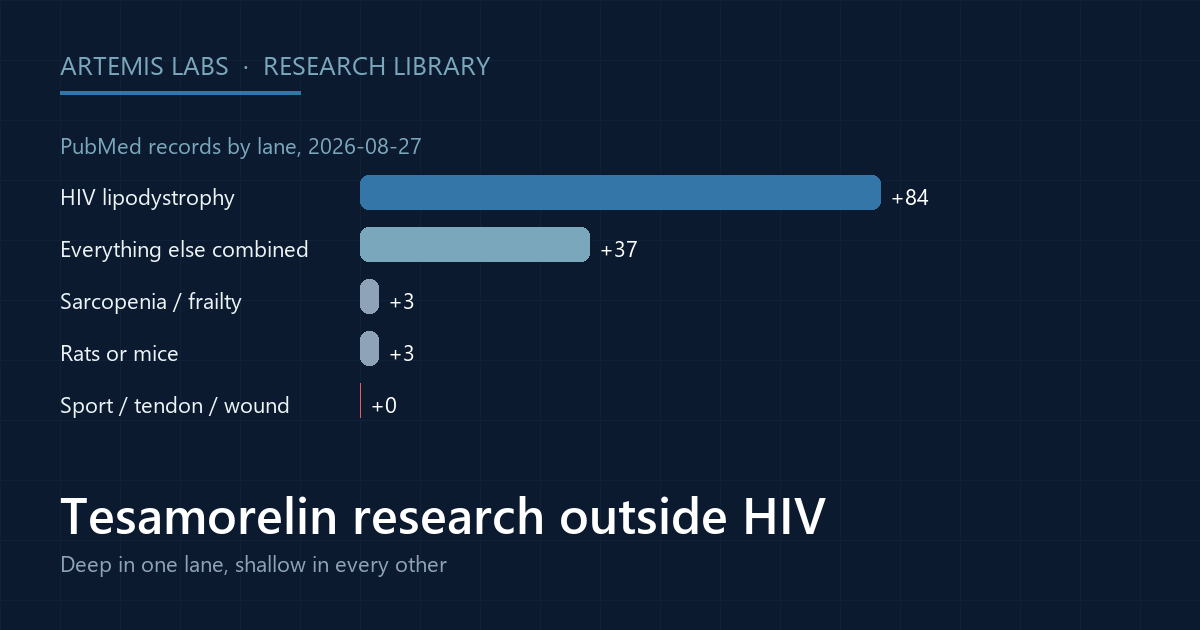
Tesamorelin research outside HIV — Tesamorelin’s controlled human evidence is deep in one lane, HIV-associated lipodystrophy, and shallow everywhere else. The PubMed search tesamorelin NOT HIV returns 37 records, most of them analytical-chemistry methods, reviews and news items. The non-HIV obesity record is one cohort of about 60 people with reduced growth-hormone secretion, published twice. The liver-fat record is one 61-patient trial in people with HIV, re-analyzed at least six ways. The cognition record is one unreplicated 2012 positive followed by two nulls. Sarcopenia, frailty, sport, tendon and wound lanes contain zero primary studies. A 2009 review said it in one sentence: Other potential indications for tesamorelin appear less promising from the current data.
Key findings
- The whole non-HIV literature is 37 records (tesamorelin NOT HIV, August 27, 2026), against 84 for tesamorelin AND HIV.
- Obesity without HIV is one study, twice. A 12-month trial in 60 abdominally obese subjects with reduced GH secretion (JCEM 2012, PMID 23015655) and a spectroscopy substudy of 39 of the same participants (JCEM 2014, PMID 24178787), both from one Boston group.
- The only dedicated non-HIV randomized trial in our corpus is a null. In 53 people with type 2 diabetes, 12 weeks of tesamorelin did not alter insulin response or glycemic control (PLoS One 2017, PMID 28617838).
- Muscle claims rest on a responder-only analysis. The one paper reporting muscle-area gains restricted its tesamorelin arm to responders and its placebo arm to nobody (J Frailty Aging 2019, PMID 31237318).
What does the literature look like, by count?
PubMed indexes 121 tesamorelin records in total, and 84 of them mention HIV. Of the 37 that do not, a large share are doping-control analytical methods, narrative reviews, and news items with no abstract. The counts below were run on August 27, 2026, and each lane is described by what the records actually are instead of how many there are, because the number alone flatters every one of them.
| Lane | PubMed count | What the records are |
|---|---|---|
| Obesity (any) | 18 | Two papers on one non-HIV cohort; the rest HIV or review |
| Liver fat (NAFLD/MASLD) | 17 | One 61-patient trial, in HIV, plus its re-analyses |
| Cognition / memory | 9 | One positive RCT, its substudy, two nulls, one news piece |
| Sarcopenia / frailty | 3 | One responder-only analysis, one protocol, one review |
| Musculoskeletal / sport / wound | 9 | All reviews, or the LiverTox monograph. Zero primary studies |
| Rats or mice (MeSH) | 3 | Two sponsor-linked papers from before 2008 plus incidental hits |
What is the non-HIV obesity record?
One trial. A Boston group randomized 60 abdominally obese subjects with reduced GH secretion to tesamorelin or placebo for 12 months and reported changes in visceral fat, with IGF-I rising 86 ± 21 vs. −6 ± 8 μg/liter (JCEM 2012, PMID 23015655). A second paper reported a magnetic-resonance-spectroscopy substudy of 39 obese men and women with reduced GH secretion from the same trial (JCEM 2014, PMID 24178787). Two things bound that record. It is one cohort, not two studies, and both papers say so. And every participant was selected for reduced growth-hormone secretion, so the finding says nothing about obesity in general. A page that describes this as “tesamorelin research in obesity” without both qualifications has overstated a single study by a wide margin.
What is the liver-fat record?
One randomized trial, in people with HIV: 61 patients with a hepatic fat fraction of 5% or more, randomized to tesamorelin or placebo for 12 months at two US sites, with a hepatic-fat reduction of −4·1% (95% CI −7·6 to −0·7) absolute (Lancet HIV 2019, PMID 31611038). The authors’ conclusion used the word might. At least six later papers, on hepatic gene expression, integrase-inhibitor subgroups, fibrosis markers and more, re-analyze the same 61 patients. Our liver-fat page lists them and explains why six re-analyses of one trial are not seven studies.
What is the cognition record?
Split, and the most recent trials are null. A 2012 randomized trial in 152 older adults, 66 with mild cognitive impairment, reported a favorable effect of GHRH on cognition (P=.03) in intent-to-treat analysis, along with a near-doubling of adverse-event reports, 68% versus 36% (Arch Neurol 2012, PMID 22869065). It has never been replicated. A 2025 open-label Phase 2 trial in 73 people with HIV found the between-group difference was not significant (P = .673) and concluded the study suggests no clear benefit (J Infect Dis 2025, PMID 39813152). A 2026 pilot in 22 adults reported that treatment was not directly linked with significant changes in study measures (eNeurologicalSci 2026, PMID 42382101). Our cognition page has the full record.
What is the muscle and frailty record?
Zero completed trials. The lane contains one secondary analysis of the HIV Phase 3 data in which tesamorelin participants were restricted to responders (visceral adipose tissue decrease ≥8%) while the placebo arm was not, and which reported truncal muscle density gains of 1.56–4.86 Hounsfield units and area gains under 1.1 cm² (J Frailty Aging 2019, PMID 31237318). Comparing a group selected for success against an unselected control cannot support a general claim about muscle, and the authors’ own conclusion is conditioned on responders. The lane also contains a 2025 protocol for a trial in 100 sedentary older adults with no results yet (PMID 42419889, NCT06554717), and one review. That is the entire record.
What did the type 2 diabetes trial find?
Nothing, which is the point of it. The only dedicated non-HIV randomized trial in our verified corpus enrolled 53 people with type 2 diabetes for 12 weeks and reported: No significant differences were observed between groups in relative insulin response over the 12-week treatment period. At Week 12, fasting glucose, HbA1c and overall diabetes control were not significantly different between groups. The conclusion: treatment did not alter insulin response or glycemic control (PLoS One 2017, PMID 28617838). That is a reassuring safety null in a population where a glucose signal would matter most. It is not a diabetes benefit, and it should never be read as one.
What about sport, tendon, wound and musculoskeletal research?
The search returns nine records and every one is a review or the LiverTox monograph. There are no primary studies of tesamorelin in tendon, wound, injury or athletic contexts. Three 2026 reviews that do discuss it do so as a compound encountered in unregulated self-administration, with one stating that growth-hormone-axis secretagogues remain investigational, with uncertain safety profiles, product quality concerns, and widespread antidoping restrictions (JBJS Rev 2026, PMID 42160466). This page reports the absence of evidence in these lanes; it does not court the demand behind them.
Why is there almost no animal literature?
Because the compound went to human trials early under a sponsor. The MeSH-filtered search for rats or mice returns three records, and the non-clinical search returns one: the sponsor’s 2007 toxicology paper (PMID 17214611) and a 2004 UK pulmonary-delivery study in dogs (PMID 15113616). Both are sponsor-linked and both predate 2008. There is essentially no independent modern preclinical literature on tesamorelin, which is the reverse of the usual research-peptide profile and worth stating plainly.
What the research does not show
The controlled human evidence for tesamorelin is confined to adults with HIV-associated lipodystrophy and belongs to a licensed product, EGRIFTA, not to research-grade material. Outside that lane there is no replicated positive finding in any population: the obesity record is one restricted cohort, the liver record is one small trial with a hedged conclusion, the cognition record ends in two nulls, the muscle record is a responder-only analysis, and the sport, tendon and wound lanes are empty of primary data. A 2009 review written before approval put it in one sentence: Other potential indications for tesamorelin appear less promising from the current data (PMID 19243281). Seventeen years later the primary record still supports that sentence.
Frequently asked questions
Has tesamorelin been tested for obesity in people without HIV?
In one 60-person cohort restricted to people with reduced growth-hormone secretion, published twice (PMIDs 23015655, 24178787). Not in general obesity.
Does it build muscle?
The one paper reporting muscle changes compared responders only against an unselected placebo group (PMID 31237318). That design cannot support the claim. No completed trial exists in sarcopenia or frailty.
Are there tesamorelin studies in athletes or injury?
No primary studies. Nine records, all reviews.
Where is the deep evidence?
In HIV-associated lipodystrophy, on our trial-record page. The compound’s identity record is on the tesamorelin research page.
References
- Effects of tesamorelin on visceral fat and metabolic parameters in abdominally obese subjects with reduced GH secretion. J Clin Endocrinol Metab. 2012. PMID 23015655.
- Magnetic-resonance-spectroscopy substudy in obese men and women with reduced GH secretion. J Clin Endocrinol Metab. 2014. PMID 24178787.
- Effects of tesamorelin on non-alcoholic fatty liver disease in HIV: a randomised, double-blind, multicenter trial. Lancet HIV. 2019. PMID 31611038 · DOI.
- Effects of growth hormone-releasing hormone on cognitive function in adults with mild cognitive impairment and healthy older adults: results of a controlled trial. Arch Neurol. 2012. PMID 22869065 · DOI.
- Effects of Tesamorelin on Neurocognitive Impairment in Persons With HIV and Abdominal Obesity. J Infect Dis. 2025. PMID 39813152 · DOI.
- The effect of growth hormone-releasing hormone on cognition and brain connectivity in adults with cognition ranging from normal to mild cognitive impairment. eNeurologicalSci. 2026. PMID 42382101 · DOI.
- The Growth Hormone Releasing Hormone Analogue, Tesamorelin, Decreases Muscle Fat and Increases Muscle Area in Adults with HIV. J Frailty Aging. 2019. PMID 31237318 · DOI.
- TRIUMPH trial protocol, NCT06554717. 2025. PMID 42419889.
- Tesamorelin in type 2 diabetes: 12-week randomized trial. PLoS One. 2017. PMID 28617838.
- Injectable Peptides in Sports Medicine: A Structured Narrative Review of Evidence, Safety, and Antidoping Implications. JBJS Rev. 2026. PMID 42160466 · DOI.
- Non-clinical pharmacology and safety evaluation of TH9507. Basic Clin Pharmacol Toxicol. 2007. PMID 17214611. Pulmonary delivery of TH9507 in the dog. 2004. PMID 15113616.
- Tesamorelin review. Expert Opin Investig Drugs. 2009. PMID 19243281 · DOI.
Methodology: lane counts and quotations were retrieved via NCBI E-utilities esearch and efetch on August 27, 2026, with each study’s own hedges preserved. Last verified August 28, 2026.
All compounds sold by Artemis Labs are for laboratory research use only. Nothing on this page is medical advice, and no statement has been evaluated by the FDA.
