
Tesamorelin Safety Research: Trials, FAERS and the Label’s Limits | Artemis Labs
Aug
Tesamorelin safety research: trials, FAERS, and the label’s own limits
Published August 28, 2026 · Artemis Labs
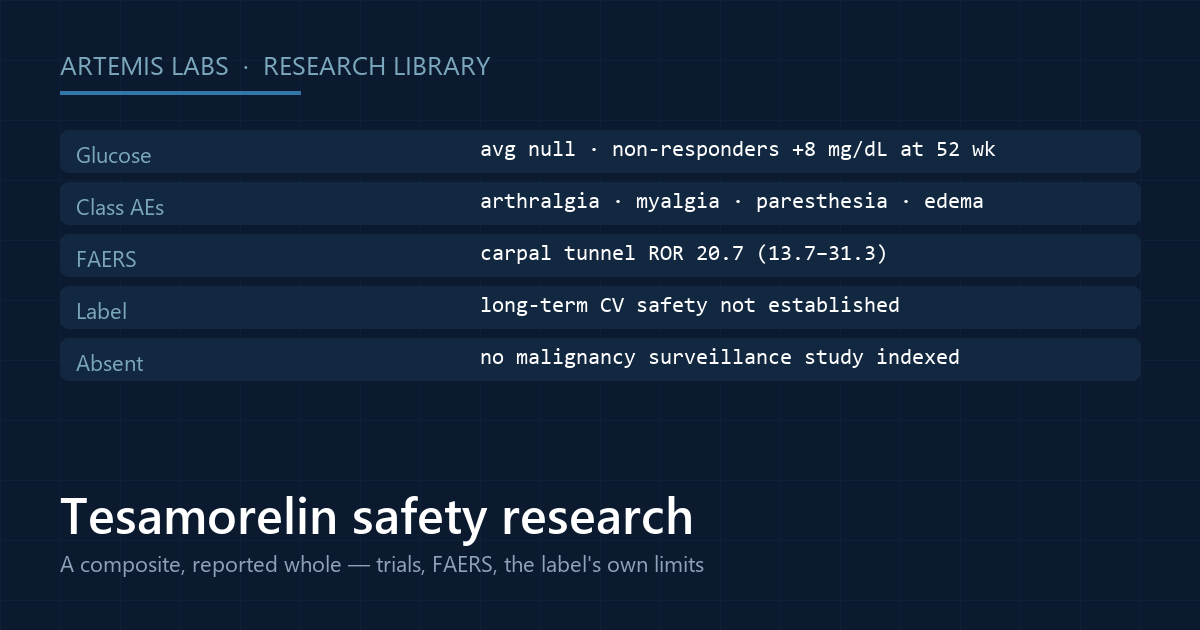
Tesamorelin safety — The tesamorelin safety record is a composite, not a single verdict. The Phase 3 trials in HIV-associated lipodystrophy reported adverse events that did not differ significantly from placebo, but more withdrawals for adverse events on the drug. PubChem’s own mechanism annotation states that the drug predisposes the patient to glucose intolerance and can also increase the risk of type 2 diabetes. Non-responders in the 52-week trials showed fasting-glucose drift; a JAMA trial found a significant fasting-glucose rise at two weeks that resolved by six months. A 2025 pharmacovigilance study found a carpal-tunnel-syndrome reporting odds ratio of 20.7. The approved product’s label states that long-term cardiovascular safety has not been established, and PubMed indexes no long-term malignancy surveillance study for this growth-hormone-axis agent. All of it describes a licensed product, not research-grade material.
Key findings
- Glucose is a composite. Four Phase 3 abstracts report no significant glucose change on average; non-responders drifted (8 ± 17 mg/dL fasting glucose at 52 weeks, PMID 22495074); a JAMA trial found a treatment effect, 7 mg/dL … P = .03 at 2 weeks (PMID 25038357); PubChem’s mechanism annotation carries a diabetes-risk statement.
- Class-typical adverse events in three syntheses. Arthralgia, myalgia, paresthesia, injection-site erythema (PMID 41545261); arthralgias and oedema (PMID 21265979); events known to be associated with growth hormone therapy (PMID 21668043).
- A pharmacovigilance signal for carpal tunnel syndrome. FAERS, 2003–2024: tesamorelin (ROR=20.7, 95% CI=13.7–31.3), fourth of ten drugs (Cureus 2025, PMID 40510111). Disproportionality is not causation.
- Named absences. PubMed indexes no retinopathy, hypersensitivity, immunogenicity, product-purity or adverse-event case-report literature for tesamorelin, and no long-term malignancy surveillance study.
What did the Phase 3 trials report on safety?
The first pivotal trial’s abstract reports: Adverse events did not differ significantly between the two study groups, but more patients in the tesamorelin group withdrew from the study because of an adverse event. No significant differences were observed in glycemic measures (N Engl J Med 2007, PMID 18057338). The 52-week extension reported the drug was generally well tolerated, with adverse-event prevalence comparable with the initial phase and glucose changes not clinically significant (AIDS 2008, PMID 18690162). The pooled analysis of 806 patients found no clinically meaningful differences … in glucose parameters at wk 26 and 52 (JCEM 2010, PMID 20554713). A 2026 meta-analysis of four RCTs added a discontinuation risk ratio of 2.25, 95%CI[0.98,5.17], p=0.06, not significant but with an unfavorable point estimate, and its authors wrote that limited data on long-term safety … warrant caution (PMID 42538058).
The adverse events themselves are class-typical for anything that raises growth hormone. The 2026 Egyptian meta-analysis lists arthralgia, myalgia, paresthesia, and injection-site reactions like erythema (PMID 41545261). The 2011 class-level systematic review of growth-hormone-axis drugs in HIV lipodystrophy found statistically significant side effects included arthralgias and oedema (PMID 21265979). The 2011 Adis drug profile describes events known to be associated with growth hormone therapy (e.g. arthralgia, headache and peripheral oedema) (PMID 21668043).
What is the glucose story, in full?
It is true that four Phase 3 abstracts report no significant average change in glucose. It is also true that three other primary sources say something less reassuring, and an honest page carries all of them.
- Non-responders drifted. In the per-protocol analysis of 402 patients, those who did not reach the responder threshold showed fasting glucose changes of 5 ± 14 mg/dL at 26 weeks and 8 ± 17 mg/dL at 52 weeks, and HbA1c changes of 0.3 ± 0.4% and 0.2 ± 0.5%, against near-zero changes in responders, all P ≤ .01 (Clin Infect Dis 2012, PMID 22495074). The authors describe responders’ changes as attenuated. Patients who took the drug and did not lose visceral fat drifted toward worse glycaemia.
- An early significant rise. In a 50-patient JAMA trial, fasting glucose increased in the tesamorelin group at 2 weeks (mean change, 9 mg/dL … vs 2 mg/dL … treatment effect, 7 mg/dL [95% CI, 1–14 mg/dL]; P = .03), with changes at six months not significant (JAMA 2014, PMID 25038357). The rise was real and it resolved; both halves belong together.
- The mechanism annotation. PubChem’s Mechanism of Action section for the compound states: Tesamorelin therapy predisposes the patient to glucose intolerance and can also increase the risk of type 2 diabetes, so the drug is contraindicated in pregnancy.
Against that, the one dedicated trial in people who already had type 2 diabetes, 53 patients over 12 weeks, found that treatment did not alter insulin response or glycemic control (PLoS One 2017, PMID 28617838). That is a reassuring null in the population where a signal would matter most, and it is not a benefit.
What is the FAERS carpal-tunnel signal?
A 2025 pharmacovigilance study used OpenVigil to analyse FDA Adverse Event Reporting System reports of carpal tunnel syndrome from October 2003 to September 2024. Ten drugs showed significant over-reporting; tesamorelin was one of them, with a reporting odds ratio of 20.7, 95% CI=13.7–31.3, fourth of the ten. The authors’ conclusion named growth hormone (GH)-releasing factor analogs among the classes disproportionately associated with the condition (Cureus 2025, PMID 40510111). Two caveats travel with that number. Disproportionality in a spontaneous-report database is not causation; reporting is biased in ways the method cannot remove. And nothing else in the 121-record tesamorelin literature discusses carpal tunnel at all, so the signal stands alone. It is, though, consistent with the fluid-retention and nerve-compression profile known for growth-hormone-axis agents, and it is the strongest post-marketing safety item in the record.
What did the sponsor’s animal toxicology show?
Theratechnologies’ 2007 non-clinical paper is the only indexed toxicology record for the compound. In rats and dogs treated for up to four months, the authors report that the compound was well tolerated but that more evident (reversible) adverse effects (liver and kidney findings, anaemia, clinical chemistry changes, organ weight effects) were observed in dogs, which they attributed to prolonged exposure to supraphysiological levels of growth hormone and/or IGF-1 (PMID 17214611). The findings are labeled reversible, occurred in dogs, and at exposures the authors call supraphysiological. That is a sponsor’s paper reporting its own adverse findings, and it is reported here as written, in neither direction upgraded.
What does the approved product’s label say about limits?
The current EGRIFTA SV and EGRIFTA WR labels carry a Limitations of Use statement immediately after the indication: Long-term cardiovascular safety of EGRIFTA WR has not been established (and the same sentence for EGRIFTA SV). No trial in the record measured cardiovascular outcomes; the endpoints were imaging-defined fat and blood markers. Our page on what application 022505 covers transcribes the regulatory record.
What the research does not show
Searches run on August 27, 2026 returned zero PubMed records for tesamorelin combined with retinopathy, with hypersensitivity or anaphylaxis, with purity or counterfeit, and with case reports. The three records matching immunogenicity terms are antibody-based doping-control assay methods, not studies of antibody formation against the drug. Searches on malignancy returned two records, neither a safety study, and there is no long-term malignancy surveillance study of tesamorelin in PubMed at all. For a compound that raises growth hormone and IGF-1, that is the most important missing evidence, and it is disclosed here as an absence instead of glossed. Everything on this page describes a licensed pharmaceutical product tested in adults with HIV-associated lipodystrophy; none of it attaches to research-grade material, and nothing here is a claim about what any research vial does. The reversal of the visceral-fat effect after treatment stops is on its own page; the full trial record is on the trial page.
Frequently asked questions
Did the trials find a glucose problem?
On average, no. In non-responders, yes: fasting glucose 8 ± 17 mg/dL at 52 weeks (PMID 22495074). And a significant early rise in one trial that resolved (PMID 25038357).
What is a reporting odds ratio?
A measure of how much more often an adverse event is reported for one drug than for all others in a spontaneous-report database. An ROR of 20.7 is a strong disproportionality signal; it is not a measured incidence and not proof of cause.
Is there a long-term safety study?
The longest controlled data are 52 weeks. The label states cardiovascular safety has not been established, and no malignancy surveillance study is indexed.
Where is the compound record?
On the tesamorelin research page, with the identity table and the full reference list including the counter-evidence above.
References
- Metabolic effects of a growth hormone-releasing factor in patients with HIV. N Engl J Med. 2007. PMID 18057338.
- Long-term safety and effects of tesamorelin. AIDS. 2008. PMID 18690162.
- Pooled analysis of two phase 3 trials with safety extension data. J Clin Endocrinol Metab. 2010. PMID 20554713.
- Reduction in visceral adiposity is associated with an improved metabolic profile in HIV-infected patients receiving tesamorelin. Clin Infect Dis. 2012. PMID 22495074 · DOI.
- Effect of tesamorelin on visceral fat and liver fat in HIV-infected patients with abdominal fat accumulation: a randomized clinical trial. JAMA. 2014. PMID 25038357 · DOI.
- PubChem. Tesamorelin, CID 16137828: Mechanism of Action. pubchem.ncbi.nlm.nih.gov/compound/16137828.
- Tesamorelin in type 2 diabetes: 12-week randomized trial. PLoS One. 2017. PMID 28617838.
- Carpal Tunnel Syndrome Attributed to Medication Use: A Pharmacovigilance Study. Cureus. 2025. PMID 40510111 · DOI.
- Meta-analyses, 2026: PMID 42538058; PMID 41545261. Class systematic review, HIV Med 2011: PMID 21265979. Adis profile, Drugs 2011: PMID 21668043.
- Non-clinical pharmacology and safety evaluation of TH9507. Basic Clin Pharmacol Toxicol. 2007. PMID 17214611 · DOI. Sponsor-authored.
Methodology: every quotation was transcribed from the PubMed abstract of the cited record, or from PubChem PUG-View for CID 16137828, via NCBI services on August 27, 2026. Absence findings are esearch counts run the same day. Last verified August 28, 2026.
All compounds sold by Artemis Labs are for laboratory research use only. Nothing on this page is medical advice, and no statement has been evaluated by the FDA.
