
Tesamorelin Sequence, Structure and Molecular Weight | Artemis Labs
Aug
Tesamorelin sequence, structure and molecular weight: what a correct identity record looks like
Published August 28, 2026 · Artemis Labs
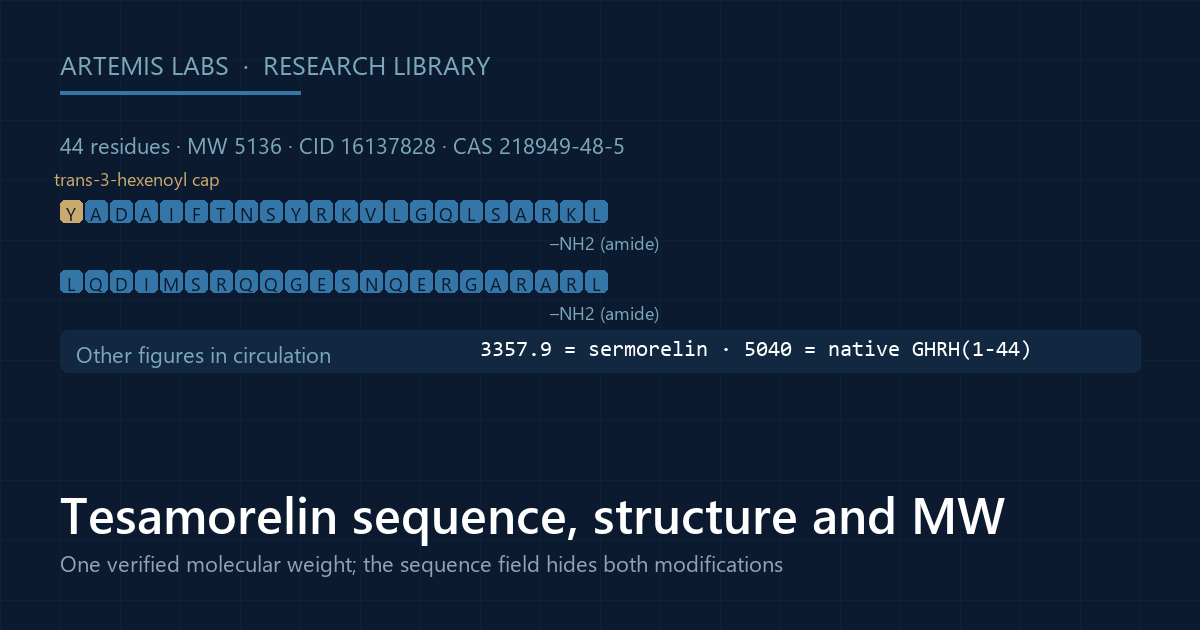
Tesamorelin identity — Tesamorelin is a synthetic analog of human growth hormone-releasing hormone (GHRH) with 44 amino-acid residues, a trans-3-hexenoyl group attached to the first residue (tyrosine), and an amide at the C-terminal leucine. PubChem lists it under CID 16137828 with molecular formula C221H366N72O67S and a molecular weight of 5136. Its current CAS number is 218949-48-5. A record that pairs the name tesamorelin with a molecular weight near 3,358 has substituted sermorelin, a different and shorter peptide; a record that gives 5040 has substituted native GHRH(1-44), which lacks the hexenoyl group.
Key findings
- One molecular weight, not three. PubChem returns exactly one molecular weight for tesamorelin, 5136 (exact mass 5134.7233503, monoisotopic mass 5132.7166406), fetched fresh from CID 16137828 on August 27, 2026.
- Both ends of the molecule are modified. The sponsor’s own non-clinical paper describes it as an analogue of human growth hormone-releasing factor (hGRF1-44NH2) minimally modified by addition of a trans-3-hexenoyl moiety to Tyr1 (Theratechnologies, 2007, PMID 17214611). PubChem’s IUPAC name confirms the same group as [(E)-hex-3-enoyl] and the same C-terminal leucinamide.
- The bare sequence hides both modifications. PubChem’s sequence field for tesamorelin reads YADAIFTNSYRKVLGQLSARKLLQDIMSRQQGESNQERGARARL, byte for byte the same as native GHRH(1-44). A sequence lookup alone cannot tell the two apart.
- Two CAS numbers still printed on vendor sheets are deprecated. PubChem files 804475-66-9 and 775305-79-8 under its Deprecated CAS heading. The current registry number is 218949-48-5.
What is the verified structure of tesamorelin?
Tesamorelin starts from the full 44-residue sequence of human GHRH. Native GHRH(1-44) already ends in an amide. Tesamorelin keeps that amide and adds one thing: a six-carbon acyl chain, with a double bond between its third and fourth carbons, joined to the amino group of the first residue, tyrosine. Chemists write that group as trans-3-hexenoyl. PubChem’s SMILES string opens with the fragment CCC=CCC(=O)N, which is exactly that chain, and its IUPAC name for the molecule contains [(E)-hex-3-enoyl], where (E) means trans (PubChem CID 16137828).
The independent confirmation comes from the company that developed the compound. Theratechnologies’ 2007 non-clinical paper, a sponsor-authored source and not an independent one, describes TH9507 as an analogue of human growth hormone-releasing factor (hGRF1-44NH2) minimally modified by addition of a trans-3-hexenoyl moiety to Tyr1 of the amino acid sequence (PMID 17214611). The NH2 in hGRF1-44NH2 is the C-terminal amide; Tyr1 is the tyrosine at position one. Two sources, one from a public chemistry database and one from the developer, describe the same molecule.
The same paper explains what the modification is for. The acyl group, the authors wrote, made the peptide resistant to dipeptidyl aminopeptidase-IV deactivation, an enzyme that trims the first two residues off native GHRH, and slowed the in vitro degradation of the peptide in rat, dog and human plasma (PMID 17214611). That is a stability finding, reported here as the sponsor reported it.
What identifiers does the primary record carry?
| Field | Verified value (PubChem CID 16137828, fetched August 27, 2026) |
|---|---|
| Molecular formula | C221H366N72O67S |
| Molecular weight | 5136 |
| Exact mass / monoisotopic mass | 5134.7233503 / 5132.7166406 |
| InChIKey | QBEPNUQJQWDYKU-BMGKTWPMSA-N |
| CAS (current) | 218949-48-5 |
| UNII | MQG94M5EEO (active moiety); LGW5H38VE3 (the acetate drug substance, which has no PubChem record of its own) |
| Residues | 44; trans-3-hexenoyl on Tyr1; C-terminal Leu44 amide |
| Other database IDs | ChEBI 63626 · ChEMBL CHEMBL1237026 · DrugBank DB08869 · WHO ATC H01AC06 · MeSH Supplementary Concept 67479538 |
One detail in that table matters for anyone searching the literature. Tesamorelin is a MeSH Supplementary Concept, not a MeSH descriptor. A PubMed search filtered on tesamorelin[MeSH Terms] returns zero results, even though the plain search returns more than a hundred records. A pipeline that filters on MeSH terms will conclude, wrongly, that no literature exists.
Why is the molecular weight so often reported wrongly?
Three figures circulate for tesamorelin. Only one of them is tesamorelin.
- 5136 is the PubChem molecular weight for CID 16137828. It is the only figure with a primary source.
- A figure near 3,358 is sermorelin, not tesamorelin. Sermorelin is GHRH(1-29), a 29-residue fragment with its own PubChem record (CID 16132413, molecular weight 3357.9, formula C149H246N44O42S, CAS 86168-78-7, WHO ATC code H01AC04). The two molecules differ by fifteen residues plus the acyl group, a gap of 1778.1 daltons. A specification sheet that pairs the name tesamorelin with a mass near 3,358 has described a different, shorter peptide.
- 5040 is native GHRH(1-44), which PubChem calls somatorelin (CID 16132353, CAS 83930-13-6). Tesamorelin minus somatorelin is 5136 minus 5040, or 96 daltons. The formula difference, C221H366N72O67S minus C215H358N72O66S, is C6H8O, which is exactly the hexenoyl group replacing one hydrogen. The arithmetic is a useful check: if a candidate mass is 96 daltons above native GHRH(1-44), it is consistent with tesamorelin.
Two further figures that appear on vendor sheets, one near 5,196 and one near 3,573, have no source in the primary record and no chemistry that produces them. Artemis Labs’ own earlier product copy carried both of them until the identity was re-verified in August 2026. They are not published here, and we treat their appearance on any document as a reason to check the rest of it.
Why does a sequence lookup mislead?
PubChem’s Biologic Line Notation section for tesamorelin contains a single line: the 44-letter backbone, YADAIFTNSYRKVLGQLSARKLLQDIMSRQQGESNQERGARARL. There is no IUPAC-condensed line, no HELM line, and nothing that shows the hexenoyl group or the amide. The same section for somatorelin, the native hormone, carries five lines including an explicit -NH2. So the two records are indistinguishable by sequence, and only the SMILES, the InChIKey, the formula and the IUPAC name separate them.
The practical consequence: publishing tesamorelin’s sequence as a plain 44-mer, or as a free acid ending -OH, describes a molecule about 97 daltons lighter with a different InChIKey. A correct identity record states the sequence together with both modifications, and a correct analytical check compares an observed mass against 5136, not against the backbone. Our guide to reading a tesamorelin certificate of analysis works through that check.
A related naming trap: the string GHRH(1-44) resolves in PubChem to tesamorelin’s CID, not to the native hormone, because PubChem lists it as a tesamorelin synonym. Anyone keying a lookup on that string gets the modified drug analog, silently.
Which CAS number is current?
PubChem lists 218949-48-5 as the current CAS registry number for tesamorelin. It lists two others, 804475-66-9 and 775305-79-8, under the heading Deprecated CAS, which PubChem defines as registry numbers that are no longer used but that users may still encounter … in some (old) references. The first of those two is the number most often printed as the “tesamorelin acetate CAS” on vendor documents. Whether it was originally assigned to the acetate salt specifically, or was simply superseded, is not stated by PubChem and remains unverified. PubChem’s own cross-reference to a separate “Tesamorelin Acetate” record is a dead link; the acetate’s UNII, LGW5H38VE3, returns no PubChem record.
What does the primary record say about half-life and bioavailability?
PubChem’s Biological Half-Life annotation, quoted in full, reads: 26 and 38 minutes in healthy subjects and HIV-infected patients, respectively. Those are two point values measured in two populations, not a range, and they are minutes. A widely copied error gives the same numbers in hours, a sixty-fold overstatement. The absolute bioavailability, per the same source, was determined to be less than 4%. PubChem’s Metabolism annotation states that no formal metabolism studies have been performed in humans. Time to peak concentration and clearance figures appear on some vendor pages; neither is cited in the primary record we checked, so neither appears here.
What the research does not show
This page is about identity, and identity is not evidence of anything else. The controlled human evidence for the approved tesamorelin product is confined to HIV-associated lipodystrophy, and belongs to that licensed product, not to research-grade material. A molecule with the same sequence made by anyone else is not covered by any approval. The identity facts on this page do not establish purity, potency, stability or activity for any given vial; those are lot-level analytical questions. And the primary record leaves the acetate-salt CAS assignment, the time to peak concentration and the clearance figures unverified, so this page does not state them.
Frequently asked questions
Is tesamorelin the same molecule as GHRH(1-44)?
No. It is GHRH(1-44) amide with one addition, a trans-3-hexenoyl group on the first residue. That single group accounts for the 96-dalton difference between tesamorelin (5136) and native GHRH(1-44), which PubChem calls somatorelin (5040).
Is 3,358 a tesamorelin molecular weight?
No. 3357.9 is sermorelin, GHRH(1-29), a separate peptide with its own CAS number and ATC code. See our page on tesamorelin versus sermorelin.
Which CAS number should a document show?
218949-48-5. The numbers 804475-66-9 and 775305-79-8 are filed by PubChem as deprecated.
Where does Artemis Labs publish its own tesamorelin record?
On the tesamorelin research page, which carries the identifiers in the table above and the published research record with its counter-evidence.
References
- PubChem. Tesamorelin, CID 16137828: properties, synonyms, deprecated CAS, Biologic Line Notation, Biological Half-Life, Absorption. National Library of Medicine. pubchem.ncbi.nlm.nih.gov/compound/16137828 (fetched 2026-08-27).
- PubChem. Somatorelin, CID 16132353; Sermorelin, CID 16132413. pubchem.ncbi.nlm.nih.gov/compound/16132353 · pubchem.ncbi.nlm.nih.gov/compound/16132413.
- Non-clinical pharmacology and safety evaluation of TH9507, a human growth hormone-releasing factor analogue. Basic Clin Pharmacol Toxicol. 2007. PMID 17214611 · DOI. Sponsor-authored (Theratechnologies Inc.).
Methodology: identity fields were fetched from PubChem PUG REST and PUG-View for CIDs 16137828, 16132353 and 16132413 on August 27, 2026; the structure statement was cross-checked against the sponsor’s non-clinical paper via NCBI E-utilities. Last verified August 28, 2026.
All compounds sold by Artemis Labs are for laboratory research use only. Nothing on this page is medical advice, and no statement has been evaluated by the FDA.
