
Tesamorelin vs Sermorelin: Two GHRH Analogs, Different Records | Artemis Labs
Aug
Tesamorelin vs sermorelin: two GHRH analogs with very different records
Published August 28, 2026 · Artemis Labs
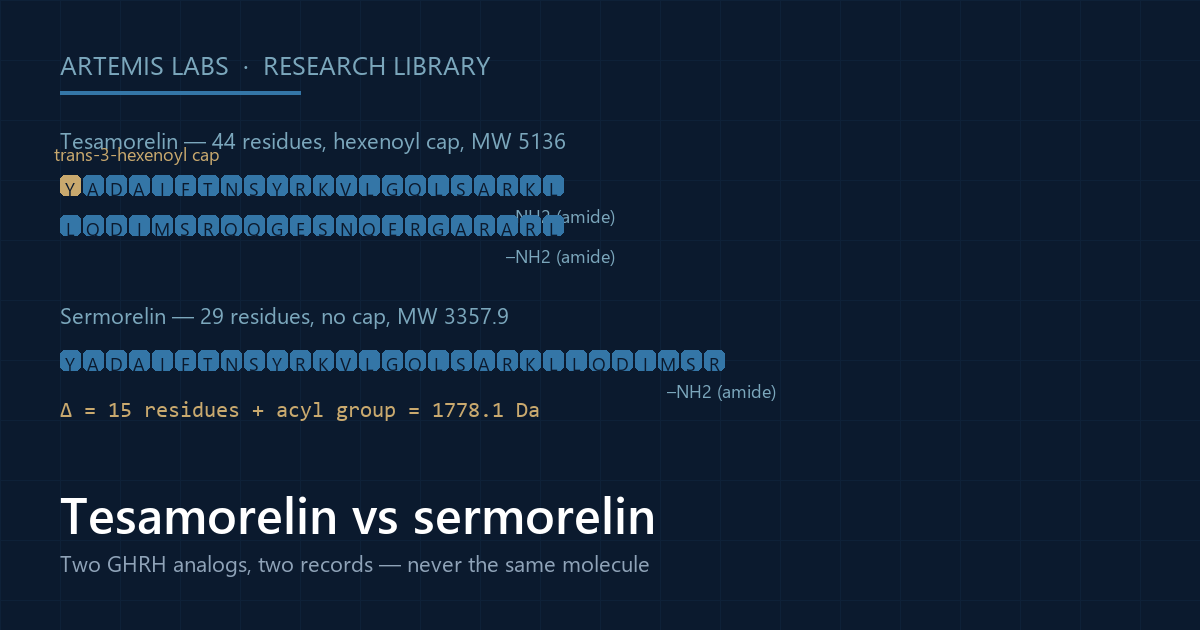
Tesamorelin vs sermorelin — Tesamorelin and sermorelin are both synthetic analogs of growth hormone-releasing hormone (GHRH), and they are often confused, sometimes on the same specification sheet. Tesamorelin is the full 44-residue GHRH sequence with a trans-3-hexenoyl cap on its first residue (PubChem CID 16137828, molecular weight 5136, CAS 218949-48-5). Sermorelin is the first 29 residues of GHRH as an amide, with no cap (PubChem CID 16132413, molecular weight 3357.9, CAS 86168-78-7). They differ by 15 residues plus the cap, 1778.1 daltons. A currently marketed FDA-approved product exists for tesamorelin, tested in two Phase 3 trials in HIV-associated lipodystrophy; a sermorelin acetate product was approved in 1990 for a paediatric diagnostic use and is now discontinued, not for safety or effectiveness reasons.
Key findings
- Different molecules, not two strengths of one. Tesamorelin: C221H366N72O67S, 44 residues, hexenoyl-Tyr1, Leu44 amide. Sermorelin: C149H246N44O42S, 29 residues, unmodified N-terminus, Arg29 amide. Both from PubChem, fetched August 27–28, 2026.
- Different half-lives, both measured in minutes. PubChem’s annotations: tesamorelin 26 and 38 minutes in healthy subjects and HIV-infected patients, respectively; sermorelin 11-12 min. A widely copied error gives tesamorelin’s figures in hours.
- Different regulatory records. Tesamorelin: EGRIFTA, application 022505, Purple Book 351(a) biologic, first approved November 2010, currently marketed. Sermorelin: NDA 019863 (approved 1990-12-28) and NDA 020443 (approved 1997-09-26), EMD Serono, both listed as discontinued at Drugs@FDA with a Federal Register determination that the product was not discontinued or withdrawn for safety or effectiveness reasons.
- Different trial records. Tesamorelin has two Phase 3 RCTs in adults with HIV. Sermorelin’s trial literature is largely 1990s paediatric growth and diagnostic-test studies; PubMed indexes no sermorelin meta-analysis.
How do the two molecules differ?
Native human GHRH is 44 amino acids long. Its first 29 residues are enough to activate the GHRH receptor; that fragment, made synthetically and ending in an amide, is sermorelin. PubChem gives sermorelin’s formula as C149H246N44O42S, molecular weight 3357.9, InChIKey WGWPRVFKDLAUQJ-MITYVQBRSA-N, CAS 86168-78-7, with two WHO ATC codes, H01AC04 and V04CD03 (CID 16132413). Tesamorelin keeps the whole 44-residue sequence and adds a six-carbon trans-3-hexenoyl group to the first residue, which the developer reported made it resistant to dipeptidyl aminopeptidase-IV deactivation (PMID 17214611). PubChem gives tesamorelin’s formula as C221H366N72O67S, molecular weight 5136, InChIKey QBEPNUQJQWDYKU-BMGKTWPMSA-N, CAS 218949-48-5, ATC H01AC06 (CID 16137828).
| Field | Tesamorelin | Sermorelin |
|---|---|---|
| PubChem CID | 16137828 | 16132413 |
| Residues | 44 (GHRH 1-44) | 29 (GHRH 1-29) |
| N-terminal modification | trans-3-hexenoyl on Tyr1 | None |
| C-terminus | Leu44 amide | Arg29 amide |
| Molecular formula | C221H366N72O67S | C149H246N44O42S |
| Molecular weight | 5136 | 3357.9 |
| CAS | 218949-48-5 | 86168-78-7 |
| WHO ATC | H01AC06 | H01AC04; V04CD03 |
| Half-life (PubChem annotation) | 26 and 38 minutes (healthy; HIV-infected) | 11–12 min |
The mass gap, 5136 minus 3357.9, is 1778.1 daltons. That matters because sermorelin’s molecular weight is the figure most often printed on tesamorelin specification sheets by mistake. A sheet that pairs the name tesamorelin with a mass near 3,358 has described sermorelin. Our tesamorelin identity page works through the three look-alike masses.
One more trap on the sermorelin side. The brand name under which sermorelin acetate was sold resolves in PubChem to three different CIDs: the acetate salt (16132412, MW 3417.9), a stereochemistry-undefined duplicate (16129620), and a different stereoisomer (57303711). Three of the four sermorelin-family CIDs share the first 14 characters of their InChIKey and differ only in the stereo block, so an identity check that matches on the InChIKey skeleton alone can merge a correct sermorelin with a wrong-stereochemistry record. The correct sermorelin CID is 16132413.
How do the regulatory records differ?
Tesamorelin’s approved product, EGRIFTA (Theratechnologies Inc.), is listed in the FDA Purple Book under application 022505 as a 351(a) biologic, license 2091, first approved 10-Nov-10, with current NDC listings for EGRIFTA SV and EGRIFTA WR. Its indication, in the label’s own words, is the reduction of excess abdominal fat in HIV-infected adult patients with lipodystrophy. The full record is on our page on what application 022505 covers.
Sermorelin’s record is in the other FDA database. Drugs@FDA lists two applications for sermorelin acetate, both held by EMD Serono: NDA 019863, an ampoule presentation, original approval 1990-12-28 as a new molecular entity; and NDA 020443, a vial presentation, approved 1997-09-26 as a new dosage form. Both are marked discontinued, and both carry the note Federal Register determination that product was not discontinued or withdrawn for safety or effectiveness reasons. Two corrections to common claims follow from that record. The first approval was 1990, not 1997; 1997 was a second presentation. And the year the product was discontinued is not stated in the Drugs@FDA record we retrieved, so a specific discontinuation year is not stated here. What the record does establish is that no sermorelin product is currently marketed under an FDA approval, and that the withdrawal was not for safety or effectiveness reasons.
Neither approval attaches to research-grade material. Both describe a specific manufactured product from a specific company under a specific application, and material of the same sequence made by anyone else is covered by neither.
How do the trial records differ?
Tesamorelin’s controlled human record is concentrated and recent: two randomized, placebo-controlled Phase 3 trials of 412 and 404 adults with HIV and abdominal fat accumulation, a pooled analysis of 806, a 52-week extension that reported the effect do[es] not last beyond the duration of treatment, and two 2026 meta-analyses that disagree on the pooled effect (PMIDs 18057338, 20101189, 18690162, 20554713, 42538058, 41545261). Our trial-record page sets it out.
Sermorelin’s record is older and differently shaped. PubMed indexes 331 sermorelin records, 29 tagged clinical trial, and no meta-analysis (searches run August 28, 2026). The trials that appear are mostly from the 1990s: growth studies in children with growth-hormone deficiency, such as a 110-child open-label multicenter study (JCEM 1996, PMID 8772599) and randomized comparisons against growth hormone in 43 and 60 children (Acta Paediatr Suppl 1993, PMIDs 8329826, 8329830), plus diagnostic-test dose-response work in adults (Eur J Endocrinol 1994, PMID 7921207). In the 60-child comparison, the authors concluded that GHRH(1-29) treatment is unlikely to be as effective as GH for the promotion of growth, and that 39 of 40 treated children developed GHRH antibodies. The two compounds were tested in different decades, different populations and for different questions, and no trial in our verified corpus compares them head to head.
What is the pharmacological difference, in plain terms?
Both bind the GHRH receptor on pituitary cells and stimulate growth-hormone release; PubChem’s mechanism annotation for sermorelin says it mimics native GRF in its ability to stimulate growth hormone secretion, and for tesamorelin that it stimulates growth hormone secretion, and subsequently increases IGF-1 and IGFBP-3 levels. The design difference is stability. Sermorelin, being an unmodified fragment, is cleared within minutes. Tesamorelin’s cap slows enzymatic breakdown, which the sponsor’s paper reports as slowed degradation in rat, dog and human plasma (PMID 17214611). Both half-lives are still measured in minutes. Comparing them is comparing two design choices, the faithful fragment against the stabilized full sequence, not two strengths of the same thing.
What the research does not show
No head-to-head trial of tesamorelin against sermorelin exists in our verified corpus, so nothing on this page ranks one above the other on any outcome. Tesamorelin’s controlled evidence is confined to HIV-associated lipodystrophy and belongs to a licensed product; sermorelin’s is largely paediatric and decades old, with no current approved product. Neither record attaches to research-grade material. Sermorelin’s regulatory and trial facts on this page are drawn from Drugs@FDA and PubMed as retrieved on August 28, 2026; its wider modern literature is being verified for a separate cluster, and claims not on this page are not made here.
Frequently asked questions
Is sermorelin just a shorter tesamorelin?
No. Sermorelin is native GHRH(1-29) amide with no modification. Tesamorelin is GHRH(1-44) amide with a hexenoyl cap. They differ by 15 residues plus the cap, 1778.1 daltons.
Which one is FDA-approved?
A tesamorelin product (EGRIFTA, application 022505) is currently approved and marketed. Sermorelin acetate products (NDA 019863, NDA 020443) were approved in 1990 and 1997 and are discontinued, not for safety or effectiveness reasons. Neither approval covers research-grade material.
Why do some sheets give tesamorelin a molecular weight of about 3,358?
Because that is sermorelin’s. Tesamorelin’s is 5136.
Where are the two compound records?
The tesamorelin research page and the sermorelin research page.
References
- PubChem. Tesamorelin, CID 16137828; Sermorelin, CID 16132413 (properties, synonyms, ATC, Biological Half-Life, Mechanism of Action). CID 16137828 · CID 16132413 (fetched 2026-08-27/28).
- FDA Drugs@FDA. Sermorelin acetate, NDA 019863 and NDA 020443 (EMD Serono), retrieved via the openFDA drugsfda endpoint 2026-08-28. accessdata.fda.gov/scripts/cder/daf.
- FDA Purple Book. Tesamorelin, application 022505. purplebooksearch.fda.gov.
- Non-clinical pharmacology and safety evaluation of TH9507. Basic Clin Pharmacol Toxicol. 2007. PMID 17214611. Sponsor-authored.
- Tesamorelin Phase 3 record: PMID 18057338; PMID 20101189; PMID 18690162; PMID 20554713; PMID 42538058; PMID 41545261.
- Once daily growth hormone-releasing hormone therapy accelerates growth in growth hormone-deficient children during the first year of therapy. J Clin Endocrinol Metab. 1996. PMID 8772599 · DOI.
- Growth response to growth hormone-releasing hormone(1-29)-NH2 compared with growth hormone. Acta Paediatr Suppl. 1993. PMID 8329826. A comparative study of GH and GHRH(1-29)-NH2 for stimulation of growth in children with GH deficiency. 1993. PMID 8329830.
- Low-dose growth hormone-releasing hormone tests: a dose-response study. Eur J Endocrinol. 1994. PMID 7921207.
Methodology: identity and annotation fields from PubChem PUG REST / PUG-View; regulatory fields from the FDA Purple Book (via PubChem) and Drugs@FDA (via openFDA); trial quotations from PubMed abstracts via NCBI E-utilities. Retrieved August 27–28, 2026. Last verified August 28, 2026.
All compounds sold by Artemis Labs are for laboratory research use only. Nothing on this page is medical advice, and no statement has been evaluated by the FDA.
