
Reading a Tesamorelin COA: The Identity Checks That Matter | Artemis Labs
Aug
Reading a tesamorelin certificate of analysis: the identity checks that matter
Published August 28, 2026 · Artemis Labs
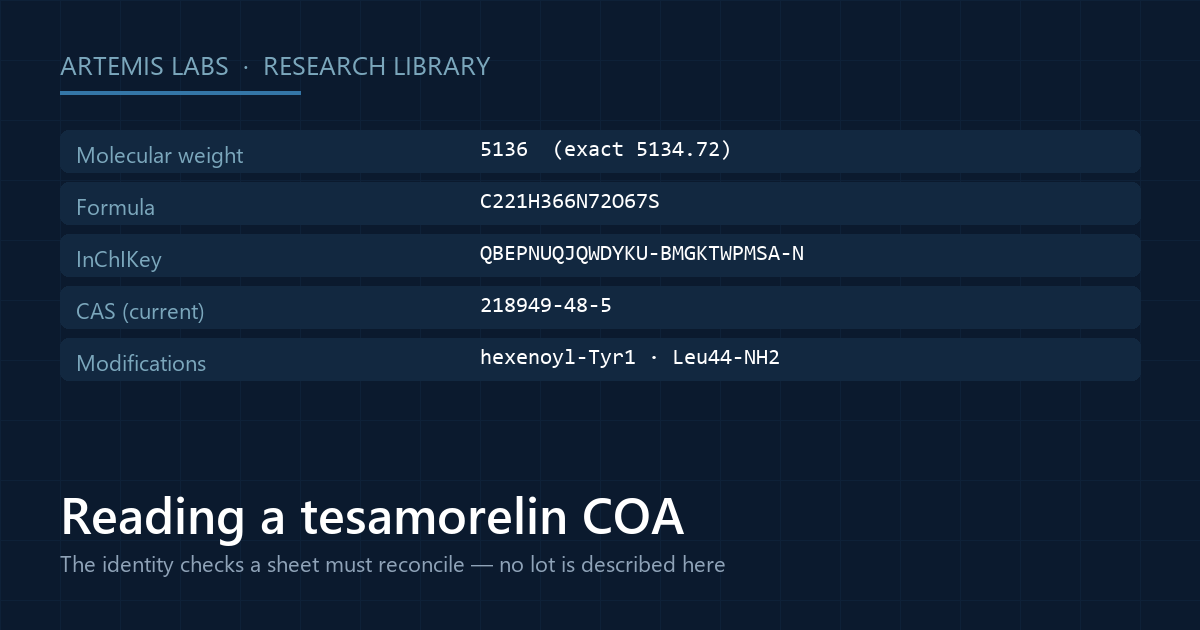
Tesamorelin certificate of analysis — A certificate of analysis (COA) for tesamorelin should identify a specific molecule: a 44-residue analog of human growth hormone-releasing hormone with a trans-3-hexenoyl group on the first residue and a C-terminal amide, molecular formula C221H366N72O67S, molecular weight 5136, PubChem CID 16137828, CAS 218949-48-5. A sheet that reports a mass near 3,358 has described sermorelin, a different peptide; one that reports 5040 has described native GHRH(1-44). This page explains how to read the identity section of any tesamorelin COA against the verified record. It makes no claim about any specific lot or vendor.
Key findings
- The mass is the first check, and only one value is correct. PubChem lists a single molecular weight for tesamorelin, 5136 (exact mass 5134.7233503), fetched August 27, 2026 from CID 16137828.
- A bare sequence proves too little. PubChem’s sequence field for tesamorelin is identical to native GHRH(1-44). A COA that shows the 44-letter sequence without both modifications has not identified tesamorelin.
- The mass difference between three look-alikes is exact. Tesamorelin minus native GHRH(1-44) is 96 daltons, the hexenoyl group; tesamorelin minus sermorelin is 1778.1 daltons (PubChem CIDs 16137828, 16132353, 16132413).
- Two CAS numbers on many sheets are deprecated. PubChem lists two older registry numbers under its Deprecated CAS heading; 218949-48-5 is current.
What is a certificate of analysis for, and what is it not for?
A certificate of analysis is a document from a testing laboratory that reports what was measured on a specific lot of material: usually identity (is this the molecule it is labeled as?), purity (how much of the material is that molecule?), and sometimes appearance, water content or residual solvents. It describes one lot. It does not describe a compound in general, and it does not describe any lot other than the one it names. Reading a COA well means checking the reported values against the verified identity of the compound, then checking that the lot number, the test methods and the laboratory are actually stated.
This page covers the identity half for tesamorelin, because that is where tesamorelin sheets go wrong most often. Tesamorelin sits in a family of three near-identical names, GHRH(1-44), sermorelin and tesamorelin, and the public databases themselves blur two of them. The checks below are the ones that separate them.
Which molecular weight should the sheet report?
PubChem returns one molecular weight for tesamorelin: 5136, with an exact mass of 5134.7233503 and a monoisotopic mass of 5132.7166406 (CID 16137828). A mass-spectrometry identity check on a tesamorelin lot should reconcile to that neighbourhood, allowing for the instrument’s stated accuracy and for whether the reported value is an average or a monoisotopic mass.
Three other figures turn up on tesamorelin documents, and each one means something specific:
| Mass reported | What it actually is | Primary record |
|---|---|---|
| 5136 | Tesamorelin | PubChem CID 16137828, formula C221H366N72O67S |
| 5040 | Native GHRH(1-44), called somatorelin; no hexenoyl group | PubChem CID 16132353, formula C215H358N72O66S, CAS 83930-13-6 |
| 3357.9 | Sermorelin, GHRH(1-29), a 29-residue fragment | PubChem CID 16132413, formula C149H246N44O42S, CAS 86168-78-7 |
| Near 5.2 kDa or near 3.6 kDa | No source in the primary record; no chemistry produces them | None |
The arithmetic between the first two rows is a useful sanity check on any sheet. Tesamorelin’s formula minus somatorelin’s is C6H8O, which is exactly the trans-3-hexenoyl group replacing one hydrogen, and the mass difference is 96 daltons. A reported mass 96 daltons above native GHRH(1-44) is consistent with the acyl modification being present; a reported mass equal to native GHRH(1-44) is consistent with it being absent.
Why is the sequence line not enough on its own?
PubChem’s Biologic Line Notation section for tesamorelin contains only one line, the 44-letter backbone YADAIFTNSYRKVLGQLSARKLLQDIMSRQQGESNQERGARARL, and that string is byte-for-byte identical to native GHRH(1-44). Neither the hexenoyl group nor the C-terminal amide appears in it. The two features exist only in the SMILES string, the InChIKey, the molecular formula and the IUPAC name (PubChem CID 16137828; structure independently described in the sponsor’s non-clinical paper, PMID 17214611, as an analogue of human growth hormone-releasing factor (hGRF1-44NH2) minimally modified by addition of a trans-3-hexenoyl moiety to Tyr1).
So a COA identity line that reads only “sequence confirmed” or that prints the 44-mer alone leaves the two defining features untested. A stronger identity line states the modifications explicitly (trans-3-hexenoyl on Tyr1; Leu44 amide), or reports an observed mass that can only be reconciled with the modified molecule, or both. The same logic applies to the free-acid form: a sequence written as ending in -OH describes a molecule about 97 daltons lighter, with a different InChIKey.
Which identifiers belong on the sheet?
- CAS 218949-48-5. Current. PubChem lists two older registry numbers under Deprecated CAS, defined there as registry numbers no longer used; one of them is the number most often printed as a “tesamorelin acetate” CAS on vendor documents, and whether it originally denoted the acetate salt is not stated by PubChem and remains unverified. Both are named, and labeled deprecated, on our identity page.
- Molecular formula C221H366N72O67S. For the free base. If the sheet names the acetate salt, the formula and mass should say so; the approved pharmaceutical product’s drug substance is tesamorelin acetate (UNII LGW5H38VE3), while the active moiety is tesamorelin (UNII MQG94M5EEO), and PubChem has no separate record for the acetate.
- InChIKey QBEPNUQJQWDYKU-BMGKTWPMSA-N. The most specific single identifier, because it encodes the modifications a sequence hides.
- PubChem CID 16137828. Note that the string GHRH(1-44) resolves in PubChem to this CID, not to the native hormone, because PubChem lists it as a tesamorelin synonym. A sheet that uses that alias is not wrong, but the alias by itself does not tell the reader which molecule was tested.
What should the purity and methods section make clear?
The purity figure on a COA is only as meaningful as the method and the lot it names. A reader should be able to see which method produced the number (reversed-phase HPLC is the usual one for peptides), which lot the number belongs to, and which laboratory ran the test. A purity percentage without a method, a lot number or a laboratory is a number without a context. This page does not report any purity value for any lot, and Artemis Labs does not publish lot-level testing claims on its product pages; the manufacturer performs periodic quality testing on production batches.
For a peptide of this size, the identity and purity lines should also be consistent with each other: a purity figure reported for “tesamorelin” on a sheet whose identity line reconciles to a 3.4 kDa mass is a purity figure for sermorelin.
What the research does not show
PubMed indexes no product-quality, purity, counterfeit or adulteration literature for tesamorelin at all; the search tesamorelin AND (counterfeit OR adulterat* OR purity OR impurit*) returned zero records on August 27, 2026. So there is no published study of how tesamorelin sold as a research reagent actually tests, in either direction. A COA is a lot document; it does not establish that a compound is safe, effective or approved, and the controlled human evidence for tesamorelin belongs to a licensed pharmaceutical product tested in HIV-associated lipodystrophy, not to research-grade material of the same sequence. Identity checks tell you what a vial contains. They do not tell you anything about what it does.
Frequently asked questions
A COA says “tesamorelin, MW 3,358”. Is that tesamorelin?
No. 3357.9 is sermorelin (GHRH 1-29), a shorter peptide with its own CAS number and ATC code. The tesamorelin figure is 5136.
The sheet prints the 44-letter sequence and nothing else about structure. Is identity confirmed?
Not fully. That sequence is identical to native GHRH(1-44). Identity for tesamorelin needs the hexenoyl group and the C-terminal amide to be stated or reconciled by mass.
Which CAS number is current?
218949-48-5. Two others in circulation are filed by PubChem as deprecated. See our tesamorelin sequence and identity page for the full identifier table.
Does Artemis Labs publish a COA for tesamorelin?
Our tesamorelin research page carries the verified identity record and the published research; it does not carry lot-level testing claims.
References
- PubChem. Tesamorelin, CID 16137828: properties, synonyms, Deprecated CAS, Biologic Line Notation. National Library of Medicine. pubchem.ncbi.nlm.nih.gov/compound/16137828 (fetched 2026-08-27).
- PubChem. Somatorelin, CID 16132353; Sermorelin, CID 16132413. pubchem.ncbi.nlm.nih.gov/compound/16132353 · pubchem.ncbi.nlm.nih.gov/compound/16132413.
- Non-clinical pharmacology and safety evaluation of TH9507, a human growth hormone-releasing factor analogue. Basic Clin Pharmacol Toxicol. 2007. PMID 17214611 · DOI. Sponsor-authored (Theratechnologies Inc.).
Methodology: identity fields from PubChem PUG REST and PUG-View (CIDs 16137828, 16132353, 16132413), fetched August 27, 2026; PubMed counts via NCBI E-utilities the same day. Last verified August 28, 2026.
All compounds sold by Artemis Labs are for laboratory research use only. Nothing on this page is medical advice, and no statement has been evaluated by the FDA.
