
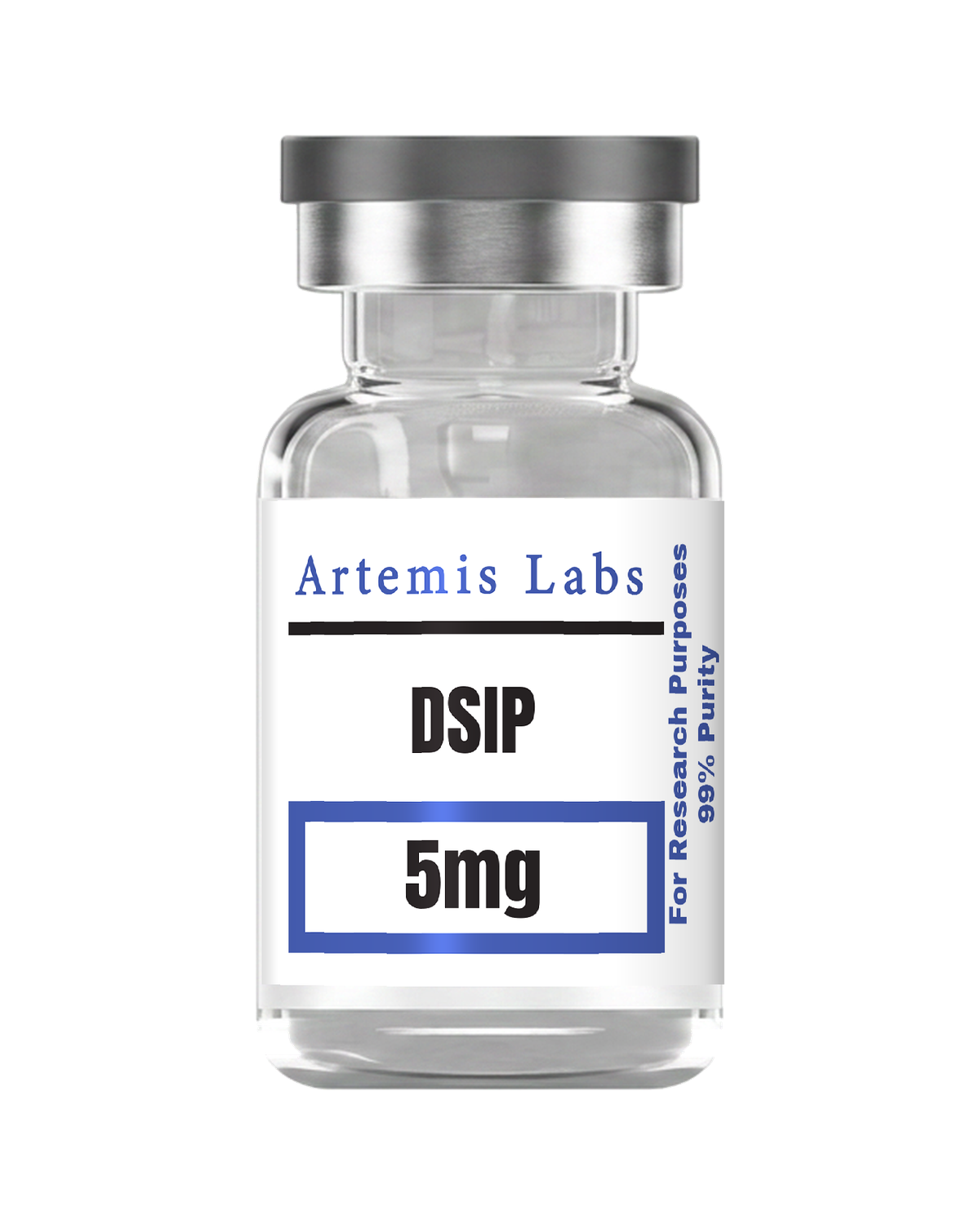
DSIP
$35.00
DSIP was named for what it was first thought to do — induce deep sleep — and the name has aged poorly. The more recent work points at something broader: a peptide involved in how tissue tolerates stress and low oxygen. Sleep may turn out to be one visible symptom of a general stress-resistance mechanism rather than the mechanism itself.
Continue readingShow less
Why the framing shifted. A DSIP-derived analog reduced infarct size in both cerebral and cardiac ischaemia-reperfusion models (Tukhovskaya 2021, PMID 33918965) — which places DSIP in a stress-tolerance family rather than a sleep-only one. In a separate focal-stroke study, intranasal DSIP improved rotarod motor recovery over 21 days without significantly reducing infarct volume (Tukhovskaya 2021, PMID 34500605), separating functional recovery from tissue protection.
Delivery is the live problem. A fusion peptide engineered with a blood-brain-barrier-crossing carrier outperformed native DSIP at restoring neurotransmitter balance in an insomnia model (Mu 2024, PMID 39444618) — which tells you how poorly the native peptide reaches the brain.
Lyophilized 9-amino-acid neuropeptide at ≥99% HPLC-verified purity, batch-specific Certificate of Analysis.
2 in stock
Description
DSIP, or delta sleep-inducing peptide, is a man-made peptide of nine amino acids. Swiss researchers first found it in rabbit blood in 1977 during sleep studies, which is how it got its name. Modern work studies it in sleep research and in animal models of stress and stroke recovery. Artemis Labs supplies it as a dry powder.
Reviewed August 22, 2026 · Artemis Labs
What is DSIP?
DSIP (Delta Sleep-Inducing Peptide) is a synthetic 9-amino-acid neuropeptide (Trp-Ala-Gly-Gly-Asp-Ala-Ser-Gly-Glu, MW 848.8 Da, CAS 62568-57-4) originally isolated by the Schoenenberger group in Switzerland from rabbit cerebral venous blood during sleep-deprivation experiments in 1977. The endogenous role of DSIP remains incompletely defined in the modern peer-reviewed literature. Modern research positions DSIP as a multi-axis stress-resistance neuropeptide rather than a ‘sleep peptide’ proper — a framing the 2026 Rahman review (PMID 41490200) makes explicit by grouping DSIP with circadian and mitochondrial regulators.
Why is DSIP studied?
The modern PubMed-indexed coverage of DSIP is sparse but specific. Three research axes are represented in 2020–2026 peer-reviewed work:
- Stress-resistance / ischaemic-tolerance axis — Tukhovskaya et al., Biomedicines 2021 (PMID 33918965): a DSIP-derived analog (‘KND’) reduced infarct size in both cerebral and cardiac ischemia-reperfusion models — reframing DSIP not solely as a sleep peptide but as a member of a stress-resistance / ischaemic-tolerance peptide family.
- Functional motor-recovery (separable from tissue protection) — Tukhovskaya et al., Molecules 2021 (PMID 34500605): intranasal DSIP improved rotarod motor recovery over 21 days in focal-stroke Sprague–Dawley rats without significantly reducing infarct volume — separating ‘functional recovery’ from ’tissue protection’ mechanisms.
- Fusion-peptide BBB delivery — Mu et al., Frontiers in Pharmacology 2024 (PMID 39444618): engineered a DSIP-CBBBP fusion peptide with a blood-brain-barrier-crossing carrier (delivered via Pichia pastoris yeast-secreted system) and demonstrated superior restoration of neurotransmitter balance versus native DSIP in PCPA-induced insomnia mice — first modern demonstration of delivery-engineering around DSIP’s poor BBB penetration.
Practical synthesis methodology was advanced by Tatsumi et al., Communications Chemistry 2023 (PMID 37884638) — a practical N-to-C nonapeptide synthesis of DSIP at the 130 mg scale with minimal protecting groups, relevant to the analytical purity standards that modern research grade material can achieve.
How does Artemis Labs source and verify DSIP?
Each lot is supplied as a sterile lyophilised peptide powder, analytically verified by reverse-phase HPLC to ≥99% peptide purity, with identity confirmed by mass spectrometry. A third-party Certificate of Analysis with residual-solvent and endotoxin reporting is available on request. The compound shipped is the canonical wild-type 9-mer sequence Trp-Ala-Gly-Gly-Asp-Ala-Ser-Gly-Glu (CAS 62568-57-4, ChEMBL CHEMBL507866, PubChem CID 68816, MW 848.8 Da). Salt form is acetate in most modern synthesis routes; verify against batch COA when reproducing literature.
Artemis Labs verifies every lot by third-party reverse-phase HPLC for peptide purity and by mass spectrometry for identity; a batch-specific Certificate of Analysis carrying the HPLC chromatogram, MS identity, residual-solvent assay and endotoxin reporting accompanies the lot and is available on request.
What does the DSIP evidence not show?
The DSIP modern literature is genuinely sparse. Only one robust 2024 paper (Mu et al., PMID 39444618) and a 2026 review (Rahman et al., PMID 41490200) directly cite DSIP; the bulk of usable modern material comes from the 2021 Tukhovskaya group at Tula State / Shemyakin-Ovchinnikov Institute. Human clinical-trial data are thin — DSIP has never reached widespread clinical registration in any jurisdiction. The endogenous role of DSIP remains incompletely defined despite five decades of investigation. Several research findings rely on engineered DSIP analogs (KND, DSIP-CBBBP fusion) rather than wild-type DSIP — translation of analog findings to wild-type pharmacology is not established.
How does DSIP differ from SS-31, MOTS-c and Selank?
Unlike SS-31 and MOTS-c (mitochondrial-targeted peptides), DSIP acts on circadian/sleep architecture and stress-resistance pathways. Unlike Selank (anxiolytic tuftsin analog), DSIP is studied for sleep-architecture and ischaemic-tolerance contexts. The 2026 Rahman review groups DSIP, MOTS-c, and SS-31 within the ‘circadian + mitochondrial regulator’ class — but mechanism, target compartment, and evidence base differ substantially.
What is the regulatory status of DSIP?
DSIP is not FDA-approved; no DEA scheduling; no EMA registration as of 2026-05. Has never reached widespread clinical registration. Not on the WADA Prohibited List 2026. Research-use-only framing applies to all commercial supply. The endogenous role of DSIP remains incompletely defined; Artemis Labs does not make sleep-promoting, anti-stress, or analgesic claims for the product. These statements have not been evaluated by the FDA. Not for human consumption, therapeutic use, or veterinary use.
Analytical Specifications
| Sequence | Trp-Ala-Gly-Gly-Asp-Ala-Ser-Gly-Glu (WAGGDASGE) |
| Residues | 9 amino acids |
| Molecular formula | C₃₅H₄₈N₁₀O₁₅ |
| Molecular weight | 848.8 Da |
| CAS number | 62568-57-4 |
| ChEMBL | CHEMBL507866 |
| PubChem CID | 68816 |
| Wikidata | Q903898 |
| Purity | ≥99% by reverse-phase HPLC; identity confirmed by mass spectrometry |
| Form | Lyophilised white powder, 5 mg per vial |
| Salt form | acetate in most modern synthesis routes; verify against the batch COA |
| Storage | Lyophilised at ≤ −20 °C, desiccated, protected from light; refer to the lot-specific Certificate of Analysis for all handling specifications |
| Certificate of Analysis | Batch-specific report with HPLC chromatogram, mass-spectrometric identity, residual-solvent assay and endotoxin reporting, available on request |
References
- Tukhovskaya EA et al. (2021). Biomedicines. PMID 33918965
- Tukhovskaya EA et al. (2021). Molecules. PMID 34500605
- Tatsumi T, Sasamoto K, Matsumoto T, et al. (2023). Communications Chemistry. PMID 37884638
- Mu X, Qu L, Yin L, et al. (2024). Frontiers in Pharmacology. PMID 39444618
- Rahman OF, Lee SJ, Seeds WA. (2026). JAAOS Global Research & Reviews. PMID 41490200
Additional information
| Vial Size | 5mg |
|---|
Science & Research
Science & Research
Mechanism of Action (Preclinical Models)
DSIP’s mechanism is incompletely defined despite five decades of research. Modern preclinical models converge on three axes of investigation:
- Stress-resistance / ischaemic-tolerance pathway. A DSIP-derived analog (‘KND’) reduced infarct size in both cerebral and cardiac ischaemia-reperfusion research models (Tukhovskaya et al. 2021, PMID 33918965).
- Functional motor-recovery separable from tissue protection. Intranasal DSIP improved rotarod motor recovery in focal-stroke Sprague–Dawley rats without significant infarct-size reduction (Tukhovskaya et al. 2021, PMID 34500605) — important separation: functional outcome and tissue outcome are not the same endpoint.
- Sleep-architecture restoration via BBB-delivered fusion peptide. DSIP-CBBBP fusion outperforms native DSIP in restoring neurotransmitter balance in PCPA-induced insomnia mice (Mu et al. 2024, PMID 39444618) — first modern demonstration of delivery-engineering around DSIP’s well-known poor BBB penetration.
Practical Synthesis Methodology
Tatsumi et al. 2023 (PMID 37884638) demonstrated a practical N-to-C nonapeptide synthesis of DSIP at the 130 mg scale with minimal protecting groups — relevant to the ≥99% HPLC purity standard achievable with modern synthesis. Salt form in most modern routes is acetate.
Class-Level 2026 Review
Rahman et al. 2026 (PMID 41490200): DSIP framed as a ‘recovery-enhancing agent’ targeting circadian and mitochondrial regulators within a broader peptide-therapeutics review covering musculoskeletal injuries and athletic performance research contexts.
Entity Disambiguation
| Identifier | Value |
|---|---|
| Sequence | Trp-Ala-Gly-Gly-Asp-Ala-Ser-Gly-Glu (WAGGDASGE) |
| Residues | 9 amino acids |
| Molecular formula | C₃₅H₄₈N₁₀O₁₅ |
| Molecular weight | 848.8 Da |
| CAS number | 62568-57-4 |
| ChEMBL ID | CHEMBL507866 |
| PubChem CID | 68816 |
| Wikidata QID | Q903898 |
Quality and Specifications
- Purity: ≥99% by RP-HPLC; identity confirmed by mass spectrometry
- Form: Lyophilised white powder, 5 mg/vial
- Storage: Lyophilised at ≤ −20°C, desiccated, protected from light; refer to lot-specific COA for all handling specifications
- Documentation: Batch-specific Certificate of Analysis with HPLC chromatogram, mass-spectrometric ID, residual-solvent assay, endotoxin reporting available on request
Honest Limitations
- Sparse modern literature. Only one robust 2024 mechanism paper and a 2026 review directly cite DSIP. Bulk of usable modern material comes from one Russian research group (Tukhovskaya et al., Tula State / Shemyakin-Ovchinnikov Institute) — independent replication is limited.
- Engineered-analog confound. Several findings rely on KND or DSIP-CBBBP fusion variants rather than wild-type DSIP. Translation to wild-type pharmacology is not established.
- No human clinical-trial data of consequence. DSIP has never reached widespread clinical registration in any jurisdiction; the endogenous role remains incompletely defined.
- Poor BBB penetration of wild-type DSIP. The 2024 Mu et al. fusion-peptide work was motivated explicitly by this limitation — wild-type DSIP may not reach therapeutic CNS concentrations without delivery engineering.
- Mechanism-of-action remains an open question. No specific DSIP receptor has been identified after 50+ years of research. Multiple proposed mechanisms (GABAergic modulation, monoamine system regulation, opioid-system interactions, circadian modulation, neuroinflammatory reduction) remain candidate hypotheses rather than established mechanism.
References (5 PubMed-Verified)
- Tukhovskaya EA et al. (2021). Biomedicines. PMID 33918965
- Tukhovskaya EA et al. (2021). Molecules. PMID 34500605
- Tatsumi T, Sasamoto K, Matsumoto T, et al. (2023). Communications Chemistry. PMID 37884638
- Mu X, Qu L, Yin L, et al. (2024). Frontiers in Pharmacology. PMID 39444618
- Rahman OF, Lee SJ, Seeds WA. (2026). JAAOS Global Research & Reviews. PMID 41490200
Research Pairings
Research Pairings
Pairing rationale below is mechanistic only. No dosing, frequency, duration, or human-use guidance is provided. Researchers design their own studies against their own institutional review, not against vendor copy.
Why is DSIP studied alongside SS-31?
Circadian/stress-resistance neuropeptide × mitochondrial-targeted antioxidant. Studied side-by-side in preclinical aging and stress-response research models — DSIP for stress-tolerance / sleep-architecture biology, SS-31 for mitochondrial-membrane stabilisation. Mechanism axes are distinct, making them a useful research-model pairing to dissect central neuropeptide effects from peripheral mitochondrial effects.
Why is DSIP studied alongside MOTS-c?
Circadian regulator × mitochondrial-derived peptide. The 2026 Rahman review (PMID 41490200) explicitly groups DSIP and MOTS-c as ‘circadian + mitochondrial regulators.’ Useful research-model pairing for stress-response and aging research designs.
Why is DSIP studied alongside Selank?
Sleep-axis neuropeptide × anxiolytic tuftsin analog. Studied in preclinical stress-and-recovery research designs where DSIP addresses sleep-architecture endpoints and Selank addresses anxiety-behavioural endpoints. Mechanistically complementary central-nervous-system research peptides.
Why is DSIP studied alongside Semax?
Sleep/wake-cycle neuropeptide × ACTH-derived heptapeptide. Studied side-by-side in rodent stress-response paradigms. Both engage neurotransmitter and stress-axis biology from different molecular entry points.
Why is DSIP studied alongside GHK-Cu?
Both peptides influence stress-response gene expression in preclinical research models. Co-application explored in aging-brain research designs.
Related Compounds in Catalogue
For mitochondrial-axis research see SS-31 and MOTS-c. For neuropeptide research see Selank and Semax. For stress-response gene-expression research see GHK-Cu.
Reviews (0)
Be the first to review “DSIP”
Related products
growth-hormone
longevity-cellular
Reviews
There are no reviews yet.