
“Wolverine stack”: what the phrase means, and what the research shows
Vocabulary reference · reviewed August 28, 2026 · Artemis Labs
If you searched for the “wolverine stack,” you used community vocabulary. It is not a
clinical designation, it appears in no published paper, and no regulator lists it. It is a
nickname, borrowed from a comic-book character, that
researchers and vendors adopted for a specific pairing of two compounds.
This page explains what the phrase covers, what each compound’s published literature actually
supports, and — the part almost nobody states — what has never been tested at
all.
What the phrase covers
In the research-compound market the phrase almost always means two compounds studied alongside
one another:
- BPC-157 — a synthetic 15-residue peptide
(sequence GEPPPGKPADDAGLV, CAS 137525-51-0, molecular weight 1,419.54 g/mol), derived from a
stable fragment of a human gastric protein. - TB-500 — a synthetic 7-residue peptide
(Ac-LKKTETQ, CAS 885340-08-9, 889.0 g/mol) matching residues 17–23 of the larger protein
thymosin β4.
Be aware the phrase is not used consistently. Research-compound vendors
generally mean those two. Some clinics use the same nickname for a larger combination, adding other
compounds entirely. Because the term has no formal definition, two sources using it may be
describing different things — which is worth checking before comparing any two accounts of it.
What the literature supports for each compound, separately
BPC-157
Its defining structural feature is a triple-proline motif that resists enzymatic breakdown.
Published preclinical work describes multi-pathway signalling, not binding at a single
receptor — VEGFR2–Akt–eNOS activation, focal adhesion kinase signalling, and
nitric oxide modulation among them. In 2026 a study in human internal mammary artery tissue reported
concentration-dependent, endothelium-dependent, nitric-oxide-mediated vasorelaxation
(Yildirim et al., J Clin Med, PMID 42123221)
— the first human-tissue mechanism evidence, in an ex-vivo preparation, not in people.
TB-500
The seven-residue sequence is described in the literature as the central actin-binding region of
thymosin β4 (Sosne 2010, PMID 20179146, a review).
Nearly every study people cite for “TB-500” actually used the full 43-residue parent
protein, not this fragment.
What has not been tested — and this is the important part
No published study has tested BPC-157 and TB-500 together. Not in humans, not in
animals. Each compound has its own preclinical literature; the pairing has none. Any account of what
the combination does is an inference from two separate bodies of work, not a finding.
It goes further than that:
- Neither compound has a published human efficacy trial. For BPC-157, after two
decades of preclinical work and the 2026 ex-vivo human-tissue result, there is still no published
Phase II or Phase III efficacy trial. For TB-500, there is no published human clinical trial of the
fragment at all. - It is not settled that TB-500 is even the active molecule. Its own pharmacology
paper reports that the wound-healing activity once credited to it may come from a breakdown product
(Ac-LKKTE), not TB-500 itself (Rahaman 2024,
PMID 38382158). - Published negative findings exist and belong here. In an irritable-bowel model,
thymosin β4 released by mast cells reduced tight-junction proteins and impaired the intestinal
barrier in rats and mice (Sun 2025,
PMID 41278163).
That study used the full-length parent protein, not the fragment, and had no human dosing arm
— but it is a direct caution for anyone whose model touches the gut barrier, and it is the
finding most likely to matter to someone studying these two compounds together. - What is in the vial is a documented problem. A peer-reviewed analysis found
products marketed as TB500 and TB1000 to be misbranded and adulterated, with contents not
systematically consistent with their descriptions (Delcourt 2023,
PMID 36482504).
Regulatory and sport status — both compounds
Both are prohibited in sport at all times, in and out of competition. BPC-157
falls under WADA Section S2 (peptide hormones, growth factors, related substances and mimetics);
thymosin β4 and its derivatives, TB-500 named explicitly, fall under Section S2.3. Neither
compound is FDA-approved for any indication. BPC-157 appeared on the FDA’s 503A interim Category 2
list in September 2023 and was removed in September 2024 following the nominator’s withdrawal.
How to read any source on this combination
Because the pairing has no combination study behind it, the useful test is what a source does with
that absence. A page that states plainly which findings are preclinical, which used the parent
protein instead of the fragment, and that the two have never been tested together is describing the
evidence. A page that presents the combination as established is not, and the absence of a
combination study is the fastest way to tell the difference.
The compounds discussed on this page
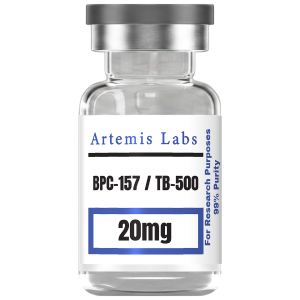
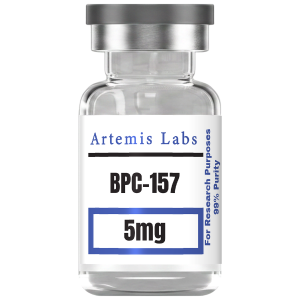
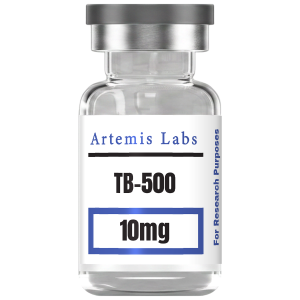
Artemis Labs supplies both as research compounds, for in-vitro and pre-clinical laboratory use.
Each product page carries its analytical specifications, its full reference list, and the same
counter-evidence set out above.
Tissue-Repair Research
References
- Yildirim, et al. Endothelium-dependent, nitric-oxide-mediated vasorelaxation by BPC-157 in human internal mammary artery. J Clin Med. 2026;15(9):3488. PMID 42123221
- Sosne G, et al. Thymosin beta 4 and the eye: review of the preclinical literature (LKKTETQ actin-binding domain). 2010. PMID 20179146
- Rahaman A, et al. Metabolism of TB-500; wound-healing activity may be due to the metabolite Ac-LKKTE, not the parent form. 2024. PMID 38382158
- Sun YS, et al. Thymosin β4 released by mast cells impairs the intestinal epithelial barrier via IL22RA1/JAK1/STAT3 in IBS. 2025. PMID 41278163
- Delcourt V, et al. TB500/TB1000 and SGF1000: misbranded and adulterated drugs. 2023. PMID 36482504
- Mendias CL, Awan TM. Safety and efficacy of approved and unapproved peptide therapies for musculoskeletal injuries. 2026. PMID 41966639
- World Anti-Doping Agency — Prohibited List (Sections S2 and S2.3). wada-ama.org
All products sold by Artemis Labs are for research purposes only. Not for human consumption.