
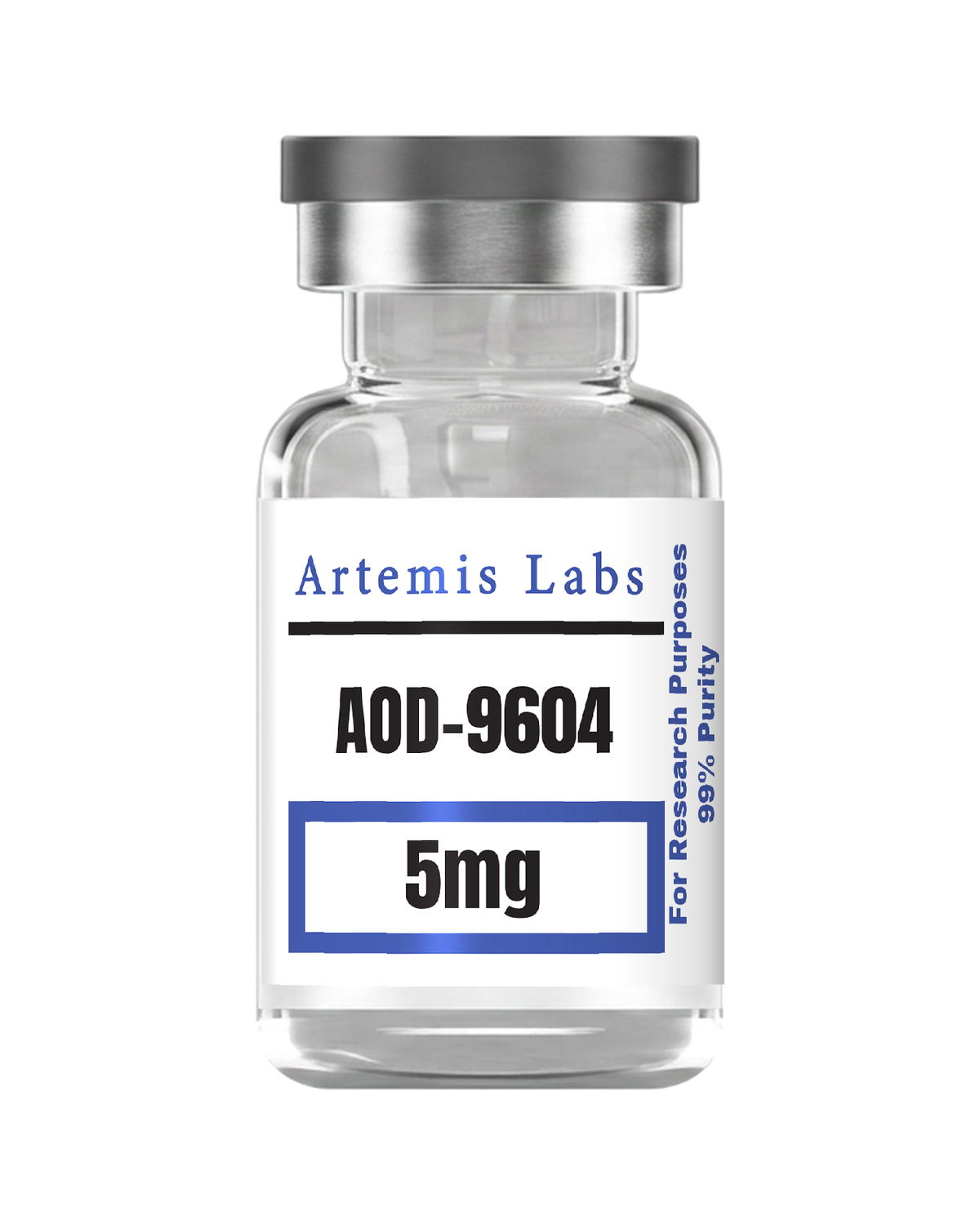
AOD-9604
$60.00
AOD-9604 is a 16-amino-acid piece cut from the tail end of human growth hormone — specifically the fragment associated with fat metabolism, with the growth-signalling parts left out. In rodent fat-cell models it acts through a route that does not involve the growth hormone receptor or IGF-1 at all. The honest headline is what happened next.
Continue readingShow less
The trial result you should know first. AOD-9604’s Phase 2b human obesity trial (Metabolic Pharmaceuticals, 2007) failed its primary weight-loss endpoint, and the compound has never been approved as a drug. Any research framing that treats it as a weight-loss agent is not supported by the human data.
Where the current literature places it. The 2024–2026 peptide-pharmacology reviews situate AOD-9604 within musculoskeletal and orthopaedic research rather than metabolic research (Mendias 2026, PMID 41966639; Rahman 2026, PMID 41490200). The legitimate open questions are about non-GHR adipocyte signalling and emerging cartilage work.
Lyophilized hGH(177–191) fragment at ≥99% HPLC-verified purity, batch-specific Certificate of Analysis.
Description
The C-Terminal Lipolytic Fragment of Growth Hormone
AOD-9604 is a 16-amino-acid synthetic peptide derived from the C-terminal region of human growth hormone (fragment 177-191, with an N-terminal tyrosine substitution). The fragment retains the lipolytic domain of the parent hormone and does not bind the growth hormone receptor — a separation that lets laboratory researchers study lipolysis apart from GH-receptor signalling (IGF-1 elevation, hyperglycemia). The fragment’s metabolic activity was characterised in research originating at Monash University in the early 2000s (Metabolism, 2001 — PMID 11146367).
Proposed Mechanism: Adipocyte Lipolysis via the cAMP/PKA/HSL Cascade
In the proposed model, AOD-9604 acts at beta-3 adrenergic receptors on white-adipocyte membranes, raising intracellular cAMP, activating protein kinase A, and phosphorylating hormone-sensitive lipase (HSL) — the cascade that hydrolyses stored triglycerides into free fatty acids and glycerol. The receptor pharmacology remains incompletely characterised in the published literature, and the beta-3 hypothesis is not firmly established; in-vitro adipocyte studies reporting HSL activation and cAMP elevation are the primary mechanistic evidence (see the Science & Research tab). What distinguishes the fragment mechanistically is where it acts: peripherally, at adipose tissue, rather than centrally at appetite-regulatory pathways — the opposite end of the mechanism spectrum from the incretin-agonist class.
Clinical Development: The Monash Program and the Phase 2b Failure
The clinical development program that grew out of the Monash research enrolled more than 900 participants with obesity across Phase 2 studies between 2000 and 2007, with body-composition change measured by DEXA as a primary outcome. The program ended with the 2007 Phase 2b trial (approximately 400 participants over 24 weeks), which failed its primary endpoint: AOD-9604 did not demonstrate statistical superiority over placebo, in part because placebo arms receiving diet and lifestyle counselling also changed substantially. The sponsor discontinued development. That failure is the central fact of AOD-9604’s clinical literature, and it is disclosed here directly — laboratory research on this fragment starts from it.
Research Applications
Published interest in AOD-9604 centres on the questions the trial failure left open: beta-3-adrenergic signalling in adipose tissue, lipolysis mechanisms independent of appetite pathways, and the pharmacology of GH fragments that dissociate lipolytic activity from growth-promoting activity. Researchers comparing peripheral and central mechanisms may evaluate AOD-9604 alongside GHRH-class comparators such as CJC-1295 or ipamorelin (GH-axis reference compounds with mechanistically distinct activity).
Regulatory Framing
Supplied by Artemis Labs strictly for in-vitro and pre-clinical laboratory research. For research use only — not for human consumption, therapeutic use, or veterinary use. These statements have not been evaluated by the FDA.
Additional information
| Vial Size | 5mg |
|---|
Science & Research
Science & Research
Beta-3 Adrenergic Receptor Pharmacology
Target Receptor: Beta-3 adrenergic receptors (β3-AR), predominantly expressed on white adipocytes with secondary expression in brown adipose tissue, liver, and gastrointestinal smooth muscle. A proposed mechanism is preferential activity at β3-AR relative to the classical β1-AR/β2-AR receptors; however, AOD-9604’s receptor pharmacology remains incompletely characterised in the published literature and the β3-AR hypothesis is not firmly established.
Mechanism of Selectivity: The peptide structure of AOD-9604 allows differential pharmacokinetics compared to small-molecule beta-3 agonists. While synthetic beta-3 agonists (like mirabegron) show significant β1 and β2 off-target binding, AOD-9604’s peptidic structure and tissue accumulation in adipose tissue provide selectivity through localization rather than pure receptor selectivity at the molecular level.
Signal Transduction Cascade: cAMP/PKA/HSL Pathway
Step 1 – Receptor Binding: In the proposed model, AOD-9604 acts at β3-AR on the adipocyte plasma membrane (specific binding affinities for the human receptor are not well established in the published literature).
Step 2 – G-Protein Activation: β3-AR coupling to Gs-alpha protein (stimulatory G-protein) occurs, activating GTP-binding and initiation of downstream signaling.
Step 3 – Adenylyl Cyclase Activation: Gs-alpha-GTP directly activates membrane-bound adenylyl cyclase (AC), catalyzing conversion of ATP to cyclic adenosine monophosphate (cAMP). Intracellular cAMP concentration rises dramatically (from basal ~0.1 μM to stimulated ~1-10 μM range).
Step 4 – PKA Activation and Lipase Phosphorylation: Elevated cAMP binds the regulatory subunits (R-subunits) of cAMP-dependent protein kinase (PKA), causing dissociation of catalytic subunits (C-subunits). Catalytic PKA phosphorylates hormone-sensitive lipase (HSL) at serine-563 and serine-660 residues, activating the enzyme.
Step 5 – Lipolysis: Triglyceride Hydrolysis: Activated HSL translocates from cytoplasm to lipid droplet surface where it catalyzes sequential hydrolysis of triglycerides: TG → DAG (diacylglycerol) → MAG (monoacylglycerol) → Free Fatty Acids (FFA) + Glycerol.
Step 6 – Fatty Acid Oxidation: Released free fatty acids are bound by fatty acid binding proteins (FABP4) and transported to mitochondria where they undergo beta-oxidation via the carnitine shuttle system, generating acetyl-CoA for ATP production and metabolic heat.
Pharmacokinetics
Distribution: Preferential accumulation in adipose tissue. Does not readily cross the blood-brain barrier (hydrophilic peptide structure); minimal central nervous system exposure.
Half-Life: Approximately 30-60 minutes for the intact peptide in circulation. The short systemic half-life reflects rapid tissue uptake and clearance; effects on lipolysis at the tissue level are reported to persist beyond circulating levels.
Metabolism: Degradation by tissue-resident proteases to amino-acid fragments; peptides of this class are not orally bioavailable. Metabolites appear to be inactive.
Elimination: Renal clearance of amino-acid metabolites.
Molecular Structure & Specifics
Sequence: 16-amino acid peptide derived from hGH(176-191): Tyr-Leu-Arg-Ile-Val-Gln-Cys-Arg-Ser-Val-Glu-Gly-Ser-Cys-Gly-Phe (YLRIVQCRSVEGSCGF), with a disulfide bridge between Cys-7 and Cys-14. The native fragment’s first residue is replaced with tyrosine (Phe→Tyr substitution), which provides chemical stability and resistance to N-terminal proteolysis.
Molecular Weight: 1,815.10 Da, significantly smaller than full-length GH (22 kDa). This small size enables rapid tissue penetration and localized distribution to adipose tissue.
Critical Distinction: Despite its GH-derived origin, AOD-9604 does NOT bind growth hormone receptors. The lipolytic domain of GH (the C-terminal fragment) operates through different mechanisms than the growth-promoting domains (N-terminal); GH-receptor-mediated effects such as IGF-1 elevation and hyperglycemia were not features of the fragment’s reported activity profile.
Clinical Trial Evidence
The Monash Phase 2 Program (2000-2007): Clinical development originating from Monash University research enrolled more than 900 participants with obesity across multiple Phase 2 studies. Body-composition change measured by DEXA scanning was a primary outcome; secondary outcomes included waist circumference and metabolic markers. Published reporting from the program noted a strong response in placebo arms receiving diet and lifestyle counselling, which complicated separation of drug effect from background lifestyle effect.
The Monash Phase 2b Trial (2007): The largest trial in the program (approximately 400 participants, 24-week duration) failed its primary endpoint of statistical superiority over placebo, and the sponsor discontinued development. This is the central negative finding in AOD-9604’s clinical literature and is disclosed here directly.
Mechanism Studies: In-vitro work reports HSL activation, lipolysis in isolated adipocytes, and dose-dependent cAMP increases in adipose tissue ex vivo (see references below).
Note: dose regimens and outcome figures previously listed in this section were not traceable to a citable publication and were removed in the 2026-08 compliance review.
PubMed References
Reviews (0)
Be the first to review “AOD-9604”
Related products
growth-hormone
recovery
weight-management
Reviews
There are no reviews yet.