
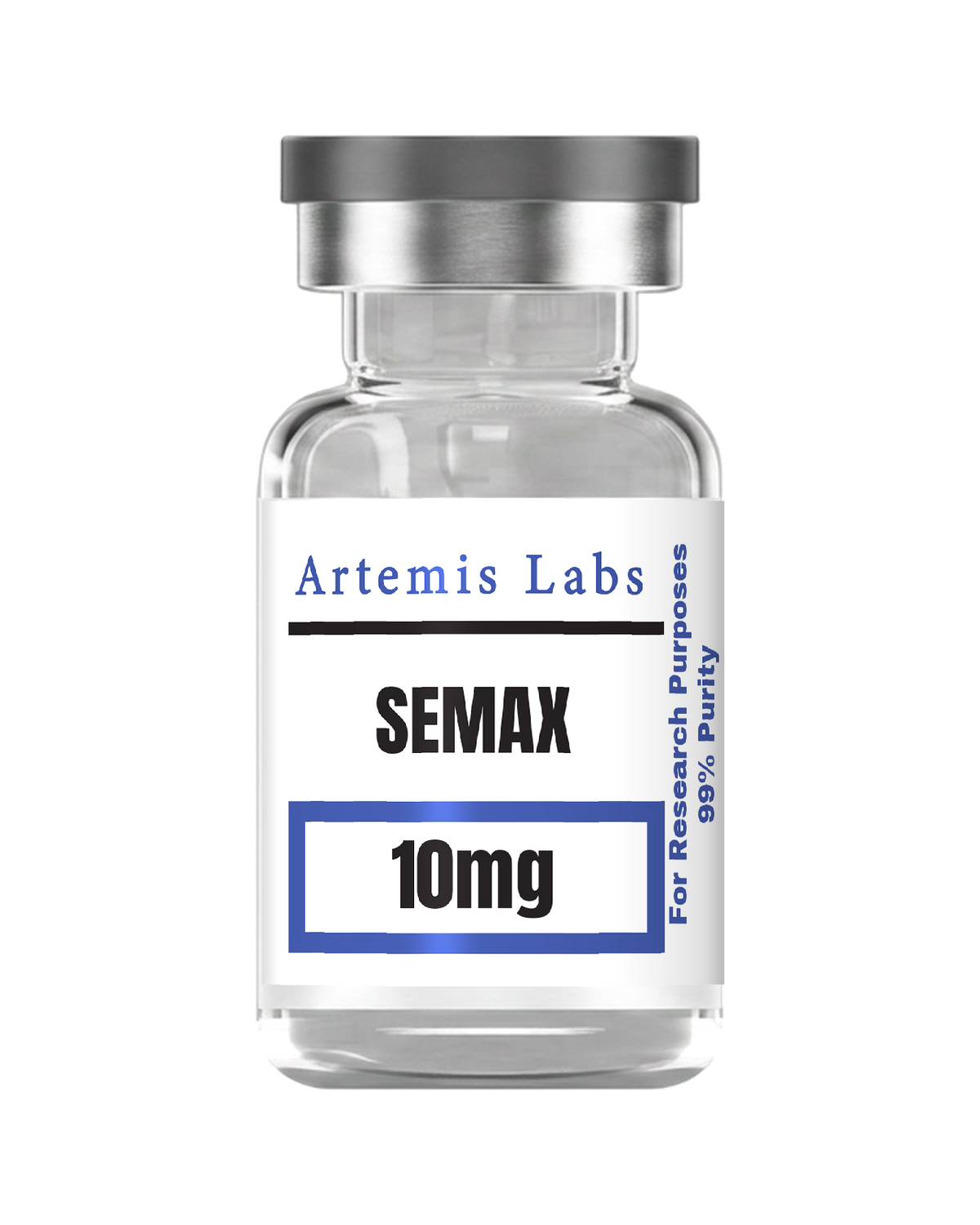
Semax
$45.00
Semax is a short fragment of ACTH with a stabilising tail, developed in Russia and studied there for decades. Its best-known effect is raising BDNF — a protein that keeps neurons alive and helps them form new connections. More recent work suggests it is doing several things at once rather than only that.
Continue readingShow less
What the newer work adds. Beyond BDNF/TrkB signalling, 2025 papers characterise Semax as an Oprm1 (μ-opioid) gene regulator (Liu 2025, PMID 40692165) and a direct modulator of intracellular calcium in hippocampal neurons (Kolbaev 2025, PMID 41171324). Regional ischaemia transcriptomics show it compensating ischaemia-responsive genes in proportion to damage severity (Filippenkov 2025, PMID 40650034).
Context that matters. Semax is registered as a prescription intranasal medicine in Russia and has been in use there since the 1990s; it holds no such status in the US or EU. Most of the literature is Russian-language or Russian-authored, and independent replication outside that group is thin.
Lyophilized ACTH(4-10) analog at ≥99% HPLC-verified purity, batch-specific Certificate of Analysis.
Description
Semax is a man-made peptide of seven amino acids. It was built from a piece of the hormone ACTH. Russian researchers added three amino acids to one end to make it last longer. Scientists study Semax for its effects on BDNF, a brain protein tied to learning and memory. Artemis Labs sells it as a dry powder for lab work.
Reviewed August 22, 2026 · Artemis Labs
What is Semax?
Semax is a synthetic 7-residue heptapeptide with sequence Met-Glu-His-Phe-Pro-Gly-Pro (MEHFPGP; molecular formula C₃₇H₅₁N₉O₁₀S; MW 813.92 Da; CAS 80714-61-0; DrugBank DB12203; PubChem CID 11074590; ChEMBL CHEMBL1809040). It was developed at the Russian Institute of Molecular Genetics as a metabolically stabilised analog of adrenocorticotropic hormone fragment ACTH(4-10). The C-terminal Pro-Gly-Pro extension confers proteolytic resistance, extending in-vivo half-life from minutes (native ACTH fragment) to approximately 20-24 hours in research models.
Why is Semax studied?
The 2024-2026 literature has materially expanded Semax’s mechanism narrative beyond the classical BDNF/TrkB framing:
- BDNF / TrkB axis — core preclinical pharmacology: single intranasal exposure raises BDNF protein and mRNA in rat hippocampus, with parallel TrkB receptor upregulation driving PI3K/AKT and MAPK/ERK signalling.
- μ-opioid receptor (Oprm1) deubiquitination — Liu et al. 2025 (PMID 40692165): first demonstration that Semax promotes Oprm1 deubiquitination and functional recovery after spinal-cord injury in female mice.
- Copper chelation in Cu(II)-Aβ silencing — Tomasello et al. 2025 (PMID 40496623): Semax strips Cu(II) from amyloid-β species and silences ROS generation — discrete molecular mechanism for Alzheimer’s-model research.
- Intracellular Ca²⁺ modulation — Kolbaev et al. 2025 (PMID 41171324): first ionic-mechanism evidence that Semax alters intracellular Ca²⁺ dynamics in rat hippocampal neurons — bridges gene-expression effects to acute neuronal signalling.
- Regional ischemia transcriptomics — Filippenkov et al. 2025 (PMID 40650034; 2024, PMID 39767736): Semax compensates ischemia-responsive genes graded by damage severity across rat brain regions.
Vyunova et al. 2023 (PMID 36828803) also documents direct and delayed GABA-receptor effects, narrowing the historic mechanistic separation between Semax and Selank.
How does Artemis Labs source and verify Semax?
Each lot is supplied as a sterile lyophilised peptide powder, analytically verified by reverse-phase HPLC to ≥99% peptide purity, with identity confirmed by mass spectrometry. The compound shipped is the canonical 7-mer sequence MEHFPGP. A third-party Certificate of Analysis with residual-solvent and endotoxin reporting is available on request.
Artemis Labs verifies every lot by third-party reverse-phase HPLC for peptide purity and by mass spectrometry for identity; a batch-specific Certificate of Analysis carrying the HPLC chromatogram, MS identity, residual-solvent assay and endotoxin testing accompanies the lot and is available on request.
What does the Semax evidence not show?
(1) Russian-research dominance. The Semax literature is heavily concentrated in Russian research groups (notably Filippenkov / Stavchansky / Vyunova at the Russian Institute of Molecular Genetics). Independent replication outside the original-development network exists but is limited. (2) No US clinical-trial data of consequence. Semax has not undergone US phase-2 or phase-3 trials. The Russian regulatory registration (1996 prescription cerebrovascular medicine) is fact of foreign regulatory record — not an Artemis Labs efficacy or safety claim under US law. (3) 2025 mechanism surge is recent. The Oprm1 deubiquitination, Cu(II) chelation, and intracellular-Ca²⁺ findings are first-or-second-report — replication and integration into a unified Semax pharmacology model are pending. (4) Salt form heterogeneity. Commercial supply is typically the acetate salt; verify against batch COA when reproducing literature.
How does Semax compare with Selank?
Selank and Semax are the canonical “complementary Russian heptapeptide pair.” Both share Pro-Gly-Pro extension and intranasal-research framing. Semax (ACTH(4-10) derivative) is BDNF/TrkB and Oprm1 dominant; Selank (tuftsin derivative) is GABA / cytokine / anxiolytic dominant. Mechanistically complementary per Panikratova 2020 fMRI functional-connectomics work, not redundant. Both peptides are explored as part of the broader “Longevity Quartet” research framing alongside MOTS-c, SS-31, and GHK-Cu.
What is the regulatory status of Semax?
Semax is not FDA-approved; not DEA-scheduled; not on the EMA register. Registered in Russia (Ministry of Health, 1996) as a prescription intranasal cerebrovascular medicine — cited as fact of foreign regulatory record only. Not currently on the WADA Prohibited List 2026. Artemis Labs supplies Semax strictly as a research-grade reference compound. These statements have not been evaluated by the FDA. Not for human consumption, therapeutic use, or veterinary use.
Analytical Specifications
| Sequence | Met-Glu-His-Phe-Pro-Gly-Pro (MEHFPGP) |
| Parent fragment | ACTH(4-10) — Semax is the C-terminal Pro-Gly-Pro extended analog |
| Molecular formula | C₃₇H₅₁N₉O₁₀S |
| Molecular weight | 813.92 Da |
| CAS number | 80714-61-0 |
| DrugBank | DB12203 |
| ChEMBL | CHEMBL1809040 |
| PubChem CID | 11074590 |
| Wikidata | Q1839902 |
| Purity | ≥99% by reverse-phase HPLC; identity confirmed by mass spectrometry |
| Form | Lyophilised white powder, 10 mg per vial |
| Storage | Lyophilised ≤ −20 °C, desiccated, protected from light; refer to the lot-specific Certificate of Analysis for all handling specifications |
| Half-life in research models | approximately 20–24 hours (native ACTH fragment: minutes) |
| Certificate of Analysis | Batch-specific report with HPLC chromatogram, MS identity, residual-solvent assay and endotoxin testing |
References
- Filippenkov IB et al. (2024). Biomedicines. PMID 39767736
- Inozemtseva LS et al. (2024). Eur J Pharmacol. PMID 39442746
- Filippenkov IB et al. (2024). Biochemistry (Moscow). PMID 39418522
- Tomasello MF et al. (2025). Bioinorg Chem Appl. PMID 40496623
- Filippenkov IB et al. (2025). Int J Mol Sci. PMID 40650034
- Liu R et al. (2025). Br J Pharmacol. PMID 40692165
- Giri S et al. (2025). Neuropeptides. PMID 41004910
- Kolbaev SN et al. (2025). Bull Exp Biol Med. PMID 41171324
- Asadullah A et al. (2025). F1000Research. PMID 41179234
- Radchenko AI et al. (2025). Acta Naturae. PMID 41479572
- Rahman OF et al. (2026). JAAOS Glob Res Rev. PMID 41490200
- Mavrych V et al. (2026). Front Aging. PMID 42021992
- Vyunova TV et al. (2023). Chem Biol Drug Des. PMID 36828803
- Filippenkov IB et al. (2023). Genes (Basel). PMID 37510287
Additional information
| Vial Size | 10mg |
|---|
Science & Research
Science & Research
Mechanism of Action (Preclinical Models)
Semax produces multi-system effects in rodent brain that have been mapped through gene-expression, proteomic, and behavioral studies. The 2024-2026 literature has materially extended the mechanism narrative.
- BDNF / TrkB axis (historical core). Single intranasal exposure raises BDNF protein and mRNA in rat hippocampus with parallel TrkB receptor upregulation driving downstream PI3K/AKT and MAPK/ERK signalling associated with synaptic plasticity in research models.
- μ-Opioid receptor / Oprm1 gene regulation (Liu et al. 2025, PMID 40692165). First demonstration that Semax acts via Oprm1 deubiquitination, promoting functional recovery after spinal-cord injury in female mice.
- Copper chelation in Cu(II)-Aβ silencing (Tomasello et al. 2025, PMID 40496623). Semax acts as a Cu(II) chelator stripping copper from Cu(II)-amyloid-β species, silencing ROS generation — Alzheimer-model molecular mechanism.
- Direct intracellular Ca²⁺ modulation (Kolbaev et al. 2025, PMID 41171324). First ionic-mechanism evidence: Semax alters intracellular Ca²⁺ dynamics in rat hippocampal neurons.
- Regional ischemia transcriptomics (Filippenkov 2025, PMID 40650034; 2024, PMID 39767736). Semax’s gene-expression compensation is regionally graded by ischemic damage severity.
- GABA-receptor crosstalk (Vyunova et al. 2023, PMID 36828803). Direct and delayed GABA-receptor effects of Semax and synthetic corticotropins — mechanistic substrate for the historic “calm focus” phenotype.
2024-2026 Peer-Reviewed Updates (Chronological)
- Filippenkov IB et al. (2024). Biomedicines. PMID 39767736
- Inozemtseva LS et al. (2024). Eur J Pharmacol. PMID 39442746
- Filippenkov IB et al. (2024). Biochemistry (Moscow). PMID 39418522
- Tomasello MF et al. (2025). Bioinorg Chem Appl. PMID 40496623
- Filippenkov IB et al. (2025). Int J Mol Sci. PMID 40650034
- Liu R et al. (2025). Br J Pharmacol. PMID 40692165
- Giri S et al. (2025). Neuropeptides. PMID 41004910
- Kolbaev SN et al. (2025). Bull Exp Biol Med. PMID 41171324
- Asadullah A et al. (2025). F1000Research. PMID 41179234
- Radchenko AI et al. (2025). Acta Naturae. PMID 41479572
- Rahman OF et al. (2026). JAAOS Glob Res Rev. PMID 41490200
- Mavrych V et al. (2026). Front Aging. PMID 42021992
Supporting References (2023)
- Vyunova TV et al. (2023). Chem Biol Drug Des. PMID 36828803
- Filippenkov IB et al. (2023). Genes (Basel). PMID 37510287
Entity Disambiguation
| Identifier | Value |
|---|---|
| Sequence | Met-Glu-His-Phe-Pro-Gly-Pro (MEHFPGP) |
| Parent fragment | ACTH(4-10) — Semax is the C-terminal Pro-Gly-Pro extended analog |
| Molecular formula | C₃₇H₅₁N₉O₁₀S |
| Molecular weight | 813.92 Da |
| CAS | 80714-61-0 |
| DrugBank | DB12203 |
| ChEMBL | CHEMBL1809040 |
| PubChem CID | 11074590 |
| Wikidata | Q1839902 |
Quality and Specifications
- Purity: ≥99% by RP-HPLC; identity confirmed by mass spectrometry
- Form: Lyophilised white powder, 10 mg/vial
- Storage: Lyophilised ≤ −20°C, desiccated, protected from light; refer to the lot-specific Certificate of Analysis for all handling specifications
- Documentation: Batch-specific Certificate of Analysis with HPLC chromatogram, MS ID, residual-solvent assay, and endotoxin testing
Honest Limitations
- Russian-research dominance — heavy concentration in one research network; independent replication limited.
- No US clinical-trial data. Russian 1996 registration is fact of foreign regulatory record only.
- 2025 mechanism surge is recent — Oprm1, Cu chelation, Ca²⁺ findings are first-or-second-report; replication pending.
- Salt-form heterogeneity in commercial supply — verify against batch COA.
Research Pairings
Research Pairings
Pairing rationale below is mechanistic only. No dosing, frequency, duration, or human-use guidance is provided. Researchers design their own studies against their own institutional review, not against vendor copy.
Why is Semax studied alongside Selank?
The canonical “complementary Russian heptapeptide pair.” Both share Pro-Gly-Pro extension and intranasal-exposure research framing. Semax engages BDNF/TrkB and Oprm1 pathways; Selank engages GABA/cytokine/tuftsin axes. Mechanistically complementary research compounds with distinct fMRI network signatures.
Why is Semax studied alongside DSIP?
Wake-cycle neurotrophic (Semax monoamine + BDNF activation) × sleep-axis neuropeptide (DSIP). Studied side-by-side in rodent sleep-recovery and stress-response paradigms. Mechanistically complementary CNS research peptides.
Why is Semax studied alongside GHK-Cu?
Both peptides influence copper homeostasis. Semax acts as a Cu(II) chelator in Cu(II)-Aβ complexes (Tomasello 2025, PMID 40496623); GHK-Cu is a copper-tripeptide complex itself. Co-application explored in aging-brain research models.
What is the “Longevity Quartet” research framing?
The “Longevity Quartet” research framing combines neurotrophic (Semax) + mitochondrial-derived signalling (MOTS-c) + mitochondria-targeted antioxidant (SS-31) across longevity-research models.
Why is Semax studied alongside BPC-157 / TB-500?
Studied in animal models pairing central BDNF + Oprm1 effects (Semax) with tissue-repair pentadecapeptide effects (BPC-157 / TB-500) — CNS-recovery research design.
Related Compounds in Catalogue
For cognitive-axis research see Selank, DSIP. For longevity-quartet framing see MOTS-c, SS-31, GHK-Cu.
Reviews (0)
Be the first to review “Semax”
Related products
weight-management
recovery
Reviews
There are no reviews yet.