
“GLOW”: what is actually in it, and what the research shows
Vocabulary reference · reviewed August 28, 2026 · Artemis Labs
“GLOW” is community vocabulary, not a clinical designation. It appears in no
published paper. It names three compounds supplied together in a single vial, and unusually for
a community nickname, the composition is consistent across the market.
What is in it
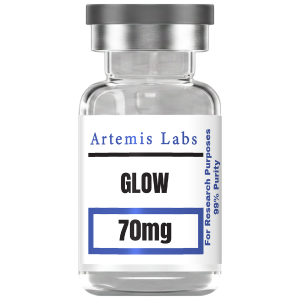
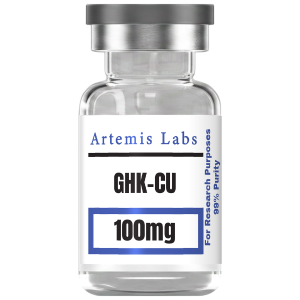
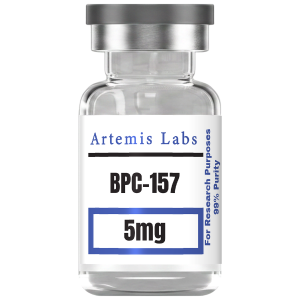
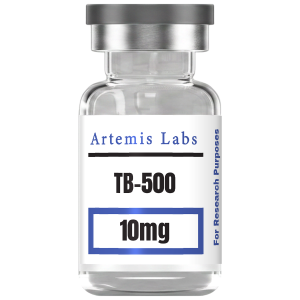
Across vendors the fill is conventionally 50 mg GHK-Cu, 10 mg BPC-157 and
10 mg TB-500 — 70 mg total. That consistency is worth knowing: if a source
quotes a different composition under the same name, it is describing something else.
- GHK-Cu — a copper-binding tripeptide
(glycyl-L-histidyl-L-lysine complexed with copper). - BPC-157 — a synthetic 15-residue peptide,
sequence GEPPPGKPADDAGLV, CAS 137525-51-0. - TB-500 — a synthetic 7-residue peptide,
Ac-LKKTETQ, CAS 885340-08-9, matching residues 17–23 of thymosin β4.
One thing to be clear about: this is a blend — three compounds in
one vial — not a set of separate vials. Sources sometimes use “blend” and
“bundle” interchangeably; they are different products.
What each compound’s literature actually supports
GHK-Cu
The proposed mechanism is not a classical receptor interaction. Current reviews describe
intracellular copper trafficking and direct interaction with chromatin- and
transcription-factor-associated proteins as the mechanisms most often proposed (Arciola 2026,
PMID 41594073).
Recent model work reported anti-inflammatory and antioxidant effects in zebrafish larvae
(Hu et al. 2026, Eur J Pharmacol,
PMID 41997403).
Zebrafish are a screening model, not a stand-in for humans.
BPC-157
Published preclinical work describes multi-pathway signalling, not single-receptor binding.
In 2026 a study in human internal mammary artery tissue reported endothelium-dependent,
nitric-oxide-mediated vasorelaxation (Yildirim et al., J Clin Med,
PMID 42123221)
— ex-vivo human tissue, not people.
TB-500
Described in the literature as the central actin-binding region of thymosin β4 (Sosne 2010,
PMID 20179146).
Nearly every study cited for “TB-500” used the full 43-residue parent protein, not this
fragment.
What has not been tested
No published study has tested these three compounds together. A 2025 review
covers BPC-157 and GHK-Cu in wound-healing research, but discusses them separately — not as a
combination. There is no trial, in humans or animals, of the three-compound blend.
Three further limits belong on any honest account of this blend:
- No human efficacy trial exists for any of the three. BPC-157 has no published
Phase II or III efficacy trial after two decades of preclinical work. TB-500 has no published human
clinical trial of the fragment at all. - It is not settled that TB-500 is the active molecule. Its own pharmacology paper
reports the wound-healing activity may come from a breakdown product, Ac-LKKTE, and not from TB-500
itself (Rahaman 2024,
PMID 38382158). - A published negative finding. In an irritable-bowel model, thymosin β4
released by mast cells reduced tight-junction proteins and impaired the intestinal barrier in rats
and mice (Sun 2025,
PMID 41278163).
That work used the parent protein, not the fragment, and had no human arm — but it is a direct
caution for gut-barrier research.
Separately, a peer-reviewed analysis found products marketed as TB500 and TB1000 misbranded and
adulterated, with contents not systematically consistent with their descriptions (Delcourt 2023,
PMID 36482504)
— which is the strongest published argument for checking what any vendor actually ships.
Regulatory and sport status
None of the three is FDA-approved for any indication. BPC-157 and TB-500 are both
prohibited in sport at all times — BPC-157 under WADA Section S2, and thymosin
β4 and its derivatives, TB-500 named explicitly, under Section S2.3.
The compounds discussed on this page
Tissue-Repair Research
References
- Arciola, et al. GHK-Cu mechanism review — intracellular copper trafficking and chromatin-associated interactions. 2026. PMID 41594073
- Hu, et al. Anti-inflammatory and antioxidant effects of GHK-Cu in zebrafish larvae. Eur J Pharmacol. 2026;1023:178880. PMID 41997403
- Yildirim, et al. Endothelium-dependent, NO-mediated vasorelaxation by BPC-157 in human internal mammary artery. J Clin Med. 2026. PMID 42123221
- Sosne G, et al. Thymosin beta 4 and the eye (LKKTETQ actin-binding domain). FASEB J. 2010. PMID 20179146
- Rahaman A, et al. Metabolism of TB-500; activity may be due to the metabolite Ac-LKKTE. 2024. PMID 38382158
- Sun YS, et al. Thymosin β4 impairs the intestinal epithelial barrier via IL22RA1/JAK1/STAT3 in IBS. World J Gastroenterol. 2025. PMID 41278163
- Delcourt V, et al. TB500/TB1000 and SGF1000: misbranded and adulterated drugs. Drug Test Anal. 2023. PMID 36482504
- World Anti-Doping Agency — Prohibited List (S2, S2.3). wada-ama.org
All products sold by Artemis Labs are for research purposes only. Not for human consumption.