Epitalon
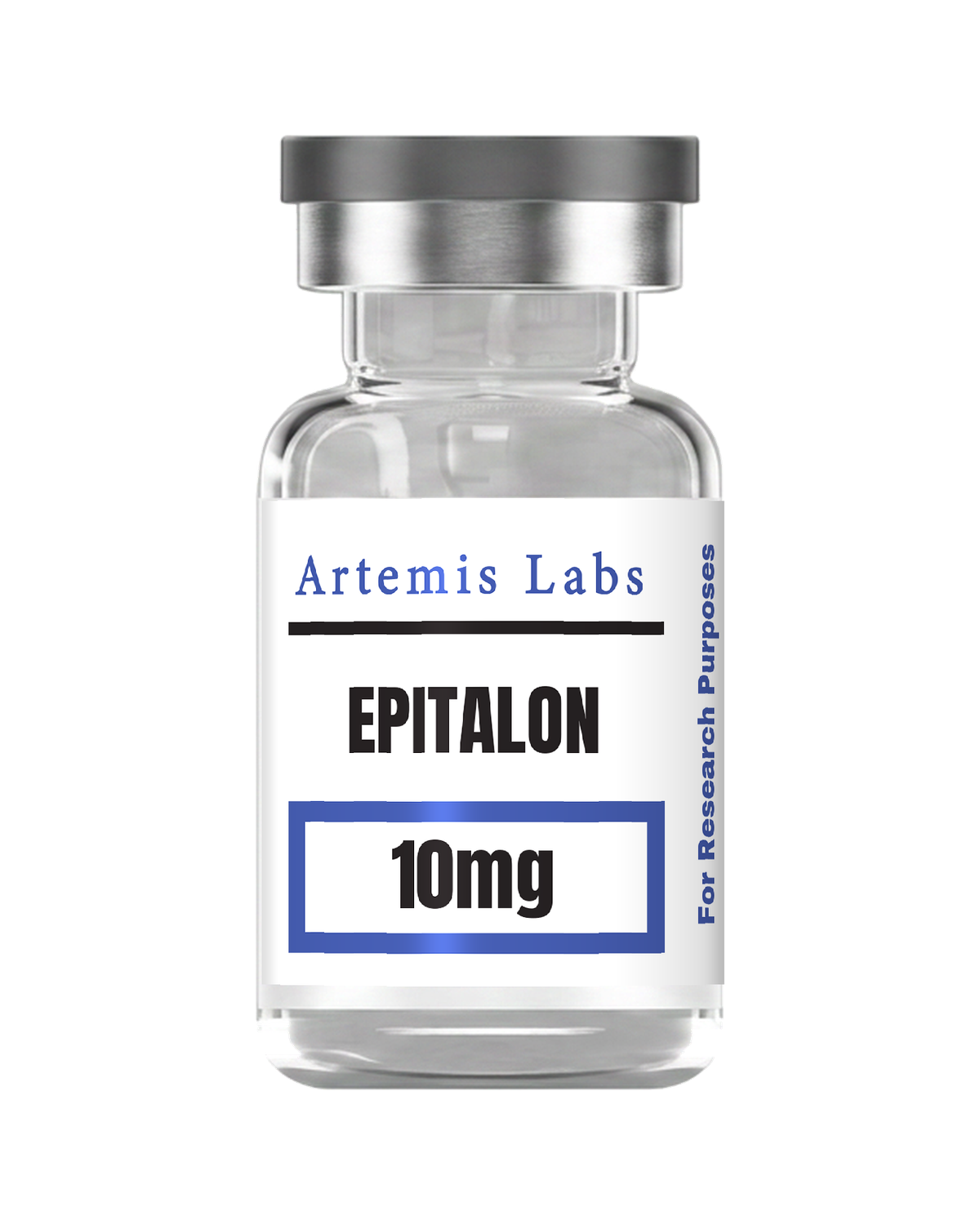
Epitalon is a man-made peptide, four amino acids long, built to copy part of a pineal-gland extract. Labs study it for how cells age: telomeres, melatonin, and gene activity. Artemis Labs does not carry it today. This page is the research record, kept honest, and the form below lets you ask to be told if we ever list it.
Continue readingShow less
What the research actually shows. Most of the work is cell culture and rodent studies from the group that designed the peptide. A few outside labs have repeated the cell-level findings: telomere lengthening in normal human cells (and, notably, in cancer cells too), and protection of aging egg cells in mice and cattle. Mouse lifespan studies found no change in average lifespan; the longest-lived animals lived somewhat longer.
What it does not show. There is no controlled human trial. The three human papers are small, originator-authored, and measure a melatonin metabolite or a retina exam, not a clinical outcome. The striking long-term human numbers you may have read about were produced with Epithalamin, the extract, which the FDA considers a different substance. In May 2026 the FDA concluded the compound is not well characterized and that the evidence weighs against listing it for pharmacy compounding; an advisory committee disagreed in July 2026, and no decision has been made.
44 published sources cited on this page see them
For research use only. Not for human consumption.
You’re on the list. We’ll send one email when this product is back in stock.
Description
Epitalon is a man-made peptide, four amino acids long, built to copy part of a pineal-gland extract. Labs study it for how cells age: telomeres, melatonin, and gene activity. Artemis Labs does not carry it today. This page is the research record, kept honest, and the form on this page lets you ask to be told if we ever list it.
Reviewed August 28, 2026 · Artemis Labs
What is Epitalon?
Epitalon (Epithalon, Epithalone, AEDG) is the synthetic tetrapeptide Ala-Glu-Asp-Gly, designed at the St. Petersburg Institute of Bioregulation and Gerontology from the amino-acid makeup of Epithalamin, a bovine pineal-gland extract (Khavinson 2002, PMID 12374906). It belongs to the Khavinson class of short peptide bioregulators, the same family as Cartalax. Epithalamin is a different substance: the FDA considers the extract and the tetrapeptide different substances, and the large human series often attributed to this peptide were run with the extract.
Why is this page a record and not a listing?
Researchers ask about Epitalon more than almost any compound we do not carry. The compound is in sourcing review. The FDA’s May 2026 evaluation found that the same common name is applied to different salts and active moieties in commerce, and that impurity, aggregation and endotoxin data are missing from the public record. Until a supply can meet that bar, the page stays a record. If the compound is ever listed, the notify-me form on this page will send one email and nothing else.
What does the published research actually report?
Roughly 140 indexed papers name the peptide across 25 years, most from the originating group. The findings that have been reproduced outside that group are cell-level. An independent Brunel University study found that epitalon extended telomere length in normal human epithelial and fibroblast cells through hTERT and telomerase upregulation, and also extended telomeres in breast-cancer cell lines, there through the ALT pathway (Al-Dulaimi 2025, PMID 40908429). At 0.1 mM in culture medium it lowered reactive oxygen species, spindle defects and apoptosis in post-ovulatory aging mouse oocytes (Yue 2022, PMID 35413689), and improved bovine oocyte maturation and post-thaw blastocyst hatching (Ullah 2025, PMID 39788414). In late-passage human periodontal-ligament and gingival stem cells it lowered p16 and p21 mRNA 1.6 to 2.4-fold (Sinjari 2020, PMID 31677028).
The originating group first reported telomerase catalytic-subunit expression and telomere elongation in telomerase-negative human fetal fibroblasts (Khavinson 2003, PMID 12937682), then ten extra passages beyond the usual division limit (Khavinson 2004, PMID 15455129). Rat pinealocyte cultures made more melatonin with the peptide present (Khavinson 2012, PMID 22816096), and old rhesus monkeys showed higher evening melatonin (Khavinson 2001, PMID 11524632).
What did the animal lifespan studies find?
Read the numbers, not the headlines. In 54-per-group female SHR mice, mean lifespan did not change; the last 10% of survivors lived 13.3% longer, chromosome aberrations fell 17.1%, and leukemia was six-fold less frequent while total tumor incidence was unchanged (Anisimov 2003, PMID 14501183). Female CBA mice showed 5.3% longer mean survival, with higher body weight and lower activity (Anisimov 2001, PMID 11163623). HER-2/neu transgenic mice developed fewer and smaller mammary tumors with 3.7-fold lower HER-2/neu mRNA (Anisimov 2002, PMID 12209581; PMID 12459848); in the same experiment the dipeptide Vilon increased mammary-cancer incidence, so the class is not uniformly benign. Rats under a standard light cycle showed no lifespan change; gains appeared only under natural northern or constant light (Vinogradova 2007, PMID 18856211; 2008, PMID 19110597). Fruit flies lived 11 to 16% longer with no dose dependence (Khavinson 2000, PMID 11087911).
What is the human evidence?
The FDA’s 2026 literature search found three studies in which epitalon was given to people, and we found the same three. Night-shift workers given the peptide excreted 1.7 times more 6-sulfatoxymelatonin, with shifts in circadian-gene expression in blood cells (Ivko 2021, PMID 33280326); the FDA noted blinding was not specified, the study was short and small, and no sleep outcome was measured. Patients with retinitis pigmentosa were reported to show a positive clinical effect in 90% of cases in an uncontrolled eye-clinic series (Khavinson 2002, PMID 12195242). Elderly volunteers with reduced pineal function were reported to have a normalized melatonin rhythm (Korkushko 2007, PMID 17969590).
The long-term human series with 1.6 to 4.1-fold lower mortality (Khavinson & Morozov 2003, PMID 14523363) and the 15-year coronary follow-up (Korkushko 2011, PMID 22451889) used Epithalamin, the extract. Any page that attributes those results to the tetrapeptide is misreading the literature.
What does the evidence not show?
- The flagship mechanism failed an independent test. A Pitié-Salpêtrière group found Ala-Glu-Asp-Gly at 10⁻⁴ to 10⁻⁶ M had no effect on melatonin secretion from perifused young or old rat pineal glands (Djeridane 2003, PMID 12809170).
- Telomere lengthening is not selective for healthy cells. The Brunel study found extension in breast-cancer lines through ALT, described as specific to cancer cells (PMID 40908429). A compound that lengthens telomeres in tumor cells is a reason for caution in any aging model that is not tumor-free.
- Lifespan claims are narrower than the marketing. Mean lifespan was unchanged in the largest mouse study and in rats under normal light; gains were confined to the last 10% of survivors or to disrupted-light conditions.
- No controlled human trial exists. No pharmacokinetic data, no toxicology package, and no adverse-event reports, which the FDA read as an absence of surveillance, not a clean record.
- Mechanism claims outrun measurements. The statement that epitalon binds the telomerase promoter rests on a complementary-binding model (Khavinson 2005, PMID 15990728) and docking studies (PMID 23484211), not on a measurement of the peptide on that promoter.
- Illegal-preparation record. A Belgian public-health laboratory identified epitalon in two illegal pharmaceutical preparations (Vanhee 2015, PMID 25535022); the compound’s orphan designation for retinitis pigmentosa was withdrawn in 2016.
What is Epitalon’s regulatory status?
Not an approved drug anywhere; not a USAN or INN; no USP monograph. In 2015 and 2018 it was nominated for the FDA’s 503A pharmacy-compounding list; both nominations were later withdrawn and the FDA evaluated epitalon (free base) and epitalon acetate on its own initiative, for the use of insomnia. Its briefing document dated May 12, 2026 concluded that a balancing of the criteria weighs against listing: the substance is not well characterized, no pharmacokinetic data exist, no clinical safety studies exist, the FDA’s adverse-event databases held no reports through December 2025, and the human papers measure melatonin markers, not sleep (FDA Briefing Document, PCAC July 23 to 24, 2026). On July 23 to 24, 2026 the Pharmacy Compounding Advisory Committee voted to recommend adding epitalon, with five other peptides, to the list; the vote is advisory and the FDA has not acted on it. Epitalon appears on none of the FDA’s 503A category lists as updated May 14, 2026. An orphan-drug designation for retinitis pigmentosa was granted in 2010 and withdrawn in 2016. The composition patent (US 6,727,227, filed 2000) has expired.
How is Epitalon different from Cartalax and Epithalamin?
| Compound | Sequence | What it is | Distinguishing fact |
|---|---|---|---|
| Epitalon / Epithalon (AEDG) | Ala-Glu-Asp-Gly | Synthetic tetrapeptide | C₁₄H₂₂N₄O₉, 390.35 g/mol, PubChem CID 219042, CAS 307297-39-8 |
| Epithalamin | undefined mixture | Bovine pineal polypeptide extract | The substance the peptide was designed from; source of the large human series |
| Cartalax (AED) | Ala-Glu-Asp | Tripeptide bioregulator | Same three residues without the glycine; 333.29 g/mol |
References
- Al-Dulaimi 2025. Telomere extension via hTERT in normal cells and via ALT in breast-cancer lines (independent). PMID 40908429; correction PMID 41240216
- Yue 2022. Post-ovulatory aging mouse oocytes: ROS, spindle defects and apoptosis reduced at 0.1 mM (independent). PMID 35413689
- Ullah 2025. Bovine oocyte maturation and post-thaw blastocyst development (independent). PMID 39788414
- Djeridane 2003. No effect on melatonin secretion from perifused rat pineal glands (independent null). PMID 12809170
- Kossoy 2006. Fewer malignant-tumor-bearing C3H/He mice, no metastases (Hebrew University with Anisimov). PMID 16634527
- Araj 2025. Review: physico-chemical literature “quite limited” relative to the biological literature. PMID 40141333
- Mavrych 2026. Review: investigational peptides lack long-term safety data and systematic validation. PMID 42021992
- Rahman 2026. Review: a current lack of clinical trials. PMID 41490200
- Vanhee 2015. Epitalon identified in two illegal pharmaceutical preparations (Belgian public-health laboratory). PMID 25535022
- Anisimov 2003. SHR mice: mean lifespan unchanged; last-10% survival +13.3%; chromosome aberrations −17.1%; leukemia six-fold lower. PMID 14501183
- Anisimov 2001. CBA mice: mean survival +5.3%, maximum +10 months. PMID 11163623
- Anisimov 2002. HER-2/neu mice: fewer, smaller mammary tumors; Vilon increased incidence. PMID 12209581
- Anisimov 2002. HER-2/neu mice: average lifetime +13.5%. PMID 12459848
- Anisimov 2002. DMH colon carcinogenesis in rats: fewer, smaller tumors. PMID 12049808
- Kossoy 2003. Colon tumors: mitotic activity reduced, apoptosis increased. PMID 12964022
- Vinogradova 2007. Female rats: no lifespan change under standard light. PMID 18856211
- Vinogradova 2008. Male rats: no mean-lifespan change; tumor inhibition. PMID 19110597
- Rosenfeld 2002. SAMP-1 mice: chromosome aberrations −20 to −30%. PMID 12360351
- Anisimov 2005. SAM mice: tumor frequency not affected. PMID 15909815
- Khavinson 2000. Drosophila lifespan +11 to 16%, no dose dependence. PMID 11087911
- Khavinson 2001. Senescent monkeys: evening melatonin up, cortisol rhythm normalized. PMID 11524632
- Khavinson 2012. Pinealocyte culture: AANAT, pCREB and melatonin up. PMID 22816096
- Kozina 2007. Antioxidant enzymes in old rats. PMID 17317455
- Khavinson 2003. Telomerase activity and telomere elongation in human somatic cells. PMID 12937682
- Khavinson 2004. Ten extra passages beyond the division limit. PMID 15455129
- Fedoreyeva 2011. Nuclear entry and oligonucleotide binding of FITC-labeled epitalon. PMID 22117547
- Khavinson 2013. Docking models with gene promoter sites (computational). PMID 23484211
- Khavinson 2005. Complementary-binding model; ATTTTC in the telomerase promoter (model). PMID 15990728
- Khavinson 2008. DNA duplex melting shifted on peptide binding. PMID 19526107
- Gatta 2025. High-glucose-injured ARPE-19 cells: wound healing restored. PMID 40493162
- Sinjari 2020. p16/p21 lowered in late-passage oral stem cells. PMID 31677028
- Khavinson 2020. Neurogenic markers up 1.6 to 1.8-fold in gingival MSCs. PMID 32019204
- Kraskovskaya 2024. Dendrite arborization in induced neurons from elderly donors. PMID 39518916
- Avolio 2022. THP-1 monocytes: LPS-stimulated TNF and IL-6 reduced. PMID 35408963
- Khavinson 2003. Chromatin activation in lymphocytes of persons aged 76 to 80 (ex vivo). PMID 14647006
- Khavinson 2004. Lymphocyte chromatin in subjects aged 75 to 88 (ex vivo). PMID 15085253
- Lezhava 2006. Chromatin reactivation in lymphocytes of old people (ex vivo). PMID 16705247
- Ivko 2021. Night-shift workers: 6-sulfatoxymelatonin 1.7× (human, uncontrolled). PMID 33280326
- Khavinson 2002. Retinitis pigmentosa: positive effect in 90% of cases (human, uncontrolled). PMID 12195242
- Korkushko 2007. Melatonin rhythm in old monkeys and elderly people. PMID 17969590
- Khavinson 2002. Peptides and Ageing (monograph; design rationale). PMID 12374906
- Khavinson & Morozov 2003. Epithalamin, the extract: mortality 1.6 to 4.1-fold lower (not epitalon data). PMID 14523363
- Korkushko 2011. Epithalamin, the extract: 15-year coronary follow-up (not epitalon data). PMID 22451889
- FDA. Briefing Document for Epitalon-Related Bulk Drug Substances, PCAC July 23 to 24, 2026 (dated May 12, 2026). fda.gov/media/193345
- FDA. 503A Category 1, 2 and 3 lists, updated May 14, 2026. fda.gov/media/94155
Not currently supplied by Artemis Labs. For in-vitro and pre-clinical laboratory research only. Not for human consumption.
Additional information
| Vial Size | 10mg |
|---|
Science & Research
Science & Research
Mechanism of Action
Two mechanisms are proposed, at different levels of evidence. Pineal and melatonin: in rat pinealocyte culture, epitalon raised AANAT and phosphorylated CREB and increased melatonin in the medium (Khavinson 2012, PMID 22816096); in old rhesus monkeys it raised evening melatonin and normalized the cortisol rhythm (Khavinson 2001, PMID 11524632). An independent Paris laboratory perifused pineal glands from young and old rats with Ala-Glu-Asp-Gly at 10⁻⁴ to 10⁻⁶ M and found no effect on melatonin secretion (Djeridane 2003, PMID 12809170). DNA and chromatin: fluorescein-labeled epitalon accumulated in HeLa nuclei and quenched fluorescence of CNG- and CAG-containing oligonucleotides (Fedoreyeva 2011, PMID 22117547); binding to a poly(dA-dT) duplex lowered its melting temperature from 69.5 °C to 28 °C (Khavinson 2008, PMID 19526107). The telomerase-promoter claim rests on a complementary-binding model proposing ATTTTC as a binding block (Khavinson 2005, PMID 15990728) and on docking (Khavinson 2013, PMID 23484211); those are computations, not measurements. Telomerase: the readout has been reproduced. The originating group reported telomerase catalytic-subunit expression and telomere elongation in telomerase-negative fetal fibroblasts (PMID 12937682) and ten extra passages beyond the division limit (PMID 15455129); an independent Brunel study confirmed dose-dependent telomere extension through hTERT mRNA and telomerase activity in normal cells, and ALT-driven extension in breast-cancer lines (Al-Dulaimi 2025, PMID 40908429).
Reported Findings (all preclinical)
- Oocyte aging: 0.1 mM epitalon lowered ROS, spindle defects and apoptosis in post-ovulatory aging mouse oocytes (Yue 2022, PMID 35413689); bovine oocyte maturation and post-thaw blastocyst hatching improved (Ullah 2025, PMID 39788414).
- Retinal cells: wound healing restored in high-glucose-injured ARPE-19 cells by limiting EMT and fibrosis genes (Gatta 2025, PMID 40493162).
- Stem-cell senescence: p16 and p21 mRNA 1.6 to 2.4-fold lower in 25th-passage oral stem cells (Sinjari 2020, PMID 31677028); neurogenic markers 1.6 to 1.8-fold higher in gingival MSCs (Khavinson 2020, PMID 32019204).
- Induced neurons from elderly donors: dendrite arborization promoted (Kraskovskaya 2024, PMID 39518916).
- Monocytes: LPS-stimulated TNF and IL-6 reduced in THP-1 cells (Avolio 2022, PMID 35408963).
- Lifespan and tumors: mean lifespan unchanged in SHR mice, last-10% survival +13.3%, leukemia six-fold lower (Anisimov 2003, PMID 14501183); CBA mice mean survival +5.3% (PMID 11163623); HER-2/neu mice fewer and smaller mammary tumors (PMID 12209581); DMH colon tumors fewer and smaller (PMID 12049808; PMID 12964022); rats under standard light no lifespan change (PMID 18856211; PMID 19110597); Drosophila +11 to 16%, no dose dependence (PMID 11087911).
- Antioxidant enzymes higher in old rats (Kozina 2007, PMID 17317455).
Human data
Three small originator-authored studies gave the peptide to people: night-shift workers, 6-sulfatoxymelatonin 1.7× higher with no sleep outcome measured (Ivko 2021, PMID 33280326); retinitis pigmentosa, positive effect in 90% of cases in an uncontrolled eye-clinic series (Khavinson 2002, PMID 12195242); elderly volunteers, melatonin rhythm reported normalized (Korkushko 2007, PMID 17969590). Ex-vivo lymphocyte work from donors aged 75 to 88 (PMID 14647006; PMID 15085253; PMID 16705247) is cell culture, not administration. The mortality series (PMID 14523363; PMID 22451889) used Epithalamin, the extract, which the FDA considers a different substance.
Counter-evidence and limitations
- Independent null on melatonin secretion from perifused rat pineal glands (PMID 12809170).
- Telomere extension in breast-cancer cell lines via ALT, specific to cancer cells (PMID 40908429).
- Mean lifespan unchanged in the largest mouse study and in rats under normal light; fly effect dose-independent.
- No controlled human trial; no pharmacokinetics; no toxicology package; FDA May 2026: not well characterized, immunogenicity cannot be ruled out.
- Vilon, tested beside epitalon, increased mammary-cancer incidence in HER-2/neu mice (PMID 12209581). Class membership is not a safety argument.
- Identified in two illegal pharmaceutical preparations (PMID 25535022); orphan designation withdrawn 2016.
Regulatory status
Not approved anywhere. FDA 503A evaluation dated May 12, 2026 concluded the criteria weigh against listing; the Pharmacy Compounding Advisory Committee voted July 23 to 24, 2026 to recommend inclusion, an advisory vote the FDA has not acted on; the compound appears on none of the 503A category lists updated May 14, 2026. Composition patent expired. Not named on the WADA Prohibited List; Section S0 would apply on its face.
References
The full numbered reference list is in the description above.
Common Questions
Common Questions
What is Epitalon?
A synthetic four-amino-acid peptide, Ala-Glu-Asp-Gly, designed in St. Petersburg from the amino-acid makeup of a pineal-gland extract called Epithalamin. It is studied for effects on telomeres, melatonin and gene activity in cells and animals.
Is Epitalon the same as Epithalon?
Yes. Epitalon, Epithalon and Epithalone are spellings of the same tetrapeptide. Epithalamin is different: it is the extract the peptide was based on.
Does Artemis Labs sell Epitalon?
Not at present. This page is a research record for a compound in sourcing review. If you would like to know if it is ever listed, the form on this page will send one email in that case and nothing else.
Has Epitalon been tested in people?
Three small studies from the originating group gave the peptide to people; none had a modern control design, and none measured a clinical outcome such as sleep. The large human studies with mortality figures used Epithalamin, the extract, not the peptide.
What did the FDA decide?
In May 2026 the FDA’s evaluation concluded the compound is not well characterized and that the evidence weighs against adding it to the pharmacy-compounding list. In July 2026 an advisory committee voted to recommend adding it. The FDA has not acted on the vote.
Does Epitalon lengthen telomeres?
In cell culture, yes, and an independent UK laboratory confirmed it in 2025. The same study found telomere lengthening in breast-cancer cell lines as well, which is a reason for caution, not enthusiasm.
Did it extend lifespan in animals?
Average lifespan was unchanged in the largest mouse study and in rats kept under a normal light cycle. The longest-lived animals lived somewhat longer, and fewer tumors of some kinds were seen. Fruit flies lived 11 to 16% longer with no dose dependence.
What is it sold for elsewhere?
In-vitro and pre-clinical laboratory research only. Not for human consumption.
Related products