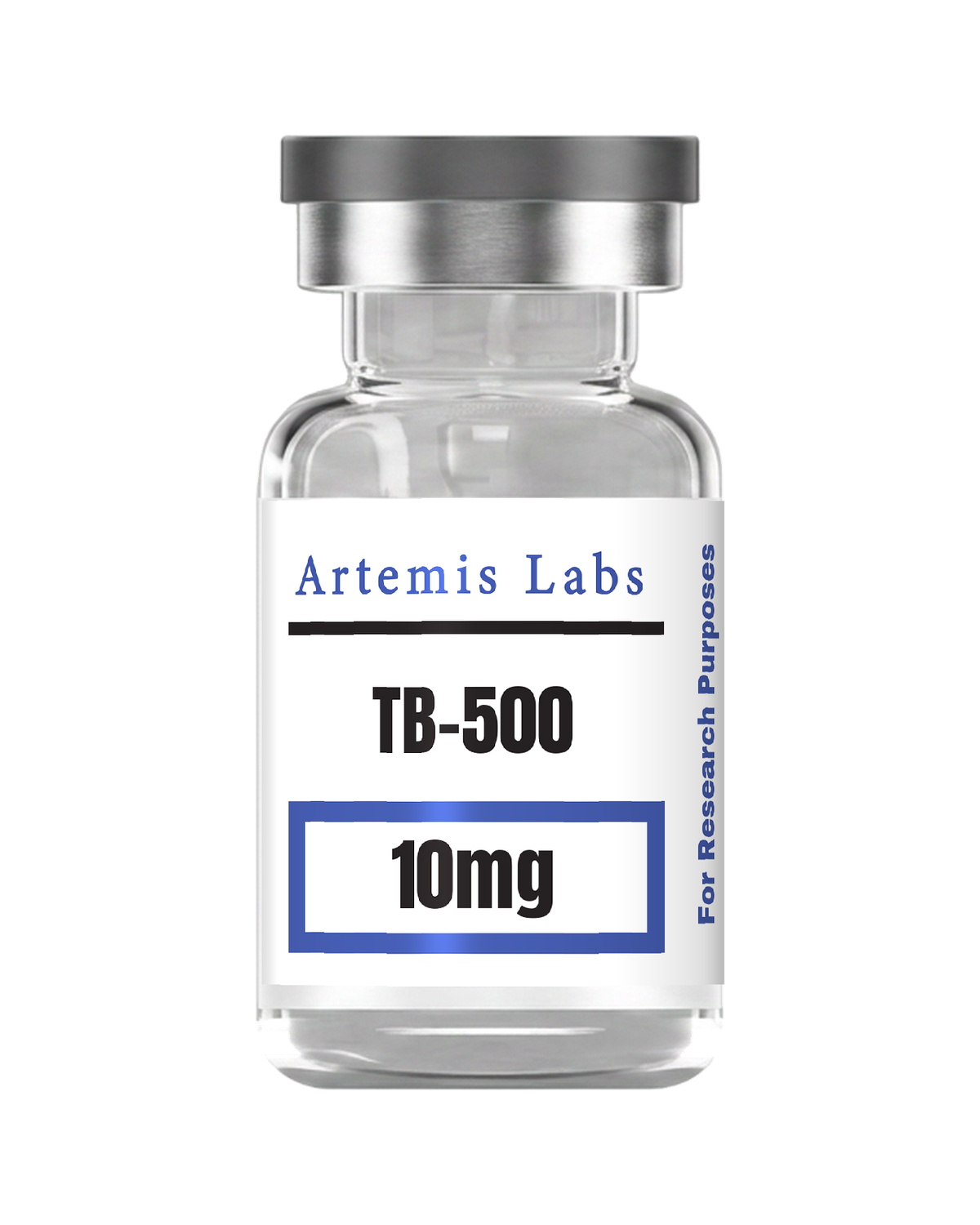
TB-500 10mg
$40.00
TB-500 is a short, lab-made peptide. It copies a small piece — positions 17 to 23 — of a larger natural protein called thymosin β4 (Tβ4). The full protein is about five and a half times bigger. They are related, and they are not the same molecule.
Here is the honest part most sellers leave out: there is no published human trial of TB-500 itself. Almost every study people point to used the big parent protein, not this seven-residue fragment. Only a handful of animal and cell studies have tested the fragment. One 2024 paper even found that the wound-healing activity once credited to TB-500 may come from a breakdown product, not TB-500 itself (Rahaman et al. 2024, PMID 38382158).
Continue readingShow less
What the fragment is. The small piece LKKTETQ is described in the literature as the central actin-binding region of thymosin β4 (Sosne 2010, PMID 20179146, a review). Actin is the scaffolding cells use to hold their shape and to move.
Honest counter-evidence. In an irritable-bowel-syndrome model, Sun et al. (2025, PMID 41278163) reported that thymosin β4 released by mast cells reduced tight-junction proteins and impaired the gut barrier in rats and mice. That study looked at the endogenous full-length parent protein, not the TB-500 fragment — but it is a direct caution for anyone studying the gut barrier. TB-500 is also on the WADA Prohibited List, and no version of it is FDA-approved.
A single lyophilized peptide, supplied strictly for in-vitro and pre-clinical laboratory research.
25 published sources cited on this page see them
For research use only. Not for human consumption.
Out of stock
You’re on the list. We’ll send one email when this product is back in stock.
Description
TB-500 is a short, lab-made peptide — seven amino acids that copy positions 17 to 23 of a larger natural protein called thymosin β4. The two are related but not the same molecule. Almost every study people cite used the big parent protein, not this fragment, and there is no published human trial of TB-500 itself. It is banned in sport (WADA) and is not FDA-approved.
Reviewed August 27, 2026 · Artemis Labs
What is TB-500?
TB-500 is a synthetic seven-residue peptide, Ac-LKKTETQ, matching residues 17–23 of thymosin β4 (Tβ4). It is supplied as a lyophilized powder for in-vitro, cell-culture, and pre-clinical laboratory research only. The molecule sold as TB-500 is N-acetylated at the N-terminus — a real +42 Da difference from the bare heptapeptide, and the form commercial reference standards use. The acetylated form is 889.0 g/mol (PMID 23084823; identity abstract PMID 22962027); the un-acetylated free acid is a different entry (847.0 g/mol) and is not what is sold here.
Is TB-500 the same as thymosin β4?
No. Thymosin β4 is the full 43-residue parent protein (~4,963 Da, CAS 77591-33-4, the INN timbetasin). TB-500 is the short fragment, about five and a half times lighter. This page keeps the two separate throughout, because the published evidence for the parent protein does not automatically transfer to the fragment. A third molecule, Ac-SDKP (the 1–4 metabolite of Tβ4), is sometimes studied alongside it and is neither TB-500 nor the 17–23 fragment.
What does the published research on the fragment actually show?
The honest starting point: every primary study in the internal Artemis reference set used full-length thymosin β4 — none studied the TB-500 fragment. Four 2026 sports-medicine reviews say so in their own words. TB-4 and its derivative TB-500 promoted angiogenesis and tissue repair in preclinical models, but human orthopaedic data are lacking (PMID 41476424); rigorous human safety data are scarce (PMID 41966639); there is a current lack of clinical trials (PMID 41490200); and a PRISMA scoping review found the claimed benefits remain unsubstantiated by current human trials (PMID 42578445). The fragment’s own pharmacology paper goes further: Rahaman 2024 (PMID 38382158) reports that the biological effects of TB-500 have not been documented, and that the previously reported wound-healing activity may be due to a metabolite (Ac-LKKTE) rather than TB-500 itself.
What is the fragment’s mechanism?
Only one mechanism statement is supported at the fragment level. LKKTETQ is described as the central actin-binding domain of thymosin β4, residues 17–23, in a review reporting that this short sequence promotes angiogenesis, wound healing, and cell migration (Sosne 2010, PMID 20179146). At the class level, a narrative review groups TB-500 with BPC-157 and GHK-Cu as wound-healing peptides that promote angiogenesis, integrin-mediated extracellular matrix remodeling, and fibroblast activation (PMID 41490200) — a class statement, not a TB-500 experiment. Mechanisms sometimes claimed for TB-500 elsewhere — G-actin sequestration, stem-cell mobilisation, cytokine downregulation, or a specific half-life — are deliberately not asserted here, because this reference set holds no source that supports them.
Is there any human trial of TB-500?
No. There is no published human clinical trial of the TB-500 fragment. Where human thymosin β4 data exists it is ophthalmic, dermal, and one cardiac trial, and its best-developed programme is graded low-certainty by an independent Cochrane review (Kruoch 2025, PMID 41347649). No form of TB-500 is FDA-approved; the parent protein’s ocular programme (RGN-259) reached human trials with FDA approval still pending (review 2025, PMID 41235866).
What are the honest negatives?
Honest counter-disclosure is the point here, and no competitor surfaces it. In an irritable-bowel-syndrome model, thymosin β4 released by mast cells reduced tight-junction proteins and impaired the intestinal barrier in rats and mice (Sun 2025, PMID 41278163); a second group reported similar gut-barrier damage in mice and human colon tissue (Hao 2024, PMID 38049080) — note the author groups overlap, so these are related programmes, not independent replication. Both studied endogenous full-length Tβ4, not the fragment, and neither had a human dosing arm, but each is a direct caution for gut-barrier research. A review reported that where Tβ4 comes from can flip the direction of its effect in the same tissue (Kim & Jung 2016, PMID 27450733). And a peer-reviewed analysis found marketed TB500/TB1000 products misbranded and adulterated, with contents not systematically consistent with their descriptions (Delcourt 2023, PMID 36482504) — the strongest published argument for testing, and it names TB500 directly.
Is TB-500 banned in sport?
Yes. The WADA 2026 Prohibited List names, under Section S2.3, “Thymosin-β4 and its derivatives e.g. TB-500,” prohibited at all times, in and out of competition (wada-ama.org/en/prohibited-list). Its controlled-substance and state-level shipping status are outside the scope of this literature and are not asserted here.
Why does independent testing matter for this compound?
Because a peer-reviewed study (Delcourt 2023, PMID 36482504) found the contents of marketed TB500 products were not systematically consistent with their descriptions. The manufacturer performs periodic quality testing on production batches.
Analytical Specifications
| Sequence | Ac-Leu-Lys-Lys-Thr-Glu-Thr-Gln-OH (Ac-LKKTETQ) — 7 residues, N-acetylated |
| Position in parent | Residues 17–23 of thymosin β4 |
| Molecular formula | C38H68N10O14 |
| Molecular weight | 889.0 g/mol (N-acetylated form) |
| PubChem CID | 62707662 |
| CAS number | 885340-08-9 (fragment); parent thymosin β4 is CAS 77591-33-4 (timbetasin) |
| UNII | QHK6Z47GTG |
| Form | Lyophilized white powder, 10 mg/vial |
| Storage | Store lyophilized at −20 °C, desiccated, protected from light |
| Evidence stage | Preclinical / in vitro — no published human trial of the fragment |
References
- Sosne G, et al. Thymosin beta 4 and the eye: review of the preclinical literature (LKKTETQ actin-binding domain). 2010. PMID 20179146
- Philp D, et al. Thymosin beta 4 and a synthetic peptide containing its actin-binding domain (LKKTETQ) promote dermal wound repair in aged mice. 2003. PMID 12581423
- Ou H, et al. Thymosin β4-derived peptides (TB500, Ac-SDKP) alleviate neuroinflammation and neurite atrophy in vitro and in 5×FAD mice; hippocampal Aβ burden remained unchanged. 2026. PMID 41443105
- Lu X, et al. First ocular application of TB500 in an alkali-burn mouse/rabbit model (enzyme-triggered hydrogel). 2025. PMID 41359360
- Ho ENM, et al. Doping-control detection of TB-500 (N-acetylated LKKTETQ) in equine plasma and urine. 2012. PMID 23084823
- Rahaman A, et al. Metabolism of TB-500; wound-healing activity may be due to the metabolite Ac-LKKTE rather than the parent form. 2024. PMID 38382158
- N-terminal acetylated 17-23 fragment of human thymosin beta 4 (Ac-LKKTETQ) — identity. 2012. PMID 22962027
- Mayfield CK, et al. Injectable peptide therapy: a primer for orthopaedic and sports-medicine physicians. 2026. PMID 41476424
- Mendias CL, Awan TM. Safety and efficacy of approved and unapproved peptide therapies for musculoskeletal injuries. 2026. PMID 41966639
- Rahman, et al. Therapeutic peptides in orthopaedics: applications, challenges, and future directions. 2026. PMID 41490200
- Tewari. PRISMA scoping review of thymosin beta-4 / TB-500 for musculoskeletal recovery. 2026. PMID 42578445
- Guarnera G, et al. Thymosin beta 4 in venous stasis ulcers (Phase 2). 2010. PMID 20536470
- Treadwell T, et al. Thymosin beta 4 in stasis and pressure ulcers (two Phase 2 trials); acceleration seen in those patients that did heal. 2012. PMID 23050815
- Sosne G, Ousler GW. Thymosin beta 4 ophthalmic solution for dry eye — Phase II CAE model; primary endpoints not met. 2015. PMID 26056426
- Sosne G, et al. RGN-259 (thymosin β4) for neurotrophic keratopathy — Phase III; complete healing p = 0.0656. 2022. PMID 36613994
- Kruoch Z, et al. Cochrane review CD015723 — corneal re-epithelialization; RGN-259 low-certainty evidence. 2025. PMID 41347649
- Zhang. Recombinant human Tβ4 in STEMI — randomized, placebo-controlled; overall infarct-area difference not significant. 2025. PMID 41229390
- Stewart WG, et al. Thymosin β4 stabilizes hypoxia-induced brain microvascular endothelial dysfunction via S1PR1 (human cells in vitro). 2025. PMID 41326489
- Di H. Thymosin beta 4: an emerging therapeutic candidate for kidney diseases (bidirectional effects on fibrosis). 2026. PMID 41570941
- Ruff D, et al. Safety of intravenous synthetic thymosin beta 4 in healthy volunteers (Phase 1). 2010. PMID 20536472
- Review noting the RGN-259 corneal trial with FDA approval still pending. 2025. PMID 41235866
- Sun YS, et al. Thymosin β4 released by mast cells impairs the intestinal epithelial barrier via IL22RA1/JAK1/STAT3 in IBS. 2025. PMID 41278163
- Hao. Tβ4 upregulation impairs the intestinal mucus barrier by inhibiting autophagy in mice. 2024. PMID 38049080
- Kim & Jung. Thymosin beta 4 in liver fibrosis — exogenous vs endogenous opposite directions (review). 2016. PMID 27450733
- Delcourt V, et al. TB500/TB1000 and SGF1000: misbranded and adulterated drugs. 2023. PMID 36482504
Supplied as lyophilized powder. For in-vitro and pre-clinical laboratory research only. Not for human consumption. Prohibited at all times in sport under WADA Section S2.3.
Additional information
| Vial Size | 10mg |
|---|
Science & Research
Science & Research
Mechanism of Action
Only one mechanism statement is supported at the fragment level. LKKTETQ is described as the central actin-binding domain of thymosin β4, residues 17–23, in a review reporting that this short sequence “promotes angiogenesis, wound healing, and cell migration” (Sosne 2010, PMID 20179146). That is a review, and it supports actin-binding, angiogenesis, wound healing, and cell migration — not the stronger mechanism verbs some vendors use.
At the class level, a narrative review groups TB-500 with BPC-157 and GHK-Cu as wound-healing peptides that “promote angiogenesis, integrin-mediated extracellular matrix remodeling, and fibroblast activation” (Rahman 2026, PMID 41490200) — a class statement from an abstract that also notes a current lack of clinical trials, not a TB-500 experiment.
Mechanisms sometimes claimed for TB-500 elsewhere — G-actin sequestration, stem-cell or progenitor mobilisation, TNF-α / IL-1β downregulation, or a “~minutes” half-life — are not asserted on this page. They may be true and well-published, but this reference set holds no source that supports them, so they are left off rather than stated.
The fragment studies that exist (none is a human trial)
- The seven-amino-acid synthetic peptide LKKTETQ promoted repair in aged mice comparable to the parent molecule; dose not stated in the abstract, aged arm only (Philp 2003, PMID 12581423).
- Tβ4-derived peptides TB500 and Ac-SDKP reduced neurite atrophy in Aβ-treated cells and improved memory-task performance in 5×FAD transgenic mice; the paper’s own negative result is that hippocampal Aβ burden remained unchanged (Ou 2026, PMID 41443105).
- The first ocular application of TB500, in an alkali-burn mouse and rabbit eye model with hydrogel delivery; dose not stated in the abstract (Lu 2025, PMID 41359360).
- A doping-control detection assay in horses — not an efficacy study (Ho 2012, PMID 23084823).
Human evidence — the honest inventory
- There is no published human clinical trial of the TB-500 fragment (Ac-LKKTETQ) itself. Every human study of this molecular family used full-length thymosin β4.
- Where human Tβ4 data exists, it is ophthalmic, dermal, and one cardiac trial. A dry-eye Phase 2 missed both pre-specified primary endpoints (Sosne & Ousler 2015, PMID 26056426); a neurotrophic-keratopathy Phase 3 reported complete healing in 6/10 versus 1/8 but at p = 0.0656 (Sosne 2022, PMID 36613994); and a Cochrane review graded that same evidence low- or very-low-certainty (Kruoch 2025, PMID 41347649).
- A randomized human trial of recombinant human Tβ4 in 96 STEMI patients was null overall for infarct area; the positive signal was an early-dosing subgroup, and three co-authors were employees of the manufacturer (Zhang 2025, PMID 41229390).
- The only published human systemic study of synthetic Tβ4 was an intravenous Phase 1 safety study in healthy volunteers, with no efficacy endpoint (Ruff 2010, PMID 20536472).
- No form of TB-500 is FDA-approved; the parent protein’s ocular programme (RGN-259) reached human trials with FDA approval still pending (review 2025, PMID 41235866).
Counter-Evidence and Limitations
We publish negative findings for compounds we sell. For TB-500 they are central, not a footnote.
- Gut barrier: in an IBS model, thymosin β4 released by mast cells reduced tight-junction proteins and impaired the intestinal barrier in rats and mice, with elevated Tβ4 measured in the colonic mucus of IBS patients; the knockout arm makes this causal-direction evidence (Sun 2025, PMID 41278163).
- Gut barrier, second finding: in mice and human colon tissue, Tβ4 damaged the intestinal mucus barrier and inhibited autophagy — same direction as Sun 2025, but the author groups overlap, so these are related programmes, not independent replication (Hao 2024, PMID 38049080).
- Direction depends on source: a review reported that exogenous Tβ4 was antifibrotic in liver models while endogenously expressed Tβ4 promoted stellate-cell activation (Kim & Jung 2016, PMID 27450733).
- What is actually in the vial: named TB500/TB1000 products were found misbranded and adulterated, with contents not systematically consistent with their descriptions (Delcourt 2023, PMID 36482504).
- Nulls embedded in the positive studies: unchanged hippocampal Aβ burden (Ou 2026); missed primary endpoints in the dry-eye Phase 2; p = 0.0656 and a Cochrane low-certainty grade in the keratopathy Phase 3; the null whole-cohort result in the STEMI trial.
- It is not settled that the seven-residue molecule sold as TB-500 is the active species at all: its own pharmacology paper reports the wound-healing activity may trace to a metabolite (Ac-LKKTE) rather than TB-500 (Rahaman 2024, PMID 38382158).
Regulatory and Sport Status
- WADA: the 2026 Prohibited List names, under Section S2.3, “Thymosin-β4 and its derivatives e.g. TB-500,” prohibited at all times, in and out of competition (verified against the primary document; wada-ama.org/en/prohibited-list).
- FDA: not approved. The full-length parent protein’s ocular programme (RGN-259) reached human trials with FDA approval still pending (PMID 41235866).
- Controlled-substance and state-level shipping status: outside the scope of this literature and not asserted here.
Entity Disambiguation
| Compound | What it is | Size / MW | Note |
|---|---|---|---|
| TB-500 (Ac-LKKTETQ) | Synthetic 17–23 fragment, N-acetylated | 7 residues, 889.0 g/mol | CAS 885340-08-9 · PubChem CID 62707662 — the article sold here |
| Thymosin β4 (Tβ4) | Full parent protein | 43 residues, ~4,963 Da | CAS 77591-33-4 (timbetasin) — for reference, not what is sold |
| Ac-SDKP | 1–4 metabolite of Tβ4 | 4 residues | A separate molecule; neither TB-500 nor the 17–23 fragment |
No dosing, reconstitution, administration, or human-use guidance is provided for this compound, and none should be inferred. Where a finding used the 43-residue parent protein rather than the fragment sold here, the text says so. All findings above are preclinical or used full-length thymosin β4, and constitute no therapeutic, recovery, or performance claim.
Related Research Compounds
Related Research Compounds
TB-500 is studied for mechanistic complementarity with other repair-pathway compounds, never for additive efficacy — no published study has tested any of these combinations.
- The BPC-157 / TB-500 combination — the canonical pairing Artemis already offers; BPC-157 contributes vascular and growth-factor signalling, the fragment contributes the actin-binding activity described in review literature. The rationale is non-redundant pathways, stated as such.
- GHK-Cu — a copper tripeptide studied on a separate matrix-remodelling pathway.
- KPV — the α-MSH C-terminal tripeptide, studied as an anti-inflammatory adjunct; its action is largely independent of melanocortin receptors.
Commentary here is restricted to in-vitro and pre-clinical research-design rationale. No dosing, frequency, route, or human protocol is provided.
FAQ
FAQ
Is TB-500 the same as thymosin β4?
No. TB-500 is a synthetic seven-residue peptide (Ac-LKKTETQ) matching residues 17–23 of thymosin β4. Thymosin β4 itself is a 43-residue protein, about five and a half times heavier. They are related, and they are not the same molecule.
Is there any human trial of TB-500?
No published human clinical trial of the TB-500 fragment (Ac-LKKTETQ) exists. The human studies people cite used the full-length parent protein, thymosin β4. One 2024 paper reported that the wound-healing activity once credited to TB-500 may come from a metabolite rather than TB-500 itself (Rahaman 2024, PMID 38382158).
Is TB-500 FDA-approved?
No. No form of TB-500 is FDA-approved. The full-length parent protein’s ocular programme (RGN-259) reached human trials, with FDA approval still pending (PMID 41235866).
Is TB-500 banned in sport?
Yes. The WADA 2026 Prohibited List names “Thymosin-β4 and its derivatives e.g. TB-500” under Section S2.3, prohibited at all times.
Does TB-500 have any negative findings in the literature?
Yes, and Artemis surfaces them. Sun 2025 (PMID 41278163) reported that thymosin β4 impaired the intestinal barrier in an IBS model; Hao 2024 (PMID 38049080) reported similar gut-barrier damage; and Delcourt 2023 (PMID 36482504) found marketed TB500 products misbranded and adulterated.
Why does independent testing matter for this compound specifically?
Because a peer-reviewed study (Delcourt 2023) found the contents of marketed TB500/TB1000 products were not systematically consistent with their descriptions.
Related products
Metabolic Research