
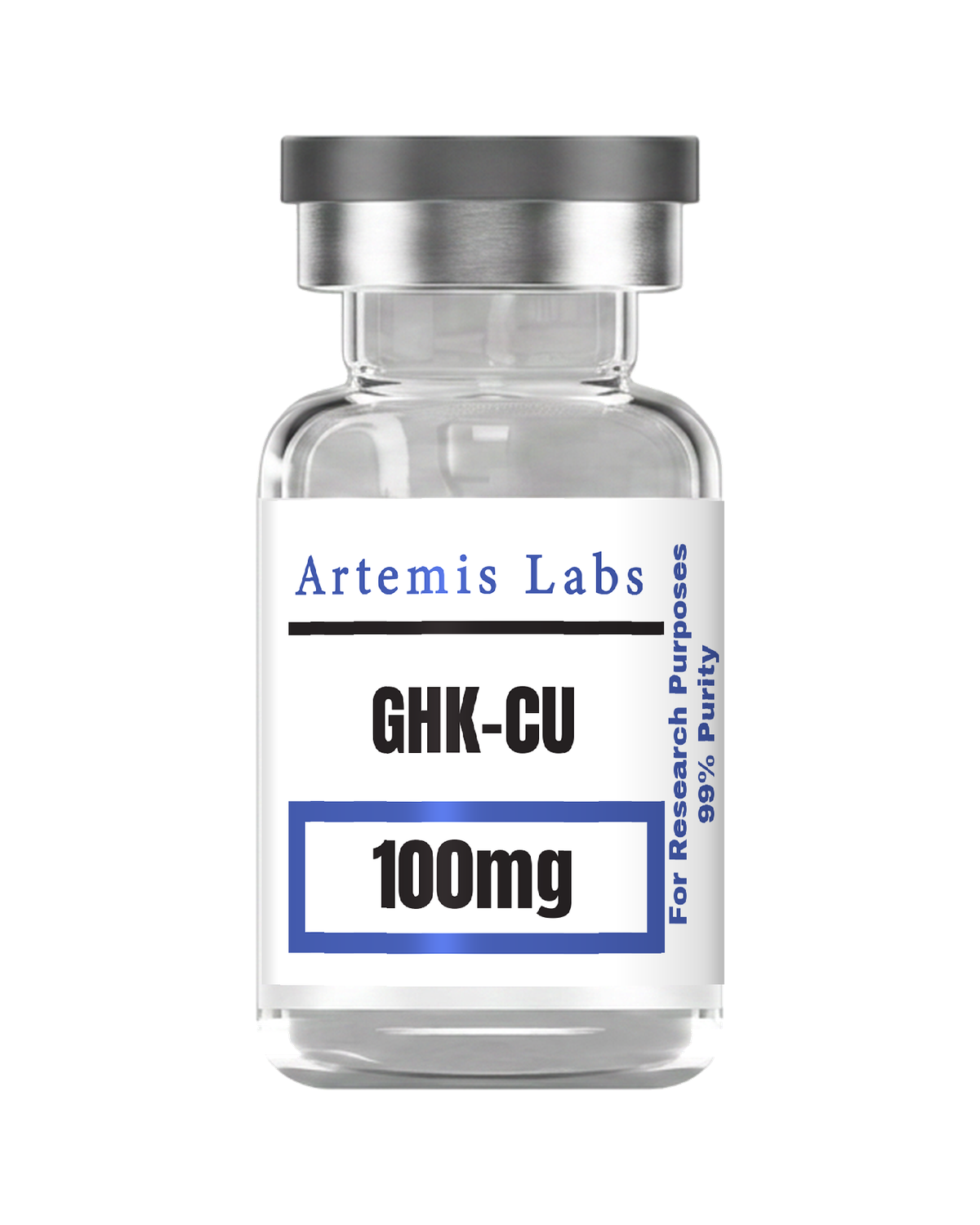
GHK-Cu
$100.00
GHK-Cu is three amino acids holding a copper atom. It occurs naturally in human plasma and falls sharply with age. What makes it unusual among research peptides is that it does not target a receptor at all — published work describes it altering the expression of roughly 4,000 human genes, which is less like a switch and more like a change of settings.
Continue readingShow less
How it works. The copper is coordinated through the histidine imidazole nitrogen and the N-terminal glycine, giving a square-planar geometry the activity depends on — remove the copper and it is a different molecule. The transcriptional programmes involved span wound healing, collagen synthesis, antioxidant defence and mitochondrial function (Renke 2026, PMID 42123471; Mavrych 2026, PMID 42021992).
Recent model work. 2026 studies reported anti-inflammatory effects in zebrafish (Hu 2026, PMID 41997403) and lifespan extension in C. elegans via DAF-16/SKN-1 signalling (Wen 2026, PMID 42084774). Both are model organisms; a worm lifespan result is a mechanistic lead, not a human one.
Lyophilized copper tripeptide at ≥99% HPLC-verified purity, batch-specific Certificate of Analysis.
20 in stock
Description
GHK-Cu is a small peptide of three amino acids that holds one copper atom. It is found in human blood, and levels drop with age. GHK-Cu does not switch on a single receptor. Published work describes it changing how roughly 4,000 human genes are turned on and off. Artemis Labs supplies it as a blue powder for lab research.
Reviewed August 21, 2026 · Artemis Labs
What is GHK-Cu?
GHK-Cu is the copper(II) complex of the endogenous tripeptide glycyl-L-histidyl-L-lysine (Gly-His-Lys). Copper coordination occurs through the imidazole nitrogen of the central histidine and the N-terminal glycine amino group, generating the square-planar Cu²⁺ geometry essential to biological activity. The complex modulates an unusually broad transcriptional program — published research describes regulation of approximately 4,000 human genes covering wound healing, collagen synthesis, antioxidant defence, mitochondrial function, and tissue remodelling (Renke et al. 2026, PMID 42123471; Mavrych et al. 2026, PMID 42021992).
How does GHK-Cu work if it does not bind a receptor?
Unlike receptor-targeted research peptides, GHK-Cu does not bind a single canonical receptor. Intracellular copper trafficking and direct interaction with chromatin- and transcription-factor-associated proteins are the leading proposed mechanisms (Arciola et al. 2026, PMID 41594073). GHK is also a naturally occurring component of human plasma at roughly 200 ng/mL in young adults, declining with age — a factual basis for the endogenous-tripeptide framing.
What did the 2026 lifespan and inflammation studies report?
A landmark 2026 Biogerontology study (Wen et al., PMID 42084774) reported that GHK-Cu extends lifespan in Caenorhabditis elegans through coordinated mitochondrial-function preservation (membrane potential, dynamics) and activation of the DAF-16 (FOXO orthologue) and SKN-1 (Nrf2 orthologue) stress-response pathways. Independent zebrafish-larvae work (Hu et al. 2026, PMID 41997403) demonstrates that GHK-Cu reduces neutrophil and macrophage migration, suppresses pro-inflammatory markers, decreases reactive oxygen species, and enhances antioxidant enzyme activity in both CuSO₄ and LPS inflammation models. These are preclinical findings; no human longevity or therapeutic claim is made.
What ships with each vial, and what is the regulatory status?
Each Artemis Labs vial ships with a third-party Certificate of Analysis confirming identity (mass spectrometry), purity (≥99% by reverse-phase HPLC), and endotoxin testing (LAL assay, ≤0.5 EU/mg). GHK-Cu is not on the FDA 503A Category 2 list and not on the WADA Prohibited List. For laboratory research use only — no human dosing, administration, therapeutic, diagnostic, preventative, or longevity claim is made.
What does the GHK-Cu evidence not show?
GHK-Cu research is dominated by in-vitro and topical cosmetic-formulation models rather than systemic use, and four limits are worth stating plainly.
- No controlled human trials of systemic GHK-Cu. Systemic efficacy and safety remain uncharacterised.
- Skin penetration is formulation-limited. An in-vitro human-skin study found most copper was retained as a depot rather than transmitted (PMID 20721598).
- The most-cited randomised trial tested a multi-ingredient cosmetic formulation, not isolated GHK-Cu, so the effects cannot be cleanly attributed to the peptide (PMID 19438432).
- Copper overload is a real ceiling. GHK-Cu is a copper-delivery vehicle; copper is redox-active with established systemic toxicity when overloaded, and the safe systemic window in humans is undefined.
How does Artemis Labs verify purity and identity?
Artemis Labs verifies every lot by third-party reverse-phase HPLC for peptide purity and by mass spectrometry for identity; the lot-specific Certificate of Analysis ships with every order.
Analytical Specifications
| Tripeptide sequence | Gly-His-Lys (GHK) |
| Coordination | Cu²⁺ chelated via histidine imidazole + N-terminal glycine amino group |
| Molecular formula (free tripeptide) | C₁₄H₂₄N₆O₄ |
| Molecular weight (free base) | 340.4 g/mol (the copper(II) complex adds ~63.5 g/mol from Cu) |
| CAS number — GHK-Cu | 89030-95-5 |
| CAS number — GHK (free tripeptide) | 49557-75-7 |
| Endogenous plasma level | ~200 ng/mL in young adults; declines with age |
| Purity | ≥99% by reverse-phase HPLC; identity confirmed by mass spectrometry |
| Form | Lyophilised blue powder, 100 mg per vial |
| Storage | −20 °C, desiccated, protected from light |
| Endotoxin | Tested ≤0.5 EU/mg (LAL assay; lot-specific) |
| Certificate of Analysis | Third-party HPLC + MS report supplied per lot; refer to the lot-specific COA for all handling specifications |
References
- Wen H et al. (2026). GHK-Cu delays aging in C. elegans via mitochondrial function and DAF-16/SKN-1 pathways. Biogerontology 27(3):100. PMID 42084774
- Hu J et al. (2026). GHK-Cu attenuates CuSO₄- or LPS-induced inflammation in a zebrafish larvae model. Eur J Pharmacol 1023:178880. PMID 41997403
- Renke G, Chinellato L. (2026). Therapeutic-peptide review; copper-peptide class positioning. Int J Mol Sci. PMID 42123471
- Mavrych V et al. (2026). Therapeutic peptides in gerontology. Front Aging. PMID 42021992
- Arciola CR et al. (2026). Multifunctional wound-repair strategies in regenerative medicine. Antibiotics (Basel). PMID 41594073
- Yu X et al. (2026). Microenvironment-responsive injectable dynamic hydrogel for radiation-induced skin injury. Bioact Mater. PMID 42058630
- Aguilar L et al. (2026). Copper(II)-tripeptide complexes: synthesis, characterisation and wound-repair ability. ChemMedChem. PMID 42047624
- Chen JS et al. (2026). The laccase-like property of GHK-Cu and colorimetric sensing of phenolic compounds. Biosensors (Basel). PMID 42041438
- Mendias CL, Awan TM. (2026). Approved and unapproved peptide therapies for musculoskeletal injuries. Sports Med. PMID 41966639
- Rahman OF et al. (2026). Therapeutic peptides in orthopaedics. J Am Acad Orthop Surg Glob Res Rev. PMID 41490200
- Counter-evidence: in-vitro human-skin penetration study; copper retained as a depot rather than transmitted. PMID 20721598
- Counter-evidence: most-cited RCT tested a multi-ingredient cosmetic formulation, not isolated GHK-Cu. PMID 19438432
Additional information
| Vial Size | 100mg |
|---|
Science & Research
Science & Research
Mechanism of Action
GHK-Cu is the copper(II)-complexed form of the tripeptide Gly-His-Lys (an endogenous human peptide). Copper coordination occurs through the imidazole nitrogen of the central histidine and the N-terminal glycine amino group, generating a square-planar Cu²⁺ geometry essential to biological activity. The complex modulates a broad transcriptional program — published research describes regulation of approximately 4,000 human genes spanning wound healing, collagen synthesis, antioxidant defence, mitochondrial function, and tissue remodelling (Renke 2026, PMID 42123471; Mavrych 2026, PMID 42021992).
The mechanism is fundamentally different from receptor-targeted research peptides: GHK-Cu does not bind a single canonical receptor. Intracellular copper trafficking and direct interaction with chromatin- and transcription-factor-associated proteins are the leading proposed mechanisms (Arciola 2026, PMID 41594073).
2024–2026 Mechanism Updates
- Lifespan extension via mitochondrial / DAF-16 / SKN-1 pathway (Wen et al. 2026, PMID 42084774). *Biogerontology* report that GHK-Cu extends lifespan in *Caenorhabditis elegans* through coordinated mitochondrial-function preservation (membrane potential, dynamics) and activation of DAF-16 (FOXO orthologue) plus SKN-1 (Nrf2 orthologue) stress-response transcription factors. Most rigorous new mechanism data on GHK-Cu. Preclinical only — no human longevity claim.
- In-vivo anti-inflammatory mechanism (Hu et al. 2026, PMID 41997403). Zebrafish larvae model: GHK-Cu reduces neutrophil and macrophage migration in both CuSO₄ and LPS inflammation models, suppresses pro-inflammatory markers, upregulates antioxidant enzymes, lowers ROS.
- Microenvironment-responsive injectable hydrogel for radiation-induced skin injury (Yu et al. 2026, PMID 42058630). Translational research into GHK-Cu delivery systems.
- Copper-tripeptide analog synthesis + wound-repair characterisation (Aguilar et al. 2026, PMID 42047624).
- Laccase-like enzymatic activity (Chen et al. 2026, PMID 42041438). Colorimetric phenolic-compound sensing context.
- Multifunctional wound-repair framing (Arciola et al. 2026, PMID 41594073; Rahman et al. 2026, PMID 41490200). GHK-Cu reviewed within smart-healing / regenerative-medicine research landscape.
Regulatory Status
- Not on FDA 503A Category 2 — unlike CJC-1295, ipamorelin, sermorelin, and BPC-157, GHK-Cu was not placed on the FDA’s interim 503A bulks Category 2 during the 2023–2024 peptide review process.
- Cosmetic ingredient status — GHK-Cu is a regulated cosmetic active ingredient. The cosmetic-grade ingredient and the research-grade reagent supplied by Artemis Labs are different supply chains; only the research-grade reagent applies to this product.
- Endogenous human plasma component — GHK is naturally present in human plasma at ~200 ng/mL in young adults, declining with age.
- Not on WADA Prohibited List — GHK-Cu is not classified as a performance-enhancing compound under WADA.
Specifications
| Property | Value |
|---|---|
| Tripeptide sequence | Gly-His-Lys (GHK) |
| Coordination | Cu²⁺ chelated via histidine imidazole + N-terminal glycine amino group |
| Tripeptide molecular formula | C₁₄H₂₄N₆O₄ (free tripeptide) |
| Tripeptide MW (free base) | 340.4 g/mol |
| CAS Number — GHK (free) | 49557-75-7 |
| CAS Number — GHK-Cu | 89030-95-5 |
| Endogenous plasma level | ~200 ng/mL in young adults; declines with age |
| Purity Standard | ≥99% by reverse-phase HPLC |
| Storage (lyophilised) | Store at −20 °C, desiccated, protected from light |
| Endotoxin | Tested ≤ 0.5 EU/mg (LAL assay; lot-specific) |
| Form | Lyophilised blue powder, 100 mg/vial |
Key Citations (selection — full list on research page)
1. Wen H et al. 2026. *Biogerontology* 27(3):100. GHK-Cu delays aging in C. elegans via mitochondrial function + DAF-16/SKN-1. PMID 42084774. 2. Hu J et al. 2026. *Eur J Pharmacol* 1023:178880. GHK-Cu attenuates CuSO₄/LPS inflammation (zebrafish). PMID 41997403. 3. Renke G, Chinellato L. 2026. *Int J Mol Sci.* Therapeutic-peptide review; copper-peptide class positioning. PMID 42123471. 4. Mavrych V et al. 2026. *Front Aging.* Therapeutic peptides in gerontology. PMID 42021992. 5. Arciola CR et al. 2026. *Antibiotics (Basel).* Smart healing for wound repair (regenerative medicine review). PMID 41594073. 6. Mendias CL, Awan TM. 2026. *Sports Med.* Approved + unapproved peptide therapies (musculoskeletal). PMID 41966639. 7. Rahman OF et al. 2026. *J Am Acad Orthop Surg Glob Res Rev.* Therapeutic peptides in orthopaedics. PMID 41490200. 8. Aguilar L et al. 2026. *ChemMedChem.* Copper-tripeptide complexes for wound repair. PMID 42047624.
No dosing, frequency, route, or human-use guidance is supplied. For laboratory research use only.
Research Pairings
Research Pairings
What Compounds Is GHK-Cu Studied Alongside?
In published research, GHK-Cu is studied alongside other small repair-pathway peptides because its broad gene-expression-modulation profile is mechanistically complementary to the receptor-targeted and cytoskeletal mechanisms of related compounds (Mavrych et al. 2026, PMID 42021992). Pairings below are *research-design rationale*, not human-use recommendations.
Why is GHK-Cu studied with BPC-157 and TB-500?
- GHK-Cu — Cu²⁺-binding tripeptide; broad gene-expression modulation of collagen, antioxidant, and tissue-remodelling pathways
- BPC-157 — Pentadecapeptide; VEGFR2-Akt-eNOS angiogenesis + GI/tendon repair literature
- TB-500 — Tβ4 fragment 17–23; G-actin sequestration; cytoskeletal-repair literature
- Why studied together — the four-peptide regeneration-research composition (sometimes called the “Wolverine” blend in popular reporting) combines complementary upstream and downstream repair-pathway mechanisms
Why is GHK-Cu studied with KPV?
- GHK-Cu — antioxidant-defence + ROS-suppression evidence (Hu 2026)
- KPV — α-MSH C-terminal tripeptide; NF-κB pathway inhibition
- Why studied together — mechanistically complementary anti-inflammatory pathways at the transcriptional level
Why is GHK-Cu studied with MOTS-c?
- GHK-Cu — preserves mitochondrial membrane potential and dynamics (Wen 2026 C. elegans data)
- MOTS-c — mitochondrial-derived peptide; AMPK signalling
- Why studied together — both target mitochondrial function through different proximal mechanisms; informative comparator pair in longevity research designs
What is the Longevity Quartet research context?
In gerontology research, GHK-Cu is one of four compounds studied together as a “longevity research” composition (with MOTS-c, SS-31, and Semax). The shared theme is mitochondrial / oxidative-stress / cognitive-protection mechanisms.
No dosing, frequency, route, or human-use guidance is supplied. All commentary above is research-design rationale per CLAUDE.md content rule #1.
For full mechanism context, see the GHK-Cu research page (Science & Research tab + full citation list).
Reviews (0)
Be the first to review “GHK-Cu”
Related products
longevity-cellular
growth-hormone
Reviews
There are no reviews yet.