
Selank is TKPRPGP, C33H57N11O9, MW 751.9, CAS 129954-34-3, PubChem CID 11765600. Two identifiers published for it across the industry — including by us — resolve to entirely different molecules.
Four Russian human studies of Selank exist, plus one imaging study. Every one used a benzodiazepine comparator rather than placebo, and none was run outside Russia.
Selank behaves like a benzodiazepine in rodents, and binding studies call it a positive allosteric modulator of GABA binding. The same group’s human-cell experiment found no effect at all.
Peptide Research, Research Education
Sermorelin, Desensitization and Antibodies: The Fading Response | Artemis Labs
28
Aug
Aug
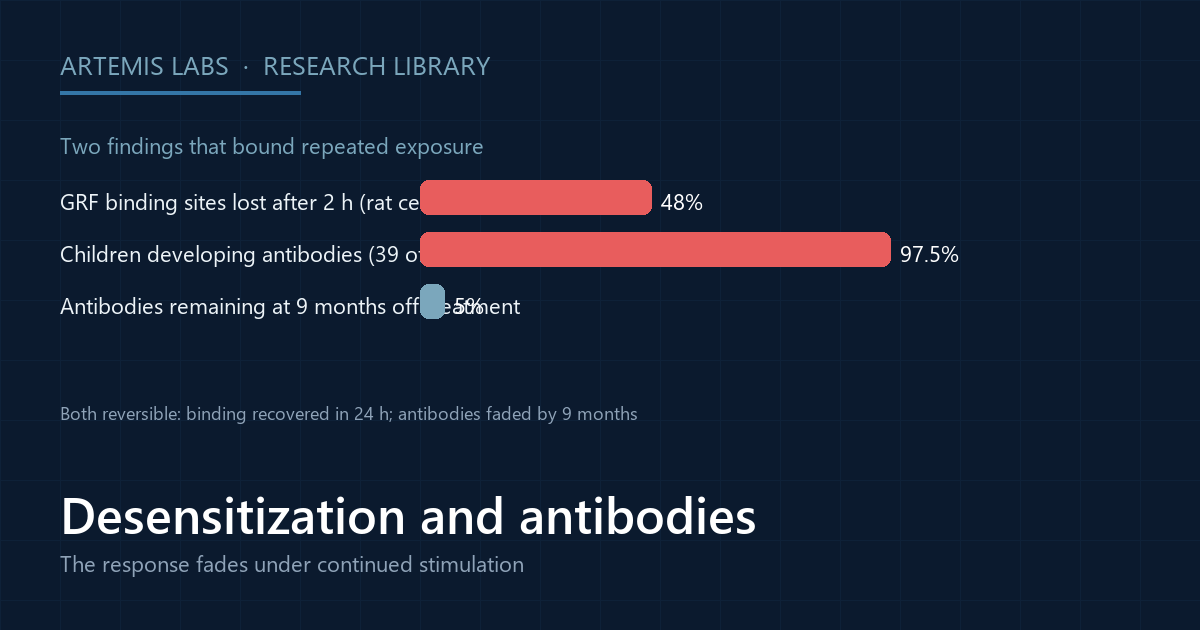
Two findings run through the GHRH(1-29) literature and are rarely reported together: the pituitary becomes less responsive under continued stimulation, and treated children produced antibodies to the peptide.
Ipamorelin is a five-amino-acid peptide studied since 1998 for growth hormone release. Here is what the published research covers, in plain language, and what it does not.
What published research reports when ipamorelin is measured head to head against GHRP-2, GHRP-6 and hexarelin: similar growth hormone release, different effects on other hormones.
Ipamorelin is a five-residue peptide, Aib-His-D-2-Nal-D-Phe-Lys-NH2, C38H49N9O5, molecular weight 711.9, CAS 170851-70-4. Why it is not a hexapeptide, and why two molecular weights circulate.
Ipamorelin’s defining finding is that it released growth hormone in swine without raising ACTH or cortisol. Here is exactly what that study measured, and what it did not.
Two independent forensic laboratories identified glycine-modified ipamorelin in black-market and customs-seized material. What that finding means for anyone reading a specification sheet.
Two human studies of ipamorelin exist. One measured pharmacokinetics in healthy volunteers; the other, a randomized placebo-controlled trial in 114 patients, found no difference from placebo.