
BPC-157 Ligament Research: What Animal Studies Show
Aug
BPC-157 and Ligaments: What the Published Research Says
Published August 22, 2026 · Artemis Labs
BPC-157 ligament research — BPC-157 is a peptide, a small chain of 15 amino acids, first identified as a fragment of a protein found in human stomach juice. It is studied for how ligaments, tendons, and muscles heal in animal models. The core ligament evidence is a 2010 study in which researchers cut the medial collateral ligament (MCL) of rats, a band of tissue on the inner side of the knee, and reported improved healing in treated animals. A 2026 review gathered this finding together with related tendon and muscle work and described the repair pathways that may be involved. Every one of these findings comes from animals or lab-grown cells; no published human trial has tested whether BPC-157 helps ligaments in people.
Key findings
- Cerovecki 2010 (DOI: 10.1002/jor.21107) reported improved ligament healing in a rat MCL transection model. It is the foundational orthopaedic study for this compound.
- Matek 2026 (PMID 41754849) reviewed the proposed mechanisms behind BPC-157 findings across tendon, ligament, and muscle models.
- Cell-culture studies in tendon cells reported faster cell outgrowth and movement through the FAK–paxillin pathway (Chang 2011, DOI: 10.1152/japplphysiol.00945.2010) and more growth-hormone receptors on tendon fibroblasts (Chang 2014, DOI: 10.3390/molecules191119066).
- No published Phase II or Phase III human trial has tested BPC-157 for ligament injury, or for any other use.
What is BPC-157?
BPC-157 is a peptide. A peptide is a short chain of amino acids, the same building blocks that make up proteins. This one is 15 amino acids long. Scientists first identified it as a partial sequence of a protein found in human gastric juice, the acidic fluid in the stomach.
That origin matters for one practical reason. Most small peptides fall apart quickly when enzymes attack them. BPC-157 has an unusual feature in its structure, a run of three proline amino acids in a row, that is associated with resistance to enzyme breakdown. Published studies report it stays intact in human gastric juice for more than 24 hours, which is rare for an unmodified peptide of this size.
Laboratories study the BPC-157 research peptide across many tissue types. Ligaments are one of the oldest and most cited research areas for the compound, alongside tendon research and muscle research.
What is a ligament, and how is it different from a tendon?
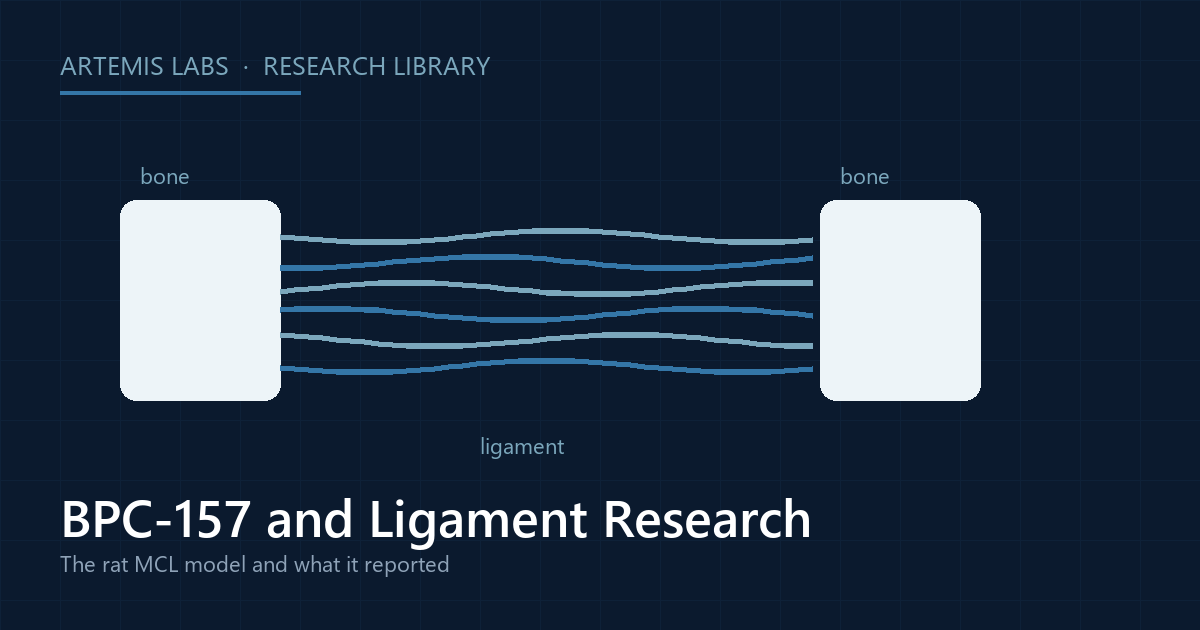
A ligament is a band of tough connective tissue that connects one bone to another bone. Ligaments hold joints together. A tendon looks similar but does a different job: it connects muscle to bone, so the muscle can pull on the skeleton.
Ligaments repair slowly. They have a limited blood supply, so oxygen and nutrients reach an injury site more slowly than they reach, say, a cut on the skin. That slow healing is the reason researchers look for compounds that might change how ligament tissue repairs itself, and it is the context for the animal work described below.
What did the 2010 rat ligament study find?
The foundational orthopaedic study for BPC-157 is Cerovecki 2010, published in the Journal of Orthopaedic Research (DOI: 10.1002/jor.21107). The researchers used a rat MCL transection model. Here is what that means in plain words.
The MCL is the medial collateral ligament. It runs along the inner side of the knee and connects the thigh bone to the shin bone. “Transection” means the researchers surgically cut the ligament all the way through. That gives every animal in the study the same well-defined injury, so the team can compare how the injury heals with and without the compound being tested. This kind of setup is a standard tool in orthopaedic research, the branch of medicine that deals with bones, joints, and the tissues that connect them.
In that model, the study reported improved ligament healing in treated rats compared with untreated ones. That single sentence is the load-bearing finding in the BPC-157 ligament literature. It is a bounded, past-tense observation in one animal model. It is not evidence about human knees, and no later human trial has tested the question.
A 2026 review by Matek and colleagues (PMID 41754849) placed this ligament finding in context. The review covered BPC-157 studies across tendon, ligament, and muscle models and summarized the mechanisms researchers propose to explain them. Reviews like this one do not add new experiments. They organize what individual studies have reported so that later researchers can see the whole picture.
How might BPC-157 affect ligament tissue? Three proposed pathways
Ligament-specific mechanism data is thin. Most of the pathway evidence comes from other connective-tissue models, especially tendon cells grown in culture, meaning cells kept alive in a dish in a lab. Because tendons and ligaments are built from similar tissue, researchers read these findings as context for the ligament results. Three pathways come up most often.
New blood vessel signalling. Preclinical studies, meaning studies in animals and cells rather than people, report that BPC-157 raised levels of VEGF receptor 2. That receptor sits on the cells lining blood vessels and responds to a signal that tells the body to grow new vessels. The studies also report activity in two relay proteins further down the chain, called Akt and eNOS. This pathway is the standard explanation for why researchers observe new blood vessels forming at injury sites in animal models. For a slow-healing, poorly supplied tissue like a ligament, blood vessel growth is the mechanism researchers care about most.
Cell movement and attachment. Chang 2011 (DOI: 10.1152/japplphysiol.00945.2010) reported that tendon cells in culture grew outward, survived, and moved faster when exposed to BPC-157. The study traced this to the FAK–paxillin pathway. FAK and paxillin are proteins that help a cell grip its surroundings and pull itself along. Repairing a cut ligament requires cells to travel into the gap and rebuild tissue, so a pathway that governs cell movement is directly relevant.
Growth-hormone receptors. Chang 2014 (DOI: 10.3390/molecules191119066) reported that tendon fibroblasts, the cells that build connective tissue, made more receptors for growth hormone after exposure to BPC-157. More receptors could make the same amount of the body’s own growth hormone count for more in that tissue. Again, this was measured in cultured tendon cells, not in a living ligament.
What the research does not show
No published Phase II or Phase III human trial has tested whether BPC-157 works for ligament injury, or for any other use. Every efficacy statement in this literature is an extrapolation from animal or cell studies.
The ligament evidence base is also narrow. It rests on one foundational rat study plus mechanism context borrowed from tendon-cell work. Effect sizes across the wider BPC-157 corpus vary substantially with the model, dose, route, and species used, so a result in one rat model does not predict the size of an effect anywhere else. The compound also has no single defined receptor. It appears to act through several pathways at once, and no standard binding assay or biomarker exists to define what a positive response even looks like.
One more fact belongs here. The World Anti-Doping Agency lists BPC-157 in Section S2 of its Prohibited List, banned at all times, in and out of competition. A tested athlete using it risks an anti-doping violation regardless of source or intent.
Frequently asked questions
Is BPC-157 an approved drug for ligament injuries?
No. The FDA has not approved BPC-157 as a drug for any use. Its regulatory status is currently unsettled and under advisory committee review.
Has BPC-157 been tested in people with ligament injuries?
No. The ligament findings come from a rat model. No published human efficacy trial exists for ligament injury or any other condition.
What is an MCL transection model?
It is a research setup in which the medial collateral ligament of the knee is surgically cut in an animal, usually a rat, so that every animal starts with the same injury. Researchers then compare how the ligament heals with and without the compound under study.
Is the ligament evidence different from the tendon evidence?
Yes. The ligament evidence centers on one whole-animal healing study, while much of the tendon evidence comes from cells in culture. Our BPC-157 tendon research page covers that work, and the comparison of BPC-157, TB-500, KPV and GHK-Cu across the tissue-repair cascade maps how the research areas fit together.
References
- Cerovecki T, et al. (2010). Improved ligament healing in a rat MCL transection model. Journal of Orthopaedic Research. DOI: 10.1002/jor.21107
- Matek D, et al. (2026). Review of BPC-157 mechanisms in tendon, ligament, and muscle models. PMID 41754849
- Chang CH, et al. (2011). Tendon-cell outgrowth, survival, and migration via FAK–paxillin signalling. Journal of Applied Physiology. DOI: 10.1152/japplphysiol.00945.2010
- Chang CH, et al. (2014). Growth-hormone-receptor expression in tendon fibroblasts. Molecules. DOI: 10.3390/molecules191119066
Methodology: This page draws only on the verified BPC-157 research record compiled by Artemis Labs (citations last verified August 22, 2026); no claims beyond the cited sources.
All compounds sold by Artemis Labs are for laboratory research use only. Nothing on this page is medical advice, and no statement has been evaluated by the FDA.
