
Are There Human Trials of BPC-157? The Honest Answer
Aug
Are There Human Trials of BPC-157?
Published August 22, 2026 · Artemis Labs
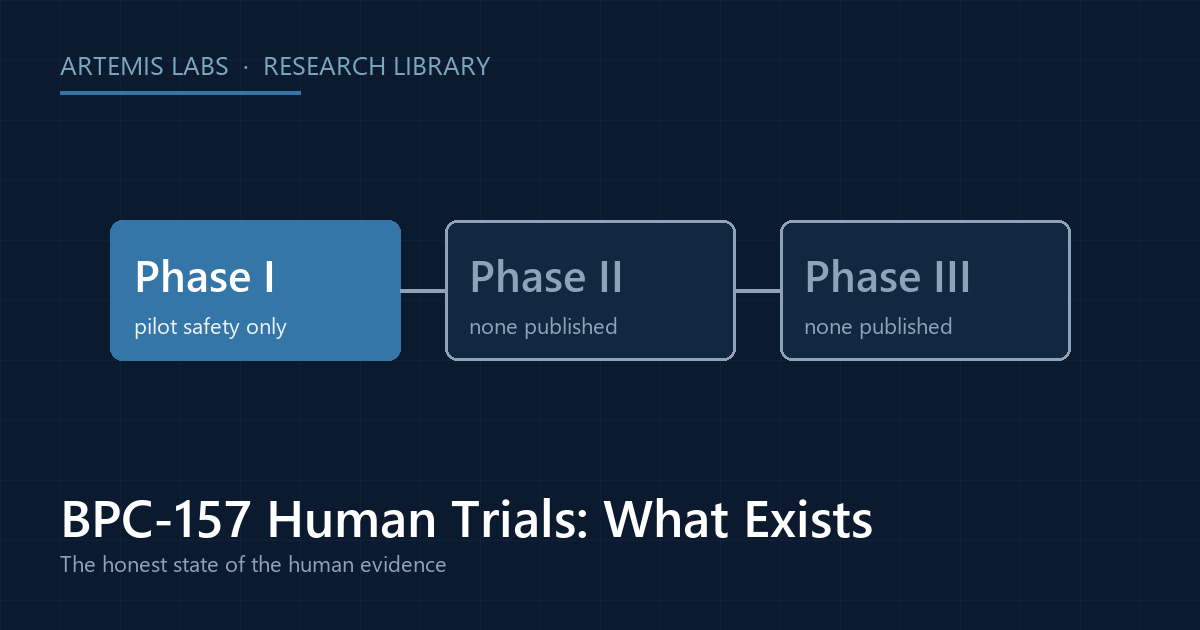
BPC-157 human trials — Despite more than two decades of animal and cell research, no published Phase II or Phase III human trial has ever tested whether BPC-157 works for any condition. The only human work in the published record is small pilot safety testing of an infusion given in a clinical setting, referenced in two 2026 medical reviews (Mendias 2026, Mayfield 2026). A 2026 study that used human artery tissue was run in a laboratory bath, not in living people. That means every claim that BPC-157 works in humans, from any clinic, vendor, or influencer, is stretched from animal or tissue data.
Key findings
- No Phase II or Phase III human efficacy trial of BPC-157 has been published for any use, for any condition, as of August 2026 (Mendias 2026, PMID 41966639; Mayfield 2026, PMID 41476424).
- The only human exposure in the published record is pilot infusion safety work, referenced in those same two 2026 reviews. A safety pilot looks for harm in a small group; it cannot show that a compound works.
- Yildirim 2026 (PMID 42123221) reported that BPC-157 relaxed human internal mammary artery tissue in a laboratory tissue bath. That is the first human-tissue mechanism data, and it is not a clinical trial.
- The evidence base behind BPC-157’s reputation is animal and cell work, including a 2010 rat ligament study (Cerovecki 2010, DOI 10.1002/jor.21107) and 2011 tendon-cell culture work (Chang 2011, DOI 10.1152/japplphysiol.00945.2010).
What counts as a human trial?
A clinical trial is a study that gives a compound to living people under a formal plan and measures what happens. Drug research moves through three phases. Phase I gives the compound to a small group, often healthy volunteers, and asks one question: is it safe enough to keep studying? Phase II gives it to a larger group of people who have the condition being studied, and asks whether it actually helps them. Phase III repeats that question in a much bigger group, usually against a placebo or a standard treatment, to confirm the effect is real. Only Phase II and Phase III answer the question most readers care about: does it work?
Hold that framework in mind, because it makes the BPC-157 record easy to read. For this compound, the record stops before Phase II begins.
What human research on BPC-157 exists?
Two 2026 review articles written for physicians point to the same small piece of human work: pilot safety testing of BPC-157 given as an infusion in a clinical setting. Mendias 2026 (PMID 41966639) surveys approved and unapproved peptide therapies in musculoskeletal medicine. Mayfield 2026 (PMID 41476424) is a primer on peptides for doctors who are being asked about them. Neither review describes a finished efficacy trial, because there is not one to describe.
The two get blurred constantly, so the difference is worth spelling out. A safety pilot asks a narrow question: when a small number of people receive this, does anything obviously go wrong in a short window? An efficacy trial asks a much harder one: did the people who received the compound end up measurably better than comparable people who did not? Answering that takes a defined condition, a comparison group, an outcome measured at the start of the study and again at the end, and enough participants that luck is an unlikely explanation. None of that apparatus exists in the BPC-157 literature.
Stopping at pilot safety work is ordinary for a compound early in development. What is unusual with BPC-157 is the size of the gap between how much it gets discussed and how little of it has been tested in people. Our companion page on BPC-157 safety research covers what the safety record does and does not contain, and the regulatory status page explains why that missing trial record is also why the compound is not an approved drug.
Is a study on human tissue a human trial?
No, and this is the distinction that trips people up most often in 2026. Yildirim 2026 (PMID 42123221) worked with tissue from a human internal mammary artery, a blood vessel in the chest wall. The tissue was studied ex vivo, a Latin term meaning outside the body: the sample sits in a temperature-controlled laboratory bath while researchers add a compound and watch how the tissue responds.
What they reported is real and genuinely new. BPC-157 produced relaxation of the vessel tissue that grew stronger as concentration rose, and the response depended both on the endothelium, the thin inner lining of a blood vessel, and on nitric oxide, a small signalling molecule that tells vessel walls to widen. Before this paper, essentially every mechanism finding for BPC-157 came from animal tissue. This was the first look at human tissue.
It still is not a trial, and the reason is structural rather than technical. A strip of artery in a bath has no bloodstream, no liver or kidneys processing the compound, no immune system, and no person attached to it. Nothing has to be absorbed, survive circulation, or reach a target elsewhere in the body, and no outcome such as pain, function, or recovery time is measured, because there is nobody there to measure it in. A tissue-bath result shows that human tissue is capable of responding to a compound. It cannot show what happens when the compound is given to a person. Our longer write-up of that study sits in the 2026 preclinical foundation and human-tissue evidence review.
What is the BPC-157 evidence base, then?
It is animal and cell research, and there is a lot of it. Named plainly: BPC-157 is studied for how tendons, ligaments, muscle, gut lining, skin wounds, and blood vessels repair themselves in animal models and in cells grown in dishes.
A few anchor studies, each bounded to what it actually did. Cerovecki 2010 (DOI 10.1002/jor.21107) reported improved ligament healing in rats after the medial collateral ligament, a knee ligament, was cut. Chang 2011 (DOI 10.1152/japplphysiol.00945.2010) reported faster outgrowth, survival, and migration of tendon cells in culture, meaning cells grown in a dish rather than in an animal. Huang 2015 (DOI 10.2147/DDDT.S82030) reported wound-healing readouts in an alkali-burn model, and Sikiric 2018 (DOI 10.2174/1381612824666180608101119) synthesised the gastrointestinal work, where the compound’s story began.
That is a substantial file. The word for it is preclinical: everything that happens before human trials begin. It is the correct label for the entire BPC-157 corpus.
Why does this change how claims about BPC-157 should be read?
Because it means every effectiveness statement about BPC-157 in humans is an extrapolation. Extrapolation is taking a result observed in one setting and assuming it carries over to a different one. A clinic that says the compound works for a specific injury is extrapolating from rats. A vendor saying so is doing the same, and so is an influencer describing what it does. None of them are drawing on a human efficacy trial, because none has been published.
Extrapolation is not worthless; it is how drug development decides what to test next. But it fails often enough that the whole clinical trial system exists to catch the failures. Effect sizes across the BPC-157 corpus already vary substantially with the model, the dose, the route, and the species used, which signals that translation to humans is uncertain rather than assured. The compound also has no single defined receptor and no agreed biomarker of activity, so there is not even a settled laboratory measure of whether it is doing anything in a given person.
Most sellers of this compound will not tell you the trial record is empty. We would rather say it directly, because a researcher who buys the BPC-157 research peptide under a false impression of the evidence has been sold something other than what they thought.
What the research does not show
No published Phase II or Phase III human trial has tested whether BPC-157 works for any condition, so nothing in the literature establishes an effect in people. The pilot human work referenced in Mendias 2026 and Mayfield 2026 addressed safety only, and a safety pilot is not evidence of benefit. The Yildirim 2026 human-tissue finding is mechanism data from an isolated sample in a bath, and mechanism data does not predict a clinical outcome. The animal literature, however large, was produced in rats and in cell culture, and results in those systems routinely fail to reproduce in humans. Anyone reading a confident statement about what BPC-157 does in people is reading an inference, not a finding.
Frequently asked questions
Has BPC-157 ever been given to humans in a study?
The published record includes pilot safety testing of an infusion, referenced in Mendias 2026 and Mayfield 2026. That work looked for harm, not for benefit. No Phase II or Phase III efficacy trial has been published.
Does the 2026 human artery study count as a human trial?
No. Yildirim 2026 studied human internal mammary artery tissue in a laboratory bath, outside the body. It is the first human-tissue mechanism data for BPC-157, but no living person received the compound and no clinical outcome was measured.
Why do clinics and sellers describe BPC-157 as effective?
They are extrapolating from animal and cell studies. That is a hypothesis about humans, not a result in humans, and the published literature does not support stating it as fact.
Does the lack of human trials mean BPC-157 does not work?
No. It means the question is unanswered. An absent trial record is not evidence against a compound any more than it is evidence for one. Nobody has run the study that would settle it.
References
- Mendias CL, Awan TM. Sports Med. 2026. PMID 41966639
- Mayfield CK, et al. Am J Sports Med. 2026. PMID 41476424
- Yildirim 2026. Endothelium-dependent, nitric-oxide-mediated relaxation of human internal mammary artery tissue ex vivo. PMID 42123221
- Cerovecki 2010. Ligament healing in a rat medial collateral ligament transection model. DOI 10.1002/jor.21107
- Chang 2011. Tendon-cell outgrowth, survival, and migration in culture via FAK-paxillin signalling. DOI 10.1152/japplphysiol.00945.2010
- Huang 2015. Alkali-burn wound-healing and angiogenesis readouts. DOI 10.2147/DDDT.S82030
- Sikiric 2018. Cytoprotection synthesis: vascular recruitment and gastrointestinal-tract healing. DOI 10.2174/1381612824666180608101119
Methodology: this page draws on the Artemis Labs BPC-157 research record, a PMID- and DOI-verified citation set compiled from the published preclinical literature and the 2026 physician review articles; last verified August 22, 2026.
All compounds sold by Artemis Labs are for laboratory research use only. Nothing on this page is medical advice, and no statement has been evaluated by the FDA.
