
Is BPC-157 FDA Approved? Regulatory Status Explained
Aug
Is BPC-157 FDA Approved?
Published August 22, 2026 · Artemis Labs
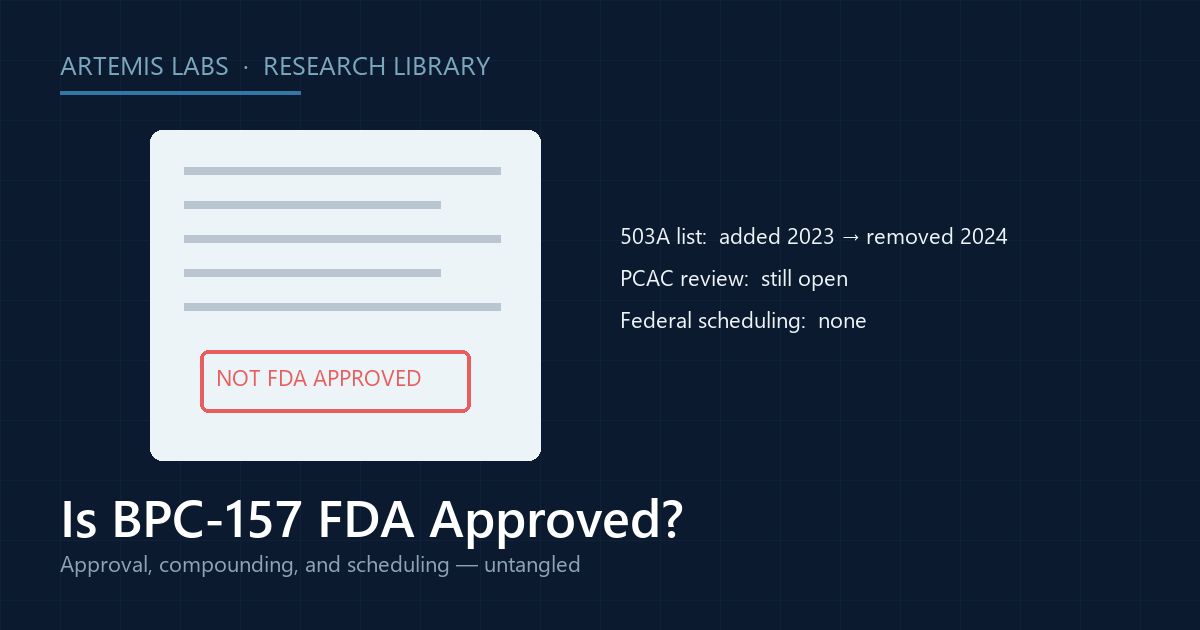
BPC-157 regulatory status — answer capsule: No. BPC-157 is not an FDA-approved drug for any use. In September 2023 the FDA placed it in interim Category 2 on the 503A compounding list, then removed it from that list on September 27, 2024 after the nominator withdrew. The compound is now under review by the FDA’s Pharmacy Compounding Advisory Committee, which held a non-binding vote in July 2026; the FDA has not issued a final decision, so its compounding status remains unsettled. BPC-157 is not a federally scheduled controlled substance in the United States, though some states restrict shipping, and it is sold only as a research compound.
Key findings
- BPC-157 has never been approved by the FDA as a drug for any condition. No published Phase II or Phase III human efficacy trial exists for any use.
- The compounding timeline: interim Category 2 on the FDA’s 503A list in September 2023, removed September 27, 2024 after the nominator withdrew, and now under Pharmacy Compounding Advisory Committee review. A July 2026 committee vote was non-binding, so the status is still unsettled.
- BPC-157 is not a federally scheduled controlled substance in the US. Federal drug scheduling and FDA drug approval are two separate systems, and BPC-157 sits outside both.
- The only human work referenced in the literature is pilot infusion safety testing, noted in Mendias 2026 (PMID 41966639) and Mayfield 2026 (PMID 41476424).
What does “FDA approved” actually mean?
“FDA approved” is a specific legal status, not a general seal of quality. A drug earns it by passing through staged human trials: Phase I checks safety in a small group, Phase II tests whether the drug works in patients, and Phase III confirms it in a large group. The manufacturer then submits all of that evidence to the FDA, and the agency decides whether the drug can be sold as a treatment for a named condition.
BPC-157 has not been through that process. There is no published Phase II or Phase III human efficacy trial of BPC-157 for any use. The research record is built on animal and tissue studies, plus pilot human safety work referenced in two 2026 reviews, Mendias 2026 (PMID 41966639) and Mayfield 2026 (PMID 41476424). A safety pilot only asks whether a compound can be given without immediate harm. It does not ask whether the compound works. Our page on BPC-157 human trials walks through what has and has not been tested in people.
So the direct answer to the title question is no. BPC-157 is not an approved drug, and no one may legally market it as a treatment for anything.
What happened with the FDA compounding list?
Most of the confusion around BPC-157’s status traces back to a different FDA process: compounding. A 503A compounding pharmacy is a licensed pharmacy that mixes custom medications for individual patients when a doctor prescribes them. These pharmacies can only work from ingredients the FDA allows, and the agency keeps lists of substances nominated for that purpose.
Here is the BPC-157 timeline, told plainly:
- September 2023. The FDA placed BPC-157 in interim Category 2 on its 503A list. Category 2 flags substances the agency has significant safety concerns about while it evaluates them. This was an interim sorting step, not a ban and not an approval.
- September 27, 2024. The FDA removed BPC-157 from that list. The reason was procedural: the party that had nominated BPC-157 for compounding withdrew its nomination. With no nomination on file, there was nothing left to categorize.
- Now. BPC-157 is under review by the FDA’s Pharmacy Compounding Advisory Committee, a panel of outside experts that advises the agency on which substances compounding pharmacies may use. In July 2026 the committee held a vote on BPC-157. Committee votes are non-binding, which means the FDA can follow the recommendation or not. The agency has not issued a final decision.
That last point matters. As of this writing, the compounding question is unsettled. Anyone who tells you the matter is closed, in either direction, is ahead of the record. For the broader picture of how the FDA handles this whole category of compounds, see our guide to research peptides and FDA regulations.
Is BPC-157 a controlled substance?
No. A controlled substance is a drug placed on a federal schedule under the Controlled Substances Act, the system that covers things like opioids and stimulants. Scheduling is about abuse potential and is run through the DEA, not the FDA’s approval process. BPC-157 is not on any federal schedule.
State law is a separate layer. Some states restrict shipping of the compound, so the rules a buyer faces can differ by where they live even though federal law is uniform on the point.
One more status worth knowing about: sport. The World Anti-Doping Agency lists BPC-157 separately from anything the FDA does, and a tested athlete faces different stakes entirely. That story has its own page: BPC-157 and WADA status.
Why do these three labels get mixed up?
Readers run into three different regulatory phrases and often read them as one. They are not.
“FDA approved” means the agency reviewed human trial evidence and cleared the drug to be sold as a treatment. BPC-157 does not have this status. Nothing about the compounding saga changes that, and nothing about not being scheduled implies it.
“Not a scheduled substance” means the compound is not on the federal controlled-substance lists. This is true of BPC-157, and also true of most things you could name, from vitamins to shampoo. It says nothing about whether a compound is approved, safe, or effective. It only says the DEA has not restricted it.
“On the compounding list” refers to the 503A nomination process described above: whether specialty pharmacies may use a substance in custom prescriptions. BPC-157 entered that process, left it when its nominator withdrew, and is now back under committee review with no final answer.
Put together: BPC-157 is unapproved, unscheduled, and in compounding limbo, all at the same time. Each label answers a different question, which is why a compound can honestly carry all three at once.
What the research does not show
No published Phase II or Phase III human trial has tested whether BPC-157 actually works for any condition, so every claim about what it does in people is an extrapolation from animal or tissue studies. The pilot human work referenced in Mendias 2026 and Mayfield 2026 addressed safety only, not effectiveness. On the regulatory side, the July 2026 advisory committee vote settled nothing by itself; until the FDA issues a final decision, the compounding status of BPC-157 remains open. Sources sold for laboratory use, including the BPC-157 research peptide from Artemis Labs, are supplied for research, not as medicine.
Frequently asked questions
Is BPC-157 FDA approved for any use?
No. BPC-157 has never been approved by the FDA as a drug for any condition, and no published Phase II or Phase III human efficacy trial exists for it.
Is BPC-157 banned in the United States?
It is not a federally scheduled controlled substance, so it is not “banned” the way scheduled drugs are. It is also not an approved drug. It exists in the space between: legal to study, restricted for shipping in some states, and unresolved in the FDA’s compounding review.
Was BPC-157 removed from the FDA compounding list?
Yes. It held interim Category 2 status from September 2023 until September 27, 2024, when the FDA removed it after the nominator withdrew the nomination. The Pharmacy Compounding Advisory Committee is reviewing it now, and its July 2026 vote was non-binding.
Does “not scheduled” mean the FDA considers it safe?
No. Scheduling is a DEA system about abuse potential. It is separate from FDA approval, and absence from the schedules says nothing about safety or effectiveness.
References
- Mendias CL, Awan TM. Sports Med. 2026. PMID 41966639
- Mayfield CK, et al. Am J Sports Med. 2026. PMID 41476424
Methodology: this page draws on the Artemis Labs BPC-157 research record (PMID-verified citations) and the FDA 503A compounding timeline as compiled in our verified facts sheet; last verified August 22, 2026.
All compounds sold by Artemis Labs are for laboratory research use only. Nothing on this page is medical advice, and no statement has been evaluated by the FDA.
