
How BPC-157 Purity Is Tested and What ≥99% Means
Aug
How Is BPC-157 Purity Tested, and What Should ≥99% Actually Mean?
Published August 22, 2026 · Artemis Labs
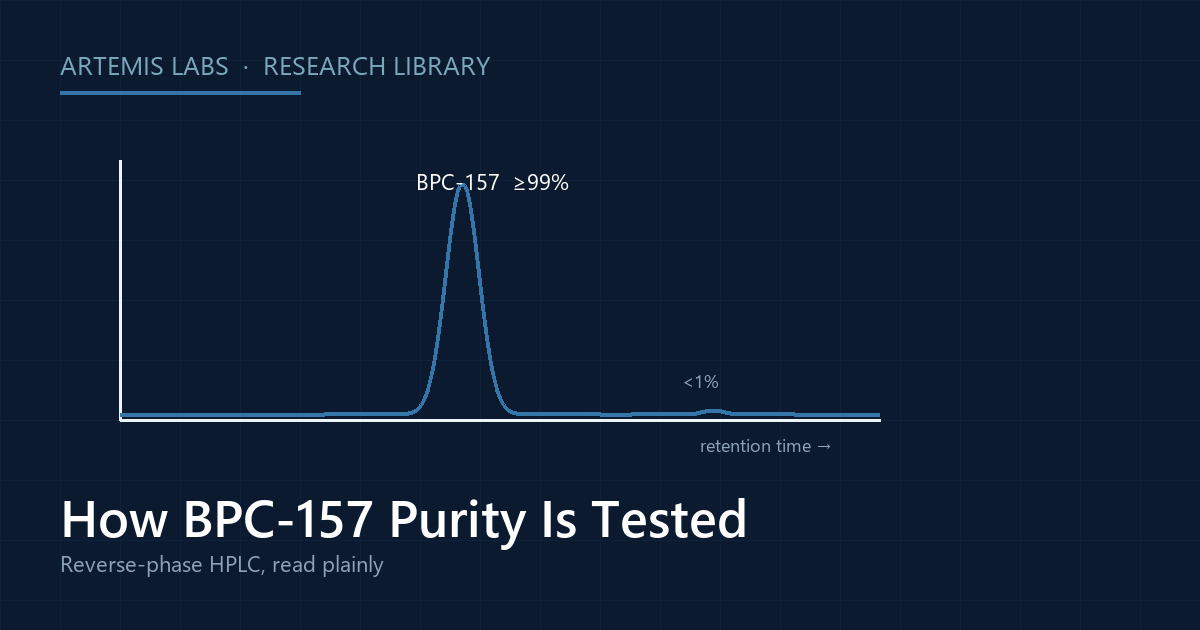
BPC-157 purity testing — BPC-157 purity is measured by reverse-phase HPLC, a lab method that separates a sample into its parts and measures how much of it is the target peptide. A result of ≥99% means at least 99% of the peptide material in the tested lot is BPC-157 itself. The small fraction left over is typically closely related material carried over from the chemical process that builds the peptide. The number belongs on a lot-specific certificate of analysis, or COA, and any vendor should be able to produce one for the lot in question. It carries the most weight when an independent lab ran the test, because a vendor should not grade its own homework.
Key findings
- Across this market a vendor will commonly offer research-grade BPC-157 against a stated purity of 99% or higher, measured by reverse-phase HPLC and reported on a lot-specific Certificate of Analysis. Those are the numbers a buyer should ask a supplier to produce.
- A purity number describes chemistry, not biology. No published Phase II or Phase III human efficacy trial exists for BPC-157 for any use (Mendias 2026, PMID 41966639).
- Identity is a separate check from purity. A complete COA also confirms the 15-amino-acid sequence GEPPPGKPADDAGLV and the molecular weight of 1,419.54 g/mol, typically by mass spectrometry.
- Purity is measured at a point in time. Keeping the number meaningful depends on proper storage of the freeze-dried powder at −20°C, dry and protected from light.
How is BPC-157 purity tested?
The standard method is reverse-phase HPLC. HPLC stands for high-performance liquid chromatography. In plain terms, it is a machine that pushes a dissolved sample through a tightly packed column. Different molecules move through the column at different speeds, so the sample separates into its parts. A detector at the end measures how much of each part comes out. So what does a figure like 99.2% actually mean? It means 99.2% of what the detector saw was BPC-157.
That one paragraph is the whole idea. The details of how the method works, how to read the resulting chart, and what can go wrong with it are covered in our full HPLC testing explainer, so this page will not repeat them. What matters here is how the method applies to one specific peptide.
BPC-157 is a 15-amino-acid peptide studied for how tendons, ligaments, muscle, and the gut lining heal in animal models. Amino acids are the small building blocks that link together to form peptides and proteins. Because BPC-157 has a defined sequence and a defined molecular weight, a lab can check a lot against those exact values rather than guessing.
What does ≥99% purity actually mean?
It means that when the lot was tested, at least 99 out of every 100 parts of the peptide material measured were the target compound, BPC-157. It is a statement about composition, nothing more.
It helps to be equally clear about what the number does not mean. It does not mean the compound produces any biological effect. It does not mean the material is sterile, and it does not mean it is fit for any use outside a laboratory. Purity answers exactly one question: how much of this lot is the molecule the label says it is?
What is in the other 1%?
Peptides are built by chemical synthesis, adding one amino acid at a time. No chemical process is perfect. The small fraction that is not BPC-157 typically consists of related impurities from that process — molecules closely related to the target peptide that were not fully removed during purification. The exact makeup varies from lot to lot, which is one reason testing has to happen per lot rather than once per product.
This is also why a fresh number matters more than an old one. A COA describing a lot made last year says nothing about the lot in front of you.
What else should a COA confirm besides purity?
Purity tells you how much of the material is one compound. Identity tells you that the compound is actually BPC-157. Both checks belong on the certificate, and a researcher can read them straight off the document.
The identity anchors are fixed facts of the molecule. The sequence is Gly-Glu-Pro-Pro-Pro-Gly-Lys-Pro-Ala-Asp-Asp-Ala-Gly-Leu-Val, written in short form as GEPPPGKPADDAGLV. The molecular weight is 1,419.54 g/mol, usually confirmed by mass spectrometry — a method that weighs molecules. The compound is registered under CAS number 137525-51-0 and PubChem CID 9941957. If a certificate’s measured weight matches 1,419.54 g/mol and the purity trace is clean, the two results support each other.
Reading a certificate line by line is its own skill. Our BPC-157 COA guide walks through a real certificate section by section.
Why does independent testing matter?
A purity claim is only as good as the lab behind it. When a vendor tests its own material and reports its own results with no outside check, the vendor is grading its own homework. An independent lab has no stake in the number coming out high, which is what makes its report worth reading.
What does lot-specific mean? It means the certificate describes the exact production batch a given vial came from, not a representative sample from some earlier run. When you compare any supplier’s paperwork, those are the two questions to ask: who ran the test, and which lot does it describe?
Does purity change after testing?
The COA captures a moment in time. BPC-157 is supplied as a lyophilized powder, meaning freeze-dried, and it should be stored at −20°C, kept dry, and protected from light. The peptide’s backbone includes a triple-proline motif, a run of three proline amino acids in a row, that published studies associate with unusual resistance to enzyme breakdown; the peptide has been reported to remain intact in human gastric juice for more than 24 hours. Structural toughness in one setting does not remove the need for correct storage, though. How storage conditions relate to the molecule’s stability is covered in our BPC-157 stability guide.
What the research does not show
A high purity number is a chemistry result, and chemistry is where its meaning stops. No published Phase II or Phase III human efficacy trial exists for BPC-157 for any use; the human record is limited to pilot safety work referenced in recent reviews (Mendias 2026, PMID 41966639; Mayfield 2026, PMID 41476424). Every efficacy claim you may encounter anywhere is extrapolated from animal or tissue studies. A perfect COA cannot change that, and no purity result should be read as evidence that the compound does anything in people.
Frequently asked questions
Is 100% purity possible?
Not in practice. Chemical synthesis always leaves trace amounts of related material behind, and detectors have measurement limits of their own. A claim of exactly 100% would say more about the test than the peptide. ≥99% is the standard a well-purified research peptide is held to.
Does a high purity number mean BPC-157 works?
No. Purity measures how much of the lot is the stated compound. Whether that compound produces any effect is a separate scientific question, and for BPC-157 that question has no published Phase II or Phase III human efficacy answer.
What does “lot-specific” mean on a COA?
A lot is one production batch. A lot-specific COA from any vendor reports tests run on that exact batch, so the numbers describe that batch rather than the product line in general.
Can I check identity myself from the COA?
Yes, against public reference values. The sequence should read GEPPPGKPADDAGLV, the molecular weight should match 1,419.54 g/mol, and the compound is listed under CAS 137525-51-0 and PubChem CID 9941957.
References
- Mendias CL, Awan TM. Sports Med. 2026. PMID 41966639
- Mayfield CK, et al. Am J Sports Med. 2026. PMID 41476424
Methodology: This page draws on public reference data for BPC-157 (compound identity checked against PubChem CID 9941957) and the peer-reviewed reviews cited above; sources last verified August 22, 2026.
All compounds sold by Artemis Labs are for laboratory research use only. Nothing on this page is medical advice, and no statement has been evaluated by the FDA.
